Михаэль ван де Поппе раскрыл состав своего криптовалютного портфеля

cryptonews.ruPubblicato 2022-09-03Pubblicato ultima volta 2025-02-03

Популярный криптоаналитик и основатель MN Consultancy Михаэль ван де Поппе (Michaël van de Poppe) сделал ставку на альткоины после серии важных макроэкономических событий, указывающих на возможный разворот рынка.

Резкий обвал рынка в начале недели был вызван неожиданным повышением ставки Банком Японии. За последние три года японская йена обесценилась на 25%, что вынудило регулятора принять меры по укреплению национальной валюты. Это спровоцировало массовые распродажи на рынках, включая NASDAQ, из-за так называемой японской йеновой торговли — стратегии заимствования в йенах для инвестирования в американские активы. Подобная ситуация уже наблюдалась в июле 2024 года, когда первое повышение ставки привело к падению Ethereum на 40%.

Поворотный момент от ФРС

Следующим значимым событием стало заседание ФРС. Хотя Джером Пауэлл (Jerome Powell) не объявил об изменениях процентной ставки, он преподнес криптосообществу приятный сюрприз, заявив о готовности банков работать с криптовалютными клиентами: «Наша роль в отношении биткоина заключается в надзоре за банками. Мы считаем, что банки вполне способны обслуживать криптоклиентов, если понимают риски и могут ими управлять». По мнению ван де Поппе, это может открыть дорогу для более широкого внедрения DeFi.

Макроэкономические сигналы

Третьим ключевым событием стала публикация предварительных данных по ВВП США. Фактический показатель в 2,3% оказался ниже ожидаемых 2,7%, что может существенно повлиять на политику ФРС в 2025 году. Ван де Поппе подчеркивает, что ключевыми факторами станут не столько инфляция, сколько внутренний рост и безработица. Он напоминает, что в 2022 году рынки не ожидали изменения ставок, однако в итоге произошло рекордное повышение.

Интересные корреляции

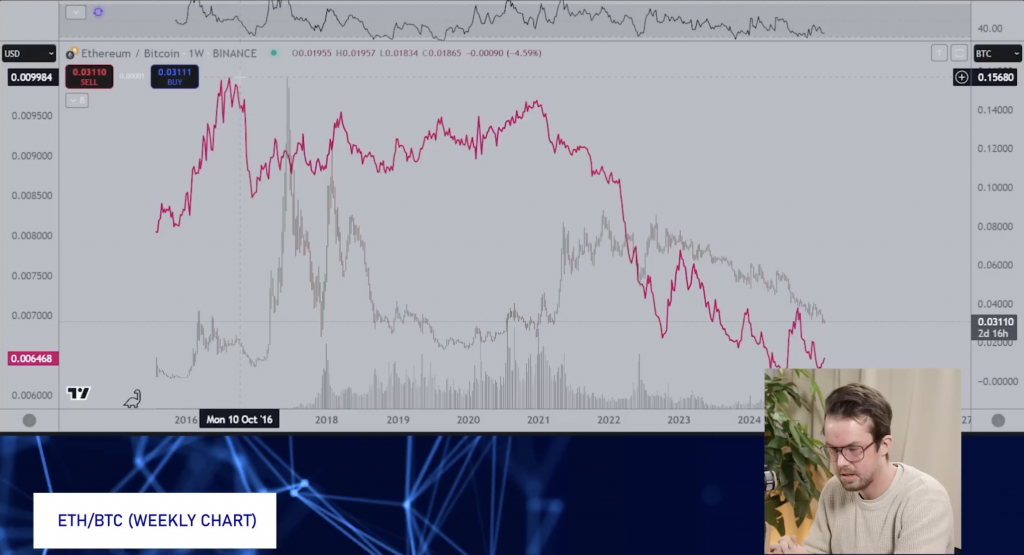
Аналитик обратил внимание на несколько важных взаимосвязей на рынке. В частности, существует четкая обратная корреляция между доходностью 10-летних облигаций США и соотношением ETH/BTC. При снижении доходности облигаций инвесторы обычно проявляют больший интерес к альткоинам.
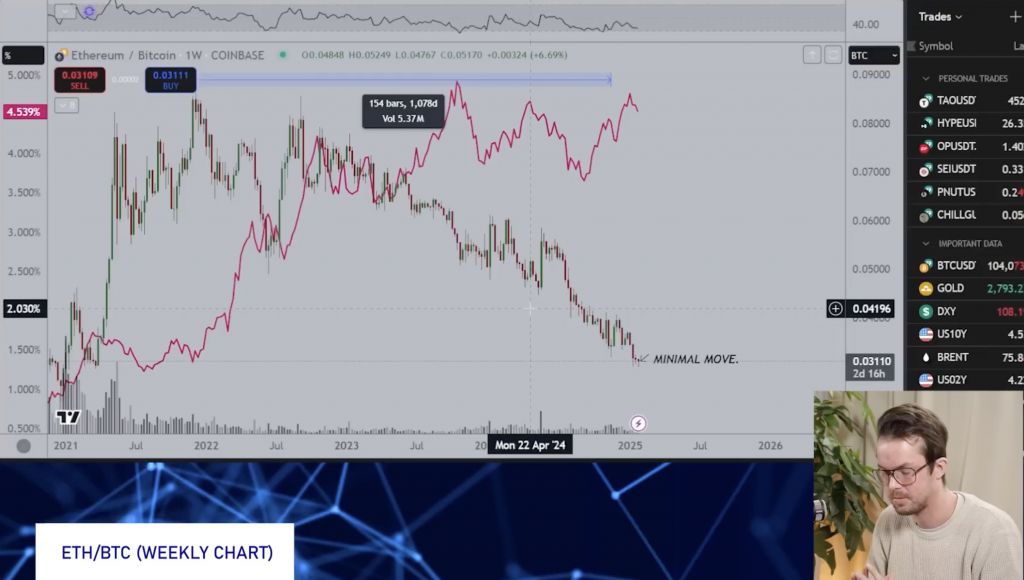
Также важным индикатором является курс японской йены — периоды ее укрепления часто совпадают с ростом Ethereum относительно биткоина.
Диверсифицированный портфель

В своем портфеле ван де Поппе выделяет восемь основных позиций:

  • Крупные активы: Optimism (OP), Celestia (TIA), Bittensor (TAO) и Sei (SEl). Эти проекты фокусируются на масштабировании и развитии инфраструктуры блокчейна.
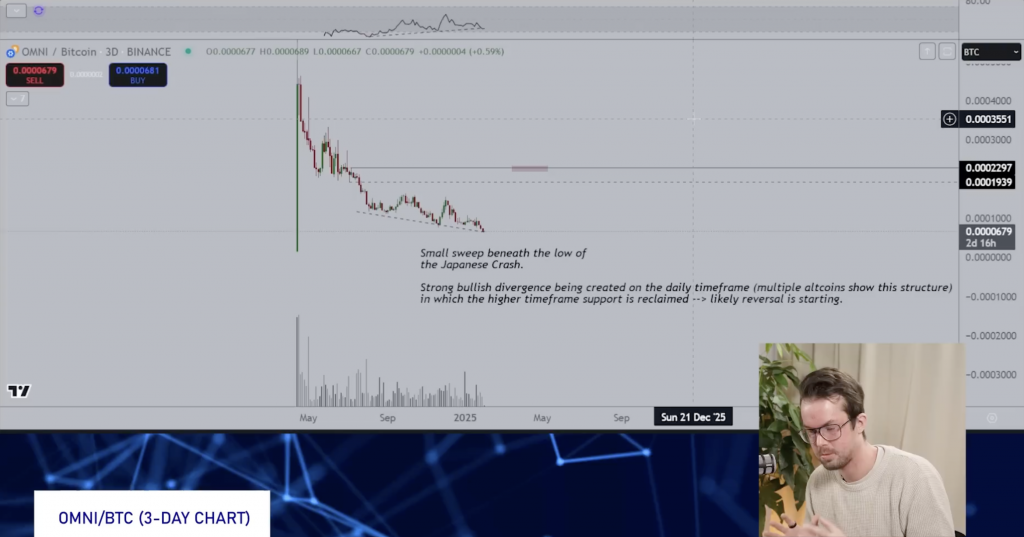
  • Небольшие позиции: Renzo (REZ), Omni (OMNI), Rocketpool (RPL) и Aevo (AEVO). Данные проекты связаны с DeFi и рестейкингом, что отражает растущий интерес к этим секторам.

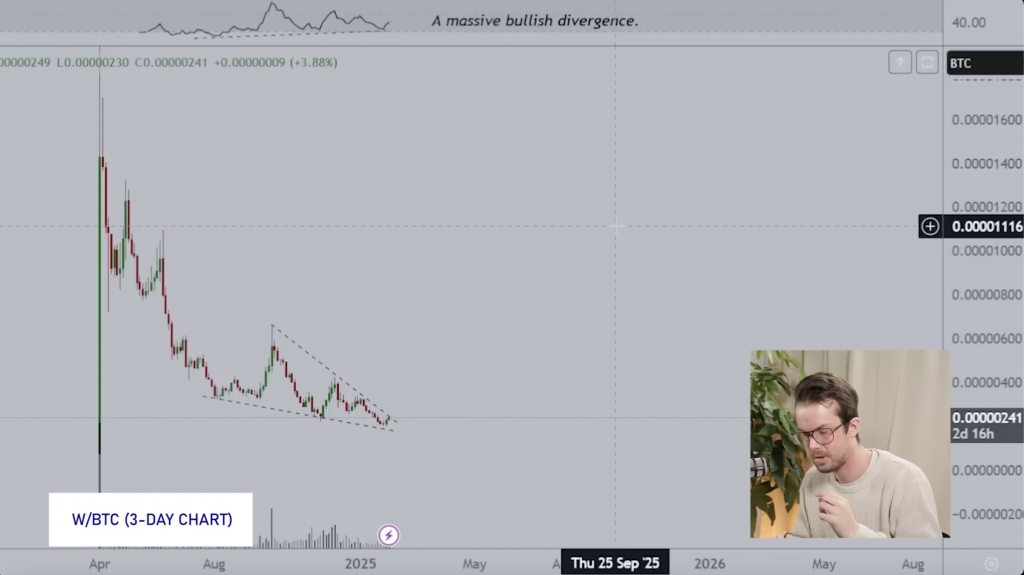
Недавно аналитик добавил в портфель еще один актив — Wormhole (W), специализирующийся на межсетевой совместимости. По его мнению, это направление станет одним из ключевых в развитии блокчейн-экосистемы, поскольку потребность в эффективном взаимодействии между различными сетями будет только расти.
Ван де Поппе отмечает, что рынок становится более сложным по мере интеграции криптовалют в традиционные классы активов через ETF. Это усиливает влияние макроэкономических факторов на поведение инвесторов. При этом он считает, что четырехлетний цикл больше не актуален, а рынок альткоинов сейчас находится в состоянии иррациональной негативности после самого длительного медвежьего тренда в истории.

Технический анализ показывает формирование бычьих дивергенций на графиках многих альткоинов, включая Wormhole и Omni, что может сигнализировать о потенциальном развороте тренда в ближайшие недели.

Letture associate

From Corning to Ciena: The 10x Opportunity in the AI Optical Communication Chain

The transition from copper to optical communication in AI data centers is creating significant investment opportunities beyond just chipmakers. The entire photonics supply chain, from glass and fiber to connectors and test equipment, is critical. Corning, a key fiber supplier, has locked in multi-billion dollar, multi-year contracts with major cloud providers (Meta, Amazon, Google, Microsoft, OpenAI, NVIDIA), demonstrating pricing power and scale. Its profit growth is outpacing revenue growth. In the interconnect layer, Amphenol benefits from high growth in AI data centers, driven by strategic acquisitions and operational efficiency, while Credo Technology acts as a bridge between copper and optical solutions, though with high customer concentration risk. At the systems level, Ciena enables higher data capacity on existing fiber lines, with a strong backlog and cloud customer adoption. Further upstream, AXT is a bottleneck supplier of key indium phosphide wafers for lasers but faces geopolitical supply chain risks. VEO Solutions provides essential testing equipment for the entire photonics industry. A new pure-play photonics ETF (FOTO) offers a consolidated investment approach. The core thesis is that the physical limits of copper are driving an inevitable shift to optical technologies, with wealth flowing to essential, often overlooked, suppliers across the photonics value chain.

marsbit13 min fa

From Corning to Ciena: The 10x Opportunity in the AI Optical Communication Chain

marsbit13 min fa

Collector Crypt's DAU Is Only 800, Yet It's Already One of Crypto's Most Profitable Projects?

"Collector Crypt: A Highly Profitable Crypto Project with Only 800 Daily Active Users?" Collector Crypt (CARDS) is a crypto project tokenizing physical graded trading cards (primarily Pokémon) on Solana, achieving significant real-world profitability and growth. According to a Maelstrom Fund analysis, it generated approximately $53M in annualized profit in May, with a June run-rate nearing $109M, against a $550M FDV. Its core revenue driver is a digital pack-opening 'Gacha' system. The platform bulk-buys cards at a 5-15% discount. Users can open digital packs and choose to keep cards or sell them back to the platform at a 7-15% discount to market price. Most users sell back common cards, creating an efficient model: users get packs with a ~2% positive expected value, while Collector Crypt captures ~4.5% profit. The project aims to disrupt the inefficient $22.2B GMV (Q1 2026) eBay trading card market, which charges sellers 16-20% in total fees. Collector Crypt offers 2% fees, instant settlement, insured custody, and one-click trading. Beyond Gacha, future revenue streams include secondary market trading fees, infrastructure partnerships, and an eBay "snipe" tool. It holds ~$23M in card inventory and ~$10M in cash, and has already begun token buybacks. With a total supply of 2B tokens, effective circulation post-2027 unlocks is estimated at ~1.3B. Trading primarily on DEXs has so far limited large institutional entry. The project is expanding into sports cards and attracting Web2 users. Maelstrom Fund's price target is $4 by summer's end, positioning Collector Crypt at the forefront of migrating collectibles on-chain.

Foresight News25 min fa

Collector Crypt's DAU Is Only 800, Yet It's Already One of Crypto's Most Profitable Projects?

Foresight News25 min fa

New Chair, Old Inflation, Better-Than-Expected Jobs: How Are Global Assets Repriced After Wash's Debut?

New Fed Chairman Kevin Wash's first FOMC meeting delivered a "hold" decision, keeping rates at 3.50%-3.75%. The key signal was a major shift in communication: the policy statement was shortened, and forward guidance was removed. Wash emphasized the Fed will no longer pre-commit to future actions, instead refocusing markets on economic data itself. The updated "dot plot" revealed a hawkish tilt, with the median forecast for the policy rate rising to 3.8% by year-end, suggesting a potential 25-basis-point hike in 2026. PCE inflation forecasts were also significantly raised. This reflects the Fed's current dilemma: a resilient job market (May nonfarm payrolls beat expectations) coupled with persistent inflation (PCE remains well above 2%) makes rate cuts unlikely and hikes a possibility. Wash inherits a deeply divided committee and a challenging macro environment reminiscent of 1994—strong growth with latent stagflation risks. His primary test is balancing inflation control against economic stability. Markets are repricing assets accordingly. The dollar strengthened on higher rate expectations. Treasury ETFs face pressure from potential hikes but may attract haven flows if growth fears emerge. Gold's role is more as a hedge amid conflicting forces. AI infrastructure stocks face valuation compression from higher rates, but the sector's fundamental demand logic remains intact if cloud CapEx holds. Defense stocks offer some resilience due to long-term government contracts. Looking ahead, key data points will drive market moves: the June nonfarm payrolls (July 2) and CPI (mid-July) will be critical for setting the tone of the July FOMC meeting (July 28-29), where Wash may face his first real policy decision. Political pressure from the White House for rate cuts will also be a persistent theme testing Fed independence.

marsbit38 min fa

New Chair, Old Inflation, Better-Than-Expected Jobs: How Are Global Assets Repriced After Wash's Debut?

marsbit38 min fa

Stablecoin Salaries: Why Are They Becoming the First Choice for Cross-Border Workers?

Stablecoin Salaries: Why They're Becoming the Top Choice for Global Remote Workers The traditional global salary system carries hidden exchange rate risks for freelancers in countries like India, Argentina, and Turkey who earn in USD but spend in local currencies. When salaries are instantly converted to local currency, workers lose purchasing power if that currency depreciates against the dollar. For instance, an Indian designer converting a $2000 monthly salary to rupees lost over 10% in purchasing power last year due to the rupee's decline. Holding even a portion of income in USD or USD-pegged stablecoins can preserve value. Stablecoins offer a solution by breaking down barriers to holding dollars. Opening foreign USD bank accounts is difficult, and international wire transfers incur high fees (averaging 6.5%) and delays. In contrast, stablecoin transfers are fast and low-cost. Furthermore, many countries with high inflation and depreciating currencies restrict citizens' access to foreign currency. Self-custody stablecoin wallets enable workers to hold dollar-equivalent assets without needing bank approval, bypassing these limits. These wallets integrate multiple functions: they allow users to convert only what's needed for daily expenses into local currency, keep the remainder in stablecoins, connect to on-chain lending or yield products, and even link to payment cards for direct spending. While challenges remain—such as the lack of deposit insurance and evolving regulatory frameworks—the trend is clear. Reports indicate a growing preference for USD or stablecoin payments among freelancers in high-inflation countries. This shift represents a fundamental restructuring of salary functions: payment currency, asset storage, yield generation, spending, and cross-border flow. It offers the freedom and flexibility that are core to money's purpose, signaling a profound change in the global financial landscape.

Foresight News53 min fa

Stablecoin Salaries: Why Are They Becoming the First Choice for Cross-Border Workers?

Foresight News53 min fa

Trading

Spot
Futures
活动图片