Джим Крамер посоветовал покупать биткоин вместо акций MicroStrategy

cryptonews.ruPubblicato 2024-04-28Pubblicato ultima volta 2025-01-28

Лучше купить биткоин, чем акции MicroStrategy. Такой совет дал экс-управляющий хедж-фондом Cramer & Co и ведущий шоу Mad Money Джим Крамер, пишет The Block.

«Если вы хотите держать первую криптовалюту, держите. У меня есть цифровое золото. […] Это отличный актив, который должен быть в портфеле. Не MicroStrategy», пояснил он.

С 21 по 26 января упомянутая компания приобрела 10 107 BTC за ~$1,1 млрд в среднем по ~$105 596, увеличив биткоин-резервы до 471 107 BTC.

Данные: BitcoinTreasuries.

С августа 2020 года MicroStrategy инвестировала в первую криптовалюту $30,4 млрд, средняя цена покупки составила ~$64 511 за монету.

На MicroStrategy приходится 76% биткоин-резервов публичных компаний и 2,24% предложения цифрового золота.

Эмитенты BTC-ETF приобрели 1,325 млн BTC (6,3%). Почти половина от этой величины содержится на кошельках IBIT от BlackRock.
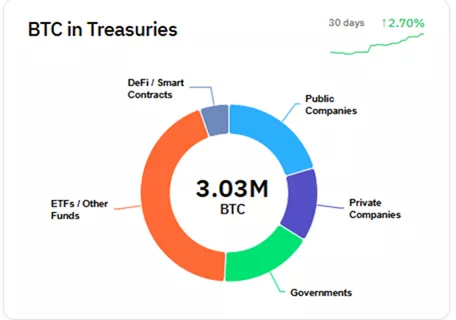
Данные: BitcoinTreasuries.

Напомним, в марте 2024 года СМИ напомнили о несбывшихся прогнозах Крамера. Ранее ведущий называл биткоин мошенничеством и рекомендовал продавать его, когда цена достигла $24 000.

Не стал исключением и эпизод весны прошлого года, когда Крамер усомнился в продолжении роста цифрового золота.

В декабре другой известный в прошлом как скептик первой криптовалюты миллиардер Рэй Далио назвал актив «твердыми деньгами». Годом ранее эксперт признался, что владеет биткоином, но предпочитает золото.


Letture associate

The Impact of OUSD on Circle, Tether, and Paxos: Not a Simple Negative, but a More Complex Competitive Landscape

OUSD's Impact on Circle, Tether, and Paxos: A Nuanced Competitive Reshuffle The launch of OUSD, a new stablecoin initiative, has complex implications for the stablecoin market. For Circle (CRCL), the initial 15-20% stock drop reflects legitimate competitive concerns but is not a "death sentence." Circle retains deep liquidity, existing integrations, and first-mover advantages. A potential restructuring or termination of its Coinbase partnership could even double its net revenue in the short term, providing more competitive freedom. However, OUSD, backed by Stripe's engineering and product strengths, could become the default stablecoin within the Stripe ecosystem for new adopters, challenging USDC's position. OUSD does not solve the core barrier for corporate adoption: it remains a credit exposure to its issuer (likely a Bridge-related entity), which, like Circle, is not an investment-grade entity. Large banks and asset managers could still capture the most lucrative enterprise use cases. Circle must accelerate its payment/fintech product development and consider defensive M&A. For Tether, OUSD targets a different market segment. Tether will continue focusing on distribution channels not prioritized by Stripe or Circle. Its market share may decline over time, but within a significantly growing total market. Paxos faces the greatest pressure. OUSD undermines the key selling points of its USDG stablecoin, and Paxos's regulatory advantages may diminish as frameworks mature. This poses a more existential challenge, explaining Paxos's recent shift back to its brokerage-as-a-service business.

marsbit52 min fa

The Impact of OUSD on Circle, Tether, and Paxos: Not a Simple Negative, but a More Complex Competitive Landscape

marsbit52 min fa

OUSD's Impact on Circle, Tether, and Paxos: Not a Simple Negative, but a More Complex Competitive Reshuffle

This article analyzes the impact of the newly announced stablecoin OUSD, backed by a consortium including Stripe, on major incumbents like Circle (USDC), Tether (USDT), and Paxos (USDG). For Circle, the announcement is not a simple negative. While the initial market reaction was rational, it's not a "death sentence." Circle retains deep liquidity, existing integrations, and first-mover advantage. A potential restructuring or termination of its exclusive revenue-sharing deal with Coinbase could even near-double its net income in the short term, providing more competitive flexibility. However, within the Stripe ecosystem, OUSD, with its strong engineering and product focus, could become the default choice, displacing USDC for new integrations. Circle must accelerate its own fintech product development and consider defensive M&A. OUSD does not directly threaten Tether's core markets, which focus on different distribution channels. Tether's market share may decline over time but within a significantly growing overall market. Paxos faces the greatest pressure. OUSD undermines the primary value proposition of its USDG stablecoin, and Paxos's regulatory advantages may erode as frameworks mature, posing a more existential challenge. This explains Paxos's recent strategic pivot towards brokerage-as-a-service. A fundamental unresolved issue for enterprise adoption remains: if issued by a Bridge-related entity, OUSD, like USDC, still represents a credit exposure to a non-investment-grade issuer, unless a parent company guarantee is provided. Large banks and asset managers entering the space later could still compete for the most lucrative enterprise use cases.

链捕手53 min fa

OUSD's Impact on Circle, Tether, and Paxos: Not a Simple Negative, but a More Complex Competitive Reshuffle

链捕手53 min fa

Trading

Spot
活动图片