Donald Trump Embraces Meme Coins—A Presidential First

bitcoinistPubblicato 2025-01-11Pubblicato ultima volta 2025-01-11

Introduzione

Donald Trump is making news once more, but this time it's not for political reasons; it's about cryptocurrency. As he...

Donald Trump is making news once more, but this time it’s not for political reasons; it’s about cryptocurrency. As he prepares to return as the 47th President of the United States, Trump will become the first sitting president to own meme currencies, a decision that has stirred both enthusiasm and skepticism in the crypto community.

Trump: A Significant Crypto Portfolio

Recent sources claim that Trump’s crypto wallet consists largely of meme coins and is valued roughly $8 million. Among the assets are $1.5 million in a meme currency with Trump-themed design and $5.5 million in TROG tokens.

In addition, he has about 1.3 billion GUA coins, which amounts to nearly $400,000, and $167,000 in TRUMPIUS tokens. This is a first of its kind, where Trump becomes an oddity in the world of politics and cryptocurrency, considering his earlier reluctance towards digital assets.

From Skepticism To Support

Trump’s journey into the crypto world is notable. He had been a strong critic of Bitcoin and other cryptocurrencies, calling them scams. But that all changed in 2024 when he started publicly endorsing Bitcoin and speaking out for the right to own it. That’s a broader trend among politicians, who are increasingly recognizing the potential of cryptocurrencies and their growing popularity among voters.

Trump’s financial success in the digital sphere was also aided by his venture into non-fungible tokens (NFTs) on Ethereum. Trump reportedly made a good living from these endeavors, and he currently owns roughly 496.77 ETH, which is worth about $1.6 million.

BTC is currently trading at $94,144. Chart: TradingView

Implications For Regulation

Many people are eager to see how Trump’s administration will regulate cryptocurrencies now that he is back in office. A possible change toward a more advantageous regulatory climate for digital assets is hinted at by the nomination of important individuals like David Sacks as “Crypto Czar” and Paul Atkins as SEC chair. This could result in more precise rules for investors and businesses involved in the cryptocurrency industry.
Trump

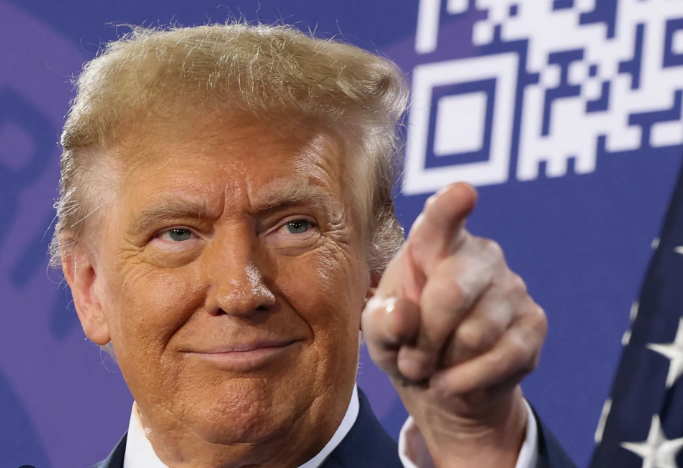
Donald Trump. Image: Ronda Churchill/Reuters

The policies by Trump are already changing market dynamics as everybody is anxiously awaiting them. During this time when Bitcoin hit a record high of $108k, while meme coins surged, analysts still feel that Trump could make the year 2025 a major turning point in cryptocurrencies.

Meme Coin Boom

The rise of Trump-owned meme coins is indicative of a broader cultural shift among younger investors who are fed up with established financial institutions. This combination of the political influence of Trump and the speculative nature of meme coins puts a scenario under which political events could significantly affect cryptocurrency markets. Thus, while the investors go about this, they are not ignorant of the volatility that is usually associated with meme coins.

Featured image from Fortanix, chart from TradingView

Christian Encila

Christian Encila

Christian, a journalist and editor with leadership roles in Philippine and Canadian media, is fueled by his love for writing and cryptocurrency. Off-screen, he's a cook and cinephile who's constantly intrigued by the size of the universe.

Letture associate

Warsh's First Day in Office, Markets Deliver a 'Wake-up Call': Rate Hike Expected This Year

On his first day in office, newly inaugurated Federal Reserve Chairman Warsh received a stark market warning, with expectations now fully pricing in a 25-basis-point interest rate hike this year. The shift was triggered by hawkish remarks from Fed Governor Waller, who stated that inflation is now the key policy "driver" and that the odds of a hike or cut are evenly split. This sent short-term Treasury yields higher. Waller signaled a significant pivot in his stance, citing disappointing inflation and labor data. He suggested removing "easing bias" language from Fed statements and did not rule out future rate increases if inflation fails to recede, though he noted immediate action isn't warranted without signs of unanchored inflation expectations. Chairman Warsh faces immediate pressure at his first FOMC meeting in June. With the preferred inflation gauge at a three-year high, analysts warn that failing to hike could be interpreted as an implicit easing of policy. The geopolitical situation in the Middle East is adding to existing price pressures. The market's expectation for a hike contrasts sharply with earlier forecasts for multiple cuts. While long-term Treasury yields have been contained by lower energy prices recently, analysts note they remain under structural upward pressure. Warsh's swearing-in at the White House highlights political scrutiny over Fed independence. However, the market has made it clear that inflation is the most urgent challenge, leaving the new chairman little time to settle in.

marsbit7 h fa

Warsh's First Day in Office, Markets Deliver a 'Wake-up Call': Rate Hike Expected This Year

marsbit7 h fa

Has Microsoft Lost Its Way in the AI Race, and Can Copilot Bring It Back on Track?

Microsoft, once seen as an early AI frontrunner due to its investment in OpenAI, is navigating a strategic shift amid increased competition. Its initial reliance on OpenAI’s GPT models has been complicated by OpenAI’s growing ambitions as a direct competitor, rapid advancements from rivals like Claude and Gemini, and the disruptive rise of AI agents, which challenge its traditional SaaS business model. These factors contributed to stock declines and slower-than-expected adoption of its flagship Copilot products. In response, CEO Satya Nadella has taken a hands-on role in product development, signaling the urgency of change. Microsoft is pivoting from a model-centric strategy to a "model-agnostic" enterprise platform approach. It aims to become the foundational layer connecting various AI models—from OpenAI, Anthropic, or its own new "Superintelligence" team—with enterprise workflows, data, security, and cloud services. Recent organizational changes merged consumer and enterprise Copilot teams to accelerate innovation, exemplified by new products like Copilot Tasks and Copilot Cowork. However, this transformation comes at a high cost. Microsoft faces massive capital expenditures, potentially reaching ~$190 billion by 2026, to support AI infrastructure. While its platform strategy shows early signs of traction with growing Azure AI revenue, it must balance startup-like agility with the reliability expected by enterprise clients. The core challenge is no longer being the sole AI winner but defending its position as the essential enterprise software entry point amidst rapid technological commoditization and the shift towards always-on AI agents.

marsbit8 h fa

Has Microsoft Lost Its Way in the AI Race, and Can Copilot Bring It Back on Track?

marsbit8 h fa

Trading

Spot
Futures
活动图片