Trump Effect On Crypto: Bitwise CEO Anticipates Merger Boom

bitcoinistPubblicato 2025-01-07Pubblicato ultima volta 2025-01-07

Introduzione

A top executive of the largest cryptocurrency index fund firm expressed optimism about the impact on economic policies on the...

A top executive of the largest cryptocurrency index fund firm expressed optimism about the impact on economic policies on the digital asset sector upon the official return of Donald Trump to the White House this month.

Bitwise Asset Management CEO Hunter Horsley recently provided fascinating insights on how the Trump administration could transform the cryptocurrency industry.

Deregulation Of M&As

Horsley believes that the policies to be implemented by the incoming Trump administration could propel the cryptocurrency sector to new heights, especially liberalizing mergers and acquisitions, saying that it could allow major American companies to expand their business further through strategic acquisitions.

The Bitwise CEO thinks President-elect Trump might “unfreeze” mergers and acquisitions, a welcome development for the country’s major companies to enhance their business foothold.

“Large corporates — mag 7, etc — may finally be able to wield their market cap,” Horsley said.

He noted that for example, retail giant Amazon could acquire Instacart, or search engine powerhouse Google could purchase Uber, saying, “The big may get bigger, and the middle may shrink.”

Accelerating Cryptocurrency

Horsley suggested that allowing major US companies to make strategic acquisitions could fuel the adoption of decentralized systems, benefiting the cryptocurrency landscape.

“If that happens, I think it will accelerate crypto,” Horsley said in a post.

The crypto index fund executive believes if large corporations accumulate more control, the demand for cryptocurrencies might soar because digital assets serve as an alternative to these institutions.

“The conceptual premise of crypto is not trusting large institutions to do what’s in your best interest. The big getting bigger accentuates this,” he claimed in an X post.

BTC market cap currently at $2.02 trillion. Chart: TradingView.com

Industry Leaders Adopting Crypto

Many analysts observed that blockchain technology and digital assets are capturing the attention of industry giants like Amazon and Google who are finding opportunities to become part of the cryptocurrency markets.

For example, Amazon Web Services launched Amazon Managed Blockchain, the retail giant’s own blockchain-related service. It allows companies to create and manage scalable blockchain networks, turning Amazon into a major player in the blockchain market.

Strategic Partnerships

Meanwhile, Google has established strategic alliances with key blockchain initiatives and joined campaigns that push for the integration of blockchain technology into its cloud infrastructure, increasing the search engine’s footprint in the cryptocurrency sector.

On Google Cloud, businesses can now find blockchain-as-a-service which offers them the opportunity to create and implement decentralized apps.
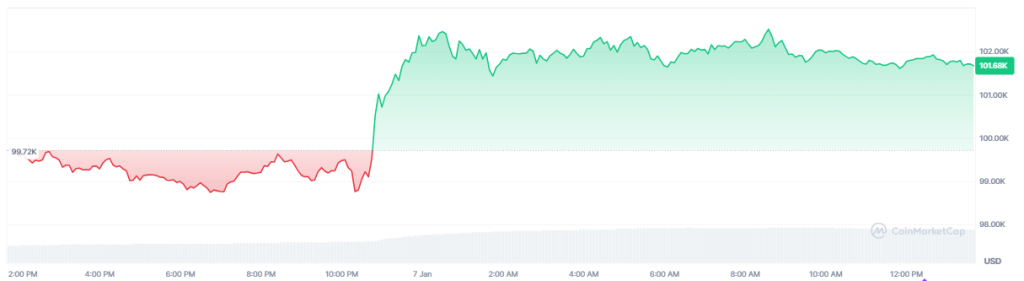
Bitcoin price breaking the $100k level today. Source: CoinMarketCap

Horsley’s statement is timely since the cryptocurrency market is currently enjoying a positive outlook brought by Trump who is perceived to be pro-crypto.

Trump’s election victory fuels the growth of the digital asset market wherein investors saw Bitcoin surpass the $100,000 level in early December, from about $69,000 in early November.

Featured image from Fox News Screengrab/AsiaTimes, chart from TradingView

Christian Encila

Christian Encila

Christian, a journalist and editor with leadership roles in Philippine and Canadian media, is fueled by his love for writing and cryptocurrency. Off-screen, he's a cook and cinephile who's constantly intrigued by the size of the universe.

Letture associate

BIS Report Compliance Observations: The True Risks of Stablecoins Go Beyond 'De-pegging'

The BIS report, "Anchoring trust in money: innovation beyond stablecoins," highlights that the primary risks of stablecoins extend beyond potential de-pegging. It argues that the core challenge is whether stablecoins can be integrated into a financial system that is identifiable, monitorable, accountable, and regulatable. While acknowledging efficiency gains like faster payments and programmability, BIS emphasizes that money requires an institutional framework—including legal certainty, liquidity support, and financial integrity controls—which many stablecoins currently lack. The report details compliance risks, noting that while blockchain transactions are transparent, address visibility does not equate to identity or purpose clarity. This creates a systemic risk as pseudonymity, non-custodial wallets, and cross-chain bridges can undermine AML/CFT controls. Furthermore, these risks can spill over into the traditional financial system through on- and off-ramps. The future direction, per BIS, is not to prohibit innovation but to embed regulatory rules—such as identity verification and transaction screening—directly into the technological infrastructure of tokenized finance. The key takeaway for compliance is that any new financial instrument must clearly address questions of customer identification, transaction monitoring, accountability, and cross-border rule consistency to be viable as a mainstream payment tool.

marsbit1 h fa

BIS Report Compliance Observations: The True Risks of Stablecoins Go Beyond 'De-pegging'

marsbit1 h fa

When US Giants Collectively "Defect" to Chinese AI Models

When Silicon Valley Giants Turn to Chinese AI Models to Cut Costs A surprising trend is emerging: major U.S. tech companies are significantly reducing AI costs by switching to Chinese models. Coinbase, the largest U.S. cryptocurrency exchange, reportedly halved its AI spending after migrating to China's GLM-5.2 and Kimi 2.7 models, despite increasing usage. They achieved this through a sophisticated three-part strategy: implementing an automatic routing system to select the most cost-effective model per task, boosting cache hit rates from 5% to 60% to reuse computations, and employing "context engineering" to provide AI with more precise, less cluttered information. They are not alone. AI startup Lindy switched from Claude to DeepSeek, saving millions, while Snowflake's tests found GLM-5.2 solved 66% of coding tasks compared to Claude Opus's 67%—but at a fraction of the cost (output pricing is 5-7 times lower). While the top Western models may offer slightly better stability, the massive price differential is leading many businesses to reconsider their value proposition. This shift signals a deeper change in the AI industry, moving beyond pure performance benchmarks to a fierce cost competition. As pressure mounts, even OpenAI and Anthropic have begun slashing prices. For users, this means more choices, lower costs, and a crucial lesson: using multiple models based on task complexity, optimizing with caching, and keeping contexts lean are now key to leveraging AI efficiently and affordably.

marsbit1 h fa

When US Giants Collectively "Defect" to Chinese AI Models

marsbit1 h fa

BIS Report Compliance Watch: The Real Risks of Stablecoins Are Not Just 'De-pegging'

BIS Report Compliance Observations: The real risks of stablecoins go beyond "depegging" The BIS report "Anchoring trust in money: innovation beyond stablecoins" argues that while stablecoins and tokenization offer efficiency gains, their primary risk lies in fitting into an identifiable, monitorable, accountable, and regulatable financial system. Money's trust stems not just from technology but from institutional arrangements: a common unit of account, guaranteed redemption at par, liquidity support, regulatory frameworks, and financial integrity requirements. Stablecoins, operating on permissionless blockchains with pseudo-anonymity and non-custodial wallets, create systemic compliance gaps: unclear customer identity, incomplete fund origins, unexplained transaction purposes, fragmented cross-chain paths, and ambiguous liability. On-chain transparency does not equal compliance transparency. Public addresses don't reveal identity or intent. While blockchain analytics aid law enforcement, they cannot replace routine, large-scale AML/CFT controls. Effective compliance requires a closed-loop process encompassing customer onboarding, transaction monitoring, investigation, reporting, and audit. Stablecoin risks are not confined to the blockchain; they re-enter the traditional financial system via on/off-ramps, exchanges, and payment institutions. This forces banks to monitor client accounts for activity linked to virtual assets. The future direction is not to prohibit innovation but to embed rules into the technology. Tokenized finance should integrate with the existing two-tier monetary system, embedding compliance—like customer identification, pre-transaction screening, and auditable data trails—directly into the transaction flow. For compliance professionals, the key takeaway is that any new financial instrument must answer core questions: Who identifies the customer? Who monitors transactions? Who handles exceptions? Who is liable? Compliance is not the antithesis of innovation but the essential infrastructure for its sustainable growth.

链捕手1 h fa

BIS Report Compliance Watch: The Real Risks of Stablecoins Are Not Just 'De-pegging'

链捕手1 h fa

Trading

Spot
活动图片