Virtuals Protocol исправляет ошибку и перезапускает программу багбаунти

cryptonews.ruPubblicato 2024-05-04Pubblicato ultima volta 2025-01-04

Неожиданная ошибка, обнаруженная в проверенном смарт-контракте, заставила Virtuals Protocol, блокчейн-компанию, специализирующуюся на агентах искусственного интеллекта, выпустить своевременное исправление и перезапустить свою программу вознаграждений за найденные ошибки.

3 декабря 2024 года псевдонимный исследователь безопасности Jinu связался с Virtuals Protocol (VIRTUAL) после обнаружения ошибки в одном из проверенных контрактов. Тем не менее, сообщив о проблеме, Jinu узнал, что у компании нет активной программы вознаграждения за ошибки, что означает, что открытие не подпадает под вознаграждение.
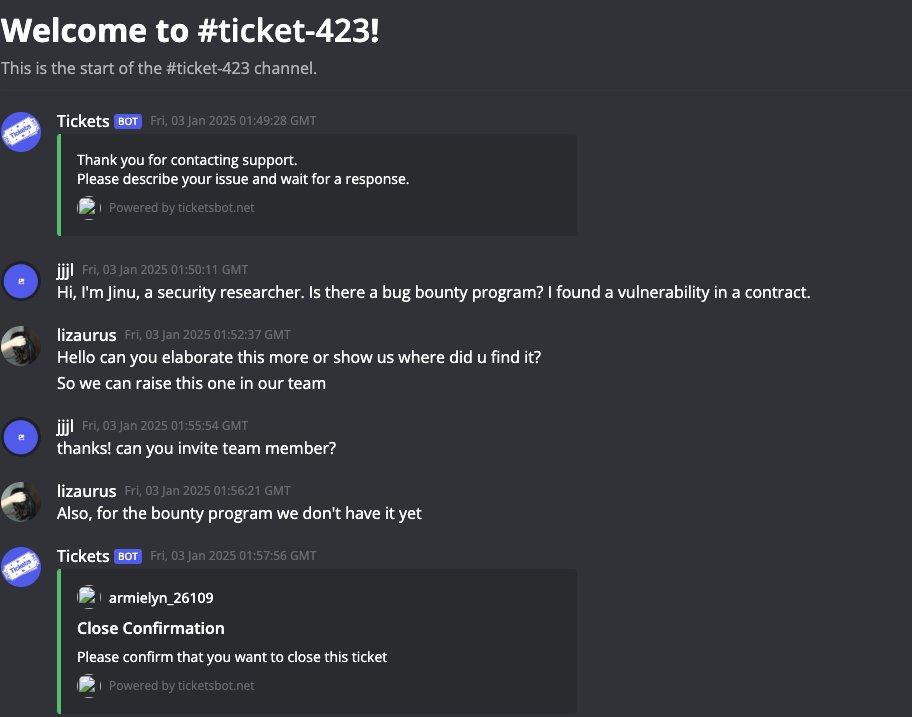

Virtuals Protocol признал обнаружение ошибки белым хакером. Источник: Jinu

Белый хакер находит уязвимость

По словам Jinu, команда Virtuals Protocol также закрыла группу Discord, созданную исключительно для сообщения об уязвимостях. В теме X Jinu сказал:

«Уязвимость проста и может повлиять на экосистему виртуальных машин (но виртуальные машины, вероятно, не заботятся о безопасности)».

Jinu объяснил, что уязвимость была связана с отсутствием проверки при создании AgentTokens на основе внутреннего порога облигаций.

«Если бы эта уязвимость была использована, AgentTokens не были бы сгенерированы до тех пор, пока контракт не был бы исправлен», — сказал Jinu.

После того, как информация была опубликована на X, Virtuals Protocol связался с Jinu и немедленно выпустил исправление.
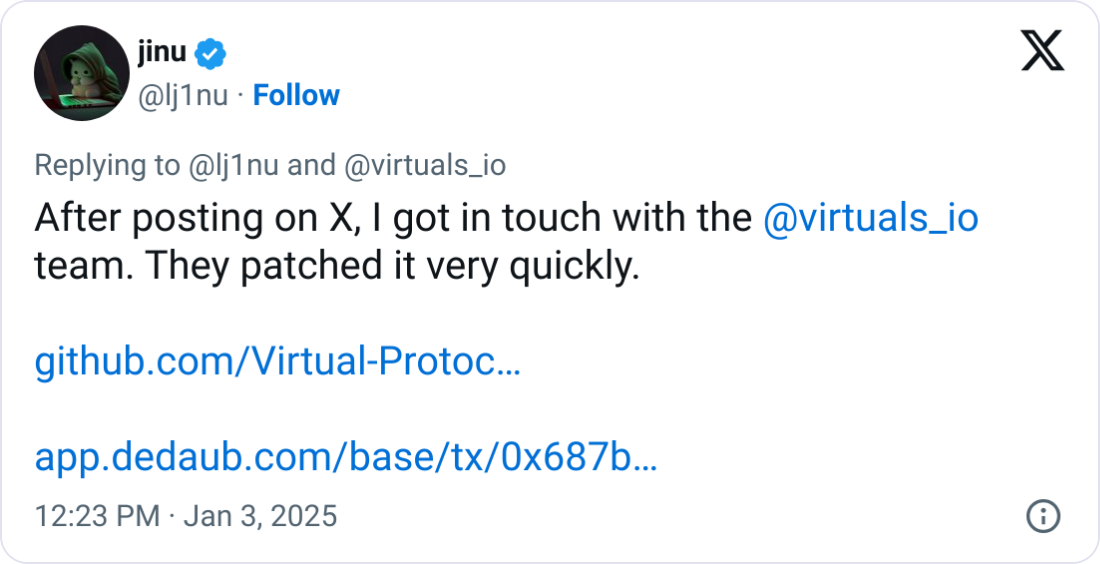

Твит белого хакера Virtuals. Источник: Jinu.

Virtuals Protocol еще не принял решение о программе багбаунти

Несмотря на своевременное исправление, Virtuals Protocol еще не объявил вознаграждение за обнаружение ошибки для Jinu. В сообщении исследователю компания поблагодарила Jinu за сообщение о проблеме и извинилась за ранее возникшее недопонимание.

«Привет, Jinu, мы проверили уязвимость и применили исправление ниже. Спасибо, что сообщили нам об этом, и мы приносим извинения за недопонимание между службой поддержки и вами. Давайте проведем внутреннюю оценку серьезности проблемы, и вскоре мы выдадим вам вознаграждение за обнаружение ошибки», — сообщили представители компании исследователю безопасности.

Когда их спросили об ожидаемом вознаграждении, Jinu ответил, что ему неизвестно об общих вознаграждениях за обнаружение ошибок. Jinu рассказал, что он заинтересовался Virtuals Protocols после того, как его друг инвестировал в токен, созданный на Virtuals.

«Я потратил около 30 минут на изучение кода, чтобы убедиться, что он хорошо сделан, — сказал Jinu, — затем наткнулся на ошибку».


Letture associate

Doubao and Qwen Will Discontinue Agent Functionality on July 15

On July 4th, Doubao and Tongyi Qianwen announced the impending shutdown of their user-created "AI Agent" features. Doubao confirmed its agent feature will be taken offline on July 15, directing users to ByteDance's CatBox app for similar needs. On the same day, Tongyi Qianwen notified users, specifying that personalized interactive agents and user-built agent functions will cease on July 10, with all agent features and services completely deactivated by July 15. After this date, access to agent configurations and historical chat records will be lost. This adjustment impacts core user scenarios like role-playing, personal assistants, and vertical tool agents. The shutdown date coincides with the official implementation of China's "Interim Measures for the Administration of Artificial Intelligence Human-like Interactive Services" on July 15. The new regulations impose strict rules on "human-like emotional interaction services," requiring platforms to implement measures like anti-addiction systems, minor verification, and content moderation. This move is widely seen as a proactive step by the platforms to align with regulatory timelines and mitigate compliance risks. Additionally, commercial challenges are a key driver. Analysis suggests that casual, human-like chat agents generate high-frequency, low-value interactions, leading to high computational costs with poor monetization. As the AI application market shifts from user growth to proving value, sustaining such "high-cost, low-efficiency" user-generated content becomes difficult. Both platforms have outlined transition plans. Doubao will allow data viewing and self-backup for a period after shutdown, with data scheduled for permanent deletion by October 15. Tongyi Qianwen similarly advised users to save important content via copying or screenshots before the deadline. This strategic retreat from C-end agent features signals a broader market shift. Compliance capability and sustainable business models are replacing user scale and feature richness as the new core competitive dimensions. Tongyi Qianwen's recent move to fully open its Agent and Skill platforms to third-party enterprises and developers further underscores a strategic pivot from low-value C-end services to high-value B-end enterprise scenarios.

marsbit3 h fa

Doubao and Qwen Will Discontinue Agent Functionality on July 15

marsbit3 h fa

Why Did Codex and ChatGPT Merge? What's Next for Codex? OpenAI Core Leader Answers Everything

In 2026, OpenAI's Codex saw explosive growth, with weekly active users surging over 5x to 5 million since January, driven largely by the February launch of its desktop app. Codex desktop lead Andrew Ambrosino explains key shifts behind its evolution. A core change is the inversion of development costs: implementation is now cheap, while curation and taste—judging which of many AI-generated prototypes is valuable—have become the new scarcities. Ambrosino defines taste as a blend of aesthetics, systems thinking, direction, and semantic coherence in interaction. He notes AI still struggles with design because evaluating it requires human cultural context and abstract reasoning about how components relate—capabilities beyond current models. Timing is critical: the same Codex app would have failed months earlier; success hinges on the model's capabilities at launch. Roles are blurring within his team, with engineers, designers, and PMs overlapping significantly. However, Ambrosino cautions against eliminating specialized roles entirely, as each field retains deep expertise. On AI-assisted development, the focus has shifted from measuring code written by AI to distinguishing between supervised and unsupervised generation. A current challenge is teaching models to simplify code, not just add complexity. The merger of Codex and ChatGPT stems from observed user behavior: non-developers adopted Codex for general knowledge work despite its developer-centric interface. This revealed a collapsing boundary between specialized tools and universal assistants. The vision is a "home base" that orchestrates tasks across external professional tools (like Excel or Premiere Pro) via connectors, rather than rebuilding everything internally. An internal example showed Codex helping edit video by interacting with Premiere Pro's files and even writing a plugin for it. The future direction is a unified, extensible platform that serves as a central hub for automating and managing work across any specialized tool the user employs.

marsbit3 h fa

Why Did Codex and ChatGPT Merge? What's Next for Codex? OpenAI Core Leader Answers Everything

marsbit3 h fa

Trading

Spot
活动图片