Dogecoin Price Could Be In Serious Trouble If The $0.394 Support Fails To Hold

bitcoinistPubblicato 2024-12-17Pubblicato ultima volta 2024-12-17

Introduzione

The Dogecoin price is now at a decisive junction as it hovers near a support level that could determine its...

The Dogecoin price is now at a decisive junction as it hovers near a support level that could determine its short-term direction. A recent analysis on TradingView highlights the importance of the $0.394 support, with outcomes pointing toward both bullish and bearish scenarios depending on price movement at this support level.

Dogecoin’s Key Support Zone Faces Growing Pressure

The Dogecoin price action in the past seven days has been highlighted by a perambulation around $0.40, which is a key psychological threshold for the meme coin. The balance between buying and selling pressure appears tight, leading to a consolidation move that could break in any direction. 

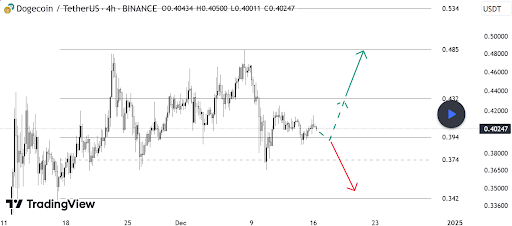
According to technical analysis of the 4-hour candlestick Dogecoin price chart on the TradingView platform, the meme coin could test $0.394 in the next few hours, and a decisive move here could lead to a rebound upwards or a further break to the downside.

In the first scenario, a short-lived dip toward $0.394 followed by a bounce would suggest that the bullish strength surrounding the Dogecoin price remains intact. From there, we could see Dogecoin retesting $0.432. A decisive break above $0.432 in one quick move would provide the much-needed momentum to break above its current 2024 high of $0.485. 

As such, the technical analysis projected that, in this case, the next resistance to watch lies at $0.485. A breach of this resistance may even allow Dogecoin bulls to target higher price levels beyond $0.50 and probably into new all-time highs.

On the other hand, the analysis warns of risks if Dogecoin fails to hold above $0.394. Bearish sentiment could dominate should buyers fail to regain control at $0.394. In this scenario, the next key support to monitor is $0.374. Failure to stabilize here could accelerate bearish momentum and push the Dogecoin price towards notable support at $0.342.
Dogecoin price
Source: TradingView

Dogecoin Price Leaning Towards Bullish Momentum

Although technical analysis suggests that the Dogecoin price could go either way, current market sentiment pushes the cryptocurrency more toward the bullish end. Particularly, trading volume, resistance, and technical indicators point to another breakout. This sentiment builds upon the anticipation of the Dogecoin price to break multiple resistance levels in the coming weeks and months.

One such technical indicator is the Gaussian Channel, which suggests that the Dogecoin price is on track to reach at least $2.5 this cycle. Notably, $2 has been a recurring price target this cycle, with many analysts projecting a confirmed break above it by 2025.

At the time of writing, Dogecoin is still trading at the $0.4 support level, although currently up by a meagre 0.53% in the past 24 hours.

Dogecoin price chart from Tradingview.com
DOGE price still above $0.4 | Source: DOGEUSDT on Tradingview.com
Featured image created with Dall.E, chart from Tradingview.com
Scott Matherson

Scott Matherson

Scott Matherson is a leading crypto writer at Bitcoinist, who possesses a sharp analytical mind and a deep understanding of the digital currency landscape. Scott has earned a reputation for delivering thought-provoking and well-researched articles that resonate with both newcomers and seasoned crypto enthusiasts. Outside of his writing, Scott is passionate about promoting crypto literacy and often works to educate the public on the potential of blockchain.

Letture associate

Silicon Valley AI Landscape Shifts: Karpathy Jumps Ship, Musk Steps In, Son Left Holding the Fort

Silicon Valley's AI landscape is shifting as key talent moves and financial pressures mount. Andrej Karpathy, a prominent AI researcher and former OpenAI co-founder, has announced he is joining competitor Anthropic full-time. His departure highlights a talent drain at OpenAI, where most of the original founders have now left. Karpathy, known for his engineering work at Tesla, is expected to help Anthropic develop more efficient model training methods using its Claude AI, challenging OpenAI's current compute-intensive approach. The move coincides with diverging financial paths for the two AI giants. Anthropic is reportedly on track to post its first quarterly profit with $10.9B in sales, while OpenAI, despite a massive $852B valuation and a recent $122B funding round led by SoftBank's Masayoshi Son, faces significant compute costs and potential heavy losses as it pushes for a rapid IPO. Son has invested over $60B in OpenAI, a concentrated bet that has drawn internal criticism over its risk, reminiscent of SoftBank's past losses on WeWork. Elon Musk, an OpenAI co-founder turned rival, is also influencing the dynamic. After losing a lawsuit against OpenAI, Musk's SpaceX leased its massive "Colossus 1" computing center, equipped with over 220,000 Nvidia GPUs, to Anthropic in a deal worth $40-45B. This provides Anthropic with crucial computational resources while pressuring OpenAI. The developments signal a consolidation where only well-capitalized players can compete in foundation model training. The focus is shifting from pure research to commercial viability, cost-efficient engineering, and strategic resource allocation, with companies like Anthropic finding success by focusing on profitable enterprise applications like code generation.

marsbit5 min fa

Silicon Valley AI Landscape Shifts: Karpathy Jumps Ship, Musk Steps In, Son Left Holding the Fort

marsbit5 min fa

In-Depth Research Report on U.S. Crypto Equity Market in 2026 — Opportunities, Risks, and Portfolio Allocation Framework

Since the U.S. Securities and Exchange Commission (SEC) historically approved spot Bitcoin ETFs in January 2024, the U.S. crypto investment landscape has undergone a profound maturation process. In 2026, investors can participate in the crypto market through four primary channels: spot ETFs, crypto-related public equities (including miners and treasury companies), leveraged and inverse ETFs, and blockchain-themed funds. As of March 30, 2026, U.S. spot Bitcoin ETFs collectively held approximately 1.29 million BTC, representing roughly $86.9 billion in assets under management (AUM), while spot Ethereum ETFs reached approximately $18 billion in AUM. Notably, the rise of the Ethereum treasury company model is reshaping the logic of institutional participation. Exemplified by Bitmine Immersion Technologies (BMNR), these firms generate native on-chain yield annually through ETH staking, creating a fundamentally different business resilience model compared with traditional Bitcoin treasury companies. On the regulatory front, the 2025 GENIUS Act established the first federal stablecoin framework in the United States. The U.S. Strategic Bitcoin Reserve has been officially established, banks have been authorized to provide crypto custody services, and major compliance bottlenecks have been definitively removed. Nevertheless, the high volatility of leveraged ETFs, the balance-sheet risks embedded in treasury-company financing structures, and the slashing risk of staked assets continue to pose investment obstacles that cannot be overlooked. For investors seeking exposure to this sector, building a tiered portfolio comprising core holdings, sector beta exposure, and high-risk tactical position may be the most viable path of participation.

HTX Learn32 min fa

In-Depth Research Report on U.S. Crypto Equity Market in 2026  — Opportunities, Risks, and Portfolio Allocation Framework

HTX Learn32 min fa

Viewpoint: After Surviving the Death Cycle, Why Has Privacy Pioneer Zcash Returned to the Mainstream Spotlight?

Zcash, the pioneering privacy-focused cryptocurrency built with zero-knowledge proof (ZK) technology, is re-emerging as a major narrative. Having survived a "death cycle" and proven its resilient community, Zcash is now positioned at a unique convergence of factors driving renewed institutional and retail interest. Key catalysts include the increasing institutionalization of crypto (e.g., BlackRock's ETF), which creates a "Trojan horse" for privacy adoption through Zcash's transparent mode. The rise of AI-powered on-chain surveillance makes financial privacy a critical necessity, not just for niche users but for mainstream wealth preservation against overreach. ZK technology has finally matured to enable practical, user-friendly private transactions, a core advantage over older "obfuscation" methods like Monero's ring signatures. Zcash’s narrative as "private Bitcoin"—a fork with the same 2100M cap and PoW—is simple and powerful. It competes in the store-of-value arena, offering cryptographic privacy as a fundamental human right. Its development roadmap is robust, featuring a soon-to-be-complete quantum resistance upgrade for its shielded pool, faster block times, and improved wallet support (e.g., from Ledger). With backing from major funds and a growing developer ecosystem, Zcash is seen as leading the crucial reintegration of privacy into the crypto landscape, fulfilling the original cypherpunk vision.

marsbit40 min fa

Viewpoint: After Surviving the Death Cycle, Why Has Privacy Pioneer Zcash Returned to the Mainstream Spotlight?

marsbit40 min fa

Trading

Spot
Futures
活动图片