«Это только начало»: биткоин взлетел на рекордные $26 400 за месяц

cryptonews.ruPubblicato 2024-01-02Pubblicato ultima volta 2024-12-02

Биткоин установил исторический рекорд, взлетев на $26 400 за один месяц — такого стремительного роста главная криптовалюта не демонстрировала никогда прежде.
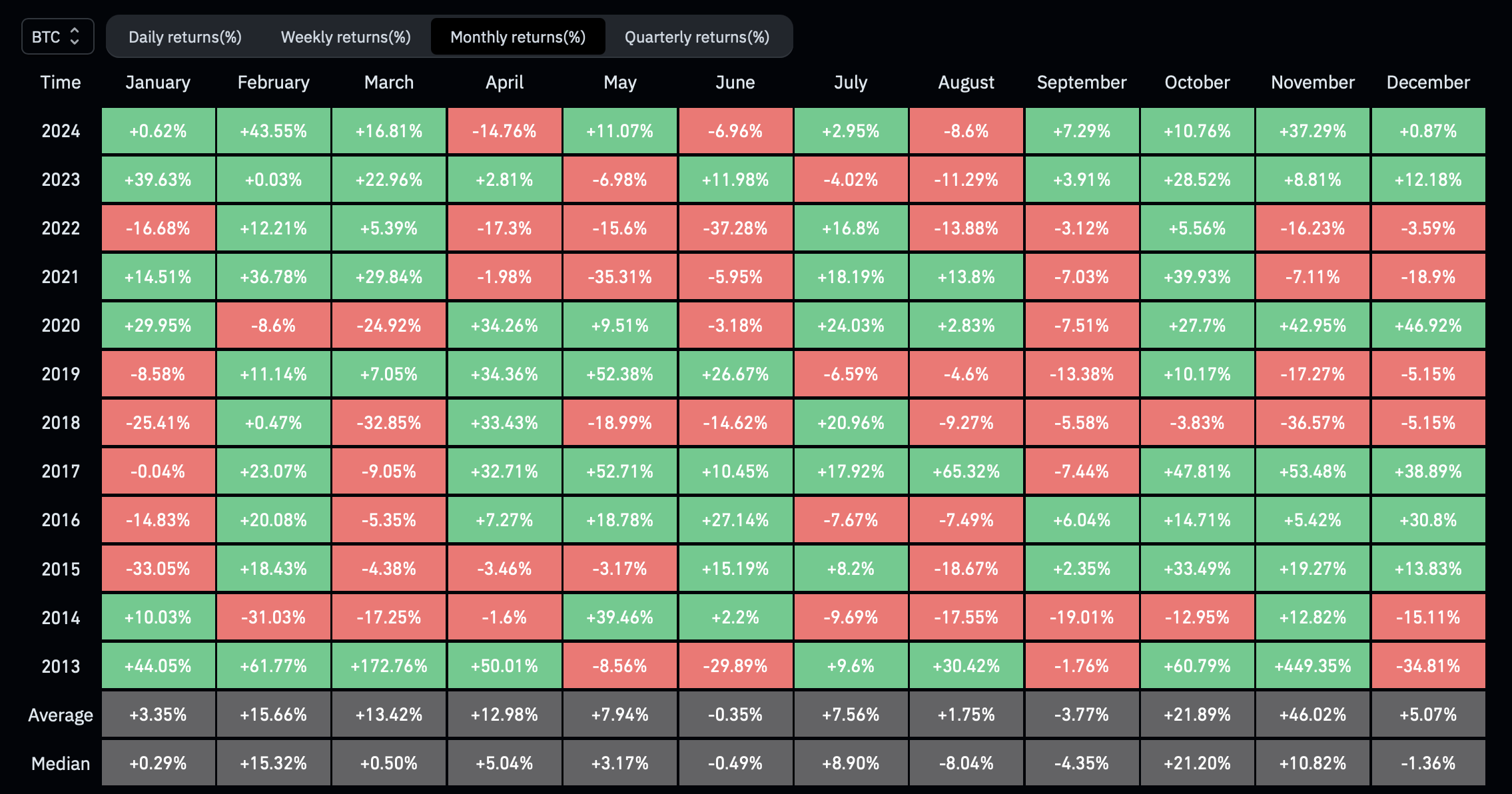
Месячная доходность биткоина. Источник: CoinGlass

Цена биткоина на закрытии ноября достигла отметки $96 400, обновив исторический максимум. Рост составил более 37%, что сделало ноябрь вторым по успешности месяцем 2024 года. И если вы думаете, что это предел, то спешу вас разочаровать — многие эксперты уверены, что текущий рост лишь разминка перед покорением новых вершин.

Ставка на $100 000

Экономист Карл Менгер (Carl Menger) считает текущий рост «только началом» пути биткоина. В подтверждение своих слов он опубликовал график с бычьими сигналами индекса относительной силы (RSI) на месячном таймфрейме.
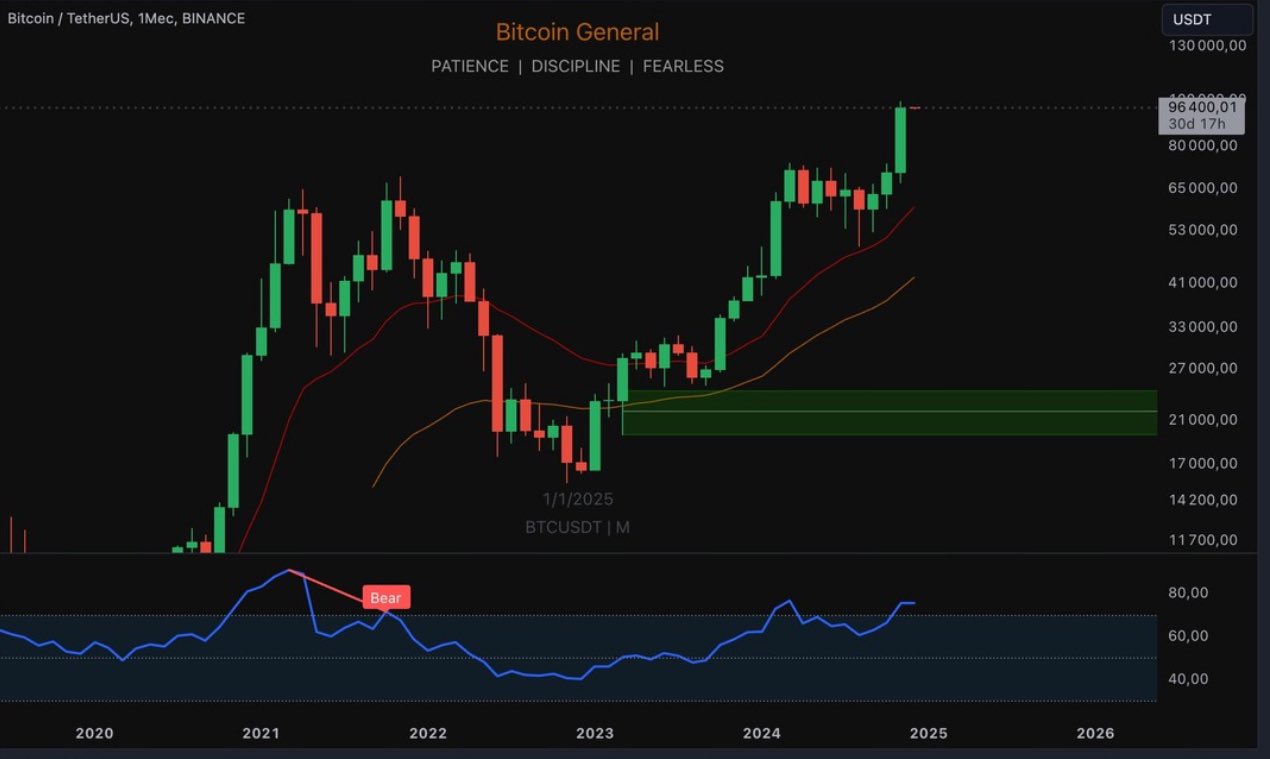
1-месячный график BTC/USD. Аналитика: Карл Менгер

Популярный аналитик Аксель Кибар (Aksel Kibar) также отметил важность пробоя сопротивления на месячном графике. При этом некоторые эксперты, включая самого Кибара, не придают особого значения психологической отметке в $100 000. И в этом есть определенная логика — когда актив демонстрирует такую впечатляющую динамику, любые круглые цифры становятся лишь промежуточными остановками.
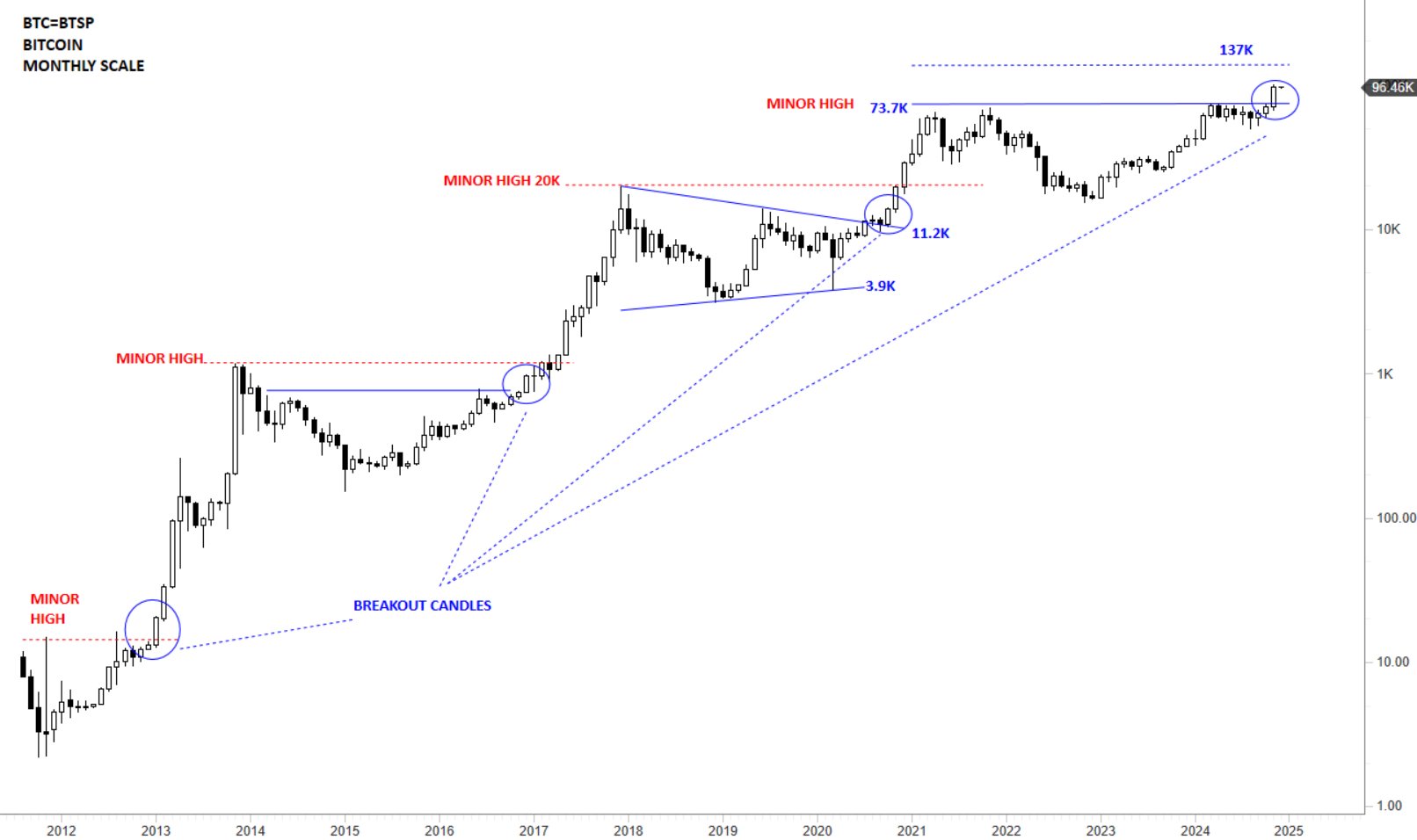
1-месячный график BTC/USD. Аналитика: Аксель Кибар

«То, что мы еще не преодолели мистический уровень $100 000, мы рассматриваем как позитивный сигнал с точки зрения силы и устойчивости текущего роста», — отмечают аналитики Material Indicators в своем последнем анализе биржевой ликвидности. Согласитесь, в этом утверждении есть рациональное зерно — слишком быстрый рост часто заканчивается столь же стремительной коррекцией.

Технический анализ: что дальше?

На момент написания статьи биткоин торгуется около $97 000. Каждое движение графика приковывает внимание тысяч трейдеров по всему миру. Трейдер под ником Skew отмечает, что для нового штурма отметки $100 000 необходимо преодолеть уровень $98 500.
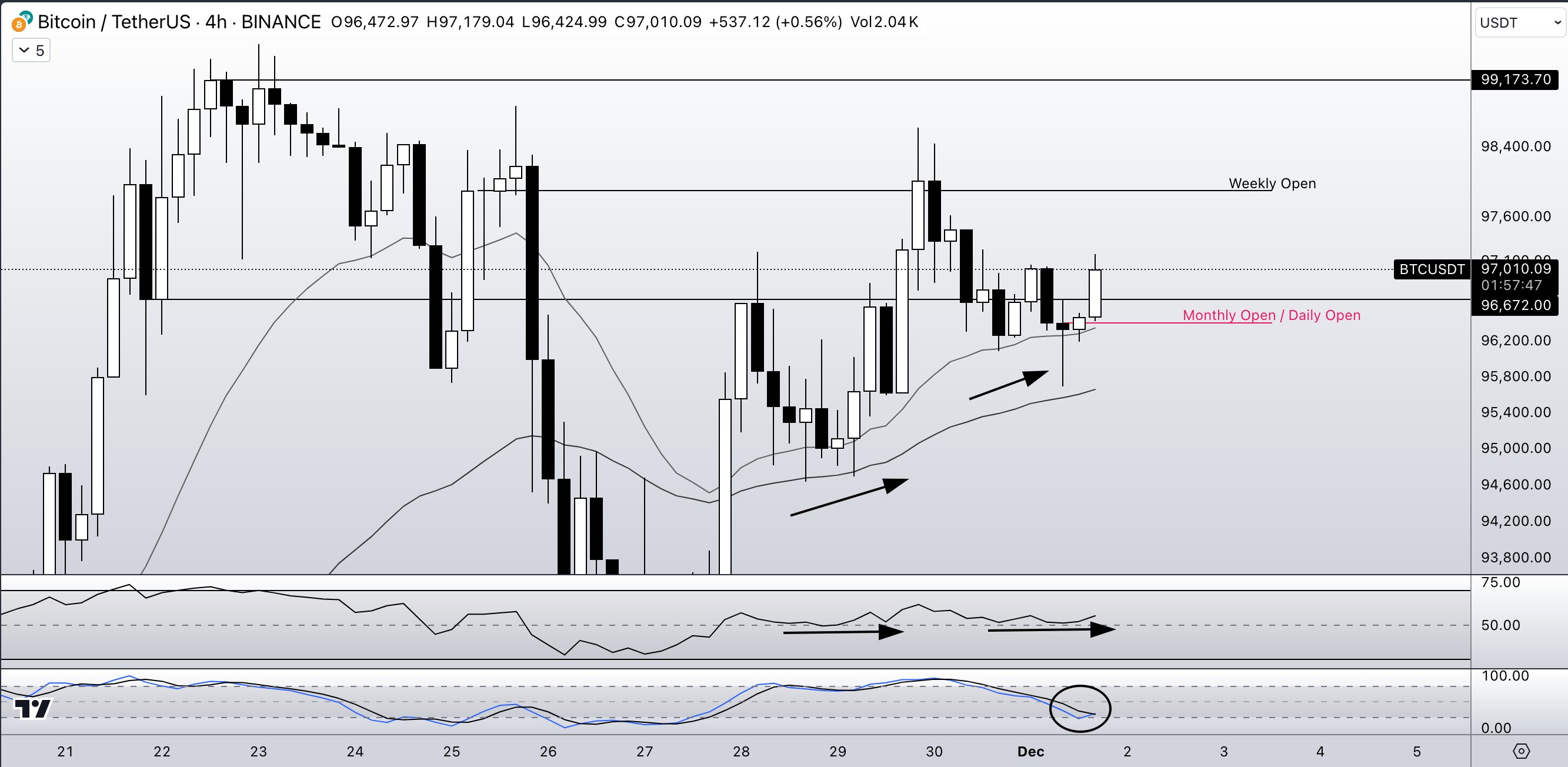
4-часовой график BTC/USD. Аналитика: Skew

«Пока формируется восходящий тренд — более высокие минимумы и устойчивая динамика. После небольшой паузы цена получила новый импульс на месячном открытии», — комментирует он 4-часовой график. Казалось бы, обычные технические термины, но за ними скрывается целая история о том, как рынок набирает силы перед очередным рывком.

Между тем, трейдер Daan Crypto Trades ожидает возвращения волатильности после открытия фьючерсов на Чикагской товарной бирже, отмечая текущее движение цены как «обычную активность выходного дня». Впрочем, в криптовалютах даже «обычная активность» может преподнести сюрпризы — особенно когда речь идет о таких исторических уровнях.
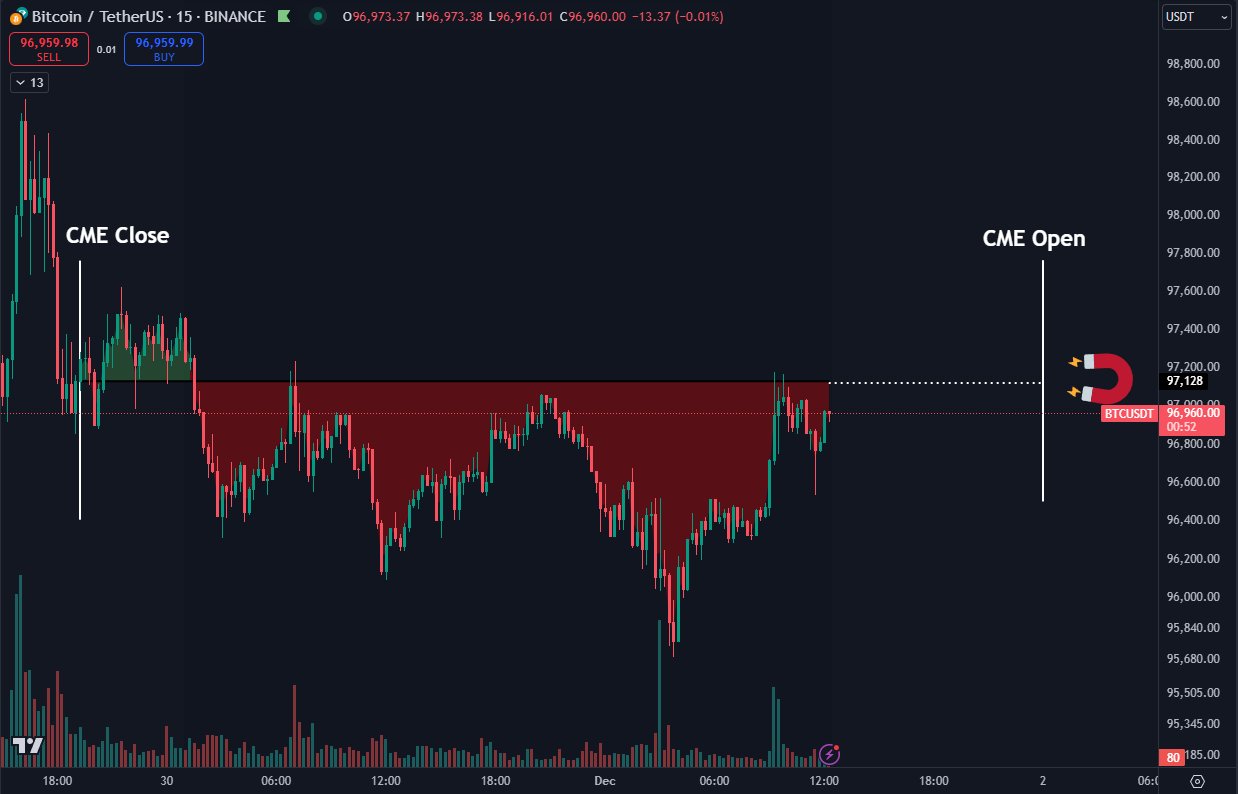
15-минутный график BTC/USD. Аналитика: Daan Crypto Trades

В условиях текущего ралли каждый следующий день может стать поворотным для первой криптовалюты. График демонстрирует устойчивый восходящий тренд, а объемы торгов указывают на серьезные намерения покупателей.

Letture associate

Crypto Payment Cards with $1.5 Billion Monthly Transaction Volume, Stuck in the 1990s

Monthly crypto payment card transaction volume has reached $15 billion, but the industry's development stage is comparable to debit cards in the 1990s, before they became a mainstream financial staple. A key limitation is the lack of established daily financial relationships, such as direct salary deposits and recurring bill payments, with crypto wallets. Despite annualized transaction volumes of approximately $18 billion, the market is concentrated and immature. The leading provider, RedotPay, commands over half the market share. User adoption is heavily skewed towards emerging markets like Bangladesh, India, and Nigeria, where access to USD and stable financial services is limited, rather than developed economies. The sector features four primary business models: 1) Card-issuing infrastructure providers, 2) Exchange-affiliated cards for user retention, 3) Decentralized wallet/DeFi cards with self-custody but high complexity, and 4) Stablecoin-focused digital banks, which dominate transaction volume by offering integrated financial services. The article argues that a pure payment functionality is insufficient for long-term success, mirroring the historical trajectory of traditional debit cards. Future winners will need to: 1) Control the upstream flow of funds, 2) Secure defensible niches in underserved markets, and 3) Most crucially, build core account relationships that integrate into users' daily financial lives. Without this evolution, crypto cards risk remaining niche prepaid tools rather than becoming universal financial infrastructure.

Foresight News6 min fa

Crypto Payment Cards with $1.5 Billion Monthly Transaction Volume, Stuck in the 1990s

Foresight News6 min fa

$7.8 Billion in Theft and Losses Reveals the Truth: Security Costs Have Become an Unavoidable Liquidity Tax for DeFi

"7.8 Billion in Thefts Reveals the Truth: Security Costs Have Become DeFi's Unavoidable 'Liquidity Tax'" A summary of Q2 2026 data reveals that security risks are now a fundamental capital cost in DeFi, directly impacting user returns and liquidity decisions. DeFiLlama recorded 88 hacking incidents with quantified losses totaling $780.3 million in Q2. April was the worst month with $644.8 million lost. DeFi protocol attacks accounted for $735.8 million, while cross-chain bridge exploits resulted in $354.4 million in losses (note: some event categorizations overlap). Cumulatively, DeFi hacks have reached $7.85 billion, with bridge losses at $3.26 billion. The quarter highlighted two primary risk categories: high-value infrastructure vulnerabilities (e.g., bridges, oracles, admin keys) causing massive single losses, and more frequent contract logic bugs. This signals a critical market shift: from post-incident analysis to preemptive pricing of risk. Users and liquidity providers now implicitly factor in the security of the entire asset pathway—not just pool APY—into their decisions. This hidden "risk premium" manifests through wider spreads, higher liquidity incentives, and capital migration towards perceived safer routes. Cross-chain bridge risks, responsible for over $353 million in Q2 losses, exemplify this change. Asset routing credibility is now part of the transaction. Following incidents like KelpDAO and THORChain, markets are demanding safer bridges, asset insurance, and clearer risk disclosure, increasing the cost of capital for riskier pathways. Consequently, security spending is transforming from a defensive cost into a core distribution cost for attracting liquidity. Protocols must invest more in audits, bug bounties, real-time monitoring, and insurance to remain competitive. Users are increasingly demanding transparency about fund flow paths, associated risks, and contingency plans. The key indicators for the industry's direction will be whether capital continues consolidating in trusted channels, if projects delay launches for enhanced audits, if insurance premiums rise, and if aggregators start displaying security risk metrics. Q2 2026 may be remembered not just as a bad period, but as the point when DeFi underwent a fundamental asset risk repricing, where security became a persistent,隐性 tax on all on-chain activity.

Foresight News35 min fa

$7.8 Billion in Theft and Losses Reveals the Truth: Security Costs Have Become an Unavoidable Liquidity Tax for DeFi

Foresight News35 min fa

Breaking News: The "Worker's Edition" Claude 5 Is Here, Everyone Can Use It

BREAKING: Claude Sonnet 5, dubbed "Fennec," is now the default model for all Free and Pro users. This mid-tier model boasts the strongest Agent capabilities in the Sonnet line yet, with performance rivaling the flagship Opus 4.8. It features autonomous planning and can utilize browser and terminal tools—capabilities previously exclusive to costly, large models. Key benchmarks highlight significant gains over its predecessor, Sonnet 4.6, in reasoning, tool use, coding, and knowledge work. Sonnet 5 scores 63.2% on SWE-bench Pro (surpassing GPT-5.5's 58.6%), 80.4% on Terminal-Bench 2.1, and 57.4% on Humanity's Last Exam (just 0.5% behind Opus 4.8). It even slightly outperforms Opus 4.8 in some knowledge tasks. Anthropic positions it as delivering ~90% of Opus's capability at a fraction of the cost. Pricing is aggressive: a limited-time promotional rate of $2 per million input tokens and $10 per million output tokens (reverting to $3/$15 after August 31). This undercuts Opus 4.8 ($5/$25) and GPT-5.5 ($5/$30). However, a new tokenizer may increase token counts by 1.0-1.35x, affecting final costs post-promotion. Notably, Sonnet 5 excels in security, with a mere 0.93% browser injection attack success rate, outperforming Mythos 5 and Opus 4.8. Its prompt injection defense matches Opus 4.8 at 0.19%. Launching amid uncertainty around the region-restricted Fable 5, Sonnet 5 is globally available. It targets the mid-market, offering near-flagship performance at a competitive price, effectively lowering the barrier for multi-Agent development and presenting a compelling alternative for cost-conscious developers.

marsbit51 min fa

Breaking News: The "Worker's Edition" Claude 5 Is Here, Everyone Can Use It

marsbit51 min fa

Trading

Spot
活动图片