Ripple CTO Reveals Why The Payment Business Hasn’t Caught On In A ‘Big Way’

bitcoinistPubblicato 2024-11-14Pubblicato ultima volta 2024-11-14

Introduzione

In an exchange on X (formerly Twitter), Ripple's Chief Technology Officer David Schwartz, also known as “JoelKatz”, addressed criticisms about...

In an exchange on X (formerly Twitter), Ripple’s Chief Technology Officer David Schwartz, also known as “JoelKatz”, addressed criticisms about his company and the XRP Ledger.

Has Ripple Failed With Its Payments Business?

User @188ape challenged Schwartz by questioning the uniqueness of the XRPL in today’s market, stating that it seems like “most new layer 1s can do what the XRPL can do, plus more.” In response, Schwartz emphasized the XRPL’s distinctive features, highlighting that it offers functionalities like stablecoins, non-fungible tokens (NFTs), and a decentralized exchange (DEX) without exposing users to the risks associated with smart contracts.

He stated: “I don’t think there’s any other blockchain that has features like stablecoins, NFTs, a DEX, and so on that doesn’t expose you to the risks of smart contracts where your wallet has no way to know what the things you agree to are actually doing.”

The conversation intensified when another user, @dr_wonder589 (Dr. Wonder Bread), remarked that despite these features, they don’t seem to translate into market value. “Over-engineering something doesn’t mean it’s valuable to the market,” he noted.

Addressing this skepticism, Schwartz expressed surprise at the slow adoption of the payments business by Ripple. We focused very heavily on payments in the early design stages. Using cryptocurrencies or blockchains for payments hasn’t really caught on in a big way anywhere yet. I find that quite surprising,” he admitted.

When pressed further about the reasons behind this lack of widespread adoption, Schwartz cited several factors. He mentioned regulatory uncertainty and the difficulty of providing a good user experience as significant hurdles. According to him, users with access to traditional financial services prefer to use their banks, while those without such access lack the discretionary funds to experiment with new technologies.

“Users with good access to financial services would rather just use their banks. Users without good access to financial services don’t have a bunch of ‘fooling around’ money they can tolerate not having good access to and need to be able to easily pay bills with their money. Two-sided market problems and difficulty forming closed loops. One-sided flows that are inefficient because you can’t net out external flows. And so on,” Schwartz elaborated.

The dialogue took a critical turn when Dr. Wonder Bread suggested that Ripple’s challenges serve as a convenient excuse for its stagnation while it continues to fund itself through XRP sales. He insinuated that this might be a tactic to indirectly influence the price of XRP and maintain its stability.

In defense, Schwartz reiterated Ripple’s transparent strategy since 2014. “Ripple very publicly chose to focus on payments in 2014 and was completely open about our strategy and why we chose it. I don’t think anyone in the space was more successful at it than we were,” he stated.

Unsatisfied, @188ape pressed Schwartz for concrete examples of a XRP success. “Where is the success, David? Give us an example of XRP being a success story… I’ll wait,” he demanded. As of the time of writing, Schwartz has not publicly responded to this query.

Another user, @hesu_krypto, observed that Schwartz was referring to Ripple, not XRP specifically. However, @188ape countered by suggesting that the community was led to believe otherwise. Echoing this sentiment, Dr. Wonder Bread accused Ripple of manipulating the market through indirect means, implying that this could be considered securities fraud.

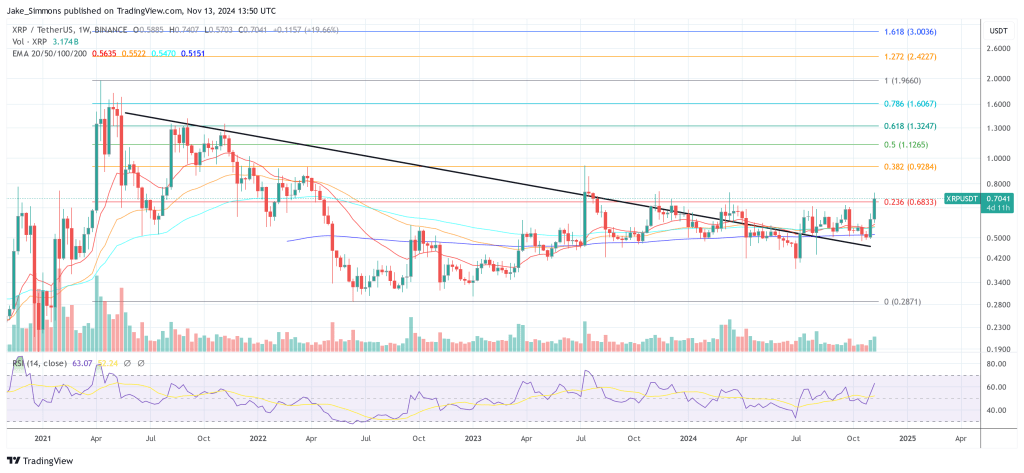
At press time, XRP traded at $0.70.
XRP price
XRP rises above the 0.236 Fib, 1-week chart | Source: XRPUSDT on TradingView.com
Featured image from YouTube, chart from TradingView.com
Jake Simmons

Jake Simmons

Jake Simmons has been a Bitcoin enthusiast since 2016. Ever since he heard about Bitcoin, he has been studying the topic every day and trying to share his knowledge with others. His goal is to contribute to Bitcoin's financial revolution, which will replace the fiat money system. Besides BTC and crypto, Jake studied Business Informatics at a university. After graduation in 2017, he has been working in the blockchain and crypto sector. You can follow Jake on Twitter at @realJakeSimmons.

Letture associate

When Hyperliquid Steals Solana's 'Internet Capital Market' Script

The article "When Hyperliquid Steals Solana's 'Internet Capital Markets' Playbook" discusses Solana's struggles to maintain its "internet capital markets" narrative by 2026. Despite its initial success as a high-performance "Ethereum killer," SOL's price has underperformed, dropping significantly compared to other major cryptocurrencies. Solana's vision of a global, on-chain trading network for all assets is being challenged not primarily by Ethereum, but by Hyperliquid. Hyperliquid, evolving from a perpetual contracts platform into a dedicated financial infrastructure Layer 1, has become a major beneficiary of the shift of derivatives trading from centralized exchanges to on-chain. The article argues that for high-frequency financial trading, a specialized, performance-focused chain like Hyperliquid may be more suitable than a general-purpose ecosystem like Solana. Further compounding Solana's issues was a major $200+ million exploit on its key perpetual protocol, Drift, in April, which damaged market confidence. In response, Solana founder Anatoly Yakovenko heavily promoted the protocol Phoenix as a replacement, boosting its visibility but not its trading volume, which remains far behind leading platforms. Solana supporters have launched a public critique of Hyperliquid's decentralization, pointing to its limited validators and closed-source code. Critics, however, note Solana's own declining validator count and centralization metrics. This strategy has also caused internal friction, with developers of other Solana protocols expressing discontent over the foundation's perceived favoritism towards Phoenix. The conclusion is that Hyperliquid's rise represents a challenge to the "general-purpose blockchain" narrative, proving that the core of a capital market might be a specialized trading engine rather than a broad ecosystem. If Solana cannot regain dominance in derivatives, it risks remaining a "meme coin paradise" while its grand "internet capital markets" ambition slips away.

marsbit1 h fa

When Hyperliquid Steals Solana's 'Internet Capital Market' Script

marsbit1 h fa

When Hyperliquid Steals Solana's 'Internet Capital Markets' Playbook

The article discusses how Solana's grand vision of becoming an "Internet Capital Markets" platform is facing significant challenges in 2026, primarily from the unexpected rise of Hyperliquid. Solana's performance has weakened, with its token SOL experiencing the largest price decline among major cryptocurrencies. Its core narrative of building a global, chain-based marketplace for all assets is under pressure both internally and externally. Hyperliquid, originally a perpetual futures exchange, has evolved into a dedicated Layer 1 financial infrastructure network. Its focused, trading-centric approach is attracting capital and challenging the assumption that a "general-purpose" ecosystem like Solana is necessary for a capital market. Hyperliquid's success suggests that for high-frequency trading, superior performance, liquidity, and user experience may be more critical than a broad application ecosystem. Internally, Solana's strategy suffered a blow from a major hack on the Drift Protocol in April, resulting in over $200 million in losses. In response, Solana founder Anatoly Yakovenko has heavily promoted Phoenix as a new decentralized perpetual futures platform on Solana. While this boosted Phoenix's visibility, its trading volume remains far behind leading platforms. Solana's community has launched a rhetorical attack against Hyperliquid, questioning its decentralization due to its limited validator set and closed-source code. Critics, however, point out Solana's own decreasing validator count and increasing centralization of stake. This focus on "decentralization metrics" has also caused internal friction, with other Solana ecosystem developers expressing discontent over the foundation's perceived favoritism towards Phoenix. The article concludes that the rise of Hyperliquid represents a challenge to the "general-purpose blockchain" narrative, proving that an efficient trading engine might be more central to a capital market than a vast ecosystem. If Solana cannot regain dominance in the derivatives space, it risks remaining a "meme coin paradise" rather than achieving its ambition of hosting global assets.

链捕手1 h fa

When Hyperliquid Steals Solana's 'Internet Capital Markets' Playbook

链捕手1 h fa

Trading

Spot
Futures

Articoli Popolari

Come comprare T

Benvenuto in HTX.com! Abbiamo reso l'acquisto di Threshold Network Token (T) semplice e conveniente. Segui la nostra guida passo passo per intraprendere il tuo viaggio nel mondo delle criptovalute.Step 1: Crea il tuo Account HTXUsa la tua email o numero di telefono per registrarti il tuo account gratuito su HTX. Vivi un'esperienza facile e sblocca tutte le funzionalità,Crea il mio accountStep 2: Vai in Acquista crypto e seleziona il tuo metodo di pagamentoCarta di credito/debito: utilizza la tua Visa o Mastercard per acquistare immediatamente Threshold Network TokenT.Bilancio: Usa i fondi dal bilancio del tuo account HTX per fare trading senza problemi.Terze parti: abbiamo aggiunto metodi di pagamento molto utilizzati come Google Pay e Apple Pay per maggiore comodità.P2P: Fai trading direttamente con altri utenti HTX.Over-the-Counter (OTC): Offriamo servizi su misura e tassi di cambio competitivi per i trader.Step 3: Conserva Threshold Network Token (T)Dopo aver acquistato Threshold Network Token (T), conserva nel tuo account HTX. In alternativa, puoi inviare tramite trasferimento blockchain o scambiare per altre criptovalute.Step 4: Scambia Threshold Network Token (T)Scambia facilmente Threshold Network Token (T) nel mercato spot di HTX. Accedi al tuo account, seleziona la tua coppia di trading, esegui le tue operazioni e monitora in tempo reale. Offriamo un'esperienza user-friendly sia per chi ha appena iniziato che per i trader più esperti.

374 Totale visualizzazioniPubblicato il 2024.12.10Aggiornato il 2025.03.21

Come comprare T

Discussioni

Benvenuto nella Community HTX. Qui puoi rimanere informato sugli ultimi sviluppi della piattaforma e accedere ad approfondimenti esperti sul mercato. Le opinioni degli utenti sul prezzo di T T sono presentate come di seguito.

活动图片