Ripple Rumored To Consider Dirham-Backed Stablecoin In UAE

bitcoinistPubblicato 2024-11-08Pubblicato ultima volta 2024-11-09

Introduzione

Ripple Labs could be exploring the launch of a dirham-backed stablecoin in the United Arab Emirates (UAE), expanding beyond its...

Ripple Labs could be exploring the launch of a dirham-backed stablecoin in the United Arab Emirates (UAE), expanding beyond its existing US-dollar-backed stablecoin, RLUSD. This speculation arises following Ripple’s newest blog post dated November 7, 2024, titled “UAE Stablecoin Regulation: A Blueprint for Financial Innovation.” The post hints at significant interest by Ripple in a dirham-backed stablecoin.

Will Ripple Launch A Dirham-Stablecoin?

The blog post outlines the UAE Central Bank’s (CBUAE) newly introduced regulatory framework designed to integrate both dirham-backed and non-AED stablecoins into the nation’s financial systems. “New regulations from the Central Bank of the United Arab Emirates (CBUAE) designed to integrate dirham-backed stablecoins as well as non-AED backed stablecoins into its financial systems are emblematic of this shift,” the Ripple team states.

The CBUAE’s framework aims to bolster the UAE’s standing as a global leader in digital asset regulation by providing clear guidelines that facilitate the issuance and use of AED-backed stablecoins for payments, while allowing non-dirham stablecoins to be registered for virtual asset transactions. “By embracing stablecoins, the UAE is laying the groundwork for safer, more efficient financial systems,” the Ripple blog emphasizes.

Ripple’s involvement in the region is well-established. The National Bank of Abu Dhabi became the first Middle Eastern bank to utilize Ripple Payments for secure and cost-effective remittance solutions, handling nearly $80 million in outbound remittances in 2022. Furthermore, XRP received approval from the Dubai Financial Services Authority (DFSA) for use within the Dubai International Financial Centre (DIFC) late last year.

The potential introduction of a dirham-backed stablecoin by Ripple aligns with the CBUAE’s objectives to promote a regulated stablecoin environment that mitigates the volatility inherent in cryptocurrencies and enhances investor protection. “The CBUAE’s aim is to proactively promote a well-regulated stablecoin ecosystem, specifically dirham-backed stablecoins, to offset more volatile cryptocurrencies and better protect investors,” the blog elaborates.

Notably, Tether has also signaled interest in the UAE stablecoin market, announcing plans to launch a UAE stablecoin pegged to the dirham as an alternative to the US dollar. The region has rapidly become the sixth largest crypto economy globally, processing nearly $400 billion in on-chain value between July 2022 and June 2023, according to Ripple.

The UAE’s comprehensive regulatory approach contrasts with other global frameworks, such as the United States’ proposed Clarity of Payment Stablecoins Act and the European Union’s MiCA regulations. Unlike these, the UAE’s framework permits unlimited use of dirham-backed stablecoins for payments while restricting non-dirham stablecoins to virtual asset transactions without imposing transaction caps. “This measured approach would also manage risks around liquidity, market volatility, compliance and operational challenges,” the blog notes.

“With a tech-forward citizenry and a government eager to foster innovation, the UAE is fertile ground for the integration of digital banking and blockchain into its financial sector,” the Ripple team concludes, adding that “stablecoins are now set to play a crucial role in the country’s economic diversification alongside its broader plans to launch a Central Bank Digital Currency (CBDC).

At press time, XRP traded at $0.55.
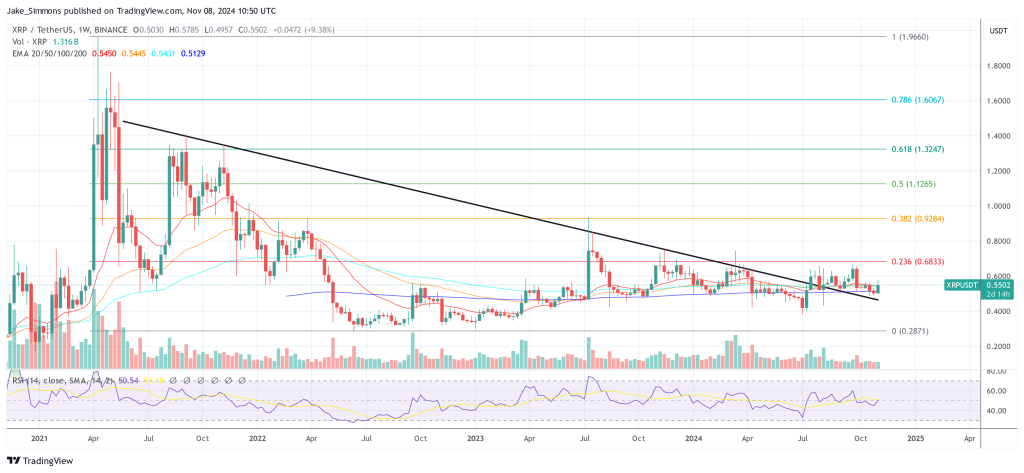
XRP price
XRP price, 1-week chart | Source: XRPUSDT on TradingView.com
Featured image created with DALL.E, chart from TradingView.com
Jake Simmons

Jake Simmons

Jake Simmons has been a Bitcoin enthusiast since 2016. Ever since he heard about Bitcoin, he has been studying the topic every day and trying to share his knowledge with others. His goal is to contribute to Bitcoin's financial revolution, which will replace the fiat money system. Besides BTC and crypto, Jake studied Business Informatics at a university. After graduation in 2017, he has been working in the blockchain and crypto sector. You can follow Jake on Twitter at @realJakeSimmons.

Letture associate

The AI-Era Power Arms Race: Energy Order Reshuffle Behind NextEra's Acquisition of Dominion

The AI arms race is shifting from a focus on chips and models to a fundamental battle over electricity. NextEra Energy's proposed $66.8 billion acquisition of Dominion Energy highlights this profound change, as AI's explosive growth is rewriting the growth logic for the power sector. The deal is less about traditional utility consolidation and more about securing a strategic gateway to Virginia’s "Data Center Alley," a critical hub where tech giants have massive, signed load requirements. The core challenge is a growing disconnect: data center construction cycles are far shorter than the years needed to build new power generation and transmission infrastructure. Morgan Stanley predicts a 49GW gap in power availability for U.S. data centers by 2028. Electricity, once a taken-for-granted commodity, is now a scarce and strategic resource. This transforms the competitive landscape—future AI competitiveness may hinge not just on algorithms but on a company's ability to secure long-term, stable, and affordable power supply. The transaction signals a broader revaluation of the entire energy infrastructure chain, from natural gas and nuclear power for base load to storage and transmission equipment. However, the largest variable is regulation. Balancing rapid AI-driven grid expansion with public concerns over costs, fairness, and environmental impact will be a complex political and social challenge. The true value in the coming AI era may lie not just in power generation assets, but in owning the crucial infrastructure nodes, grid access rights, and the regulatory relationships needed to deliver electricity where it's needed most.

marsbit2 min fa

The AI-Era Power Arms Race: Energy Order Reshuffle Behind NextEra's Acquisition of Dominion

marsbit2 min fa

VISA Steps Up Stablecoin Settlement Efforts, The Path for Crypto Payments Becomes Increasingly Clear

VISA continues to expand its global pilot for stablecoin settlement, adding support for five more blockchain networks (Arc, Base, Canton, Polygon, Tempo) to bring the total to nine. More significantly, the program's annualized settlement volume has grown 50% quarter-over-quarter to $7 billion. This move highlights a key shift: stablecoins are increasingly being integrated not as a front-end consumer novelty but as a foundational infrastructure for back-end settlement between issuers, acquirers, and the payment network itself. Against a backdrop where many Web3 narratives have lost momentum, crypto payments stand out due to their tangible utility. The core value proposition is clear: enabling faster, cheaper, and more accessible value transfer, especially for cross-border business, payroll, and B2B transactions. Stablecoins like USDC and USDT have evolved into a de facto on-chain dollar network, creating sustained demand for related payment, exchange, and compliance services. While major players like VISA are building the underlying networks, opportunities remain for specialized service providers in areas like cross-border payments for e-commerce, payroll for Web3 companies, or fiat on/off-ramps for exchanges. However, this growing legitimacy also raises the regulatory bar. Touching monetary flows inevitably attracts scrutiny regarding licensing, KYC/AML, and the precise classification of activities (e.g., custody, money transmission). Success in this increasingly defined sector will depend not just on technical execution but on building compliant business structures from the outset.

marsbit3 min fa

VISA Steps Up Stablecoin Settlement Efforts, The Path for Crypto Payments Becomes Increasingly Clear

marsbit3 min fa

The World Cup is Approaching: Sports Entering the Era of 'Fragmented Finance'

With the approaching World Cup, sports are entering an era of "fragmented finance." This shift is exemplified by FIFA's new rule requiring debutant players to wear a special "World Cup debut patch." Post-tournament, these patches will be authenticated, cut, and embedded into collectible cards, potentially transforming into high-value assets. The global sports trading card market, valued at over $11.5 billion, represents a sophisticated alternative asset class with deep secondary markets and distinct bull/bear cycles. While football has a massive fanbase, its card market has historically lacked the liquidity and unified narrative of the NBA's system. The NBA's success stems from its centralized, star-driven storytelling—from draft nights to championships—which perfectly fuels financialization. The World Cup patch initiative is FIFA's attempt to create similar "financial raw material" for football. The NBA card market, evolving over 70 years, has matured into a financial ecosystem. After a 1990s crash due to overproduction, the industry rebounded by embracing scarcity: limited editions, autographs, game-worn memorabilia (patches), and serial numbering. Today, it features professional grading (e.g., PSA, BGS), auction platforms, live "break" streams, and dedicated marketplaces, mirroring aspects of cryptocurrency markets with their volatility, speculation, and community-driven trading. The core driver is narrative. A card's value is tied to a specific historic moment or player potential—like Stephen Curry's 1/1 card commemorating his Olympic game-winning shot selling for $518,500. This trade in "ownership of history" or "future greatness" parallels prediction markets, both monetizing collective emotion. Unlike many NFT projects that struggle to generate sustained narratives, sports are a perpetual emotion-generating machine. Leagues like the NBA and UFC constantly produce real-world drama—rivalries, comebacks, and triumphs—that fuels ongoing interest and investment. For younger audiences consuming sports via highlights and social media clips, trading cards become a direct financial instrument for engaging with these narratives. Thus, traditional sports leagues are leading the charge in assetization, leveraging their unique advantages: real events, global fan consensus, and endless storytelling. They are becoming platforms for issuing financial assets, turning fragments of history—a patch, a signature, a moment—into tradable commodities.

Odaily星球日报57 min fa

The World Cup is Approaching: Sports Entering the Era of 'Fragmented Finance'

Odaily星球日报57 min fa

Trading

Spot
Futures
活动图片