Toncoin подешевел: пора ли покупать TON на падении

cryptonews.ruPubblicato 2022-07-01Pubblicato ultima volta 2024-11-01

За последний месяц TON подешевел на 11%. Разбираемся, стоит ли воспользоваться этим падением и инвестировать в Toncoin

Ончейн-данные предполагают, что недавнее падение цены Toncoin может сигнализировать о недооцененности актива. Это представляет собой потенциальную выгодную возможность для желающих купить его на падении. Однако следует разобраться, действительно ли сейчас — подходящее время для инвестиций в TON.

Toncoin подает сигнал к покупке, но есть нюанс

Соотношение рыночной и реализованной стоимости Toncoin (MVRV) — это ключевой для оценки прибыльности показатель. Он показывает, что альткоин был недооценен в последние недели.

В настоящее время 30-дневное и 90-дневное значения MVRV составляют -6,49% и -12,63% соответственно. Отрицательное значение говорит о том, что текущая рыночная цена TON ниже средней цены покупки за последние 30 и 90 дней. Если инвесторы из этой категории решат продать его по текущей рыночной цене, они понесут убытки.

Между тем исторически отрицательное значение MVRV часто рассматривается как сигнал к выгодной покупке. Трейдеры получают возможность купить недооцененный актив по низкой цене и продать по более высокой.
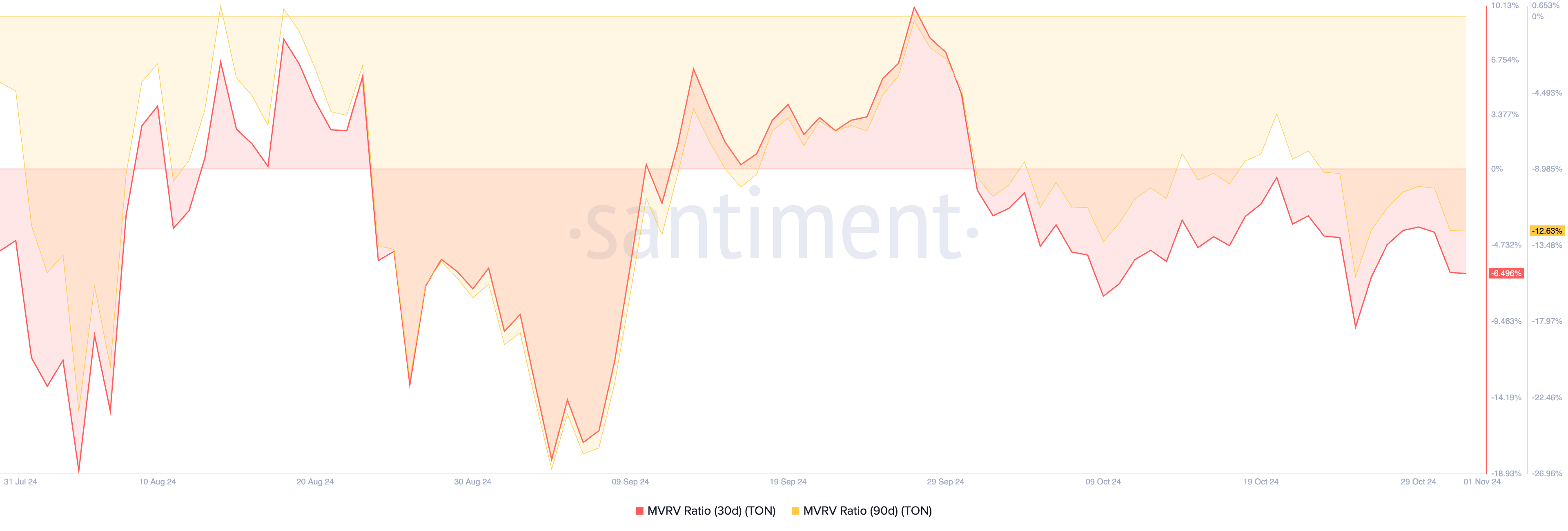
Соотношение MVRV. Источник: Santiment

Впрочем, Toncoin подвержен риску дальнейшего падения из-за преобладающего медвежьего настроения. Это подтверждается текущей ставкой финансирования Toncoin. Она составляет -0,019%.

Этот механизм обеспечивает баланс между длинными и короткими позициями на рынке бессрочных фьючерсных контрактов. Положительные значения указывают на доминирование длинных позиций и означают, что цена контракта превышает спотовую цену. Это значит, что больше трейдеров покупают монету с расчетом продажи по более высокой цене. Между тем отрицательная ставка указывает на то, что большинство трейдеров ожидает снижения цены.

Читайте также: Toncoin (TON) может обогнать Ethereum по числу пользователей к концу года
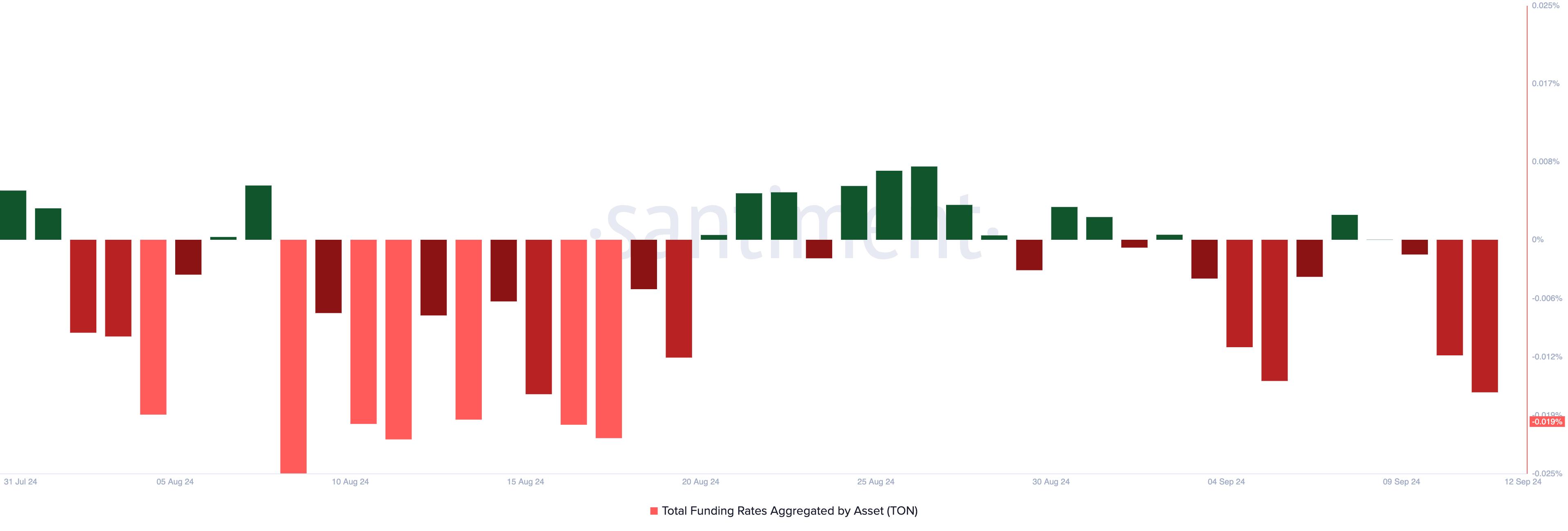
Ставка финансирования TON. Источник: Santiment

Прогноз TON: цене нужна поддержка быков

В результате падения цена упала ниже 20-дневной экспоненциальной скользящей средней (EMA). Этот индикатор отражает среднюю цену за последние 20 дней.

20-дневная EMA обычно служит уровнем поддержки во время восходящего тренда. Если актив опускается ниже этого уровня, это может означать, что восходящий тренд теряет силу. Также это может свидетельствовать о смене бычьего настроя на медвежий, предупреждая трейдеров о возможном дальнейшем снижении цены.
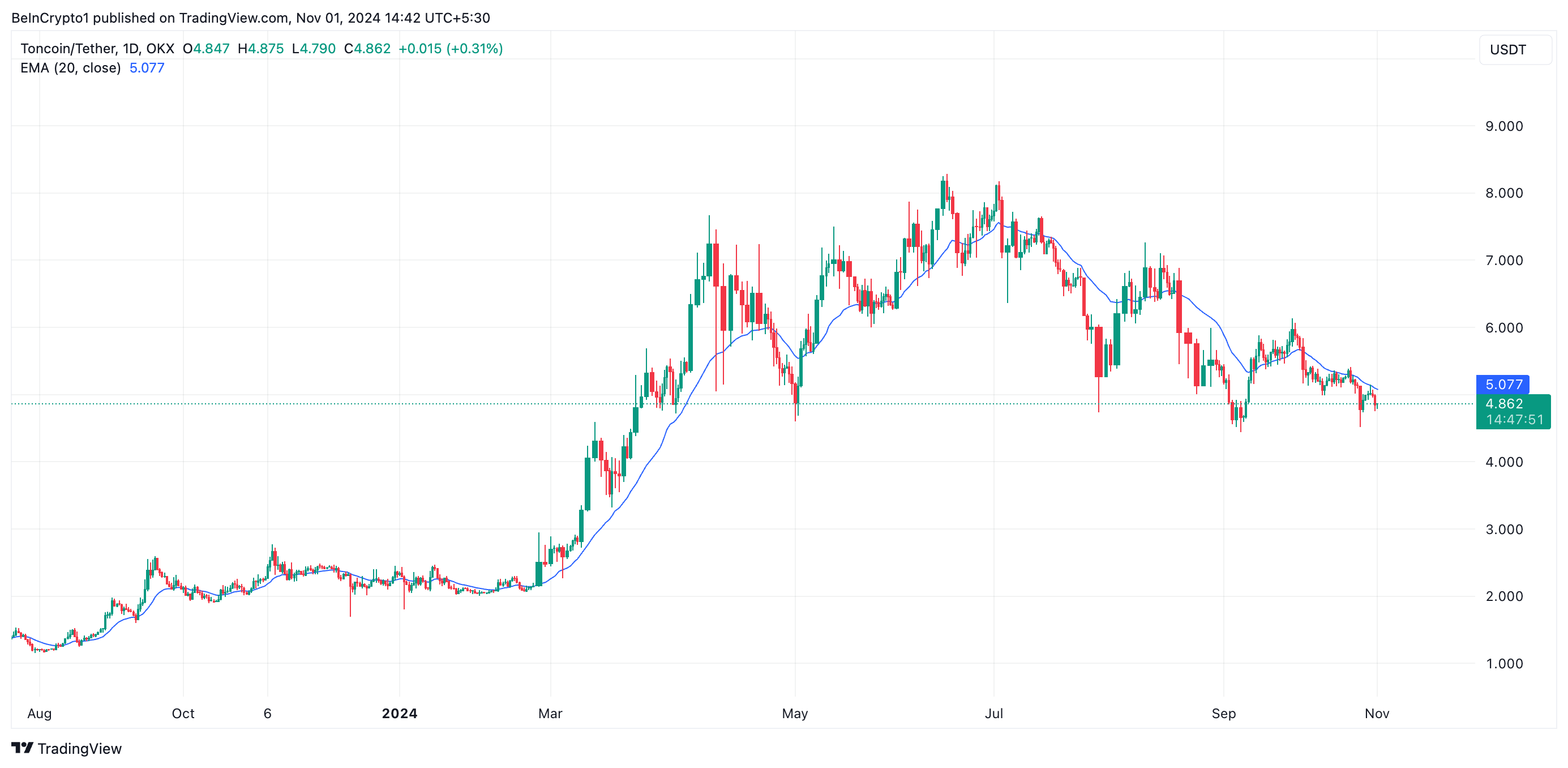
20-дневная EMA. Источник: TradingView

Сейчас Toncoin торгуется немного ниже сопротивления на $5,19. В условиях усиления продаж альткоин может опуститься до $4,47, где расположена основная поддержка. Если этот уровень не устоит, TON рискует достигнуть многомесячного минимума $3,44.
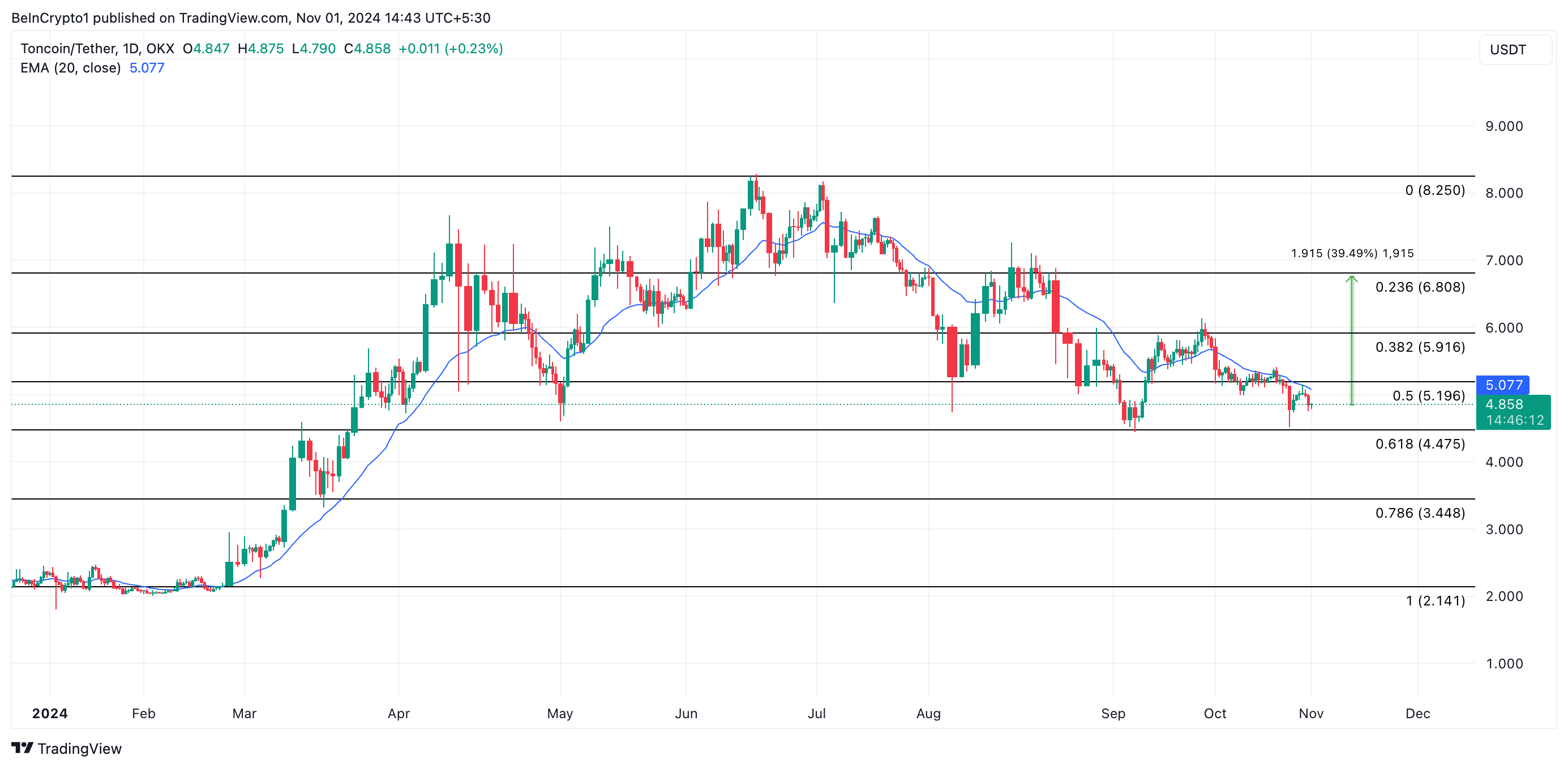
Анализ цены Toncoin. Источник: TradingView

Однако если настроение на рынке станет более оптимистичным и спрос на Toncoin усилится, токен попробует преодолеть сопротивление на $5,19. В случае успешного прорыва цена может вырасти до $6,80, на 39% от текущего уровня.


Letture associate

A Threefold Performance Leap! NEAR Achieves 200ms Physical Block Time Limit with SPICE

NEAR's core development team, Near One, has announced its next major protocol evolution: SPICE (Separation of Consensus and Execution). Currently in development, SPICE represents the most significant upgrade before the full implementation of Nightshade 3.0. Its core innovation is decoupling the consensus layer, responsible for ordering transactions, from the execution layer, which processes them. This allows the consensus layer to run at full speed without waiting for transaction execution to complete. Once deployed, SPICE is projected to triple NEAR's block production speed, achieving a 200ms block time, which is considered the physical limit due to the speed of light and network latency. This leap will dramatically reduce transaction latency and finality, with transactions confirming in roughly 0.4 seconds—faster than a typical card payment. The upgrade also enables more complex, long-running transactions and significantly improves user experience for applications like NEAR Intents and near.com. Beyond raw speed, SPICE enhances network scalability and security. It enables deeper parallelism, efficiently distributing workload across shards and improving resource utilization. The simpler block structure and lighter contracts also facilitate formal verification and security auditing. Furthermore, SPICE lays the critical groundwork for future Nightshade 3.0 features, most notably atomic cross-shard transactions, which would simplify complex contract logic and eliminate development hurdles caused by asynchronous execution. The Near One team is actively developing SPICE, targeting deployment in the coming months.

Foresight News56 min fa

A Threefold Performance Leap! NEAR Achieves 200ms Physical Block Time Limit with SPICE

Foresight News56 min fa

Deep Insight: Decentralized Inference is Not Hype, but a Key Track for AI to Break Through Centralized Monopoly

Decentralized Reasoning: Beyond the Hype, a Key to Breaking AI's Centralized Monopoly A future scenario where a powerful AI model is banned by a major government illustrates the core value proposition of decentralized AI: resistance to censorship. The core bet of decentralized inference networks is mitigating this risk, with other benefits like cost being secondary. The path is extremely difficult, involving four key challenges: 1. **Running Massive Models:** Distributing a single model across a decentralized GPU swarm requires sophisticated techniques like pipeline and speculative decoding to overcome crippling network latency, aiming for usable speeds (e.g., 30-40 tokens/second). 2. **Proving Model Integrity:** Verifying that a node runs the correct model is critical. Solutions range from cryptographically secure but slow ZKML to faster, economically-secure methods like statistical fingerprints, deterministic re-execution, or live-weight proofs, each involving trade-offs between integrity, latency, and cost. 3. **Ensuring Prompt Privacy:** Simply sharding a model does not protect user inputs from nodes. Robust solutions currently require trusted hardware (TEEs) or advanced cryptography (FHE), which are not yet widely deployed in consumer swarms. 4. **Building a Real Market:** Identifying the ideal customer is tough. Beyond speculative AI agents, the viable market currently consists of startups embedding AI and projects needing batch processing (e.g., synthetic data generation), where decentralized aggregation can be an advantage over low-latency needs. The article analyzes several projects tackling these problems, such as Dolphin Network (live-weight proofs), Inference.net (statistical verification), Morpheus (TEE-based), and Darkbloom (Apple Secure Enclave). It provides a framework: decentralization is a "tax" for latency-sensitive applications (e.g., chat) but a potential supply-side advantage for throughput-oriented tasks (e.g., batch processing). The long-term vision is a closed data loop where decentralized inference generates valuable data (traces, preferences) to feed decentralized training networks, which in turn produce better open-weight models for the inference networks. A due diligence checklist advises focusing on projects that: are truly decentralized at specific layers; have a credible integrity method; offer real cost benefits; ensure genuine privacy; handle node reliability; have paying users; and are built by teams with deep AI expertise. The ultimate goal should be products that appeal beyond the crypto-native audience, using crypto mechanisms invisibly to deliver better cost, performance, or privacy.

Foresight News1 h fa

Deep Insight: Decentralized Inference is Not Hype, but a Key Track for AI to Break Through Centralized Monopoly

Foresight News1 h fa

Trading

Spot
Futures
活动图片