Криптогиппопотам и проблемный «хомяк»: обзор мемов

cryptonews.ruPubblicato 2022-12-28Pubblicato ultima volta 2024-09-28

Конец недели — отличный момент, чтобы вспомнить, что поднимало настроение участникам рынка в течение этой рабочей пятидневки

Собрали для вас в одном обзоре самые забавные мемы, над которыми смеялись криптаны.

На этой неделе биткоин наконец-то вернулся к уровням выше $65 000. Для многих криптанов, которые уже потеряли веру в светлое будущее, рост рынка оказался приятным потрясением.

Криптаны шутят, что на волне роста рынка многие персонажи выходят из темноты.

«Мои бывшие, когда услышали, что биткоин снова вырос».

Многие считают, что в росте биткоина в конце сентября нет ничего удивительного, ведь крипта традиционно растет в четвертом квартале года.

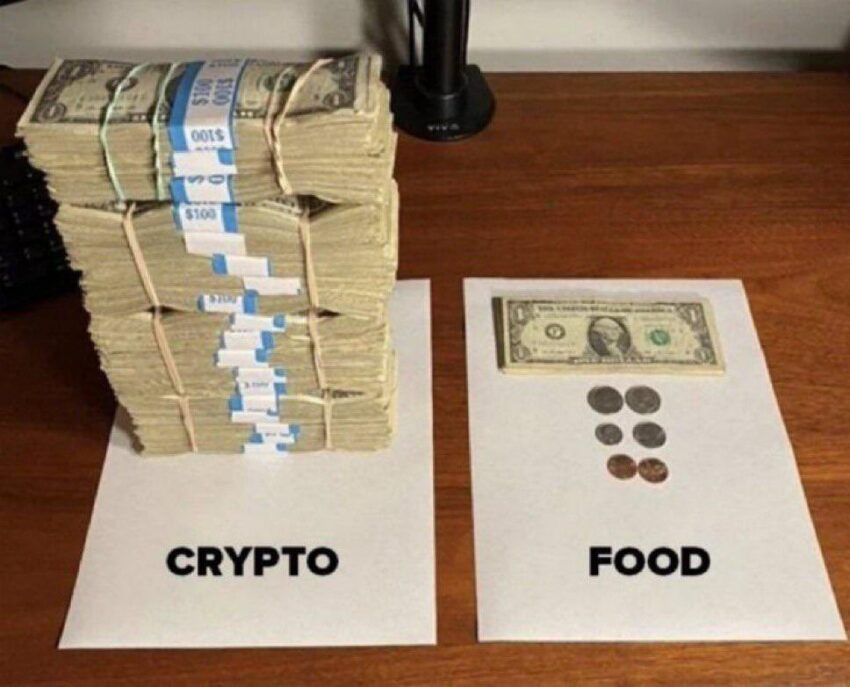
Поэтому криптаны начали распечатывать свои заначки, чтобы запастись монетами перед предполагаемым ростом.

«На крипту. На еду».
Еще на этой неделе в центре внимания оказался маленький гиппопотам Му Денг, который родился в одном из тайских зоопарков. В его честь запустили мемкоин Moo Deng. Монета быстро оказалась в центре внимания. Криптаны шутят, что если бы не Му Денг, то никакого роста рынка не было бы.

Не обошлось без шуток про любителей похайповать:

«Теперь я верю в крипту.
– Будь честна.
Да я и так честна.
– Ты читала whitepaper биткоина?
Мне нравятся малыши гиппопотамов.
– Понятно. Спасибо.»

Нашлись и те, кого рост не особо впечатлил.

«Криптоинвестор ждет, когда там биткоин уже дойдет до $100 000».

Некоторые участники криптосообщества жалуются, что волну роста поймали далеко не все проекты. Поэтому пока что у них не так много поводов для радости.

«Рынок: начал расти.
Тем временем тот самый мемкоин, на который ты поставил последние сбережения».

Также криптаны не упустили возможность подшутить над аирдропом нашумевешей Телеграм-игры Hamster Kombat. Многие считают, что распределение токенов было несправедливым.

Любите мемы так же, как их любим мы? Тогда ловите «добавку» — обзор за прошлую неделю.


Letture associate

South Korean Institutions' Crypto Race: Dual Explosion of Stablecoins and RWA

**Summary: South Korea's Institutional Crypto Race: Stablecoins and RWA Take Off** South Korea is undergoing a structural shift in its crypto ecosystem, moving beyond its historical role as a major retail trading hub. Major financial institutions and internet platforms are now building institutional-grade blockchain infrastructure, with stablecoins and Real-World Asset (RWA) tokenization as the primary drivers. The push for a regulated Korean won stablecoin market is a major policy and corporate focus. This is driven partly by an estimated $115 billion outflow into dollar stablecoins like USDC, threatening the domestic financial system. Banks (e.g., KB Financial, Hana), payment giants (e.g., Shinhan Card, BC Card), and internet super-apps (KakaoPay, NAVER Pay) are all conducting pilots. The goal is to anchor future digital finance to the Korean won and local regulations. In RWA, South Korea is advancing rapidly within regulatory sandboxes, focusing on unique domestic assets beyond typical global templates like US Treasuries. Projects involve tokenizing ships (with Hyundai Heavy Industries), defense supply chain assets, and K-pop intellectual property, alongside more conventional assets. A legal framework is set for 2027, and platforms like NXT are preparing for regulated trading. Key opportunities for crypto-native projects lie in providing the underlying technology these traditional institutions lack: global distribution channels for tokenized assets, cross-chain liquidity solutions, and enabling infrastructure tools (e.g., for asset packaging and management). Partnerships, such as Solana with Shinhan Card or LayerZero with the Korea Gold Exchange, exemplify this proactive approach. Crucially, user access is being shaped by consumer platforms. NAVER's planned acquisition of Upbit's operator Dunamu and Kakao's development of a unified wallet aim to seamlessly integrate crypto with everyday payments for tens of millions of users. The race is now about which protocols and projects will become the foundational standards as regulation solidifies and institutional adoption accelerates.

Foresight News3 min fa

South Korean Institutions' Crypto Race: Dual Explosion of Stablecoins and RWA

Foresight News3 min fa

How to Detect AI-Generated Videos? A Review of Dynamic, Traceable, and Explainable Detection Systems

**How to Detect AI-Generated Videos: A Survey on Dynamic, Traceable, and Explainable Detection Systems** With rapid advances in AI video generation (e.g., Sora, Veo), creating highly realistic, multi-minute videos is now possible, widening the gap with detection research. Current AI video detection, often limited to unreliable binary classifications, is insufficient. This survey, accepted at ACL 2026, reframes the goal as **"factual fidelity verification"**—checking if a video's content (who, when, where, what) aligns with the real world perceptually and cognitively. It categorizes AI-generated videos into three paradigms: **Local Manipulation Videos (LMV**, e.g., face swaps), **Audio-Visual Editing (AVE**, e.g., lip-syncing), and **Generative Video Synthesis (GVS**, fully synthetic videos like Sora's). Detection challenges evolve from visual artifacts in LMV to multi-modal inconsistencies in AVE and higher-level world knowledge violations in GVS. The core proposal is a **Vision-Language Dual-View framework** with four hierarchical layers: 1. **Layer 1 (Intrinsic Visual Cues):** Analyzes low-level signal statistics, noise patterns, and physiological signals. 2. **Layer 2 (Spatiotemporal Consistency):** Checks for temporal coherence in object motion and scene dynamics. 3. **Layer 3 (Cross-Modal Consistency):** Verifies alignment between video, audio, and text within the video. 4. **Layer 4 (Language-Guided World-Level Reasoning):** Uses external knowledge, facts, and physical laws to judge semantic plausibility and factual correctness. The survey traces a shift in detection focus from lower layers (1 & 2) toward higher, language-involved layers (3 & 4). It also reviews evolving evaluation metrics and datasets tailored for each video paradigm. The conclusion advocates for a **dynamic, evidence-first detection system** that moves beyond simple classification. Future trustworthy detection requires combining visual evidence (from CV) with semantic reasoning and explanation (from NLP & multimodal AI), ultimately creating traceable and explainable judgments about a video's adherence to real-world constraints.

marsbit40 min fa

How to Detect AI-Generated Videos? A Review of Dynamic, Traceable, and Explainable Detection Systems

marsbit40 min fa

It Turns Out the First Real-World Application of AI x Crypto is in Security Auditing

The article explores the surprising trend where AI's first major impact on crypto has been in security auditing, not in areas like trading or analytics. It details how AI-powered tools are dramatically lowering the barrier to finding smart contract vulnerabilities, enabling attackers to scan thousands of contracts and execute exploits within minutes. This has rendered traditional, manually-produced audit reports with their month-long validity periods increasingly obsolete, creating a critical "structural crack" in the old security model. Cases like Drift Protocol and KelpDAO show that even extensively audited protocols can be hacked through social engineering, operational flaws, or infrastructure misconfigurations beyond pure code review. Attackers are also using AI to find and exploit vulnerabilities in years-old, deployed contracts. Notably, OpenZeppelin's co-founder has expressed a grim view that "all DeFi is insecure" due to AI's asymmetric advantage. In response, the audit industry is undergoing a fundamental shift. While there's a short-term spike in defensive re-audits, the long-term business model is changing. Firms are developing AI-assisted systems and moving from one-time report deliveries towards embedded, continuous services like real-time monitoring and formal verification. Examples include AI tools uncovering critical, previously missed vulnerabilities in heavily audited protocols like Curve Finance and Zcash. The conclusion is that security must become a continuous investment, not a one-time checkbox, and audit firms must rapidly evolve their tools and service models to survive.

marsbit46 min fa

It Turns Out the First Real-World Application of AI x Crypto is in Security Auditing

marsbit46 min fa

Never expected that the first tangible application of AI x Crypto is in security auditing

Unexpectedly, the initial major application of AI in the Crypto sphere has turned out to be security auditing. In 2026, DeFi has faced significant security challenges, with 121 hacking incidents resulting in approximately $942 million in losses. While AI was expected to first impact areas like quantitative trading, its initial breakthrough has instead transformed security auditing by drastically lowering the cost and skill barrier for finding smart contract vulnerabilities. The traditional audit model is facing obsolescence. Advanced AI models, such as Claude Mythos, enable attackers to scan thousands of contracts and identify vulnerability patterns at scale, compressing the time from discovery to execution to mere minutes. This renders the month-long validity of traditional audit reports ineffective. Notably, attacks now frequently target well-audited, established protocols by exploiting business logic flaws, operational security weaknesses, and even years-old historical contracts, demonstrating that old audit reports offer zero protection. This pressure is forcing a fundamental shift in the industry. In the short term, a wave of defensive re-auditing is occurring, driven by projects seeking to meet new AI-era security standards and regulatory requirements. In the long run, audit firms' business models are diverging. The one-time report delivery model is declining in value, as evidenced by platforms like Code4rena shutting down. Leading firms are now pivoting towards AI-powered defense, integrating continuous monitoring, real-time on-chain risk detection, and embedding security directly into the development phase, as seen with tools like OpenZeppelin's Skills system. Ultimately, the era of "audit once, secure forever" is over. Security must become a continuous, embedded infrastructure investment for projects. For audit companies, survival depends on proactively transforming from traditional service providers into platforms offering AI-native, ongoing security solutions.

链捕手54 min fa

Never expected that the first tangible application of AI x Crypto is in security auditing

链捕手54 min fa

Trading

Spot
活动图片