Why Did Dogecoin Rise 10% And The Shiba Inu Price Jumped 22%?

bitcoinistPubblicato 2024-09-27Pubblicato ultima volta 2024-09-27

Introduzione

Dogecoin (DOGE) and Shiba Inu (SHIB) prices have surged by 10% and 22% in the last 24 hours, respectively. These...

Dogecoin (DOGE) and Shiba Inu (SHIB) prices have surged by 10% and 22% in the last 24 hours, respectively. These price surges are thanks to developments on the macro side and these meme coins’ fundamentals, which provide a bullish outlook for them. 

Why Dogecoin And Shiba Inu Prices Are Up

Dogecoin and Shiba Inu’s prices have surged thanks to macro developments like the monetary policies being rolled out by world governments. This has boosted investors’ confidence in allocating more capital to risk assets like Dogecoin and Shiba Inu. Earlier this week, the People’s Bank of China announced rate cuts and a stimulus package to revive the country’s economy. 

Meanwhile, the latest US jobless claims and GDP data showed that the US economy is healthy. This follows last week’s 50 basis point (bps) rate cuts by the US Federal Reserve. Moreover, these rate cuts by the US and China are expected to cause more liquidity to flow into risk assets, including Dogecoin and Shiba Inu. 

That already looks to be happening, seeing how their prices have surged recently. It is worth mentioning that Bitcoin (BTC) rose above $65,000 in the last 24 hours, contributing to the rally for these meme coins. Dogecoin and Shiba Inu share a strong positive price correlation with the flagship crypto and are bound to rally as BTC does. 

Dogecoin and Shiba Inu’s bullish fundamentals are also why these meme coins have rallied. On September 26, QED Protocol announced its partnership with Nexus to build a zero-knowledge virtual machine (zkVM) on the Dogecoin Network. This will enable smart contracts on the network and help boost DOGE’s utility. 

Meanwhile, Shiba Inu’s marketing lead, Lucie, revealed the team’s plans to launch the SHI stablecoin in the meme coin’s ecosystem. This move provides a bullish outlook for Shiba Inu, considering how it will further draw attention to its ecosystem. Meanwhile, Shiba Inu’s team developer, Shytoshi, has also continued to hint about the potential launch of the layer-3 privacy chain in the meme coin’s ecosystem. 

More Price Rallies To Come

Dogecoin and Shiba Inu are expected to record more price rallies in the coming weeks as governments continue introducing monetary easing policies. Crypto analyst Ali Martinez also recently stated that Dogecoin looks strong. He noted that DOGE has witnessed an RSI and price breakout from multi-downtrends. He added that the foremost meme coin got a buy signal from the SuperTrend indicator. 
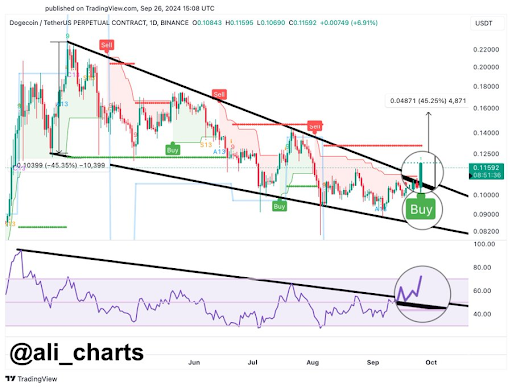
Dogecoin
Source: X

In another X post, Martinez stated that Dogecoin could rally to as high as $0.150, having surged past the $0.111 resistance. Shina Inu is also on the edge of a historic run, as the meme coin has always recorded positive monthly returns in October. Dogecoin and Shiba Inu whales are already positioning for these price rallies, as they have been accumulating these past few days. 

Shiba Inu price chart from Tradingview.com (Dogecoin)
SHIB price sparks bullish sentiment | Source: SHIBUSDT on Tradingview.com
Featured image created with Dall.E, chart from Tradingview.com
Scott Matherson

Scott Matherson

Scott Matherson is a leading crypto writer at Bitcoinist, who possesses a sharp analytical mind and a deep understanding of the digital currency landscape. Scott has earned a reputation for delivering thought-provoking and well-researched articles that resonate with both newcomers and seasoned crypto enthusiasts. Outside of his writing, Scott is passionate about promoting crypto literacy and often works to educate the public on the potential of blockchain.

Letture associate

Wall Street's 'Compliance Hunt': The Great Stablecoin Reserve Migration

In a concentrated move over the past week, several Wall Street giants have advanced their tokenized money market fund initiatives, signaling a strategic shift driven by impending U.S. stablecoin regulations. JPMorgan Chase launched its second such fund, JLTXX, on Ethereum, explicitly targeting future stablecoin issuer reserve needs. Concurrently, Franklin Templeton partnered with Kraken to integrate its BENJI tokenized funds onto the exchange platform for use as collateral and cash management tools. BlackRock further solidified its position by filing for two new tokenized funds with the SEC, aiming to convert its massive traditional stablecoin custody business into a tokenized model. These parallel developments represent a multi-pronged institutional "compliance hunt" to capture future crypto liquidity. BlackRock and JPMorgan are focusing on the backend, preparing to serve as the core reserve and settlement infrastructure for compliant stablecoins as outlined by the GENIUS Act. This act defines strict "qualified reserve asset" requirements for stablecoin backing while prohibiting interest payments to holders. Franklin Templeton and Kraken, however, are exploiting a potential regulatory gap. By offering a tokenized fund (BENJI) that is not a stablecoin, they aim to provide yield-bearing, collateralizable digital cash instruments, circumventing GENIUS Act's ban on stablecoin yield. The impending CLARITY Act, which will delineate digital asset market structure, is seen as a complementary piece to GENIUS. Its treatment of passive income could solidify the niche for instruments like BENJI. With conservative market size estimates for tokenized money market funds reaching hundreds of billions by 2030, Wall Street institutions are positioning themselves early, using on-chain settlement as a key competitive differentiator to offer superior liquidity and composability for the next generation of dollar reserves.

marsbit57 min fa

Wall Street's 'Compliance Hunt': The Great Stablecoin Reserve Migration

marsbit57 min fa

Altman Drops Bombshell While Musk is Away: He Once Wanted His Children to Inherit OpenAI

In a California court, Sam Altman testified for the first time in the ongoing legal battle between Elon Musk and OpenAI. Altman made a striking claim: Musk once suggested that control of OpenAI could one day be passed down to his children. This statement reframes the long-standing conflict not as a simple governance dispute but as a foundational power struggle. Altman sought to counter the narrative that OpenAI betrayed its original non-profit, idealistic mission. He argued that from the beginning, it was Musk who sought increasing control over the organization, including a larger equity stake and ultimate decision-making authority. Altman opposed this, citing OpenAI's core principle that AGI should not be controlled by any single individual. He also addressed the key point of contention about OpenAI's shift to a for-profit structure, claiming Musk was aware of and initially supportive of exploring such a model to secure the massive funding needed for advanced AI research. Altman framed the change as a practical necessity, not a betrayal. Further testimony revealed internal concerns after Musk left OpenAI's board, with worries he might take retaliatory action. Altman critiqued Musk's management style as unsuitable for a research lab, damaging morale and culture. Throughout his testimony, Altman's focus appeared to shift from technological idealism to the realities of organizational governance and resource requirements. Regarding his brief ouster in 2023, Altman stated he seriously considered joining Microsoft but ultimately returned because OpenAI was too important to abandon.

marsbit2 h fa

Altman Drops Bombshell While Musk is Away: He Once Wanted His Children to Inherit OpenAI

marsbit2 h fa

Trading

Spot
Futures
活动图片