На Ближний Восток приходится 7,5% мирового объёма криптовалют

cryptonews.ruPubblicato 2024-06-27Pubblicato ultima volta 2024-09-27

Согласно отчёту аналитиков Chainalysis, в период с июля 2023 года по июнь 2024 года на страны Ближнего Востока и Северной Африки пришлось 7,5% от всего объёма транзакций с криптовалютами в мире. Сумма переводов составила около $338,7 млрд, причём подавляющее количество операций пришлось на институциональных и профессиональных инвесторов.

По данным аналитиков, почти 93% транзакций были совершены на сумму $10 000 и более.
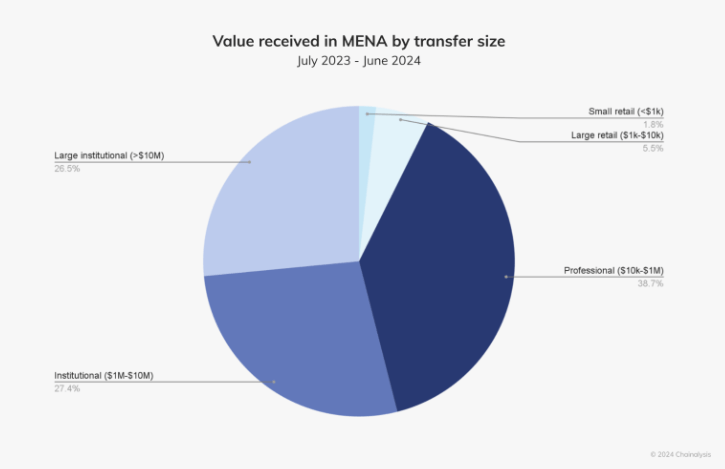
рис 2

Сетевой трафик в регионе в основном проходит через централизованные биржи. Однако в отчёте также отмечается «высокий интерес» инвесторов из Объединённых Арабских Эмиратов и Саудовской Аравии к децентрализованным платформам.

Эксперты Chainalysis подчеркнули растущее влияние ОАЭ как глобального криптоцентра, в первую очередь, благодаря прозрачному регулированию цифровых активов и дальновидной позиции властей в отношении отрасли. К примеру, в августе 2024 году суд первой инстанции Дубая постановил, что сотрудники могут получать заработную плату в криптовалюте.

В сентябре 2024 года финансовые регуляторы ОАЭ сделали ещё один шаг к внедрению цифровых активов, разрешив поставщикам виртуальных активов, имеющим лицензию в Дубае, предоставлять свои услуги пользователям по всей стране.

А совсем недавно Центральный банк Объединённых Арабских Эмиратов одобрил страхование, которое должно защитить финансовые учреждения и их клиентов от убытков, возникающих в результате взломов, внутреннего мошенничества и повреждения инфраструктуры хранения.


Letture associate

Can Open USD Support Stripe's Ambitions?

Can Open USD support Stripe's ambition? The article argues that OUSD represents a pivotal strategic move for Stripe, shifting its narrative from being a superior payments API company to becoming a "money movement network." Unlike simply facilitating payments, this new model aims to organize and define the settlement layer, default assets, and economic distribution rules for future commerce. The analysis highlights OUSD's role in giving Stripe a potential default settlement asset, enabling deeper economics through reserve earnings, and providing a programmable money layer for emerging use cases like AI agentic commerce. Crucially, OUSD is presented not as a direct "USDC killer" but as an attempt to redefine the business model of stablecoins, proposing a collaborative governance structure where contributing partners share in the network's economic benefits and governance. For Stripe, this is about evolving from a powerful "abstraction layer" over traditional financial rails into an active participant and potential architect of the next-generation global settlement network. While OUSD alone cannot immediately realize this ambition, it signals Stripe's intent to move closer to the money layer itself, positioning itself at the center of future money flows in an increasingly automated, platform-driven, and AI-powered economy. The ultimate question is whether Stripe can transition from being a best-in-class payment processor to becoming the foundational infrastructure for internet-native money movement.

marsbit5 min fa

Can Open USD Support Stripe's Ambitions?

marsbit5 min fa

This Week's Crypto Watchlist|Jupiter, NEAR, Jito, and 7 Other Projects are Active. Understand Who's Worth Monitoring with a 'Catalyst Calendar'

This week brings a concentrated wave of catalysts for several crypto projects, based on a schedule compiled by an analyst. Jupiter (JUP) leads by launching a private testnet for its GUM unified market on July 6th, aiming to aggregate diverse assets on Solana. On July 7th, NEAR hosts a major livestream reveal focused on enterprise "black box" tech, likely detailing its SPICE upgrade. Also on July 7th-8th, Berachain executes its largest mainnet upgrade, "PoL Next," simplifying its tokenomics by retiring the BGT token and consolidating value into BERA. Zcash (ZEC) eyes recovery with its critical Ironwood network upgrade slated for July 21st, designed to restore trust after a recent privacy vulnerability scare. Looking ahead, Lighter (LIT) plans to launch tokenized stocks next week, leveraging its key position as the default perpetual DEX on the new Robinhood Chain. Jito (JTO) is rumored to launch its JTX trading platform in mid-July, targeting professional traders and promising substantial protocol revenue sharing. Lastly, Ether.fi (ETHFI) has proposed deploying a dedicated Aave V4 instance to power its EtherFi Cash Visa card, though this remains in the early governance stage. The week presents a mix of product launches, major upgrades, and strategic expansions, each carrying its own potential for momentum and associated risks like token unlocks or execution challenges.

marsbit18 min fa

This Week's Crypto Watchlist|Jupiter, NEAR, Jito, and 7 Other Projects are Active. Understand Who's Worth Monitoring with a 'Catalyst Calendar'

marsbit18 min fa

How Token Economy Reshapes the Business Rules of AI 'Measurement' | ToB Industry Observation

"Token Economy: How It Reshapes the Business Rules of AI's 'Metrics' | ToB Industry Observation" The article discusses how the token economy is fundamentally changing the business landscape for AI, moving from a phase of explosive technical supply to a focus on measurable value for enterprise demand. It highlights the astronomical growth in daily token usage in China, framing tokens as the new "measurement standard" or "electricity" of the intelligent era. A central challenge is determining a token's value, which varies drastically—up to 100,000x—across different applications, from drug discovery to casual chat. The concept of "high-quality tokens" that deliver real intelligence, versus "noise," is emphasized as crucial. Lenovo's Vice President shares three proposed "laws" of token economics: 1. **Law of Inertia:** The cost per token will continuously decline due to technological innovation, system optimization, and intelligent runtime scheduling. 2. **Law of Acceleration:** The value generated per token accelerates based on the depth of AI integration into business workflows, the level of engineering support, and organizational readiness. 3. **Law of the Singularity:** A tipping point where the value curve of AI application surpasses its cost curve, shifting from cost-saving to generating incremental, previously impossible value—enabling "innovation at scale." The article notes real-world struggles, such as companies exceeding AI budgets due to unpredictable token pricing and "token inflation" from agentic AI workflows. Solutions being explored include standardized metrics for token quality, transparent pricing, and new infrastructure like "Token Factories" for efficient, on-demand token production. The ultimate goal is for businesses to move past anxiety and reach the "singularity," where AI drives scalable innovation, akin to how electricity enabled countless modern appliances.

marsbit31 min fa

How Token Economy Reshapes the Business Rules of AI 'Measurement' | ToB Industry Observation

marsbit31 min fa

Trading

Spot
活动图片