Dogecoin’s RSI Shift Ignites Optimism For Potential Gains Toward $0.1293

bitcoinistPubblicato 2024-09-22Pubblicato ultima volta 2024-09-22

Introduzione

Dogecoin is capturing attention once again as a recent shift in its Relative Strength Index (RSI) ignites optimism for potential...

Dogecoin is capturing attention once again as a recent shift in its Relative Strength Index (RSI) ignites optimism for potential gains. The RSI, a key indicator, has shown signs of a bullish reversal, signaling that buying interest may be on the rise, positioning Dogecoin for possible gains to the $0.1293 significant level. As market sentiment shifts in favor of the bulls, the question remains: could this be the moment DOGE breaks through to new heights?

This article aims to analyze the recent shift in Dogecoin’s RSI and its implications for potential price gains. By exploring the technical indicators and market sentiment surrounding this change, the article will assess the likelihood of DOGE reaching the target of $0.1293.

At the time of writing, DOGE was trading at approximately $0.1055, reflecting a 0.86% decline over the past 24 hours. Its cryptocurrency’s market capitalization was around $15.4 billion, with trading volume surpassing $503 million, representing decreases of 0.08% and 23.74%, respectively.

Technical Analysis: Key Indicators Supporting The Upside

Following a recent pullback, DOGE’s price on the 4-hour chart is making a bullish comeback, with the purpose of reaching the $0.1293 mark. DOGE is trading above the 100-day Simple Moving Average (SMA), suggesting a positive upward trend.

Dogecoin
DOGE rebound eyes the $0.1293 target | Source: DOGEUSDT on Tradingview.com

An analysis of the 4-hour Relative Strength Index suggests a potential for additional upward movement. The RSI has risen again to 59% after a previous attempt to drop below the 50% threshold, indicating that bullish movement is gaining strength. 

This resilience demonstrates that buyers are stepping in to support the price, creating a favorable environment for continued gains. As long as the RSI remains above this critical level, the outlook for upside movement remains positive.

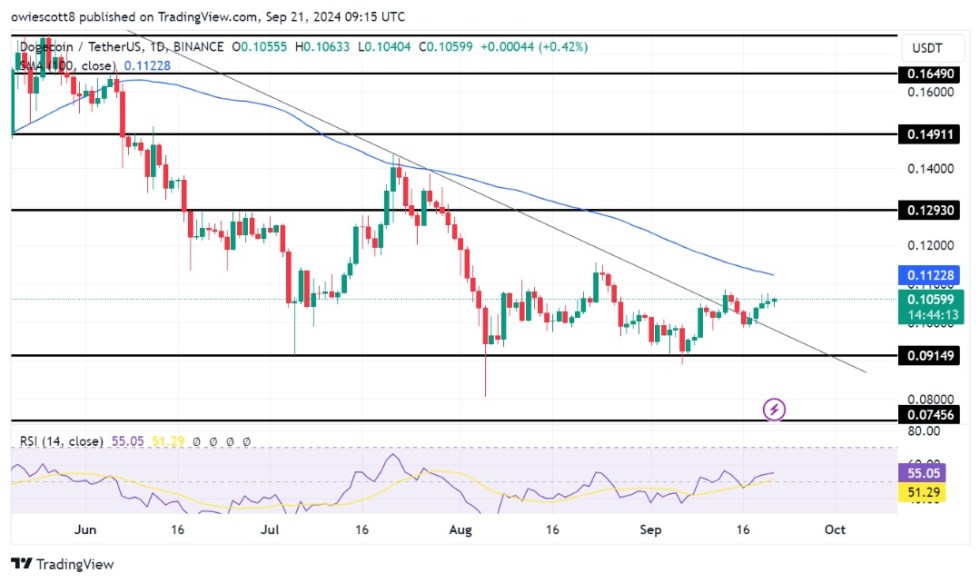
On the daily chart, DOGE shows positive momentum, reflected in multiple bullish candlesticks. Although it is currently trading below the 100-day SMA, this upward movement suggests that bulls are actively in control and may push the cryptocurrency higher, aiming to surpass the 100-day SMA and reach the $0.1293 mark.
Dogecoin
Dogecoin displaying bullish strength to surpass the 100-day SMA |  Source: DOGEUSDT on Tradingview.com

Finally, on the 1-day chart, a detailed examination of the RSI formation indicates that DOGE may maintain its upward momentum as the indicator’s signal line has risen above the 50% threshold and is currently positioned at 54%, suggesting a sustained bullish outlook.

Resistance Levels: Targeting $0.1293 And Beyond

As Dogecoin maintains bullish momentum, the next key level to watch is the $0.1293 mark. If the meme coin successfully breaks through this level, the following resistance target is likely to be around $0.1491, which could further boost positive sentiment and pave the way for even higher price levels.

However, should Dogecoin encounter strong resistance at $0.1293, the price may begin to decline toward the $0.09149 support level. A break below this level could signal a continuation of the downward trend, potentially targeting the support range at $0.07456 and beyond.

Dogecoin
DOGE trading at $0.10 on the 1D chart | Source: DOGEUSDT on Tradingview.com
Featured image from Adobe Stock, chart from Tradingview.com
Godspower Owie

Godspower Owie

Godspower Owie is my name, and I work for the news platforms NewsBTC and Bitcoinist. I sometimes like to think of myself as an explorer since I enjoy exploring new places, learning new things, especially valuable ones, and meeting new people who have an impact on my life, no matter how small. I value my family, friends, career, and time. Really, those are most likely the most significant aspects of every person's existence. Not illusions, but dreams are what I pursue.

Letture associate

Cerebras IPO: A $48.8 Billion Valuation—Is the 'Nvidia Challenger' a Bubble or a New King?

Cerebras Systems, positioning itself as an NVIDIA challenger, is going public with a $48.8 billion valuation despite several underlying paradoxes revealed in its S-1 filing. While 2025 revenue grew 76% to $510M and GAAP net income was $237.8M, this profitability relies heavily on a one-time, non-cash accounting gain. Adjusting for this, the company's non-GAAP net loss actually widened to $75.7M. Furthermore, customer concentration remains extreme: 86% of 2025 revenue came from two Abu Dhabi-based entities, MBZUAI (62%) and G42 (24%). Its landmark deal with OpenAI, valued at over $20 billion, creates a complex, nested relationship where OpenAI is simultaneously a major customer, lender, warrant holder, and strategic partner with exclusivity clauses. Cerebras's technical edge in latency-sensitive AI inference is real, with its wafer-scale chip outperforming competitors in benchmarks. However, this advantage is confined to a specific niche, not the broader AI training market dominated by NVIDIA's CUDA ecosystem. With a 95x price-to-sales ratio, the valuation demands flawless execution of the OpenAI contract and massive future revenue growth. Key long-term risks include intense competition from giants like NVIDIA and AMD, a dual-class share structure granting insiders near-total voting control, and ongoing geopolitical uncertainties regarding export controls. The IPO is a pivotal capital markets event for AI infrastructure. As an investment, it represents a high-risk, high-reward bet on the "inference-first" narrative and Cerebras's ability to dominate its specialized segment, underpinned by a valuation that highlights the current fervor in the sector.

marsbit11 min fa

Cerebras IPO: A $48.8 Billion Valuation—Is the 'Nvidia Challenger' a Bubble or a New King?

marsbit11 min fa

What Happens to Ethereum Developer Tools After the Grants Run Out?

On February 27th, the Ethereum Foundation (EF) announced Project Odin, a structured sustainability support program designed for a select group of strategic, previously grant-funded teams. Unlike a standard grant, Odin offers a long-term advisory mechanism focused on helping these teams establish credible, sustainable paths within a two-year framework, thereby reducing long-term dependence on single funding sources. The program addresses a critical post-grant challenge: how essential public goods, especially major developer tools, can achieve financial sustainability beyond initial funding. While grants from EF and programs like Gitcoin or RetroPGF remain vital for startups and research, they often fall short for mature, widely-used infrastructure. Tools like compilers, languages, and network stacks are deeply embedded but struggle with monetization, trapped between being too foundational to lose and too public to generate natural revenue. Project Odin provides teams with a dedicated Strategic Advisor to guide them through a three-phase process: 1) analyzing current funding and realistic options, 2) validating potential paths with stakeholders, and 3) executing plans, which may include crafting support contracts, service agreements, or other recurring revenue models. The first pilot participant is Vyper, a critical smart contract language for the EVM, highlighting the need for sustainable models for core infrastructure. The initiative reframes the public goods conversation from "who should be funded" to "how do already-proven teams avoid perpetual funding crises?" It encourages ecosystem participants—protocols and projects that depend on these tools—to view sustainable support not just as charity, but as essential risk management for their own operational supply chains.

marsbit40 min fa

What Happens to Ethereum Developer Tools After the Grants Run Out?

marsbit40 min fa

MARA Reports Q1 Revenue Below Expectations, Net Loss of $1.3 Billion, Stock Plunges After Hours

Bitcoin mining firm MARA Holdings reported disappointing Q1 2024 results, causing its stock to erase all daily gains and fall 3.44% in after-hours trading. Revenue dropped 18% year-over-year to $174.6 million, missing Wall Street estimates of $192.7 million. The company posted a net loss of $1.3 billion, a significant increase from a $533.4 million loss a year ago, primarily driven by unrealized losses on its holdings of 38,689 Bitcoin, which depreciated in value during the quarter. MARA also sold over 15,100 BTC in late March to repurchase debt at a discount. The broader mining environment remains challenging due to a 35% decline in Bitcoin's price from its all-time high and a nearly 30% increase in mining difficulty over the past year. MARA's market cap ranking among U.S. miners has slipped to seventh. Critically, the company announced a strategic pivot away from Bitcoin mining expansion. It stated it has no plans to purchase new mining equipment and is fully transitioning toward AI data centers. Its strategy involves retrofitting existing mining sites for AI and high-performance computing (HPC) and leveraging its recent $1.5 billion acquisition of Long Ridge Energy & Power, a gas-fired power plant and data center. This infrastructure could eventually support 600 MW of AI compute capacity, allowing MARA to redeploy up to 90% of its non-custodial mining power for AI and IT workloads.

marsbit41 min fa

MARA Reports Q1 Revenue Below Expectations, Net Loss of $1.3 Billion, Stock Plunges After Hours

marsbit41 min fa

Trading

Spot
Futures
活动图片