Catize空投收益与未来预估:4倍增长是否靠谱?

marsbitPubblicato 2024-09-14Pubblicato ultima volta 2024-09-15

从2月 $NOT 开始我就在中文社区安利TON链小游戏了。不仅 $NOT 上线币安,随后 $DOGS 也是拍马赶到,再到最近的仓鼠和 $CATI. TON链这波小游戏上币狂潮其实是超过我在今年二月发布视频时预期的,没有想到推进的速度如此之快。

说到Catize, 从币安宣布上线仓鼠,以为猫没机会上币的失落,到猫确定上币安的双响炮大惊喜,再到空投查询的开放,社区的情绪可以说就像是坐云霄飞车一般,而这两天就像是一个缩影,整个确实有喜有忧。下面我将通过几个关键点来解答和复盘一下这个过程,并且在文章最后也将分享我对TON生态后市的判断

1. 对空投份额及规则怎么看?

把这个问题放在第一个, 是因为这是看到最多的问题。首先,我和大家一样对初始空投份额的变故感到诧异,可以说是一个完全没有料到的开局。在用户视角,分批空投确实可能是低于心理预期的。关于规则,我也看到很多单纯挂机几个月的玩家实际获得的空投并不多,而氪金的玩家却拥有相当高的权重,获得了游戏花费金额3.4倍左右的代币空投。我虽然本身也是氪金玩家,并且也理解氪金与权重的关系。但是,我还是认为对于那些早期挂机,且获得了高段位的玩家来说确实有些不公平。没氪金的王者和大师,给的份额相对太少了。毕竟在Web3还是讲究一个社区OG文化的,而早期玩家就等于早期支持者。所以,我非常希望项目方能重新思考一下初始代币分配,给予那些高段位玩家和早期玩家更多激励。

2. 交互策略

首先简单说一下我的撸猫策略。小号大师和部分钻石,大号王者和部分大师。小号成本在120u-300u,大号基本一号一"救助猫"成本在600u左右。原本的计划是每个号控制在200u封顶,然后70%的号氪到大师就停,30%冲王者,7\3配比。在空投延期以及币安宣布投资后,看着地址越来越来多,我发现单纯冲等级上段位可能并不够了。随后,官方就上线了流浪猫救助活动。起初看到这个活动上线时还是懵逼的,和几个重仓的养猫大户开了电话会议,那天聊了得有三个半小时,最后多数决定加仓干,做一批高成本差异化号,也就是救助流浪猫。特别记得那时刚聊完有些上头,直接就开了1级新号冲499的流浪猫,后来发现亏麻了(现在看来区别其实不大)。

TON链小游戏

救助猫证书如下图,因为流浪猫一领养成功就会直接开始猫窝掉落,上千个猫窝掉完才发现并没有升多少级,因为初始级别太低了所以掉落的猫窝也是低级的...

TON链小游戏

当时上头1级起氪救助猫...蠢哭了,不过现在看结果都一样后来摸索出了“正确”的做法,先冲鱼币直接买猫,然后再救助流浪猫,加上送的1500次免费钓鱼,等级咔咔就上去了。现在看来,虽然等级和段位纯属脑补的权重了,但是差异化还是做到了。如果没有那次流浪猫活动我可能也不会加仓氪金,这里要感谢曹哥的分析,虽然当时他也并没想到是纯看金额,所以这次赚到或多或少也有运气的成分。在日渐饱和的空投赛道,或许真的只有"差异化"才是唯一的捷径,因为走“大路”太卷

3. 当前收益和预估收益当前的收益

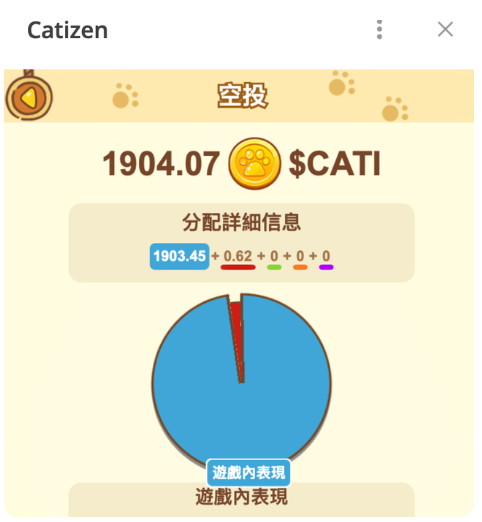
前面说了空投的代币数约等于游戏花费金额的3.4倍代币。以我下图这个号为例,救助流浪猫+fish币消费在540u,空投代币1904枚。按照 $CATI 盘前价格0.7计算约等于1332U, 盘前也有近2.5倍的收益,所以对于大额氪金和多号氪金的大户来说几乎是稳赚的,只不过千金难买早知道,这么偏执的"权重"是真的很难猜到
TON链小游戏

救助猫号 均值在2000币左右

TON链小游戏小号 中位数在700 氪200u出头

TON链小游戏小号 平均上限在1000左右

预估收益

已知 $CATI 总量是10亿,但初始流通只有30.5% 按照盘前0.7u的价格,目前流通市值只有2亿出头,甚至不如很多一个大所没上的meme. 哪怕币安上线后$CATI路火花带闪电拉高到3u,其实流通市值也不到1B。至于为什么要拉?为什么会拉?格不格局?我不想在这里说太多,因为每个人有每个人的看法和观点,都是自己的认知决定的。不过大家可以对比一下not dogs的流通市值作为参考。当前流通量,我预估能有4倍左右的收益保底,8倍10倍其实也不算高。

4. 后市TON生态怎么抓重点?

小游戏依短期内旧会是主要叙事,因为TG的“人口红利”实在是太厚了。对于保守派而言,可以选择在撸猫和仓鼠上市之后,根据币价表现再做判断。而看好小游戏的行动派,可以考虑先相对低成本的开始养号。另外,我个人觉得TON其实当前给CEX导流大于生态导流了,便宜都给CEX占了显然是不合理的。所以这波小游戏狂潮之后,我认为很有可能会扶持链上的一些生态项目或者代币,把流量和用户引流到链上生态。我会保持关注生态最新进展,后续发现好的早期项目第一时间发出来。

最后,希望Catizen团队能倾听社区的声做出一些改变,给予早期OG一些应有的激励!

Letture associate

Doubao and Qwen Will Discontinue Agent Functionality on July 15

On July 4th, Doubao and Tongyi Qianwen announced the impending shutdown of their user-created "AI Agent" features. Doubao confirmed its agent feature will be taken offline on July 15, directing users to ByteDance's CatBox app for similar needs. On the same day, Tongyi Qianwen notified users, specifying that personalized interactive agents and user-built agent functions will cease on July 10, with all agent features and services completely deactivated by July 15. After this date, access to agent configurations and historical chat records will be lost. This adjustment impacts core user scenarios like role-playing, personal assistants, and vertical tool agents. The shutdown date coincides with the official implementation of China's "Interim Measures for the Administration of Artificial Intelligence Human-like Interactive Services" on July 15. The new regulations impose strict rules on "human-like emotional interaction services," requiring platforms to implement measures like anti-addiction systems, minor verification, and content moderation. This move is widely seen as a proactive step by the platforms to align with regulatory timelines and mitigate compliance risks. Additionally, commercial challenges are a key driver. Analysis suggests that casual, human-like chat agents generate high-frequency, low-value interactions, leading to high computational costs with poor monetization. As the AI application market shifts from user growth to proving value, sustaining such "high-cost, low-efficiency" user-generated content becomes difficult. Both platforms have outlined transition plans. Doubao will allow data viewing and self-backup for a period after shutdown, with data scheduled for permanent deletion by October 15. Tongyi Qianwen similarly advised users to save important content via copying or screenshots before the deadline. This strategic retreat from C-end agent features signals a broader market shift. Compliance capability and sustainable business models are replacing user scale and feature richness as the new core competitive dimensions. Tongyi Qianwen's recent move to fully open its Agent and Skill platforms to third-party enterprises and developers further underscores a strategic pivot from low-value C-end services to high-value B-end enterprise scenarios.

marsbit2 h fa

Doubao and Qwen Will Discontinue Agent Functionality on July 15

marsbit2 h fa

Why Did Codex and ChatGPT Merge? What's Next for Codex? OpenAI Core Leader Answers Everything

In 2026, OpenAI's Codex saw explosive growth, with weekly active users surging over 5x to 5 million since January, driven largely by the February launch of its desktop app. Codex desktop lead Andrew Ambrosino explains key shifts behind its evolution. A core change is the inversion of development costs: implementation is now cheap, while curation and taste—judging which of many AI-generated prototypes is valuable—have become the new scarcities. Ambrosino defines taste as a blend of aesthetics, systems thinking, direction, and semantic coherence in interaction. He notes AI still struggles with design because evaluating it requires human cultural context and abstract reasoning about how components relate—capabilities beyond current models. Timing is critical: the same Codex app would have failed months earlier; success hinges on the model's capabilities at launch. Roles are blurring within his team, with engineers, designers, and PMs overlapping significantly. However, Ambrosino cautions against eliminating specialized roles entirely, as each field retains deep expertise. On AI-assisted development, the focus has shifted from measuring code written by AI to distinguishing between supervised and unsupervised generation. A current challenge is teaching models to simplify code, not just add complexity. The merger of Codex and ChatGPT stems from observed user behavior: non-developers adopted Codex for general knowledge work despite its developer-centric interface. This revealed a collapsing boundary between specialized tools and universal assistants. The vision is a "home base" that orchestrates tasks across external professional tools (like Excel or Premiere Pro) via connectors, rather than rebuilding everything internally. An internal example showed Codex helping edit video by interacting with Premiere Pro's files and even writing a plugin for it. The future direction is a unified, extensible platform that serves as a central hub for automating and managing work across any specialized tool the user employs.

marsbit2 h fa

Why Did Codex and ChatGPT Merge? What's Next for Codex? OpenAI Core Leader Answers Everything

marsbit2 h fa

Trading

Spot
活动图片