观点:摧毁“四年周期”论,加密货币才能真正跨越鸿沟

链捕手Pubblicato 2024-09-13Pubblicato ultima volta 2024-09-13

作者: Matti

编译: Luffy , Foresight News


不久前,我发表了自己对 cryptotwitter ( CT ) 的一些思考。出乎我意料的是,这些观点在社区引发了激烈的讨论。我不确定我的观点是否超出了批评者的理解范围,或者我触动了 CT 的既得利益。
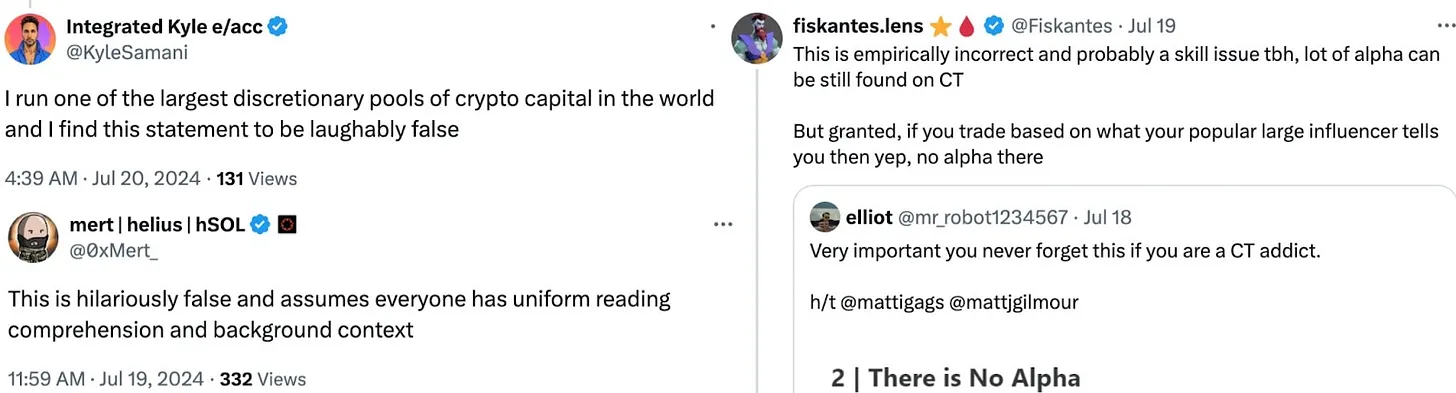
CT 很容易骗人

这并不是说人们在 CT 上不会偶然发现有用的投资建议。 CT 是一种新颖的信息狂欢形式,是一部永无止境的肥皂剧,情节和反派都非常荒谬。它是一个娱乐阵地。 

这段经历让我开始思考加密货币的现状。在某个时刻,我突然意识到:加密货币已然是主流。它可能不是主流采用,但它是主流娱乐。你周围有多少人没有听说过加密货币?今天加密货币已经是美国总统大选的一个热门话题,它怎么可能不是主流呢?

人们喜欢当「早鸟」,他们自欺欺人地认为早点行动就能够赚钱。参与是成功的前提条件,而 CT 是一个延续这种观点的虚假先知。这个是 Alpha ,那个是 Alpha …… CT 是一个以销售代币作为娱乐的真人秀。

CT 对行业来说既不是坏事也不是好事,它只是加密货币主流化的一种表现。从卑微的无政府资本主义到巅峰时期的理想主义文化,如今的加密货币正在经历抖音化,并以中本聪无法想象的方式包装呈现给消费者。

这就是我们融入主流的方式

CT 的代表人物曾写道(大致如下):「泡沫迹象与主流采用之间难以区分。」主流的问题在于你失去了早期机会。

加密货币已经采用了自己的天定命运文化。无论您是比特币、 ETH 还是 SOL 最大主义者,您都会相信四年周期的传说。几乎所有人都相信加密货币注定会成长,每四年就会有一次大牛市突然出现,带领我们走向富饶之地。

但随着行业规模不断扩大,模仿和借用变得比创新更有价值。加密行业现在借助四年周期的口号,延续着「早起就是优势」的理念。这种情况可能会改变,参与可能还不够。自满的后果最终会到来。

需求是发明之母,但不幸的是,有大量的资本专注于短期游戏(价格上涨),也有大量精明的创始人知道如何玩风险投资的选美大赛。过去两年,既没有需求,也没有真正触发创新的因素。

这就是为什么目前加密货币只将宏观干预视为救命稻草,无论是降息还是新总统政府。这表明我们期望从自上而下的资本流入(例如 ETF ),而不是自下而上的创新中获益。问题是这场游戏是否迟早会破裂。

当前,风险投资公司难以筹集到新资金,风险投资行业因投回报减少而受到严格审查。加密货币也是如此,但有一个前提,即现有的加密货币 LP 在 2021 年左右已经获得了回报。这一次不会发生这种情况,因为吹捧账面收益的基金很快就遭遇了残酷打击。

救星是什么?把金融畸形当作唯一出路,并希望更大的傻瓜来拯救我们,这表明我们已经堕落到何种程度。问题是大多数人甚至毫不掩饰这一点。我从来没有见过:站在牛市的边缘,每个人都迫不及待地想要卖出。

加密货币「四年周期」的概念需要被彻底摧毁,只有这样加密货币才能真正跨越鸿沟,成为一种全新的事物。只要「四年周期」的概念存在,默认的激励机制就是 :

  • 优先考虑短期行为(无论是建设者还是投资者) 
  • 延续「更大傻瓜理论」,因为人们总是相信当前的周期最终会崩溃。

随着唾手可得的创意被采纳,加密货币正在变成一场零和游戏。创始人和「社区」庆祝没有任何产品的大规模融资,并以此作为胜利。虽然 X 和 Y 得到了来自各方的资助,但他们掩盖了一个事实,他们没有像上一个周期( DeFi )那样的真正的技术创新。

除了傻瓜式地希望有人接盘,我们还相信什么呢?我们相信 CT 吗?它不过是一个情绪放大器?我们相信 alpha ,还是相信自欺欺人的叙事?

瞧,这就是我们唯一剩下的……叙事。我们强行灌输自己不相信的故事,只希望别人会相信。但是没有叙事,就不可能有牛市和采用!是的,但只有当你不把它们当作叙事时,叙事效果才最好。

真正的叙事不是在推特上制造出来的。它们是由创新锻造出来的,创新激发了人们的热情,然后又变成了自以为是的狂妄自大。这就是狂热,狂热必须有其基础。我们没有这种基础,我们只想传播——利用 Meme ,通过推特将空洞的叙事变成现实。

我自己也犯过这样的错误。通过大声呼喊「文化!」来掩盖产品缺陷算不得是一种好方法。我们一直在培育的唯一文化是利用空洞的叙事和暴力的社区文化,而这些文化的强大程度只取决于价格表现。但也许,我们终究不应该低估愚蠢的可预测性。以前,愚蠢不是总能让我们免于灭亡吗?或者,也许在某个角落,一项重大创新正在酝酿? 

我没有答案。我怀疑,如果市场没有达到新的高度,我们就会进入一个不可预见的领域,这在短期中期内可能会很痛苦,但对加密货币的创新来说却是好事。

Letture associate

Google Cracks Down on 'AI Poisoning'

Google has taken a strong stance against "AI poisoning," a new form of manipulation where advertisers subtly feed information to influence AI-generated answers like those in Google's AI Overview. Unlike traditional SEO, which aims for higher website rankings, Generative Engine Optimization (GEO) seeks to have a brand or product recommended within the AI's response itself. This is particularly valuable as AI summaries, often perceived as neutral and comprehensive, can shorten the consumer decision path and directly influence purchases. The article illustrates the issue with a "hot dog experiment," where fabricated content was quickly picked up and presented as fact by AI. GEO exploitation is potent because AI models aggregate information from various sources—reviews, articles, forums—and can mistake coordinated marketing campaigns for genuine consensus. This threatens the core credibility of search engines. While Google's updated spam policy now explicitly covers attempts to manipulate AI-generated content, enforcement faces challenges. Google can leverage its long experience fighting SEO spam, using penalties like ranking demotion. However, sophisticated "gray area" tactics, such as sponsored third-party reviews or industry reports, are harder to distinguish from legitimate promotion. Other AI players, like Microsoft, have taken a more open approach to GEO, viewing it as a new channel for brands. Ultimately, as AI becomes a primary information source, maintaining the trustworthiness of its answers is a critical challenge for all platforms.

marsbit11 min fa

Google Cracks Down on 'AI Poisoning'

marsbit11 min fa

When Futu Turns into a Matchmaking Corner: Overseas Identity Becomes the Hard Currency for the Middle Class

When Futu Becomes a Matchmaking Corner: Overseas Status as the New Hard Currency for China's Middle Class Following a severe penalty announcement from Chinese regulators on May 22nd targeting offshore brokerages like Futu, its app community unexpectedly transformed into an impromptu matchmaking platform. Users posted相亲 (matchmaking) requests, explicitly seeking partners with overseas residency or citizenship, revealing a stark new reality: for China's middle class, an overseas identity has become a crucial asset. The regulatory crackdown, which restricts mainland Chinese residents from opening new accounts to buy overseas securities like US stocks, has sharply escalated the value of a foreign passport or permanent residency. This status now acts as a gateway to global asset allocation—including US equities, offshore property, and foreign currency deposits—effectively becoming a new form of "hard currency." Its scarcity, non-transferability (except through marriage, inheritance, etc.), and role as a hedge against domestic uncertainty have driven its premium. The article traces the evolution of how China's middle class views overseas resources: from an investment for opportunity (2000s), to risk diversification (2010s), and now to a mandatory "insurance policy" for financial access. With the regulatory window closing for many, the demand is shifting towards securing such status for the next generation through international education. The surreal scene of high-performing investors posting dating resumes underscores a 2026 where financial talent can be secondary to the right passport.

marsbit1 h fa

When Futu Turns into a Matchmaking Corner: Overseas Identity Becomes the Hard Currency for the Middle Class

marsbit1 h fa

Understanding Bound in One Article: The "Multi-signature + Timelock" Escape Mechanism and the Off-Chain Matching Black Box

**Title**: Understanding Bound: The Escape Mechanism of "Multi-Sig + Time Lock" and the Off-Chain Matching Black Box **Summary**: Bound Exchange, evolved from the earlier radFi platform, introduces a novel approach to Bitcoin trading by combining self-custody security with exchange-like speed. Its core mechanism relies on a 2-of-2 multi-signature (multi-sig) address for user deposits. One private key is held by the user via a passkey, and the other is held by Bound. This setup requires both keys to sign any transaction, preventing Bound from unilaterally accessing user funds (non-custodial). To address the risk of Bound becoming unavailable, a 3-month timelock is integrated into the Bitcoin script. After this period, users can withdraw their assets with just their single signature, ensuring an escape hatch. For trading, Bound operates a concentrated liquidity AMM. However, as Bitcoin L1 lacks smart contracts, the AMM curve, liquidity management, and trade price calculations occur off-chain in Bound's backend database. On-chain Bitcoin transactions serve only as final settlement receipts for pre-determined amounts. This creates a centralization point: the critical sequence of trade execution—which determines the exact price along the curve for each order—is managed off-chain by Bound in a non-transparent "black box." While the 2-of-2 setup protects user本金 (principal), the pricing and ordering of trades introduce potential operational MEV risks, as the order processing is invisible and unverifiable on-chain. In practice, users can also connect external wallets (like Unisat) for fully self-custodied trading, but this requires manually signing every transaction. The platform currently supports deposits of BTC and Runes only.

marsbit1 h fa

Understanding Bound in One Article: The "Multi-signature + Timelock" Escape Mechanism and the Off-Chain Matching Black Box

marsbit1 h fa

Technology Has No Barriers, 24/7 Trading is the Key to Hyperliquid's Success

The article argues that Hyperliquid's competitive edge lies not in technological superiority but in its 24/7 trading model, which fundamentally challenges traditional finance's fixed market hours. Based in Singapore with an 11-person team, Hyperliquid has generated significant revenue and trading volume. Its core advantage is the ability to facilitate trading continuously, including during weekends when major exchanges like the CME are closed. This was demonstrated when Hyperliquid listed a SpaceX pre-IPO perpetual contract on a Sunday, allowing the market to price the company hours before traditional institutions opened. This disruption has drawn regulatory scrutiny from traditional giants like CME and ICE, who cite risks like lack of KYC and market manipulation. However, the article suggests their concern stems from Hyperliquid eroding the "time monopoly" of established markets. The piece contrasts Hyperliquid's synthetic derivatives—pure price-betting contracts with no underlying asset or centralized issuer—with other models like PreStocks (dependent on real股权) and Ondo (licensed but targetable). Hyperliquid's code-based, decentralized structure makes it resilient to takedowns, even if founders face legal action. Ultimately, the author concludes that while it raises legitimate regulatory questions, Hyperliquid's "unforgeable" competitive barrier is the time advantage of non-stop trading, a feature legacy systems cannot replicate.

marsbit1 h fa

Technology Has No Barriers, 24/7 Trading is the Key to Hyperliquid's Success

marsbit1 h fa

Trading

Spot
Futures
活动图片