За 11 лет соло-майнеры добыли не менее 329 блоков биткоина

cryptonews.ruPubblicato 2023-04-03Pubblicato ultima volta 2024-09-03

С 2014 года майнеры-одиночки первой криптовалюты добыли по меньшей мере 329 блоков, подсчитали журналисты Protos на основе данных CK Pool.

CHART: When solo miners found a Bitcoin block

Operating as lone wolves and paying for 100% of their own equipment and electricity, solo bitcoin miners sometimes strike it lucky.

Read more: https://t.co/SNFocjIsqS pic.twitter.com/O024Vjf1Pk

— Protos (@Protos) September 2, 2024

Структура не является пулом в строгом значении, но предоставляет услуги индивидуальным добытчикам криптовалюты. Последние подключают через нее к сети свой хешрейт и получают 98% вознаграждения за блок (за минусом комиссии CK Pool) в случае удачи.

Реальные показатели соло-майнинга, скорее всего, несколько выше, поскольку подобным участникам сети не обязательно пользоваться сервисом платформы, отметили в издании.

При этом, шансы решить криптографическую головоломку биткоина для одиночек практически равна 0%.

«Однако около нуля, не равно нулю», — констатировали журналисты.

По данным на март 2023 года, соло-майнеры добывали в среднем один блок за 10 месяцев. Традиционные пулы за этот период генерировали 43 200 базовых элементов сети.

Хасс Маккук из Bitcoin Mining Council обозначил шансы одиночек как еще более низкие — один к 1,4 млн.

Но эти оценки никоим образом не объясняют 11 блоков, добытых соло-майнерами за последние шесть месяцев, подчеркнули в Protos.
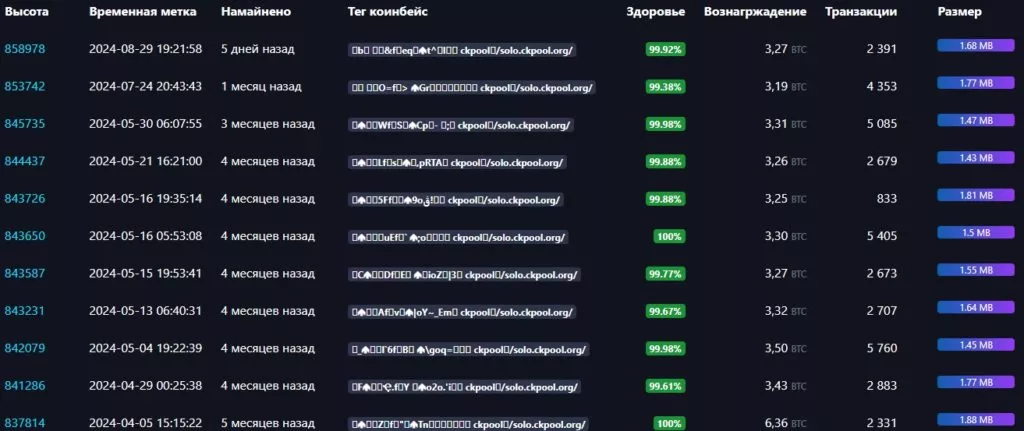
Данные: mempool.space.

На момент написания в последний раз это удалось 29 августа пользователю CKPool с хешрейтом 38 PH/s. По мнению администратора пула Кона Коливаса, вычислительная мощность оборудования допускает майнинг таким образом одного блока раз в четыре месяца.

Согласно его подсчетам, соло-майнеры CKPool суммарно включили в сеть 291 блок.

24 июля это сделал пользователь пула с хешрейтом 3 TH/s. Его суммарное вознаграждение составило $211 972.

В апреле участникам CKPool подобное удалось дважды: первый в начале месяца заработал при этом ∽$422 750, второй из-за состоявшегося халвинга получил уже только ~$218 544.

Напомним, 28 августа в результате очередного перерасчета сложность майнинга биткоина увеличилась на 2,99%.

Letture associate

Just now, DeepSeek V4 updates with DSpark, improving inference speed by 80%

DeepSeek has updated its DeepSeek V4 model with the DSpark speculative decoding framework, achieving a significant 60-85% speedup in generation for Flash models and 57-78% for Pro models while maintaining the same overall throughput. This engineering-focused update, rather than a core architectural change, introduces DSpark to address latency and throughput bottlenecks in high-concurrency production environments. DSpark combines high-throughput parallel generation with adaptive load-aware verification. Its key innovations include a semi-autoregressive generation architecture to model dependencies within token blocks and a hardware-aware confidence-scheduled verification system. This system uses a confidence head to predict token acceptance probabilities, allowing it to dynamically optimize verification length per request and allocate compute only to tokens with the highest expected payoff. The asynchronous scheduler is designed for real-world deployment, ensuring zero-overhead scheduling and continuous CUDA graph replay while preserving the target model's output distribution. In tests across mathematical reasoning, code generation, and daily dialogue, DSpark outperformed state-of-the-art models like Eagle3 and DFlash, increasing average acceptance length by 26.7%-30.9% and 16.3%-18.4% respectively on Qwen3 target models. DeepSeek also open-sourced DeepSpec, a full-stack codebase for training and evaluating speculative decoding draft models, providing a standardized toolkit that includes data preparation tools, model implementations, training code, and evaluation scripts.

marsbit1 h fa

Just now, DeepSeek V4 updates with DSpark, improving inference speed by 80%

marsbit1 h fa

BIT Research: The 2028 Halving Is Not the End, the Real Shake-Up of the Bitcoin Mining Industry Is Just Beginning

The Bitcoin mining industry is undergoing its most complex structural adjustment since inception. Despite Bitcoin's price holding near $61,000 and the network hash rate approaching a record 1 ZH/s, miner profitability is deteriorating. The industry is operating close to its breakeven point, with the 2028 halving expected to accelerate consolidation. The challenges extend beyond the halving's subsidy reduction; the industry's revenue model has yet to successfully transition towards a fee-driven structure. Increasingly, mining companies are evolving from simple Bitcoin producers into infrastructure and energy operators, including providers of AI/HPC computing power. Competition is shifting from pure hash rate expansion to business model upgrades. Economic pressure is evident. The theoretical daily mining revenue at current prices is around $78 million, yet the actual figure is only about $33 million—a 136% gap. Transaction fees remain low at roughly $220k daily, far below historical implied levels. With a current estimated industry-wide breakeven price near $65,000, mining alone is struggling to generate ideal profits. The 2028 halving is projected to push the fundamental production cost floor to approximately $93,289. This will likely accelerate a shift towards consolidation among larger, well-capitalized miners with diversified revenue streams. Competitive advantage will belong to institutionalized players with access to low-cost energy, AI/HPC hosting operations, and stronger balance sheets. In essence, Bitcoin mining is transitioning from a "mining business" to an "infrastructure business." Future profitability and resilience will depend less on block rewards and more on diversified income sources like energy management and computational infrastructure services. For investors, the key question is not the halving itself, but which miners can successfully navigate this business model transformation.

marsbit3 h fa

BIT Research: The 2028 Halving Is Not the End, the Real Shake-Up of the Bitcoin Mining Industry Is Just Beginning

marsbit3 h fa

This is How God Karpathy Uses Claude?

Andrej Karpathy, a prominent figure in AI, has reportedly joined Anthropic, leading to a noticeable decrease in his open-source contributions and social media activity. A document claiming to be his personal "CLAUDE.md" file—a set of instructions for the Claude AI to follow within a specific codebase—has been circulating online. While its authenticity is unverified, the content aligns closely with Karpathy's publicly shared principles on effective AI-assisted programming. The document outlines key rules for AI coding assistants, emphasizing the importance of reading existing code thoroughly before writing new code to maintain consistency. It advises against over-engineering, advocating for simple, surgical modifications that match the project's existing style. Other guidelines include clarifying assumptions upfront, writing meaningful tests, thoughtful debugging, and carefully considering dependencies. The core message is that these principles help prevent common AI coding failures, such as introducing unnecessary abstractions, style drift, or making invisible architectural decisions. The community has noted that even experts like Karpathy require detailed instructions to guide AI effectively, akin to managing a junior developer. A related GitHub repository, "andrej-karpathy-skills," which encapsulates these ideas, is reported to significantly reduce Claude's code error rate. Ultimately, the advice stresses that the best CLAUDE.md is tailored to one's own tech stack and coding practices.

marsbit3 h fa

This is How God Karpathy Uses Claude?

marsbit3 h fa

Trading

Spot
活动图片