Украденную у биржи WazirX криптовалюту отмыли через Tornado Cash

investing.ruPubblicato 2024-09-03Pubblicato ultima volta 2024-09-03

Happycoin.club - Часть украденных у крупнейшей в Индии по объёму торгов биржи криптовалют WazirX цифровых активов отмыли через Tornado Cash.

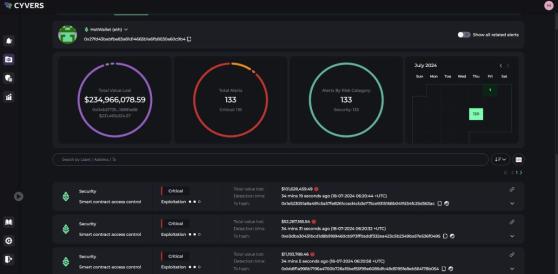
Сотрудники компании по безопасности блокчейнов Cyvers сообщили, что 2 сентября взломавший WazirX хакер отправил в миксер Ethereum (ETH) стоимостью $6,5 млн для легализации дохода, полученного преступным путём. В его криптохранилище остались монеты на сумму $153 799.

В июле злоумышленнику удалось получить доступ к горячему криптокошельку WazirX с мультиподписью и вывести из него цифровые активы на сумму $234,9 млн. Помимо ETH, хакеру удалось завладеть токенами-мемами Pepe (PEPE), виртуальной валютой Gala (GALA), выпущенной разработчиком блокчейн-игр Gala Games, и стейблкоинами Tether (USDT).

Отчёт о взломе криптохранилища WazirX

После инцидента представители WazirX объявили награду в размере $23 млн за помощь в возврате похищенных активов и связались с работниками других бирж, чтобы заблокировать отправленные хакером монеты. 3 сентября пользователям WazirX, пострадавшим от взлома, разрешили вывести до 66% принадлежащих им сбережений в индийских рупиях. Остальные средства будут заморожены до завершения расследования хакерской атаки.

Читайте оригинальную статью на сайте Happycoin.club
Letture associate

RWA Weekly: EU Proposes Revision of MiCA to Cover Tokenization and Non-EU Stablecoins; Swift and 17 Banks to Pilot Tokenized Cross-Border Payments

RWA Weekly: EU Proposes MiCA Revision for Tokenization and Non-EU Stablecoins; Swift to Pilot Tokenized Cross-Border Payments with 17 Banks During the statistical period of July 3-10, 2026, the RWA sector showed signs of recovery. The total on-chain market capitalization of RWAs rebounded to $33.12 billion, ending a prolonged decline. The stablecoin market cap also returned above $300 billion, with active addresses and holders increasing, indicating restored market vitality. Key regulatory developments include China promoting the use of digital yuan in consumption vouchers, the EU considering revisions to its MiCA framework to cover tokenization and non-EU stablecoins, and Kazakhstan authorizing stablecoin use for cross-border corporate and government payments. In Hong Kong, HSBC issued its first "digitally native" structured product. Major project updates feature Swift announcing readiness of its blockchain ledger for a 24/7 tokenized cross-border payment pilot involving 17 global banks. Ondo launched a perpetuals platform allowing tokenized stocks as collateral. Sony received conditional U.S. OCC approval to launch a stablecoin-focused trust bank in 2027. Tether plans to natively issue USDT on Bitcoin via the RGB protocol. Significant funding rounds saw Securitize planning to deploy over $400 million for acquisitions to expand its institutional tokenization business, while Tether invested $20 million in Brazil's Mercado Bitcoin to support its growth in on-chain financial services. Analysis highlights that stablecoins are evolving into global financial infrastructure with regional specializations and that institutions should consider international expansion to gain practical experience in the RWA tokenization space amidst evolving regulations.

marsbit16 min fa

RWA Weekly: EU Proposes Revision of MiCA to Cover Tokenization and Non-EU Stablecoins; Swift and 17 Banks to Pilot Tokenized Cross-Border Payments

marsbit16 min fa

The first to catch the wave of the Robinhood Chain hype is Arbitrum, up nearly 20%

"ARB, the native token of Arbitrum, surged nearly 20% recently, emerging as a top-performing L2 token. This rally is attributed to the launch of 'Robinhood Chain,' a Real-World Asset (RWA) Layer 2 built using Arbitrum's technology. The launch has brought renewed attention to the 'Arbitrum Expansion Plan' (AEP), a year-and-a-half-old program. AEP allows external projects to build their own chains using Arbitrum's Orbit technology. In return, these 'tenant' chains that do not settle on Arbitrum's main networks must share 10% of their net protocol revenue with the Arbitrum ecosystem—8% to the DAO treasury and 2% to the developer guild. While smaller chains like Degen Chain previously triggered AEP, Robinhood Chain is the first major, high-profile tenant, making the revenue-sharing model economically significant for the first time. Initial data from Robinhood Chain is impressive, with over 35 million transactions, 350,000 addresses, $2.5 billion in TVL, and over $1 billion in DEX volume shortly after launch. However, its current protocol revenue, at roughly $146,000 net, translates to only a minimal payout to Arbitrum DAO. The ARB price surge thus reflects the market's anticipation of future revenue as Robinhood's vast $324 billion platform assets potentially migrate on-chain. This 'landlord' model mirrors Optimism's approach with its OP Stack and Superchain. However, Optimism's model faces pressure as its largest tenant, Base, announced plans to depart, causing a significant drop in OP's price. Similarly, analysts question Robinhood Chain's long-term dependence on Arbitrum, noting its daily sequencer revenue already nears three times that of Arbitrum itself. There is speculation that, like Base, it may eventually seek independence, with ETH potentially being its primary economic token rather than ARB."

Foresight News43 min fa

The first to catch the wave of the Robinhood Chain hype is Arbitrum, up nearly 20%

Foresight News43 min fa

The Ethereum Foundation is Dead, The Era of Ethereum's Pluralistic Organizations Has Dawned

The Ethereum Foundation (EF) has announced the dissolution of its Protocol Support Team, marking a significant organizational shift. This move, described as the largest layoff in EF's history with a 20% staff reduction, follows a major internal restructuring announced in late June. The restructuring, which EF framed as necessary to streamline for future challenges, has drawn criticism for its perceived cold execution. Concurrently, several new independent non-profit organizations have emerged, founded by former EF members. These include Ethlabs, a research and development lab, and Ethereum Institutional, which focuses on promoting institutional adoption of Ethereum. Their rise is seen as both filling roles vacated by EF's downsizing and signaling a fragmentation of the Ethereum ecosystem's leadership. Amidst these changes, EF is also integrating advanced AI tools into its security operations. The security team has begun using AI agents to conduct red-team testing, which has already uncovered vulnerabilities in Ethereum's code. While EF states that AI complements rather than replaces human researchers, this technological shift hints at potential future reductions in human-centric roles within the organization. The article posits that these developments—massive layoffs, the exodus of key personnel like former Executive Director Xiaowei Wang, the rise of rival organizations, and AI integration—collectively point to a decline in EF's central authority. Once the undisputed leader of the Ethereum ecosystem, EF now faces questions about its future role, with speculation that it may evolve into more of a symbolic "ecosystem mascot" rather than a driving force for growth and adoption. This organizational turmoil unfolds against a backdrop of ongoing market pressure and community debate over Ethereum's value proposition.

marsbit49 min fa

The Ethereum Foundation is Dead, The Era of Ethereum's Pluralistic Organizations Has Dawned

marsbit49 min fa

Trading

Spot
活动图片