LUNA 2.0 falls by 77% in 14 days as Do Kwon takes Twitter account private

cryptoslatePubblicato 2022-06-08Pubblicato ultima volta 2022-06-08

Introduzione

Trust in Terra's new ecosystem is dwindling as new allegations emerge against Do Kwon, who has taken his Twitter account private.

Two weeks after Terra’s ecosystem restarted through LUNA 2.0 airdrop, the coin has seen its value plummet to new lows after its price dropped by 77%. According to Coingecko data, the coin is currently trading for $4.33.

Although the overall performance of the crypto market has played a role in the decline, the level of FUD surrounding the new coin is also worth watching.

Trust in the new ecosystem is low as speculations have emerged about Do Kwon’s role in making the new Terra network.

The speculations came into light after self-proclaimed Terra insider FatMan alleged that Kwon and Terraform Labs lied about making the new network community-owned. He claimed that “TFL owns 42M LUNA, worth over $200m.”
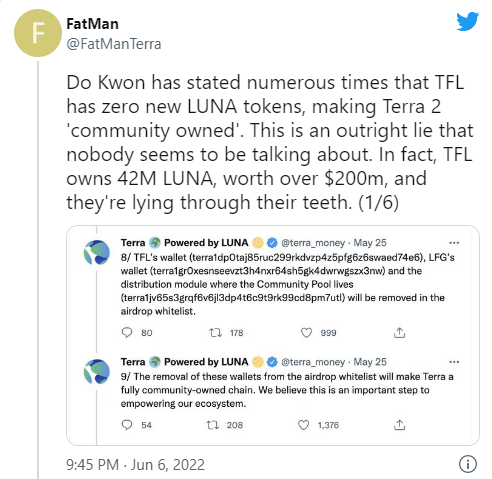
He also claimed that Kwon was active in the relaunch and used his holdings of LUNA to vote in support of the hard fork, which was contrary to the community calls for him to burn the tokens.

However, all these claims are yet to be verified, but they have generated enough uncertainty to cause a massive sell-off of the token. Do Kwon’s decision to take his Twitter account private might have also added to the fears surrounding the ecosystem.
Those allegations were not the first FatMan made about Do Kwon. A few days ago, he alleged that Kwon’s rise to the top was due to nepotism.
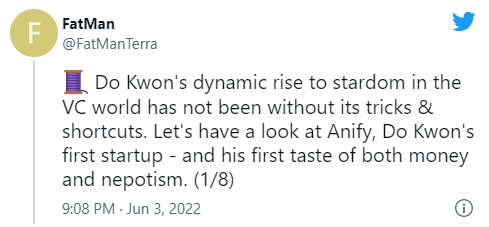
He mentioned that Kwon became popular after winning a $550,000 Infobank grant for his first startup, Annify. But he questioned how he got the grant since the startup had no product at that time. According to him, Kwon got the funding due to his connections with Infobank.

Meanwhile, South Korea’s law enforcement authorities are reportedly investigating a Terraform Labs employee over the possible embezzlement of Bitcoin belonging to the company. Aside from that, the authorities have also sought to know whether Do Kwon knew the crash would happen.

LUNA 2.0 is not the only token associated with the Terra project that has fallen due to these speculations. While LUNA Classic has already lost 100% of its value, the coin’s price further plummeted by 11.3% in the last 24 hours as any hope of recovery grows dimmer.

Letture associate

Altcoin: The ETF Boom Explodes – XRP, SOL, LTC, HBAR, DOGE, LINK, and the Emergence of New Opportunities

While the spotlight has been on Solana (SOL) ETFs, which have attracted approximately $682 million in inflows, XRP ETFs have quietly surpassed them with $874 million, despite launching later. Simultaneously, a new wave of altcoin ETFs for LTC, HBAR, DOGE, and LINK has entered the market, each recording modest but stable inflows since their debut. Seven separate Solana ETFs have generated $618.62 million in net inflows, holding $915.08 million in assets under management, representing about 1.15% of Solana's market cap. In contrast, four XRP ETFs have attracted $874.28 million, with Canary's XRPC leading at $357 million. The newly launched altcoin ETFs for LINK, HBAR, LTC, and DOGE have collectively seen $133.46 million in net inflows. Grayscale's GLNK attracted $40.90 million, Canary's LTCC (Litecoin) drew $7.67 million, and its HBR (HBAR) ETF recorded $82.04 million. Two DOGE ETFs brought in $2.85 million. This expansion signals a new market phase of diverse choices and intense competition. However, these new altcoin ETFs remain far behind the established Bitcoin and Ethereum ETFs in terms of total capital. Amid this ETF boom, Bitcoin Hyper (HYPER) is emerging as a potential altcoin outside the traditional ETF scope. It's a Bitcoin Layer-2 project built on the Solana Virtual Machine (SVM), combining Solana's speed with Bitcoin's security. Having raised nearly $29 million in its presale, it offers a fixed supply of 21 billion tokens and 40% staking APY, positioning itself to unlock Bitcoin's potential in DeFi.

bitcoinist27 min fa

Altcoin: The ETF Boom Explodes – XRP, SOL, LTC, HBAR, DOGE, LINK, and the Emergence of New Opportunities

bitcoinist27 min fa

Polymarket Revival: The Mainstreaming of Crypto Prediction Markets and Future Prospects

Polymarket, a crypto-based prediction market platform, has made a significant comeback in 2025 by re-entering the U.S. market through regulatory-compliant means, including the acquisition of regulated trading and清算 entities. This resurgence is further supported by institutional capital investment and integration with mainstream platforms like the MetaMask wallet, allowing users to trade directly without leaving their wallets. Mainstream financial data platforms have also begun displaying prediction market data, increasing market visibility. Once viewed primarily as a gambling or speculative platform, Polymarket is increasingly recognized as a mechanism for information pricing in financial markets. Widespread participation from both retail and institutional users has made its probability assessments of future events more representative and liquid. Prediction market data is now being incorporated by traditional financial media and data platforms, highlighting its growing potential. However, challenges remain. Prediction markets are not always accurate, with studies showing limited predictive reliability in certain contexts. Questions about platform neutrality and business models have emerged, such as the employment of internal market makers, which could undermine trust. Information asymmetry and insider risks are inherent, potentially disadvantaging ordinary users when some participants access information early. Regulatory, tax, and disclosure requirements also present ongoing uncertainties. The revival and transformation of Polymarket signify a broader shift of prediction markets from niche experiments toward mainstream financial infrastructure. By converting public expectations into tradable probabilities, these markets may complement traditional analysis and polling, providing real-time, decentralized signals in areas like macroeconomics, policy, technology, and geopolitics. As traditional financial institutions invest in compliance and structured products, DeFi is evolving beyond an alternative asset pool to resemble traditional financial infrastructure. Prediction market applications are expanding beyond crypto to potentially include stocks, macroeconomic indicators, sports events, and tech product launches, tightening the link between crypto and the real world. If platforms like Polymarket continue on a path of compliance, stable operation, and integration with mainstream financial services, they could become next-generation market infrastructures—event-driven financial tools alongside stocks, bonds, and options. Key factors for development include platform neutrality, prediction accuracy, regulatory environment, participant diversity, and the maturity of related financial products. In summary, Polymarket’s comeback represents a move of prediction markets from the fringe into the core of financial systems, reflecting deeper changes in how information is priced and how financial infrastructure is rebuilt. This shift brings not only new trading methods but also potential changes in how investors perceive and engage with future events and asset valuation.

cointelegraph_中文1 h fa

Polymarket Revival: The Mainstreaming of Crypto Prediction Markets and Future Prospects

cointelegraph_中文1 h fa

Trading

Spot
Futures
活动图片