Биткоин-майнер IREN сообщил о рекордной годовой выручке в $184,1 млн

cryptonews.ruPubblicato 2023-11-29Pubblicato ultima volta 2024-08-29

  • Майнинговая компания IREN опубликовала отчет за 2024 финансовый год.
  • Фирма добыла 4191 BTC, а ее доход от майнинга составил $184,1 млн.
  • К концу 2024 года IREN планирует увеличить общую вычислительную мощность с 15 EH/s до 30 EH/s.

Майнинговая компания IREN (ранее Iris Energy) подвела итоги работы за 2024 финансовый год. По состоянию на 30 июня 2024 года биткоин-майнер заработал $184,1 млн, что является рекордным результатом для фирмы.

$IREN reported FY24 results

– Record Adj. EBITDA of $54.7m
– Record mining rev. of $184.1m (4,191 Bitcoin mined)
– AI Cloud Services rev. of $3.1m
– $404.6m cash, no debt
– 15 EH/s installed; on track for 30 EH/s in 2024
– 10.5 EH/s S21 XP miners secured
– 816 NVIDIA H100 GPUs

— IREN (@IREN_Ltd) August 29, 2024

В своем пресс-релизе IREN сообщила о сокращении чистых убытков по сравнению с предыдущим отчетным периодом. Доход фирмы за 2024 финансовый год вырос на 144% по сравнению с 2023 финансовым годом, когда компания получила $75,5 млн выручки.

Согласно отчету, улучшить финансовые показатели удалось за счет увеличения хешрейта и роста курса биткоина. В частности, общая производительность IREN выросла с 5,6 EH/s до 10 EH/s. Кроме того, компания добыла 4191 BTC ($250 млн на момент написания).

По состоянию на 29 августа 2024 года общая вычислительная мощность майнера составляет 15 EH/s. В следующем месяце IREN намерена достичь 20 EH/s, а к концу 2024 года нарастить производственные мощности до 30 EH/s.
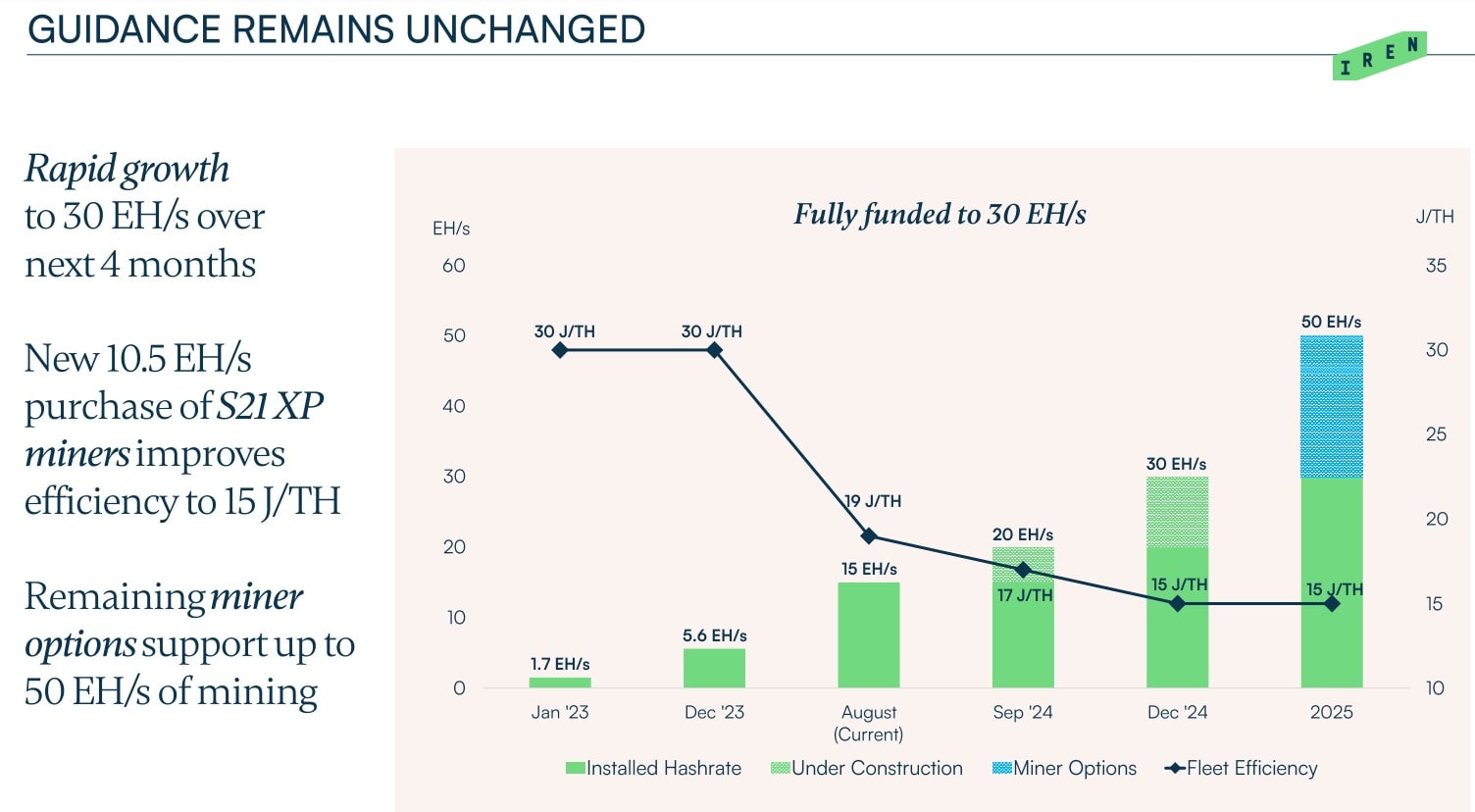
Планы IREN по увеличению вычислительной мощности. Данные IREN.

В отчете говорится, что компания договорилась о поставках устройств Bitmain S21 XP последнего поколения для достижения поставленных целей.

«Результаты за 2024 финансовый год указывают на растущую прибыль, выручку и денежные потоки нашей компании. Наши ориентиры остались неизменными — достижение рубежа в 20 EH/s в следующем месяце и 30 EH/s в этом году», — заявил соучредитель IREN Дэниел Робертс.

Помимо роста прибыли за счет майнинга биткоинов, компания впервые сообщила о выручке от облачных технологий ИИ в размере $3,1 млн. IREN стремится диверсифицировать свои услуги и расширить количество центров обработки данных, отмечается в релизе.

Напомним, компания считается «зеленым» майнером, который использует для добычи биткоина возобновляемые источники энергии. Например, солнечные панели или гидроэлектростанции.

В конце 2022 года тогда еще Iris Energy оказалась на грани дефолта. Из-за неисполнения обязательств по кредиту в размере $103 млн австралийскому майнеру пришлось отключить ряд устройств для использования в качестве залога.

Несмотря на ряд трудностей, компании удалось решить финансовые проблемы и продолжить работу. В декабре 2023 года она заказала новую партию оборудования — 8380 ASIC на $22,3 млн.


Letture associate

In the AI Era, What's Left for Bitcoin?

As Bitcoin falls below $60,000, the author reflects on the relationship between AI and Bitcoin, seeing them as two sides of the same coin. In the AI era, the cost of generating content has plummeted, making fake text, images, and videos increasingly easy and cheap to produce. This has led to a fundamental shift: while AI dramatically lowers the cost of information production, it also undermines trust and authenticity online. What becomes truly valuable is not more content, but the ability to verify what is real—"verifiability." This perspective offers a new lens for Bitcoin. Its massive energy consumption, often criticized as wasteful, is reinterpreted. While AI burns energy to enhance "capability" and efficiency, Bitcoin burns energy to produce "verifiability." Its purpose is not to be trusted but to enable a system where no trust in intermediaries—banks, platforms, or developers—is needed. Every transaction and the entire ledger's history is secured by cryptography and a decentralized network of nodes, making it independently verifiable. AI cannot forge a transaction on the Bitcoin network because the system is designed for proof, not generation. The author draws a historical parallel to the Renaissance: the printing press drastically reduced the cost of copying knowledge, while double-entry bookkeeping reduced the cost of trust in commerce. Today, AI is the new printing press, reducing content creation costs to near zero. Blockchain, and Bitcoin as its pioneer, may be the modern equivalent of double-entry bookkeeping—a foundational technology for verifying digital asset ownership and historical records without centralized authorities. Thus, AI and blockchain are not competitors. AI lowers the cost of creation; blockchain lowers the cost of verification. In an age where AI can generate anything, true scarcity may lie not in more content, but in independently verifiable facts. Whether the market will reprice Bitcoin accordingly remains uncertain, but its core value proposition as a "machine for producing verifiability" becomes strikingly relevant.

marsbit17 min fa

In the AI Era, What's Left for Bitcoin?

marsbit17 min fa

In the Age of AI, What's Left for Bitcoin?

Author: Sevclub, Seven Research Amid Bitcoin's recent drop below $60k, the author reflects on a growing sense that AI and Bitcoin are two sides of the same coin. Today, encountering any content triggers a new default question: "Was this made by AI?" The cost of generating convincing text, images, and video is now negligible. While the internet lowered information *distribution* costs, AI is crashing information *production* costs to near zero. The consequence is a flood of content where truth and falsehood are increasingly indistinguishable. In this environment, what becomes truly valuable is not more information, but the ability to verify what is real—"verifiability." This reframes the common criticism that Bitcoin "wastes electricity." AI consumes power to produce "capability" (e.g., more powerful models). Bitcoin consumes power to produce something else: "verifiability." Bitcoin's core purpose isn't about belief or trust in any institution, developer, or even its creator. It's about enabling independent verification. Every bitcoin's origin, every transaction, and the integrity of the entire ledger are secured by mathematics, cryptography, and a global network of nodes. AI can fabricate convincing media, but it cannot falsify a transaction on the Bitcoin network. The expended energy makes篡改历史 (tampering with history) prohibitively expensive, purchasing a globally verifiable ledger. The author draws a historical parallel to the Renaissance. The printing press drastically reduced the cost of copying knowledge, while double-entry bookkeeping reduced the cost of trust in commerce—one enabled creation, the other verification. Today, AI is the new printing press, driving content production costs toward zero. The question becomes: what is this era's "double-entry bookkeeping"? Blockchain appears to be the leading candidate. It doesn't verify which news is true or which image is real, but it provides a foundational layer for independently verifying asset ownership and historical records in the digital realm without centralized authorities. Therefore, AI and blockchain are not in competition. AI lowers the cost of *generation*. Blockchain (and Bitcoin as a prime example) lowers the cost of *verification*. One creates, the other proves. Whether Bitcoin ultimately succeeds remains uncertain, facing potential challenges from quantum computing, regulation, and technical evolution. However, the author now sees it less as a "machine for making bitcoin" and more as a "machine for making verifiability." In an age where AI can generate anything, true scarcity may no longer be "more content," but "more independently verifiable facts." Whether the market will price this accordingly is a separate question.

链捕手26 min fa

In the Age of AI, What's Left for Bitcoin?

链捕手26 min fa

Trading

Spot
活动图片