XEX市场观察报告 一度暴涨近100% 中国市场突迎“历史性时刻

币界网Pubblicato 2024-08-21Pubblicato ultima volta 2024-08-21

币界网报道:

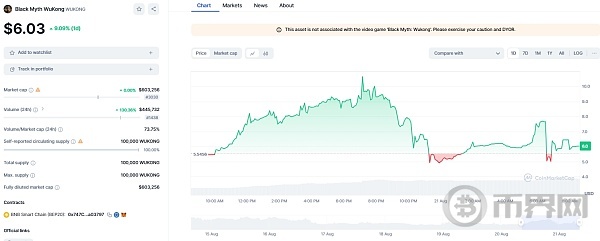
中国历史上首款3A游戏《黑神话:悟空》在周二(8月20日)正式推出,全平台销量超450万份,销售额超15亿元人民币。利多消息传出后,WUKONG迷因币(Black Myth WuKong)一度暴涨近100%,随后回吐涨幅报在6.03美元。

根据国游畅销榜统计,截至目前,《黑神话:悟空》在Steam上已售出超过300万份,加上WeGame、Epic和PS平台,目前总销量超过450万份,总销售额超过15亿元。当前,游戏Steam好评率维持在95% 的水平,其中,中文评论占比约为90%。

?code=NjAyZWQ5NzZmNmE0MGJlYmQ4ODg0NjcwY2Y2MWZkY2NfVGZJd1ZzcEE2c0x3STFUQUlyZUhjRDBCcEtTYjBucnNfVG9rZW46TFZqOGJtVm1Qb1NJQ2J4cWRjZ2xiZGhUZ1JnXzE3MjQyMTc0Mjk6MTcyNDIyMTAyOV9WNA

《黑神话:悟空》是由中国游戏开发商“游戏科学”(Game Science)采用虚幻5引擎制作,以古典名著《西游记》为蓝本开发、打造充满仙佛妖怪神话世界的动作角色扮演游戏。周二开放预载导致Steam下载频宽飙升至70Tbps,打破了2020 年底《Cyberpunk 2077》创下的50Tbps纪录。

该游戏凭借其高开发成本和较长的开发周期,将其誉为中国首款3A游戏大作,备受中国玩家期待,称其为“国产游戏之光”,号称如中国版《战神》、《艾尔登法环》,玩家将扮演中国神话小说人物孙悟空,击败肆虐人间的妖怪。

据悉,游戏科学成立于2014年6月,与腾讯有着千丝万缕的关系。公司创始团队全部来自腾讯,主创团队主要来自《御龙在天》《qq华夏》《全民飞机大战》等腾讯端游、手游项目。比如,公司创始人冯骥,曾是腾讯《斗战神》项目的核心成员,这款游戏同样建立在孙悟空这个大IP上面。

腾讯是游戏科学的金主之一,在《黑神话:悟空》的演示视频发布后,腾讯第一时间组团调研,随后通过增资获得了游戏科学公司5%的股权。据估算,腾讯对游戏科学公司投资很有可能超过了2亿元人民币。

此次投资不像以往那样,腾讯承诺不干预经营决策的“三不”原则,游戏科学将继续保持独立经营,自主性上不会受到影响。除了获得来自腾讯的战略投资,在2017年5月,游戏科学获得了英雄互娱(现名为英雄游戏)的6000万元投资,使游戏科学公司估值升至3亿元。

中国网友普遍对《黑神话:悟空》抱持满意态度,更有网友推论,黑悟空线上人数破140万, 比2077最高峰还高40万,不是到周末晚上就上看线上200万了?唯一悬念就是能不能破绝地求生的300万记录。

但与此同时,游戏社群对《黑神话:悟空》也有质疑声浪,提出“黑神话的战斗没什么意思,就一根棍子从头打到尾,不知道后面会不会有什么变化?”、“体验主要靠探索捡的妖怪技”、“只狼也是从头到尾一把刀啊,说实话我比较喜欢其他魂那种试新武器的感觉,但一把武器做得好的话也不错”等。

随着《黑神话:悟空》的高人气,WUKONG迷因币也应声上涨,一度触及10.67美元高位,涨幅逼近100%,但随后回落至6.03美元。
?code=MzM5Zjk0ZGZjYzk0NTRmNDAyY2I3OGU1OTFhODg3NzNfMTNBUDg1Q0tZVm5TYjFkZ3djSXcwdFVOcTVBZ29xRDZfVG9rZW46TG45bGJxQ2xvb3dYbEh4UnBYZmxVSmZuZ09iXzE3MjQyMTc0Mjk6MTcyNDIyMTAyOV9WNA

Letture associate

The Next Generation of Payments Lies Not in the Payment Layer

The Next-Generation of Payment is Not in the Payment Layer This is the second piece in a series analyzing Stripe's AI strategy. The series stems from Stripe's vision of becoming the economic infrastructure for the AI Agent era, announced at Stripe Sessions 2026. A key debate centers on whether Know Your Agent (KYA) is merely an upgrade to existing payment systems. The author argues the opposite: payment will become a subsystem of KYA, not the other way around. Historically, major payment innovations (online banking, mobile wallets, QR codes) emerged from new transaction scenarios that broke the underlying assumptions of old systems, not from optimization within the payment layer itself. Agent economy is that new scenario, and KYA is the foundational infrastructure growing to support it. KYA's proposed five layers—Agent Identity, Authorization Scope, Intent Signing, Liability Chain Auditing, and Credit Rating—extend far beyond payments. Only authorization and auditing directly touch the payment链路. Identity, intent, and credit layers serve broader needs like cross-platform calls, AI alignment, and permission management. Stripe's strategic moves validate this view. Its focus on "economic infrastructure for AI," investments in protocols like Agentic Commerce Protocol (an identity/session protocol), Shared Payment Tokens, stablecoin infrastructure, embedded wallets, and its own Tempo blockchain for settlement, all point to building the KYA layer, not just optimizing payments. Data shows the core challenge in AI commerce has shifted upstream: determining "who this is, what they intend to do, and if they deserve resources" happens long before checkout. This is why Stripe is moving its Radar fraud prevention from the transaction moment to the entire user lifecycle—a KYA-layer concern. Legally, ultimate responsibility will still fall on a human, as laws like AB 316 dictate. However, in a distributed,网状 liability chain involving users, Agent platforms, model providers, and payment protocols, KYA's role is to use cryptography to make every entity's actions and roles verifiable and traceable. This enables accountability where it was previously impossible to pinpoint evidence, fundamentally changing责任追溯, not just payment efficiency. The next-generation payment形态 will not be designed within the payment layer. It will emerge from the Agent economy scenario after the KYA infrastructure is established.

marsbit16 min fa

The Next Generation of Payments Lies Not in the Payment Layer

marsbit16 min fa

The Next Generation of Payments Is Not in the Payment Layer

The next generation of payments won't be designed within the payment layer itself. This article argues that historical payment innovations (e.g., online banking, mobile wallets) emerged from new transactional scenarios, not from optimizing existing payment systems. The new scenario is the Agent economy. Know Your Agent (KYA) is not merely a payment-layer upgrade for efficiency. It is the foundational infrastructure layer for the Agent economy. KYA’s five layers—Agent identity, authorization scope, intent signature, accountability chain audit, and credit rating—primarily serve broader needs like cross-platform identification, AI alignment, and permission management. Payment is just one application built on top of this KYA foundation. Stripe’s strategy exemplifies this shift. Its focus on "economic infrastructure for AI," investments in protocols like the Agentic Commerce Protocol (identity/session layer), stablecoin infrastructure, embedded wallets, and moving risk management (Radar) to the user lifecycle all indicate it is building the KYA layer, not just optimizing payments. While ultimate legal liability remains with a human (as laws like AB 316 stipulate), KYA enables traceability in a distributed,网状 responsibility chain involving multiple entities (user, Agent platform, model provider, etc.). It makes accountability verifiable where previously it was opaque. The conclusion: A new class of economic actors (Agents) forces a new infrastructure layer (KYA) to emerge. This layer redefines identity, authorization, and accountability. On top of it, the next generation of payment will reorganize and emerge from the demands of the scenario, not from within the traditional payment system.

链捕手22 min fa

The Next Generation of Payments Is Not in the Payment Layer

链捕手22 min fa

The "Big Short" Prototype Makes a Major Bet: Shorting Nvidia, Going Long on Software Stocks 'Scared Away' by AI

'The Big Short' Legend Michael Burry Doubles Down on AI Bet: Shorts Nvidia, Buys Beaten-Down Software Stocks As the Nasdaq hits record highs and Nvidia's market cap nears $5.3 trillion, Michael Burry—famed for his 2008 subprime mortgage bet—is making a major contrarian move. He is significantly expanding his bearish wagers against the AI frenzy while buying traditional software stocks he believes have been unfairly punished. Burry's latest portfolio adjustments, revealed in his Substack column, include maintaining and increasing put options on Nvidia and Palantir. He has also initiated new short positions on Palantir and expanded bearish bets on the semiconductor ETF (SOXX), the Nasdaq 100 ETF (QQQ), and Oracle. Simultaneously, he is buying shares of software companies like Adobe, Autodesk, Salesforce, and Veeva Systems. He argues these stocks have been sold off due to "AI disruption" fears and technical selling pressure from private credit funds, not deteriorating fundamentals. Their valuations have fallen to multi-year lows. This creates a complete hedge: short the perceived "AI winners" and long the oversold "AI losers." Burry believes the current AI infrastructure spending boom mirrors the late-1990s internet bubble, with inflated demand projections and questionable accounting practices by large cloud customers extending GPU depreciation schedules. While his Palantir short is currently profitable, his Nvidia put options are deeply underwater as the stock trades near all-time highs. Burry remains steadfast, comparing Nvidia to Cisco during the dot-com era. He anticipates a broad repricing of the AI bubble, where overvalued beneficiaries fall and unfairly battered companies rebound.

marsbit26 min fa

The "Big Short" Prototype Makes a Major Bet: Shorting Nvidia, Going Long on Software Stocks 'Scared Away' by AI

marsbit26 min fa

Trading

Spot
Futures
活动图片