Messari:Memcoins 杀死散户

深潮Pubblicato 2024-08-20Pubblicato ultima volta 2024-08-20

Memecoins 是一场零和游戏,价值不仅被重新分配,而且被摧毁。

撰文:Mike Kremer,Messari 数据工程师

编译:0xjs,金色财经

自 ICO 热潮以来,Meme 币热潮可能是最具掠夺性的加密现象。与过去的周期不同,过去的周期中,代币通常由具有有形价值的真正项目支持,而模 Meme 币的兴起标志着向更具破坏性的动态的转变。为了理解这一点,让我们将 DeFi Summer 期间的价值流与今天看到的情况进行比较。
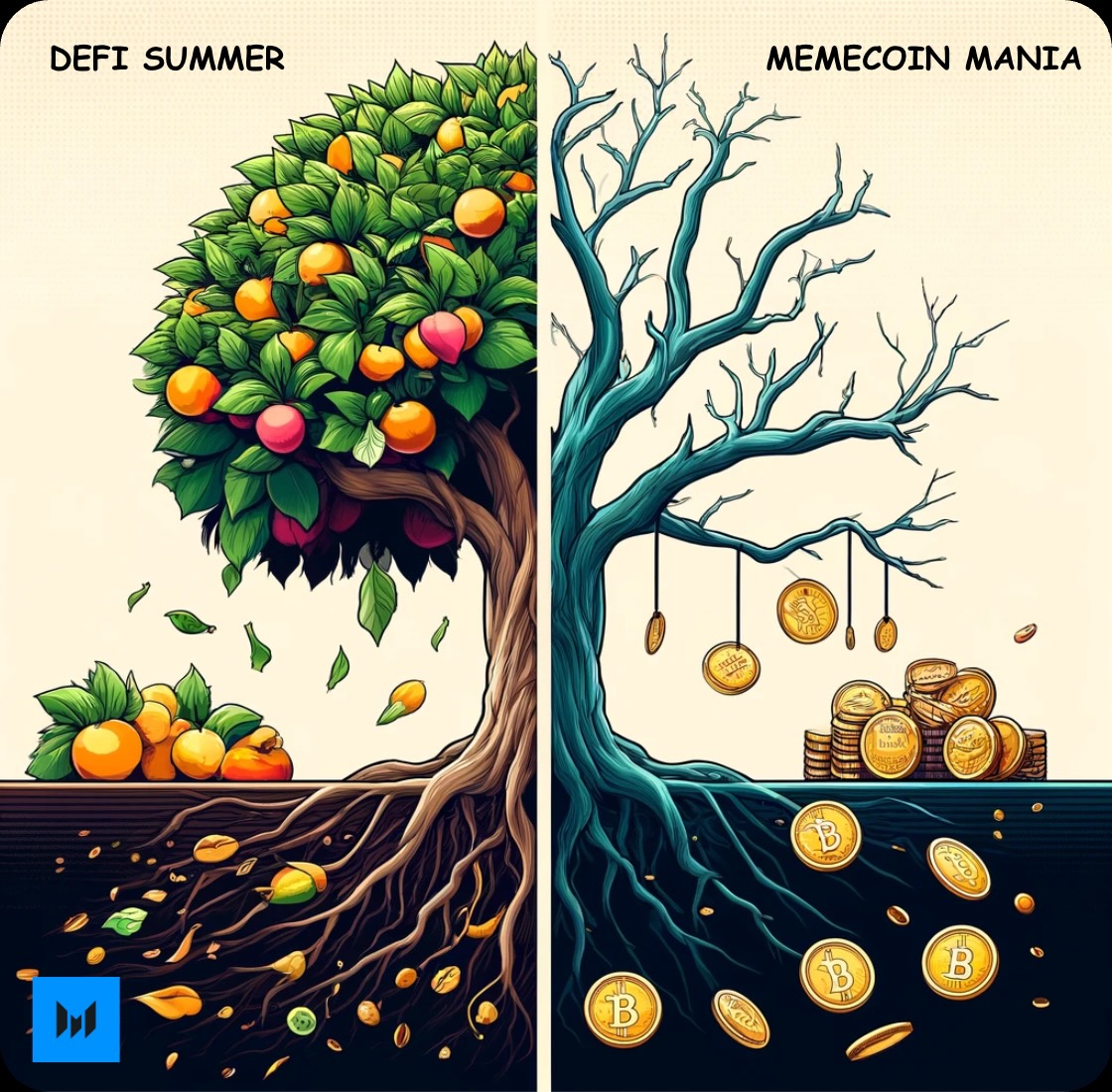
在 DeFi Summer 期间,Uniswap Labs 等项目推出了为加密经济提供真正效用的协议。

参与这些平台的用户通常会获得代币奖励——这些代币代表了协议所创造价值的一部分。当投机狂潮消退时,这些代币仍然具有潜在价值,因为它们与功能齐全、有价值的服务挂钩。

将此与 Meme 币趋势进行对比。

在这里,内部人员或卡特尔会创建像 supercumrocket69 这样的代币,对其进行炒作,并诱使散户投资者竞购这些「革命性」的新资产。一旦价格上涨,内部人员就会抛售其持有的资产,从而有效地从散 户参与者手中榨取财富,留下没有实际价值或效用的代币。整个过程是一场零和游戏,价值不仅被重新分配,而且被摧毁。

对散户投资者的影响是显而易见的。看看像 Friend.Tech 和 Ore Supply 这样的项目。

尽管实施了有利于散户投资者的分配机制——FRIEND 完全空投给其社区,ORE 是使用公平的基于 CPU 的算法开采的——但这两种代币的价格都大幅贬值。

这表明散户买家被 Meme 币无情地榨干了,不再有资本来支撑那些更真实的项目的市值。与此同时,memecoin 最多只能靠可疑的市场活动和散户的天真来维持。

可悲的事实是,尽管投机泡沫一直是加密货币领域的一部分,但它们之前以合法项目的形式留下了一些剩余价值。然而,Meme 币泡沫纯粹是投机性的,正在耗尽生态系统的价值,让散户投资者的境况比以前更糟。

信息披露:本文作者在 FRIEND 上遭受了巨额损失,现在持有和开采 ORE 也遭受了巨大损失。本文的灵感来源于财富的损失以及 memecoin 卖家和买家的普遍沮丧。

Letture associate

The AI Economy I Saw at Stripe Sessions 2026

"At Stripe Sessions 2026, the AI economy's impact is undeniable, echoing the delayed productivity recognition seen with computers in the '90s. Stripe's data shows an AI boom: new business formation has surged vertically since early 2026, with companies generating revenue 5x faster than a year ago. AI firms like Lovable and Cursor scale to billions in months. Two key features define this economy: unprecedented speed and being 'global by default,' with companies reaching 55+ countries in their first year. Stripe's global financial infrastructure is critical for this instant international commerce. The conference's central theme was 'Agentic Commerce'—a future where AI agents become economic participants. Demos showed agents autonomously purchasing data, generating reports, and selling them. This shift introduces micro-payments and continuous 'strategic' spending, as agents lack human cognitive friction. New challenges like fraud targeting AI's real inference costs are met with systems like Stripe's Radar. The transition requires an ecosystem. Stripe is collaborating on protocols like the Machine Payments Protocol (MPP) and joining the Universal Commerce Protocol (UCP) to enable seamless agent-to-agent transactions. Underpinning this vision is Stripe's philosophy: 'money is data,' programmable and operable by agents. Thus, Stripe is not just powering the AI economy but acting as its 'heart-rate monitor,' capturing its rapid pulse through transactions equating to nearly 2% of global GDP."

marsbit8 min fa

The AI Economy I Saw at Stripe Sessions 2026

marsbit8 min fa

Three Months of Raising $6 Billion in Funding: What Are the Leading Crypto VCs Betting On?

While the crypto bear market persists, top-tier venture capital firms are making significant moves by raising massive new funds, signaling a strategic bet on the industry's future. Haun Ventures and a16z recently announced funds totaling $1 billion and $2.2 billion, respectively. This follows other major raises from firms like Dragonfly, Paradigm, ParaFi, and Blockchain Capital. In under three months, these six VCs have amassed over $6 billion in fresh capital, a clear example of counter-cyclical investing during a quiet market phase. The fundraising landscape highlights a sharp divergence between large and small VCs. Many mid-sized and smaller funds are struggling with poor returns, limited exit options, and difficulty raising new capital, leading some to scale back or exit. In contrast, leading firms are strengthening their dominance due to structural advantages: superior access to high-quality deals, the ability to invest across all stages, greater capacity for long-term bets and risk, and stronger negotiation power. These new funds are largely converging on key investment themes. The strongest consensus centers on next-generation on-chain financial infrastructure, including stablecoins, real-world asset (RWA) tokenization, prediction markets, and on-chain payments. VCs are focusing on projects with validated demand that can attract traditional finance flows. Another major focus is artificial intelligence (AI), particularly AI agents, as crypto seeks to position its open, composable networks as foundational infrastructure for the emerging AI economy. Ultimately, this wave of bear-market fundraising is a strategic wager on the next cycle. By deploying capital when valuations are lower and market noise is reduced, these top VCs aim to identify and back the foundational projects that will define the industry's future, betting on which companies will become the next generation of leaders.

marsbit17 min fa

Three Months of Raising $6 Billion in Funding: What Are the Leading Crypto VCs Betting On?

marsbit17 min fa

AI Agent Practical Guide: How to Power an Entire Company with Three Intelligent Agents?

AI Agent Implementation Guide: How to Use Three Intelligent Agents to Run an Entire Company? Every solopreneur faces the same bottleneck: too much work for one person, yet not enough revenue to hire three full-time employees at $60,000 each. These roles—market research, content creation, and daily operations—are essential and often consume the founder's time. The smartest entrepreneurs are now "building" AI agents for these jobs instead. Using Claude, MCP servers, and agentic workflows, you can build three specialized AI agents: 1. **Research Agent:** Acts as a full-time market intelligence analyst. It proactively monitors competitors, tracks industry trends, identifies opportunities, and delivers a concise weekly briefing. It requires a knowledge base of competitors and market data, tools like web search APIs and access to your files, and a workflow that runs automatically every Monday. 2. **Content Agent:** Manages your entire content production pipeline from ideation to publishing. It generates topics, drafts content, edits for your specific brand voice, repurposes content across platforms, and schedules posts. Key steps include feeding it your best writing samples to learn your style and implementing quality checks to ensure content meets your standards before you add your unique "soul" to it. 3. **Operations Agent:** Serves as your chief of staff, handling time-consuming administrative tasks like email triage, meeting preparation, and generating weekly reports. By connecting to your email, calendar, and project management tools, it can compress hours of daily work into a 15-minute review. The crucial step is enabling these agents to collaborate as a team. A shared knowledge base allows them to work together; for example, the research agent flags a competitor's new feature, the content agent creates a response, and the operations agent drafts a related email to clients. Financially, three human employees cost around $180,000 annually plus overhead, while three AI agents primarily cost your Claude subscription and setup time. While agents lack human judgment, creativity, and empathy, they can handle 70-80% of the workload for these core roles in a startup's first 12-18 months. The guide recommends building one agent per week: start with research, then content, then operations. In three weeks, you can have a 24/7 AI-powered team instead of working alone.

marsbit18 min fa

AI Agent Practical Guide: How to Power an Entire Company with Three Intelligent Agents?

marsbit18 min fa

2026 Crypto Funding Reshuffle: Game and DePIN Are Dead, Prediction Market Duo Takes 18% of All Year's Funding with Two Deals

Cryptocurrency Funding in 2026: Gaming & DePIN Falter as Prediction Markets Dominate Data from the first four months of 2026 reveals a stark shift in crypto venture funding. The gaming and DePIN (Decentralized Physical Infrastructure Networks) sectors have seen capital nearly dry up. In contrast, the "Consumer" category, led by two massive deals for prediction market platforms Kalshi ($1B) and Polymarket ($600M), captured a significant share. These two deals alone accounted for 18% of the year's total $8.65 billion raised and exceeded the combined funding of all 47 DeFi projects. Overall, the $8.65B across 305 deals is misleading. A March surge to $4.57B was largely due to two major acquisitions (BVNK at $1.8B and Kalshi). Excluding these, the underlying monthly funding rate is approximately $1B, indicating continued softness. The "Payments" and "Consumer" sectors together consumed 72% of all capital. Another notable trend is the rise of mergers and acquisitions (M&A), with 48 deals nearly matching the 57 seed-round investments. This signals a market pivot from funding new ideas to consolidating around established leaders. The most active investors so far in 2026 are Coinbase Ventures (18 deals), Tether (13 deals), Animoca Brands (11 deals), and GSR (11 deals). Notably, a16z's pace has slowed significantly compared to previous years.

marsbit1 h fa

2026 Crypto Funding Reshuffle: Game and DePIN Are Dead, Prediction Market Duo Takes 18% of All Year's Funding with Two Deals

marsbit1 h fa

Trading

Spot
Futures
活动图片