24H Hot Posts Overview: TA Made 100K U by 'Shorting Eggs' on Prediction Markets!

比推Pubblicato 2026-02-27Pubblicato ultima volta 2026-02-27

Introduzione

This 24-hour roundup covers key discussions from crypto influencers. One trader reportedly earned $100K by consistently shorting egg futures on Polymarket, with commentators highlighting the importance of discipline and market-specific expertise over complex models. In regulatory news, ZachXBT exposed alleged insider trading at Axiom exchange, sparking warnings about the risks of centralized platforms and comparisons of crypto to "online Myanmar." A technical thread detailed arbitrage strategies between Kalshi and Polymarket, including common pitfalls. Another topic explored the experimental use of AI trading bots, with mixed results. (Note: All content represents personal opinions from X platform and not investment advice.)

Dear readers, hello~

What have crypto KOLs been talking about in the past 24 hours?

Note: The following content is compiled from the X platform, represents personal opinions, does not represent the stance of this platform, and does not constitute investment advice.

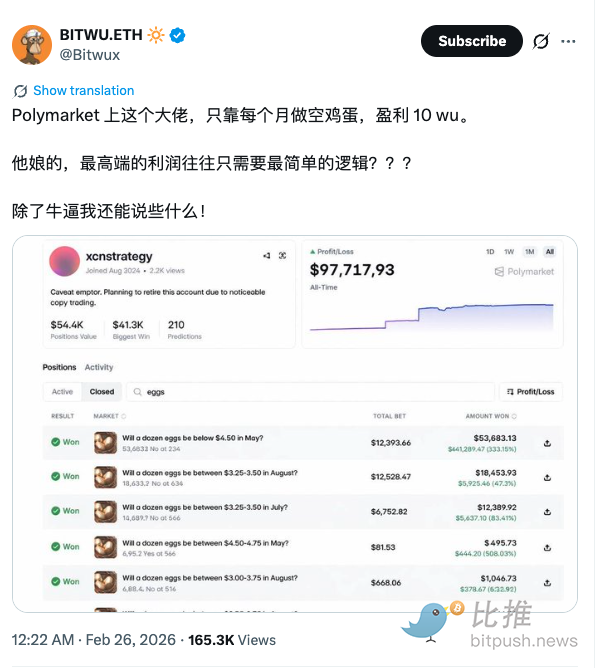
Made 100K U by 'Shorting Eggs Every Month' on Polymarket!
Hot Replies:

People who focus on one category are more sensitive to pricing deviations in this market than anyone else; this is the real edge, not some complex model;

The volatility of eggs is indeed outrageous, but the most impressive part is that they consistently short it every month. If it were me, I probably would have been shaken out by the weekly fluctuations long ago—discipline is the core skill.

This is hedging in a strongly correlated industry, right? Every trade has its master;

Egg futures are just bizarre. The domestic egg futures market has been manipulated by a few people because the market cap is too small.

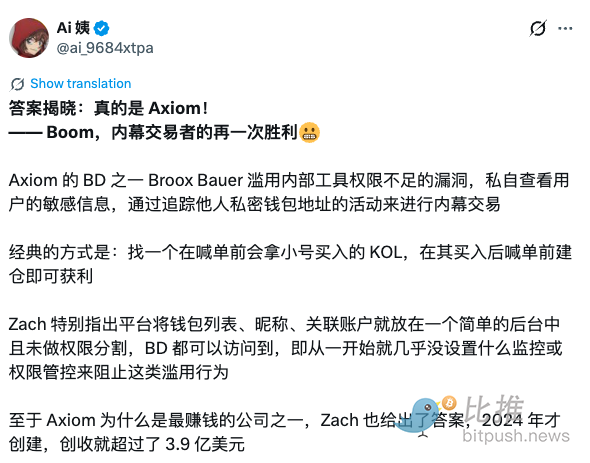
Zach's Hammer Falls: Insider Trading at Axiom Exchange

Hot Replies:

Suggest everyone not be too quick to kick them while they're down. For centralized custodial services, users' private keys and funds are in the hands of the project team. Push them too hard, and they might just pull the plug and run.

Institutions manipulate Bitcoin, exchanges engage in insider trading, project teams pump and dump... Nothing is surprising in the crypto world, which is famously called the 'Online Northern Myanmar'.

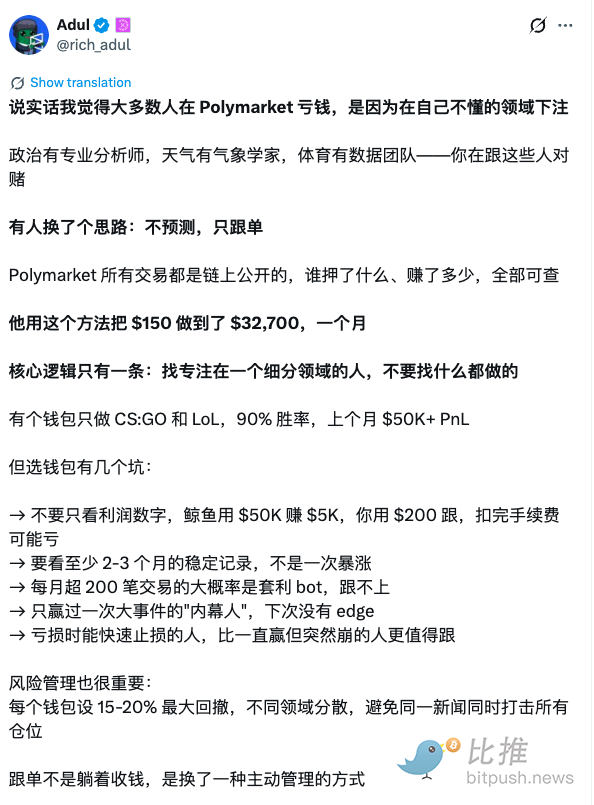
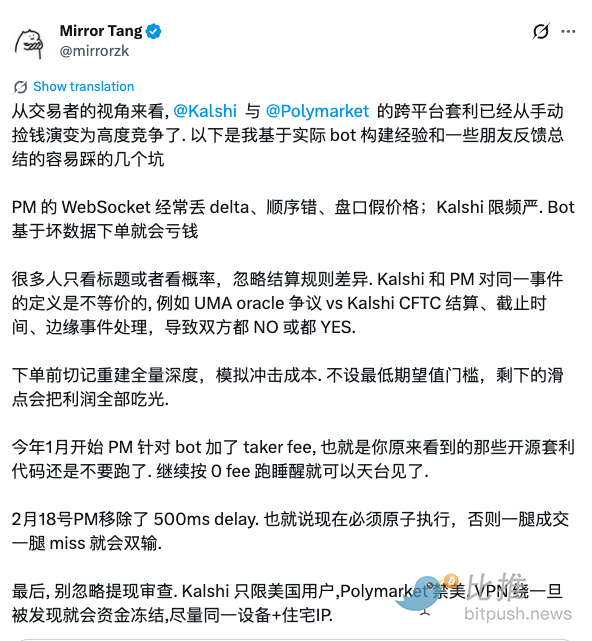
Common Pitfalls and Experience in Kalshi vs. Polymarket Arbitrage (Technical干货)

Experience post link:https://x.com/mirrorzk/status/2023303202196570420
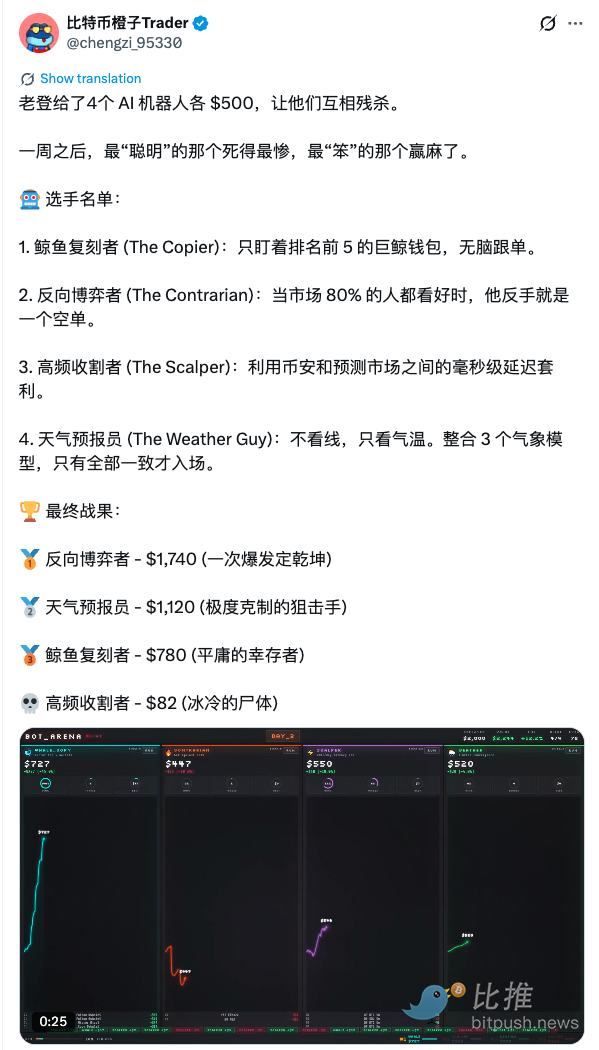
Letting AI Bots/Agents Trade Crypto for You: How Did It Go?

Twitter:https://twitter.com/BitpushNewsCN

BitPush TG Discussion Group:https://t.me/BitPushCommunity

BitPush TG Subscription: https://t.me/bitpush

Original link:https://www.bitpush.news/articles/7614958

Domande pertinenti

QWhat strategy did the trader use to earn 100,000 USDT on Polymarket?

AThe trader consistently shorted eggs on the prediction market, capitalizing on pricing inefficiencies and high volatility in the egg market.

QAccording to the article, what is considered the real 'edge' in prediction markets?

AThe real edge is having deep knowledge and sensitivity to pricing deviations in a specific category, rather than relying on complex models.

QWhat major issue was exposed involving Axiom Exchange?

AAxiom Exchange was involved in an insider trading scandal, as highlighted by Zach's investigation.

QWhat platform comparison is discussed for arbitrage opportunities in the article?

AThe article discusses arbitrage between Kalshi and Polymarket, including common pitfalls and technical insights.

QWhat caution is advised regarding centralized exchanges in the context of the Axiom scandal?

AUsers are cautioned against provoking centralized exchanges, as they control private keys and funds, and might disconnect services or exit scam if pressured.

Letture associate

With Two Consecutive Quarters of Losses, Coinbase Must Rely on Paths Beyond Trading

Coinbase posted its second consecutive quarterly net loss of $359 million on $1.22 billion in revenue for Q2, highlighting its vulnerability to crypto market cycles where weaker prices and lower volatility reduce user trading. However, the report also reveals a strategic shift in its business model. Despite a 25% quarter-over-quarter decline in global spot trading volume, Coinbase increased its market share to a company-record 10.3%. This suggests its position as a compliant U.S. on-ramp is strengthening even in a cooler market. A key development is the diversification of revenue streams. Transaction revenue fell to $599 million, nearly equaling subscription and services revenue of $555 million. Stablecoin services, generating $292 million, are becoming a crucial revenue "floor." This income, derived from interest on the $20 billion average USDC balance held on its platform, is less tied to daily trading activity. Furthermore, while spot trading volume dropped significantly, derivatives volume held steady at $1.03 trillion. Coinbase is pushing to integrate spot, stablecoin, and derivatives liquidity to create a more interconnected and sticky ecosystem for users. The GAAP net loss includes non-cash expenses like stock-based compensation and crypto asset valuation changes. Its adjusted EBITDA remained positive at $208 million for the 14th straight quarter, indicating core operations can cover ongoing costs. The company is also reducing expenses to manage the downturn. The central question moving forward is whether Coinbase's growing market share, stablecoin revenues, and expanding product integration can sufficiently offset the inherent cyclicality of its core trading business during future market contractions.

marsbit18 min fa

With Two Consecutive Quarters of Losses, Coinbase Must Rely on Paths Beyond Trading

marsbit18 min fa

In the Age of Artificial Intelligence, We Need 'Magicians,' Not 'Managers'

In the AI era, leadership must shift from management to magic. As knowledge rapidly expires, value shifts from what leaders know to what they can facilitate. Traditional "inside-out" management, driven by internal experience, is giving way to "outside-in" thinking focused on external opportunities, customer needs, and disruptive change. The core challenge is fostering new ideas that may invalidate existing knowledge. While technologies like steam, electricity, and AI provide the "skeleton" for innovation, it is human vision—connecting technology to customer dreams—that creates magic. Historical figures like Richard Arkwright and Eldridge R. Johnson succeeded not by inventing core technologies, but by reimagining work and business models from the outside in. Leaders must transition from controllers to "architects of flourishing." Their role is to design environments where empowerment, creativity, and adaptive learning thrive. This involves granting autonomy, fostering partnerships, and building resilient systems that scale innovation. Critical leadership qualities now include judgment, creativity, and the ability to learn continuously rather than relying on static expertise. Therefore, cultivating future leaders requires a focus on timeless fundamentals, humanities for broader perspective, and social acuity, rather than over-specialization in quickly outdated technical skills. The future rewards those who respond to the unseen and create conditions for better answers to emerge. Leadership in the AI age is less about having all the answers and more about enabling others to discover them—creating organizations where people explore, imagine, and thrive.

marsbit53 min fa

In the Age of Artificial Intelligence, We Need 'Magicians,' Not 'Managers'

marsbit53 min fa

Trading

Spot
活动图片