特朗普与马斯克,SPACE深度对话回顾

marsbitPubblicato 2024-08-12Pubblicato ultima volta 2024-08-13

美国

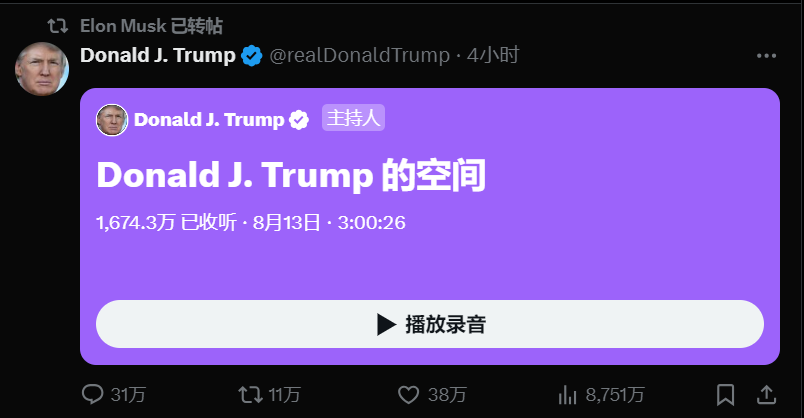
今晨,伊隆·马斯克与美国前领导人唐纳德·特朗普在X平台展开了一场持续超过两小时的太空对话。尽管X平台的界面显示最多有120万人同时在线,马斯克却宣称有超过6000万听众通过太空对话收听。值得注意的是,太空对话对于参与人数有一定的显示限制。

在对话过程中,由于马斯克频繁使用“yeah”来回应特朗普,新近推出的网络迷因货币YEAH在短短20分钟内市值飙升至200万美元以上,但随后其价值迅速回落。

在这次太空对话中,马斯克首先解释了推特所遭受的大规模服务器网络攻击。接着,对话从特朗普遭遇未遂刺杀事件开始,涵盖了非法移民、边境安全、经济挑战、全球安全等众多社会政治议题。尽管对话中并未提及加密货币行业的发展,但强调了美国政府需要对人工智能产业给予更多关注。以下是BlockBeats对太空对话要点的简要梳理:

刺杀事件

特朗普详述了一次未遂的刺杀经历,称这次经历既令人不快又超现实。当时他耳朵受伤,出血量较大,但在那种紧急情况下,伤势相对较轻。特朗普表示,是一张“非法移民图表”在关键时刻救了他一命。当子弹发射时,他因查看图表而转头,从而避免了更严重的伤害。这张图表通常在演讲结束时使用,但这次却意外地在演讲开始时放置在了一旁,发挥了救命作用。

一名特勤局狙击手在大约400码外成功击中了枪手。尽管当地警察和安全部队之间的协调存在问题,导致枪手得以登上屋顶,但特勤局的表现十分英勇,一名特工在危急时刻跳到特朗普身上进行保护。同时,现场群众保持了秩序,没有发生踩踏等混乱情况。

移民问题

特朗普在任期内通过实施“留在墨西哥”和“在墨西哥抓捕后释放”等政策,成功将非法移民数量降至历史最低。然而,他批评现任政府取消了这些政策,导致非法移民数量激增,对国家安全构成威胁。特朗普强调了支持合法移民和关闭非法移民通道的重要性,并批评了现任政府在边境安全方面的不力表现。

特朗普还提到,通过在德克萨斯州鹰关的观察,他目睹了大量移民跨越边境,其中许多人看起来并不友好,且来源多样,不仅限于墨西哥。他警告说,开放边境可能导致多达5000万到6000万移民涌入美国,这对国家来说是不可持续的。

特朗普宣布了美国历史上最大规模的驱逐行动计划,并批评了一些国家,如委内瑞拉,向美国输送非生产性人口和罪犯。他还批评了现任民主党领导人的无能,认为他们未能有效威慑全球独裁者,导致了全球性问题。特朗普强调,与全球领导人如普京和金正恩保持良好关系对于全球稳定至关重要。

美国经济

特朗普指出,美国目前正面临严重的经济挑战,包括显著的通货膨胀和能源价格的大幅上涨,这些问题给许多家庭带来了生活负担。他将这些经济问题归咎于现任政府的政策,尤其是不可持续的能源政策。特朗普还强调了在国防和政府效率方面的成就,包括重建军队和通过谈判削减空军一号成本。他主张成立政府效率委员会,以确保纳税人资金的合理使用,并批评了现任政府的过度支出和缺乏明智的法规管理。

特朗普提出了一系列应对措施,包括增加石油开采以降低能源价格,并警告现任政府在应对人工智能发展带来的能源需求方面准备不足。他还呼吁继续推进放松管制,减少不必要的法规,并改革教育体系,将教育控制权移交给各州,以提高教育质量和效率。

能源问题

在气候变化问题上,特朗普持温和态度,主张在不妖魔化石油和天然气行业的情况下,推动可持续能源的发展,同时认识到化石燃料的必要性。他认为核能作为安全电力来源被低估了,值得重新考虑,而核扩散则是一个重大担忧,需要强有力的领导来防止。特朗普还提到了向福岛捐赠的太阳能水处理系统,以支持核安全改进。

现任政府

特朗普批评了现任政府在多个方面的表现,包括利用法律诉讼和地方检察官对政治对手进行打压,对拜登的身体和精神健康表示担忧,批评卡马拉·哈里斯的极左政策和过往记录。他还指出,欧盟在贸易上利用美国,美国在北约中承担了不成比例的费用,并对乌克兰局势和财政贡献提出了讨论。

在技术进步方面,特朗普提到了一些潜在项目,如月球基地、火星任务和城市高速连接,并强调了拉斯维加斯隧道项目的进展和对先进交通系统的需求。他还讨论了监管改革,批评FDA药物审批流程过于缓慢,并强调了“尝试权”立法的成功。

特朗普还对美国的安全和犯罪现状提出批评,指责骚乱和移民犯罪导致民众感到不安全,并表示暴力罪犯常常被无保释释放。

加密货币

值得注意的是,本次直播对话从始至终,均未提及加密货币或比特币,令两人不少加密粉丝感到失望。

在直播开始至结束后,特朗普概念相关MEME代币比如MAGA、FIGHT等一转此前上涨的趋势,根据coingecko数据,过去8小时MAGA跌幅高达40%。

最新消息,马斯克又邀请美国副总统、总统大选民主党候选人卡玛拉·哈里斯参加Space,这是否又会引起相关加密行情及meme走势,火星财经持续为你追踪。

Letture associate

Rented Faith: How Much of the Bitcoin ETF Inflows Is Real Money?

"Rented Conviction: How Much of Bitcoin ETF Flows Is Real Money" The weekly inflows into Bitcoin ETFs are often interpreted as a gauge of institutional belief. However, a significant portion of this activity is driven by a hidden arbitrage trade, not directional conviction. The core mechanism is a cash-and-carry arbitrage: traders buy spot Bitcoin (often via ETFs) while simultaneously shorting CME futures to lock in the price difference, or "basis." This delta-neutral trade is essentially an interest rate play. In weekly data, about half the fluctuation in ETF flows can be explained by new short positions added by leveraged funds (hedge funds), with a correlation of 0.70. Bitcoin's price movement in a given week shows no statistical power in predicting these flows. While this arbitrage trade drives weekly *volatility*, it is not the main component of the cumulative *stock*. Of the total ~$55 billion in net ETF inflows, the current net arbitrage position is only about $1 billion. The remainder is steady, directional buying averaging ~$400 million per week, which constitutes the vast majority of the accumulated "mountain" over two years. Thus, ETF flow data overstates the *volatility* of conviction, not its *level*. This arbitrage trade has been unwinding for nearly two years. Leveraged fund short positions peaked at ~$14 billion in late 2024 and have since declined to ~$4.5 billion. When the basis compresses to unprofitable levels, ETF inflows and short positions retreat together. Recent outflows should not be mistaken for a loss of faith but rather the routine unwinding of this rate trade. For Ethereum ETFs, the pattern is weaker. Accounting for staking yield makes the basis often negative, so neither strong conviction buying nor robust arbitrage supports its flows. To interpret ETF flows correctly, monitor the CME basis versus T-bill rates and leveraged fund net shorts. They reveal how much of the next "demand" headline is real. The real, patient buy-and-hold demand is what constitutes the enduring bulk of ETF assets.

marsbit46 min fa

Rented Faith: How Much of the Bitcoin ETF Inflows Is Real Money?

marsbit46 min fa

Soaring Over Tenfold Within the Year: The Frenzy Over SK Hynix Leveraged Products

South China Morning Post The leveraged ETF tracking SK Hynix has surged over tenfold year-to-date, fueled by intense market speculation on the memory chip sector. By June 22, the value of the 'South Korea 2x Long SK Hynix ETF' listed in Hong Kong had skyrocketed by more than 1,061% since the start of the year, while its asset size exploded over twenty times from the end of last year. The rally is driven by AI-driven demand for high-bandwidth memory (HBM), with SK Hynix recently sampling its next-generation HBM4E product. However, industry professionals warn of significant risks. Leveraged ETFs magnify both gains and losses. During a recent market correction, while the underlying SK Hynix stock fell 19.1%, its double-leveraged ETF dropped nearly 38%. Korean regulators noted that such products could theoretically lose 60% in a single day. Additionally, these ETFs face risks like time decay in volatile markets, liquidity spirals during mass redemptions, and extreme price dislocations from market-making failures, as seen in early June when an ETF moved opposite to its underlying stock. The trading is predominantly driven by retail investors, with institutional capital largely absent due to the products' high volatility. Analysts caution that with the semiconductor sector at elevated valuations and facing geopolitical and supply chain uncertainties, leveraged ETFs pose a substantial threat of amplified losses for uninformed investors.

marsbit1 h fa

Soaring Over Tenfold Within the Year: The Frenzy Over SK Hynix Leveraged Products

marsbit1 h fa

18 Months, Over 50x Surge: KIOXIA's Epic Comeback

KIOXIA, a NAND flash memory giant, staged a dramatic comeback driven by AI demand. After a period of significant losses, a failed merger, and missed HBM opportunities, its 2024 IPO began modestly. However, fueled by explosive demand for AI data storage, its stock price skyrocketed over 50 times within 18 months, making it Japan's most valuable company, surpassing Toyota. Its Q1 FY2026 profit guidance soared 30-fold year-over-year, with 2026 NAND capacity already sold out. Key to its success is its 3D NAND technology, BiCS FLASH. As the inventor of NAND, KIOXIA advanced its technology through generations, reaching over 200 layers by 2023. Key innovations include CBA (CMOS directly Bonded to Array), which separately manufactures control circuits and memory arrays for better performance, and OPS (On Pitch Select Gate) to increase density. The company is now developing high-capacity packages like an 8TB solution stacking 32 dies. Looking beyond NAND, KIOXIA is exploring 3D DRAM with its OCTRAM technology, using oxide semiconductor transistors for ultra-low leakage to reduce power consumption. This fundamental research differs from HBM and represents a long-term bet to extend its 3D expertise from NAND into future DRAM architectures. KIOXIA's story highlights how technological assets and shifting market cycles can rapidly transform a company's fortunes. While questions remain about sustaining growth beyond the current AI boom, its resurgence demonstrates that in semiconductors, being down does not necessarily mean being out.

marsbit1 h fa

18 Months, Over 50x Surge: KIOXIA's Epic Comeback

marsbit1 h fa

Trading

Spot
Futures
活动图片