It has been nine years since Dr. Gavin Wood first publicly proposed the concept of Web3 in 2014. Although there is still no consensus on the definition of Web3 in crypto industry, people have been able to get a rough idea of its prototype through several years of exploration. Before discussing what values a Web3 community needs, here’s a brief outline about what the Web3 era might look like.
What will the Web3 era look like?
Looking closely at the development history of human civilization over thousands of years from the standpoint of an ordinary person, it is the process of ever-evolving individual values’ gradual transition from emphasis on collective values to respect and discovery of personal values running through social evolution from primitive society to slave society, then feudal society and capitalist society. This is the reason why the concept of Web3 is rooted in the soil of decentralized crypto assets represented by Bitcoin, which also means that with the dominant spiritual core covering keywords such as fairness, equality, freedom and values, Web3 is naturally resistant to the centralized operation mode.
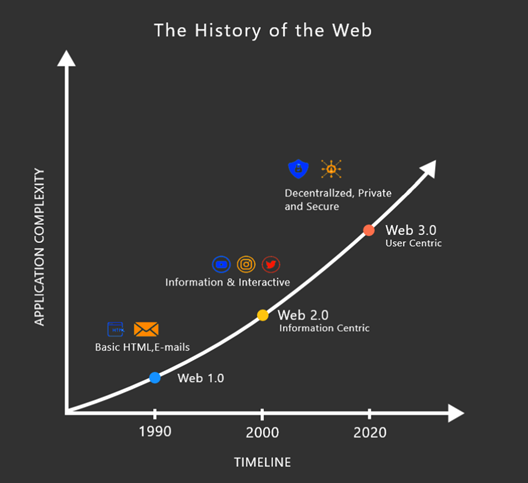
A brief history of the Web. Source: MOJOR
The chart above shows the development of Web1 from the 1990s to current Web3. In conclusion, network information in the Web1 era, also known as the portal era, is in the “read-only” stage with significant PGC characteristics. That is to say, platforms create, own, control the release of the contents and enjoy the final benefits. This mode seems to be reasonable from the perspective of economics. After entering the Web2 era, network information evolves to the “read-write” stage when users are granted with the rights of creating contents, showing the feature of UGC and PGC coexisting while the former one booming. Having offered a wide range of high-quality contents to the platforms, users can’t have full ownership of what they create, for platforms sitting in the absolute dominant position and determining distribution of contents and allocation of final income, which is obviously unreasonable, resulting in contradictions eventually.
Even though a unified definition of Web3 has not been formed, people still can see the embryonic form of it through making requests towards Web3 era by comparing with various unreasonable aspects of Web2 from the perspective of pragmatism. In short — “I own my data. ”Users must have full ownership and control over all the contents created by themselves and are able to determine the distribution channels and ways to obtain benefits.
What values do communities need in the Web3 era?
To achieve the above-mentioned requests in Web3 communities, the most essential values to be upheld are equality and fairness. Equality here not only refers to the equality of identity and status among community members, but also includes the equality over governance rules and benefit distribution mechanism between general community members and the core team of the platform, so as to achieve a comprehensive review of various details based on equality and jointly propose fair governance rules. The next principle is to adhere to and strengthen the concept of real respect for personal values, thereby improving the data element market based on this, opening up the channel of self-monetization of personal information, furthermore completing the thorough transformation over different problems in the current Web2 communities.
In the Web2 era, most Internet companies, or information service providers, have two major ways to make profits: advertising and finance. What these two main businesses have in common is that by taking advantage of controlling tremendous amount of user information and conducting multi-dimensional calculation with centralized servers, the information service providers not only put personalized ads based on user portraits, but also promote financial consumer products, online consumer loan services etc. for high-quality users. From the past practice, the above two business models constitute the main part of current data element market and objectively generate considerable value, most of which is grasped by information service providers while the prominent ills generated on the other side are borne by general users, such as information service providers have collected and used user data without informing users or gaining their authorization for quite a long time, and they keep collecting user information relying on their monopoly situation, thus resulting in data island, making data elements unable to circulate effectively, meanwhile infinitely magnifying its dominant position relative to users, counting against users for effectively protecting their rights and interests. Therefore, Web3 communities urgently need to make a breakthrough in respect for personal values to complement the fatal weakness of data element market.
Finally, another indispensable opinion about values in the Web3 era should be the awareness of personal privacy protection, which is actually consistent with the previous two. That is to say, the Web3 communities should not only broaden the extension of users’ rights, but also enhance protection on users’ privacy. Due to the popularity of cryptocurrency such as Bitcoin, especially the emerging business models such as DeFi throughout the world, more and more people have realized that they can participate in financial activities and diversified social activities without identity censorship, greatly stimulating users’ consciousness awakening on privacy protection, further pushing more countries to regard privacy as a basic human right in need of protection. At the same time, the discussions and applications about DIDs in the crypto market have also attracted more and more attention.
How to establish high-level values in the Web3 era?
The development of Web3 is still at a very early stage from the application level, objectively speaking, which is very beneficial for establishing a system of high-level values adapted to Web3. Learning from the lessons that the values construction lagged behind development of technology and implementation of applications in the Web1/Web2 eras, and in the context of great progresses in blockchain technology, decentralization concept and consciousness of personal privacy protection nowadays, our thinking and construction about the system of values in the Web3 era have been carried out simultaneously with the implementation of applications, among which the most representative way to reach the majority of Web3 users is to establish new values at the entrance of the Web3 communities.
This is exactly what MOJOR, a dark horse project focusing on Web3 infrastructure and services, commits to building. As an NFT-based Web3 community platform founded just several months ago, MOJOR has already attracted attention of users and the capital market, successfully raising $2 million in seed funding at a post-money valuation of $20 million in February this year. The core team members of MOJOR have years of work experience in some well-known Web2 platforms, and keep paying attention to the development of Web3 at the same time. Understanding the deep-rooted problems of Web2 platform communities and greatly influenced by the values of Web3, the team members hold a profound understanding of construction and development of the system of values of Web3 era in the future.
The vision of the team is presented in every detail of MOJOR’s product design, such as users can directly communicate and trade with others with their Web3 addresses in MOJOR without identity censorship and verification, which greatly protects the security of users’ personal information and improves efficiency of transactions. All the users can then mint their own NFTs in MOJOR, and the process of minting NFTs is also the process of creating community server. Due to the unique nature of NFTs, completing minting means that users are granted the absolute ownership and highest authority of the server. At its simplest, the ownership and control of communities created in MOJOR will not be shared by any other organizations or individuals, and users can choose any token as a community governance tool at their own will. During the whole process, all the value generated will fully belongs to the community and how to distribute the value is completely determined by the community as well, demonstrating a design truly respecting individual values. What’s more, MOJOR creates a decentralized social graph by integrating users’ on-chain data, as well as the interactions and friending activities generated by community members, to form universal identity IDs for users in the Web3 world. The biggest difference from Web2 era is that MOJOR only integrates the above information through its protocol, and all the steps will be implemented on chain in the way of encryption, instead of collecting and storing user information like centralized service providers. Every user coming to the Web3 era through MOJOR is equal and will feel enough respect towards personal values and gain the sense of satisfaction, which is the ideal scene in the Web3 era as imagined and the long-term mission that MOJOR is striving to carry out in the meantime.