What is BounceBit: Liquid Restaking on Bitcoin

cryptodailyPubblicato 2024-05-14Pubblicato ultima volta 2024-05-14

Introduzione

The concept of liquid restaking, a topic that has gained significant popularity in recent quarters, offers users the exciting possibility to extract additional value from their staked tokens. Predominantly, however, this has been applied throughout a variety of Ethereum-based applications. BounceBit, on the other hand, is delivering a BTC restaking infrastructure designed to provide a foundational layer for various restaking products. In the following guide, we take a closer look at how BounceBit works, the tokenomics behind its native cryptocurrency, and more. Let’s dive in. Quick Navigation


Table of Contents

The concept of liquid restaking, a topic that has gained significant popularity in recent quarters, offers users the exciting possibility to extract additional value from their staked tokens.
Predominantly, however, this has been applied throughout a variety of Ethereum-based applications.
BounceBit, on the other hand, is delivering a BTC restaking infrastructure designed to provide a foundational layer for various restaking products.
In the following guide, we take a closer look at how BounceBit works, the tokenomics behind its native cryptocurrency, and more. Let’s dive in.
Quick Navigation

  • What is Liquid Restaking?
  • What is BounceBit?
  • What Problems Does BounceBit Solve?
  • Understanding BounceBit’s Infrastructure
    • Dual-Token PoS Structure
    • Sustainable Validator Economics
    • EVM Compatibility
    • BounceClub: For Owners and Members
    • BTC Bridge

  • The Liquid Staking Tokens
  • BounceBit Economy: Everything You Need to Know About BB Tokenomics
  • The Binance Megadrop: Step by Step Guide

What is Liquid Restaking?
Before we explain what BounceBit does, it’s important to understand the concept of liquid restaking that we mentioned above.
You might be familiar with liquid staking protocols and their liquid staking tokens (LSTs). It’s a mechanism that came to prominence with protocols like Lido. Users are able to stake their ETH into Lido (or other protocols) and receive a synthetic representation of this ETH. This is a new token that’s supposed to be pegged to the value of ETH 1:1. They could then use this synthetic ETH to carry out various operations with other protocols that support it.
Liquid restaking, on the other hand, is a process aimed at increasing the economic security of external systems. In essence, you can take your synthetic ETH (your LST) and restake it, receiving another token called a liquid restaking token.
As mentioned above, most of the LRT protocols are increasingly focused on Ethereum because of its Proof of Stake architecture.
BounceBit, on the other hand, is building a BTC restaking infrastructure that’s designed to provide a layer for restaking products on the Bitcoin network.
How do they do it? Well, let’s find out.


What is BounceBit?
In a bid to reimagine Bitcoin’s value, BounceBit proposes an infrastructure designed based on the conviction that Bitcoin should be predominantly asset-driven at the infrastructure level.
BounceBit differentiates itself as a Proof of Stake layer one ecosystem where validators are required to stake BTC and the native BounceBit token. This establishes a dual-token security system that’s aimed at strengthening the network itself but also at improving the intrinsic value of Bitcoin by providing its holders with an active role in validating the BounceBit network.
The goal is to provide a symbiotic relationship between BounceBit’s native token and BTC in an attempt to create a versatile and resilient network.
BounceBit also leverages interoperability with other networks that are EVM-compatible, incorporating staked assets such as BTCB on the “Build ‘N’ Build” (BNB) Chain and Wrapped Bitcoin (WBTC).
Now, it’s worth noting that when t comes to generating yield on BTC – there is a very unique challenge that’s inherently different from yield-generation protocols associated with Ethereum. The Bitcoin protocols can’t yield returns when the BTC is held within multi-signature wallets. This is what BounceBit confronts by integrating a centralized finance (CeFi) approach, taking advantage of Mainnet Digital’s custody services, as well as Ceffu’s MirrorX technology stack.
This essentially allows Bitcoin to maintain its presence on-chain, while also engaging in trading activities on centralized exchanges.
What Problems Does BounceBit Solve?

  • Tackling Lack of Transparency

Those who were around in 2022 remember the transparency issues that plagued the industry through the likes of Celsius and others.
BounceBit incorporates on-chain proof-of-reserve (PoR), while also maintaining transparent activities in a bid to restore the trust and deliver a secure platform that allows BTC holders to earn interest.

  • Underutilized BTC Assets

Undoutedbly, BTC holders face the challenge of their assets being underutilized. BounceBit seeks to tackle this challenge by providing them with a means of actively engaging their assets in the thriving sectors of decentralized finance and NFTs.

  • Improving Bitcoin Utility by Enabling Additional Use Cases

By extension of the above, BounceBit also commits to expanding the overall utility of BTC and Bitcon’s network as a whole. The goal is to broaden the scope of opportunities for BTC holders and leverage the cryptocurrency as a major asset.

  • Unifying BTC Across Chains

BounceBit identifies the absence of a smart contract platform within Bitcoin’s ecosystem as limiting the overall development of dApps and works to provide one.

Understanding BounceBit’s Infrastructure
BounceBit is building a network that leverages the well-known Proof-of-Stake (PoS) consensus algorithm to rethink conventional staking models that focus on a single token. They call this approach Dual-Token Proof of Stake (PoS).

  • Dual-Token PoS Structure

In light of the above, it’s worth explaining that the protocol’s architecture incorporates a number of node operators. These can be selected as validators. These are parties that have to stake BB (the native token of BounceBit) and/or BBTC (staked BTC on the BounceBit chain). Their job is to record and verify the transactions on the network and as a reward – they receive transaction fees. As it’s a hybrid model, validators can choose to accept BBTC and/or BB tokens.
The purpose of accepting BTC, albeit staked, in the consensus mechanism, is to bootstrap the protocol with the deep liquidity that Bitcoin’s network has to offer, while also taking advantage of its relatively lower volatility.

  • Sustainable Validator Economics

In a bid to balance the requirements for operating the network, BounceBit empowers its validators to charge a commission on the staking rewards. This is an approach that attempts to ensure that validators are compensated appropriately for the important role that they play in maintaining the robustness and functionality of the network.

  • EVM Compatibility

BounceBit’s chain is fully compatible with both the Ethereum Virtual Machine and with Solidity. The latter is the programming language that’s predominantly used to create smart contracts for Ethereum. This ensures that the migration for developers would be seamless while also leveraging the proven security and abundant ecosystem of Ethereum.

  • BounceClub: For Owners and Members

The BounceClub takes inspiration from Apple Inc.’s strive for innovation. It is an on-chain Web3 world where users are empowered to customize, launch, and engage with various dApps.
For BounceClub Owners -> If you meet the criteria to own a BounceClub, you will be able to select desired protocols from the BounceBit App Store and customize the space seamlessly and in a very user-friendly way. There’s a complete guide on it that you can find here.
For BounceClub Members -> Say you’re not interested in operating a BounceClub, you can still browse the various clubs that are created by other users and engage in different Web3 activities. You would only need to get your wallet connected.

  • BTC Bridge

The main purpose of the BTC bridge within BounceBit’s ecosystem is to provide a secure way of transferring BTC between Bitcoin’s network and other EVM Chains, including BounceBit.
It is a critical component of the functionality and the completion of BounceBit’s vision and purpose.
It’s important to note that network validators are responsible for maintaining the security of the bridge. Each validator also operates a bridge node. They contribute to the signing of cross-chain messages, taking the multi-signature approach multiple steps further. You can find out more about the BounceBit BTC bridge here.
The Liquid Staking Tokens
BounceBit has a native liquid staking smart contract. If users opt-in to stake their BB or BTC, they will receive an LST (liquid staking token). These are:

  • stBB – derived from staking BB
  • stBBTC – derived from staking BBTC (BTC staked on BounceBit)

These can be later restaked to Shared Security Clients with the aims of aggregating security and unlocking liquidity of staked assets. LSTs can be redeemed here by simply unstaking. Following the redemption request, users have to wait for 24 hours before they can claim.
BounceBit Economy: Everything You Need to Know About BB Tokenomics
First things first, BounceBit’s economy is primarily composed of three types of actors, all of which are relatively self-explanatory:

  • Users
  • BB Holders
  • Node operators

BB is the native token that powers the BounceBit platform. The total supply is capped at 2.1 billion (paying homage to the number of 21 million – Bitcoin’s capped supply.)
BB tokens can be used in multiple ways, so we will list a few of them:

  • Use BB to take part in the on-chain governance process
  • Stake BB to participate in the PoS Dual-token mechanism (read above)
  • BB is paid out as a reward for validators who secure the network
  • It’s the denomination of gas fees on the network

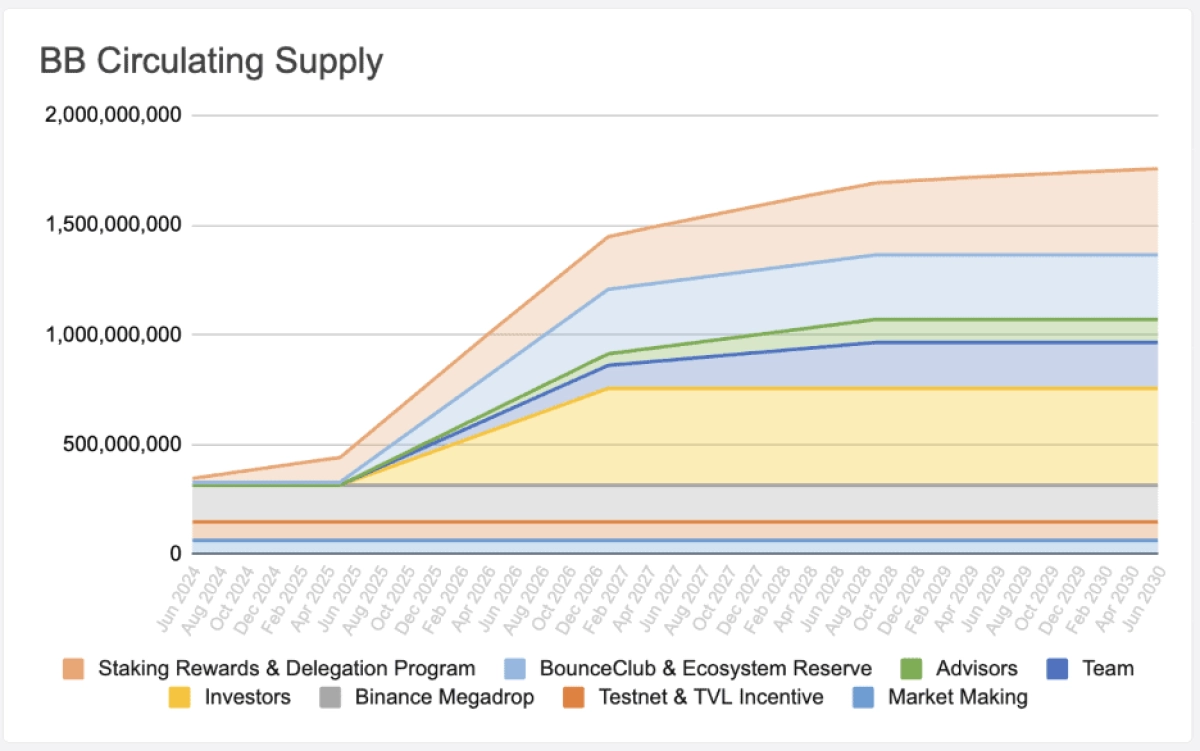
Here’s what the token release schedule looks like:

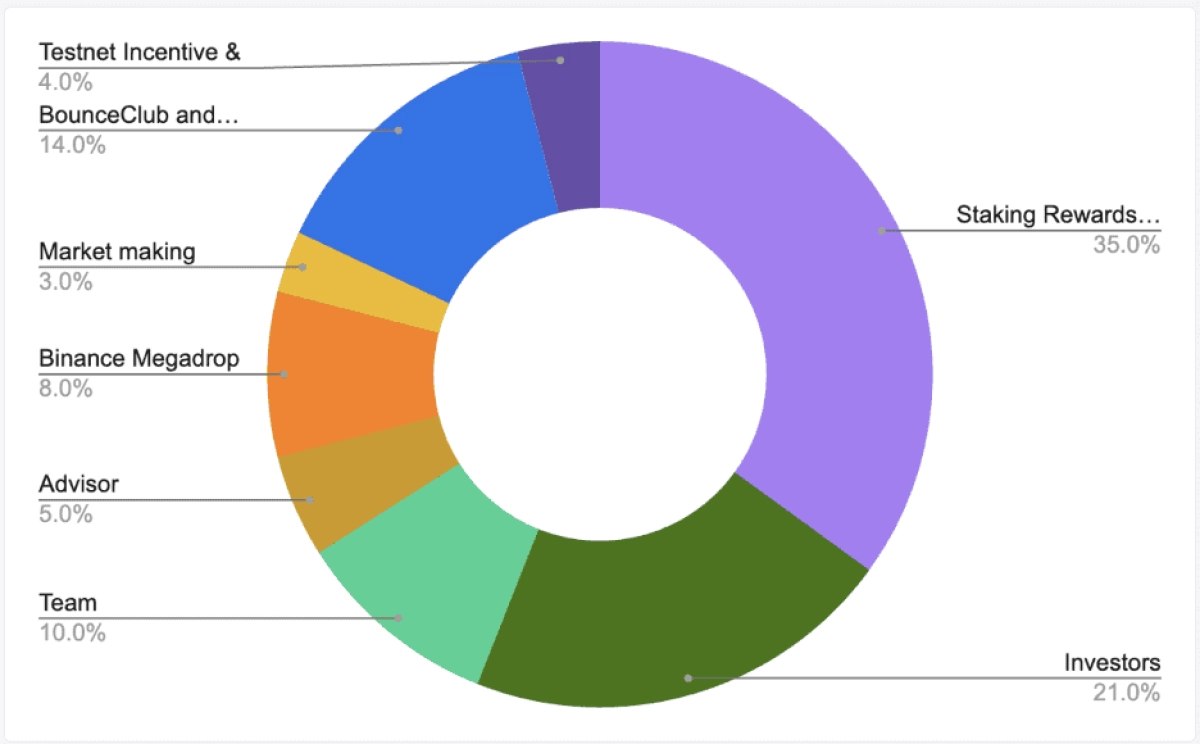
This is the BB token distribution:
Testnet & TVL Incentive: 4%
Investors: 21%
Team: 10%
Advisors: 5%
Binance Megadrop: 8%
Market Making: 3%
BounceClub & Ecosystem Reserve: 14%
Staking Reward & Delegation Program: 35%

The Binance Megadrop: Step by Step Guide
As you can see, the Binance Megadrop has 8% of the total supply reserved for it. It is a new token launch platform that’s designed to integrate Binance’s Simple Earn and the Web3 Wallet of the company.
It aims to provide users with early access to certain Web3 projects well before they are listed on the exchange.
The following is a step-by-step guide on how to participate in the Binance Megadrop for BounceBit.
There are two ways to participate, and both require a Binance account.
You can register one using this link and also earn a $600 welcome bonus as an exclusive deal for CryptoPotato readers!
Now that your account is ready, the first thing you can do is navigate to the Megadrop section and lock your BNB to earn scores. From there, you can subscribe to your BNB and lock it for a certain period of time, thus earning a score.
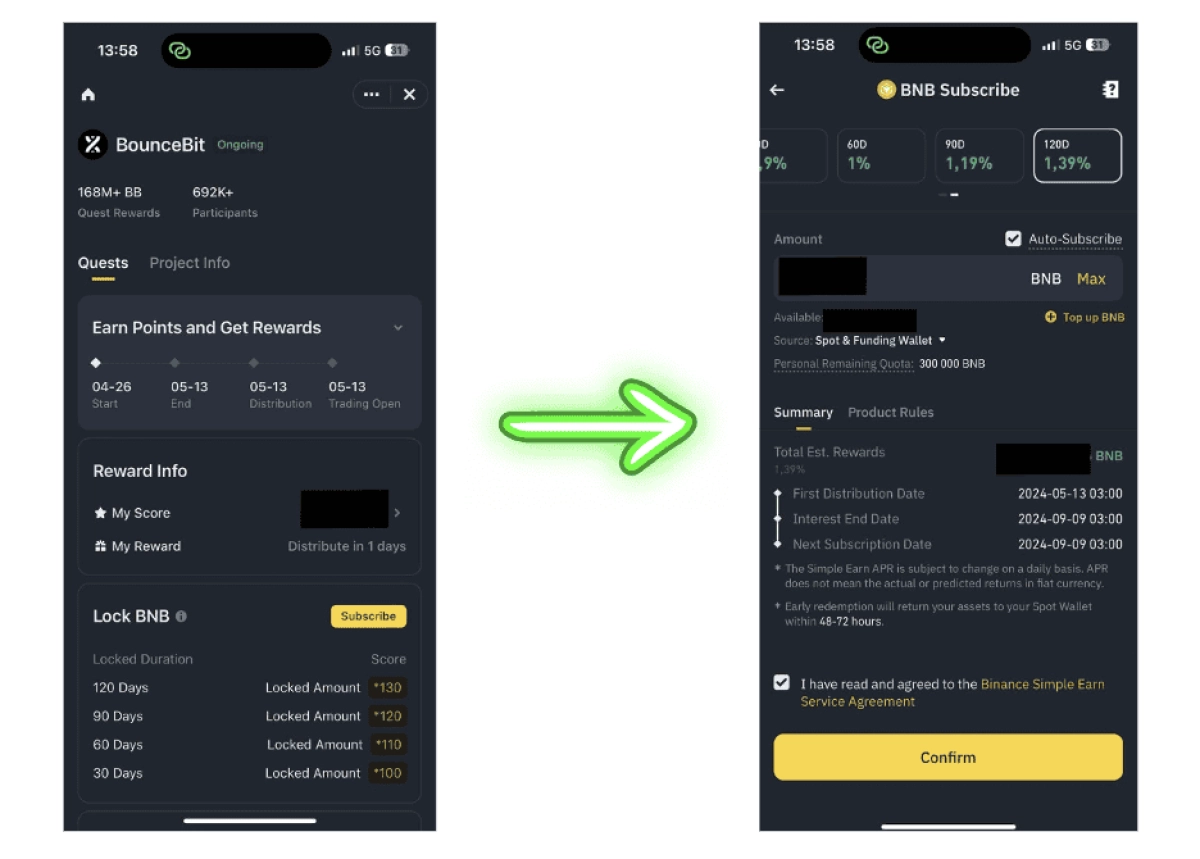

As you can see, the longer the subscription period, the higher the multiplier is.
The next thing you can do is complete Web3 quests. To do so, you will need the Binance Web3 Wallet. You can create one from your Binance mobile application. Navigate to your “wallets” tab at the bottom and then tap on the “Web3” at the top.
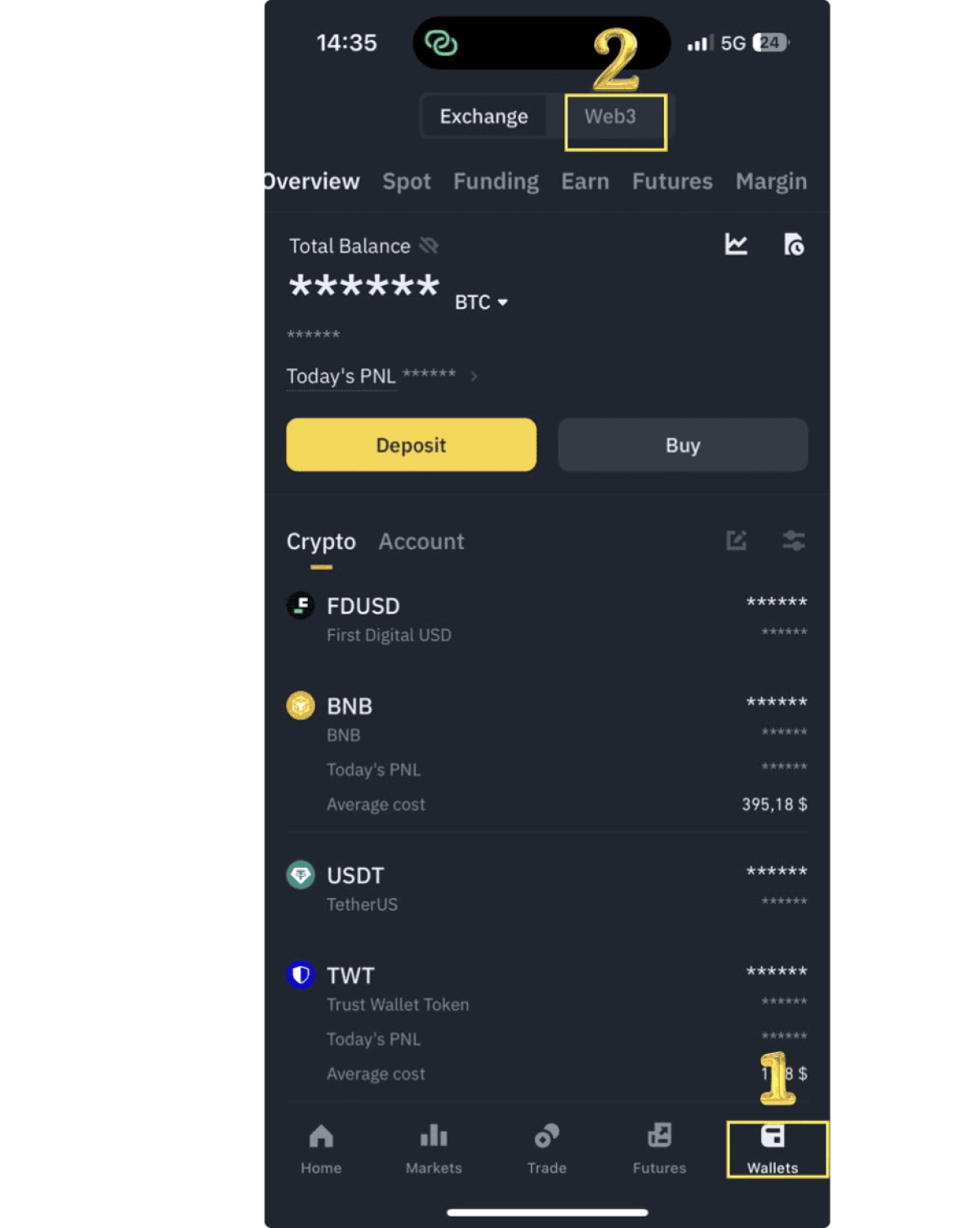

From here, simply follow the instructions, and your Web3 wallet will be generated. Now that your wallet is complete, navigate back to the Megadrop section and hit the “Start Quest” at the bottom – you will have to stake with BounceBit.
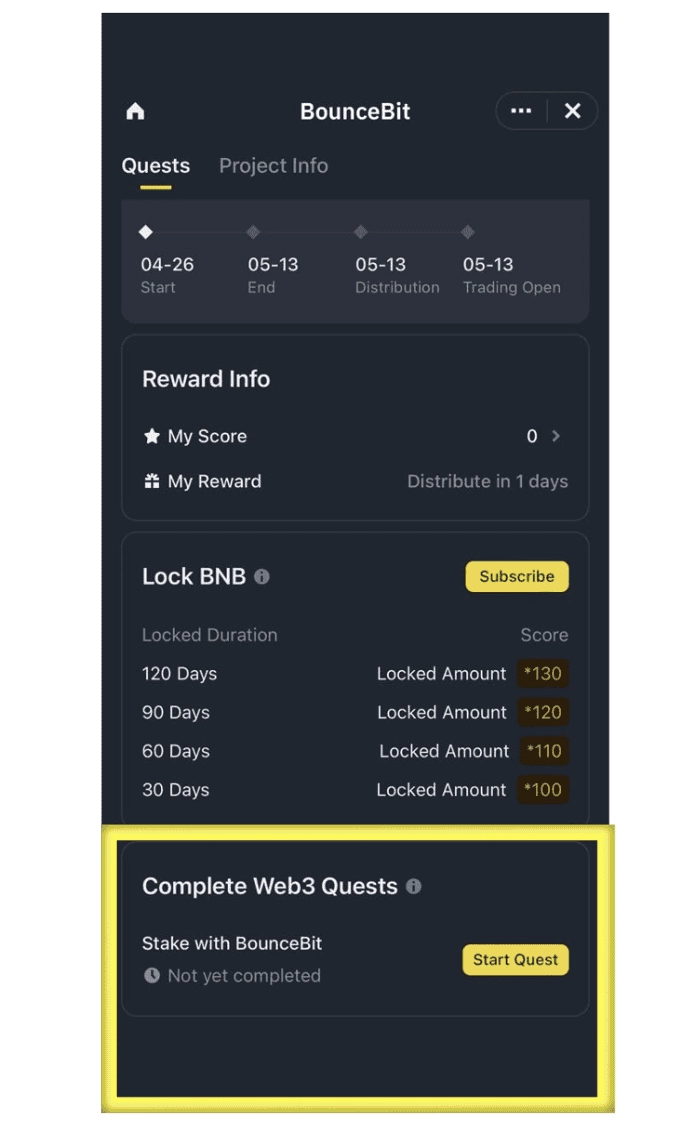
From there on, you can follow the instructions, which will guide you toward quest completion.
The total score you receive will be a combination of your Locked BNB score, your Web3 quest multiplier, and will also add your Web3 quest bonus. So the formula looks like this:
Total Score = (Locked BNB Score * Web3 Quest Multiplier) + Web3 Quest Bonus.
If you fail to finish all the quests, you will receive a multiplier of just 1.
This post has been powered by BounceBit.
The post What is BounceBit: Liquid Restaking on Bitcoin appeared first on CryptoPotato.
Disclaimer: This article is provided for informational purposes only. It is not offered or intended to be used as legal, tax, investment, financial, or other advice.
Read on CryptoPotato Investment Disclaimer

Letture associate

How Many Tokens Away Is Yang Zhilin from the 'Moon Chasing the Light'?

The article explores the intense competition between two leading Chinese AI companies, DeepSeek and Kimi (Moon Dark Side), and the mounting pressure on Yang Zhilin, the founder of Kimi. While DeepSeek re-emerged after 15 months of silence with its powerful V4 model—boasting 1.6 trillion parameters and low-cost, long-context capabilities—Kimi has been focusing on long-context processing and multi-agent systems with its K2.6 model. Yang faces a threefold challenge: technological rivalry, commercialization pressure, and investor expectations. Despite Kimi’s high valuation (reaching $18 billion), its revenue heavily relies on a single product with low paid conversion rates, while DeepSeek’s strategic silence and open-source influence have strengthened its market position and valuation prospects, now targeting over $20 billion. Both companies reflect broader trends in China’s AI ecosystem: Kimi aims for global influence through open-source contributions and agent-based advancements, while DeepSeek prioritizes foundational innovation and hardware independence, notably shifting to Huawei’s chips. Their competition is seen as vital for China’s AI progress, with the gap between top Chinese and U.S. models narrowing to just 2.7% on the Elo rating scale. Ultimately, the article argues that this rivalry, though anxiety-inducing for leaders like Zhilin, is essential for driving innovation and solidifying China’s role in the global AI landscape.

marsbit47 min fa

How Many Tokens Away Is Yang Zhilin from the 'Moon Chasing the Light'?

marsbit47 min fa

TechFlow Intelligence Bureau: ChatGPT Helps Amateur Mathematician Crack 60-Year-Old Problem, CFTC Sues New York Regulator Over Coinbase and Gemini

An amateur mathematician, with the assistance of ChatGPT, has solved a combinatorial mathematics puzzle originally proposed by Hungarian mathematician Paul Erdős in the 1960s. This marks another milestone in AI-aided mathematical research, demonstrating the evolving capabilities of large language models in formal reasoning. In other AI developments, OpenAI introduced a new privacy filter tool for enterprise API usage, automatically screening sensitive data. Meanwhile, the Qwen3.6-27B model achieved 100 tokens per second on a single RTX 5090 GPU using quantization, significantly lowering the cost barrier for local AI deployment. In crypto and Web3, the U.S. CFTC sued New York’s financial regulator, challenging its oversight of Coinbase and Gemini—a first-of-its-kind federal-state regulatory clash. Following a vulnerability, KelpDAO and major DeFi protocols established a recovery fund. Tether froze $344 million in assets linked to Iran’s central bank upon U.S. Treasury request, highlighting the centralized control risks in stablecoins. Separately, Litecoin underwent a 3-hour chain reorganization to undo a privacy-layer exploit. In the U.S., former President Trump invoked the Defense Production Act to address power grid bottlenecks affecting AI data centers and dismissed the entire National Science Board, raising concerns over research independence. A retail trader gained 250% on a $600k Intel options bet amid AI-related speculation. Xiaomi announced its first performance electric vehicle, targeting rivals like Tesla. Meanwhile, iPhone users reported devices automatically reinstalling a hidden app daily, suspected to be MDM-related. A Chinese securities report noted that A-share institutional crowding has reached its second-longest streak since 2007, signaling high valuations and potential style rotation. The day’s developments reflect a dual narrative: AI is enabling unprecedented individual breakthroughs, while centralized power structures—whether governmental or corporate—are becoming more assertive, underscoring that decentralization is as much a political-economic challenge as a technical one.

marsbit1 h fa

TechFlow Intelligence Bureau: ChatGPT Helps Amateur Mathematician Crack 60-Year-Old Problem, CFTC Sues New York Regulator Over Coinbase and Gemini

marsbit1 h fa

Trading

Spot
Futures

Articoli Popolari

Cosa è BITCOIN

Comprendere HarryPotterObamaSonic10Inu (ERC-20) e la sua posizione nel mondo delle criptovalute Negli ultimi anni, il mercato delle criptovalute ha assistito a un aumento della popolarità delle meme coin, catturando l'interesse non solo dei trader, ma anche di coloro che cercano coinvolgimento comunitario e valore di intrattenimento. Tra questi token unici c'è HarryPotterObamaSonic10Inu (ERC-20), un progetto intrigante che mescola riferimenti culturali nel tessuto delle criptovalute. Questo articolo esplora gli aspetti chiave di HarryPotterObamaSonic10Inu, analizzando i suoi meccanismi, l'etica guidata dalla comunità e il suo coinvolgimento con il panorama crittografico più ampio. Che cos'è HarryPotterObamaSonic10Inu (ERC-20)? Come suggerisce il suo nome, HarryPotterObamaSonic10Inu è una meme coin costruita sulla blockchain di Ethereum, classificata secondo lo standard ERC-20. A differenza delle criptovalute tradizionali che possono enfatizzare l'utilità pratica o il potenziale investimento, questo token prospera grazie al valore di intrattenimento e alla forza della sua comunità. Il progetto mira a creare un ambiente in cui gli utenti coinvolti possono riunirsi, condividere idee e partecipare ad attività ispirate a diversi fenomeni culturali. Una caratteristica notevole di HarryPotterObamaSonic10Inu è la zero tassa sulle transazioni. Questo elemento allettante tende a incoraggiare il trading e il coinvolgimento della comunità, privo di costi aggiuntivi che possono scoraggiare i trader di piccole dimensioni. L'offerta totale della moneta è fissata a un miliardo di token, un numero che segna la sua intenzione di mantenere una circolazione sostanziale all'interno della comunità. Creatore di HarryPotterObamaSonic10Inu (ERC-20) Le origini di HarryPotterObamaSonic10Inu sono avvolte in un certo mistero; i dettagli sul creatore rimangono sconosciuti. Lo sviluppo di questo token non presenta un team identificabile o un piano esplicito, cosa non rara nel settore delle meme coin. Invece, il progetto è emerso organicamente, con il suo progresso fortemente dipendente dall'entusiasmo e dalla partecipazione della sua comunità. Investitori di HarryPotterObamaSonic10Inu (ERC-20) Per quanto riguarda investimenti esterni e finanziamenti, HarryPotterObamaSonic10Inu rimane ambiguo. Il token non elenca alcuna fondazione di investimento conosciuta o un sostegno organizzativo significativo. Invece, la linfa vitale del progetto è la sua comunità di base, che informa la sua crescita e sostenibilità attraverso azioni collettive e coinvolgimento nello spazio crittografico. Come funziona HarryPotterObamaSonic10Inu (ERC-20)? In quanto meme coin, HarryPotterObamaSonic10Inu opera principalmente al di fuori delle strutture tradizionali che governano spesso il valore degli asset. Ci sono diversi aspetti distintivi che definiscono il funzionamento del progetto: Transazioni senza tasse: Senza costi fiscali sulle transazioni, gli utenti possono comprare e vendere liberamente il token senza preoccuparsi di costi nascosti. Coinvolgimento della comunità: Il progetto prospera sull'interazione della comunità, sfruttando le piattaforme social per creare entusiasmo e facilitare il coinvolgimento. Discussioni, condivisione di contenuti e coinvolgimento sono elementi cruciali che aiutano ad espandere la sua portata e a favorire la lealtà tra i sostenitori. Nessuna utilità pratica: Va notato che HarryPotterObamaSonic10Inu non offre un'utilità concreta all'interno dell'ecosistema finanziario. Piuttosto, è classificato come un token principalmente per attività di intrattenimento e comunitarie. Riferimento culturale: Il token incorpora astutamente elementi della cultura pop per attirare interesse, collegandosi a appassionati di meme e seguaci delle criptovalute. HarryPotterObamaSonic10Inu esemplifica come le meme coin operino in modo diverso rispetto ai progetti di criptovalute più tradizionali, entrando nel mercato come costrutti sociali innovativi piuttosto che come asset utilitari. Cronologia di HarryPotterObamaSonic10Inu (ERC-20) La storia di HarryPotterObamaSonic10Inu è segnata da diversi traguardi notevoli: Creazione: Il token è emerso da un meme virale, catturando l'immaginazione di molti appassionati di criptovalute. Le date di creazione specifiche non sono disponibili, sottolineando la sua crescita organica. Inserimento negli scambi: HarryPotterObamaSonic10Inu ha fatto il suo ingresso in vari scambi, consentendo un accesso e un trading più facili da parte della comunità. Iniziative di coinvolgimento della comunità: Attività in corso volte a migliorare l'interazione della comunità, comprese gare, campagne sui social media e generazione di contenuti da parte di fan e sostenitori. Piani di espansione futura: La tabella di marcia del progetto include il lancio di una collezione NFT, merchandising e un sito di eCommerce relativo ai suoi temi culturali, coinvolgendo ulteriormente la comunità e cercando di aggiungere più dimensioni al suo ecosistema. Punti chiave su HarryPotterObamaSonic10Inu (ERC-20) Natura guidata dalla comunità: Il progetto dà priorità al contributo collettivo e alla creatività, garantendo che il coinvolgimento degli utenti sia al centro del suo sviluppo. Classificazione come meme coin: Rappresenta l'epitome delle criptovalute basate sull'intrattenimento, distinguendosi dai veicoli d'investimento tradizionali. Nessuna affiliazione diretta con Bitcoin: Nonostante la somiglianza nel nome del ticker, HarryPotterObamaSonic10Inu è distintivo e non ha alcuna relazione con Bitcoin o altre criptovalute consolidate. Focus sulla collaborazione: HarryPotterObamaSonic10Inu è progettato per creare uno spazio per la collaborazione e la condivisione di storie tra i suoi detentori, fornendo un canale per la creatività e il legame comunitario. Prospettive future: L'ambizione di espandersi oltre il suo presupposto iniziale verso NFT e merchandising delinea un percorso per il progetto per potenzialmente entrare in strade più mainstream all'interno della cultura digitale. Poiché le meme coin continuano a catturare l'immaginazione della comunità crittografica, HarryPotterObamaSonic10Inu (ERC-20) si distingue per i suoi legami culturali e il suo approccio centrato sulla comunità. Anche se potrebbe non adattarsi al modello tipico di un token orientato all'utilità, la sua essenza risiede nella gioia e nella camaraderia coltivate tra i suoi sostenitori, evidenziando la natura in evoluzione delle criptovalute in un'epoca sempre più digitale. Con la continuazione dello sviluppo del progetto, sarà importante osservare come le dinamiche della comunità influenzano la sua traiettoria nel panorama in continuo cambiamento della tecnologia blockchain.

1.2k Totale visualizzazioniPubblicato il 2024.04.01Aggiornato il 2024.12.03

Cosa è BITCOIN

Come comprare BTC

Benvenuto in HTX.com! Abbiamo reso l'acquisto di Bitcoin (BTC) semplice e conveniente. Segui la nostra guida passo passo per intraprendere il tuo viaggio nel mondo delle criptovalute.Step 1: Crea il tuo Account HTXUsa la tua email o numero di telefono per registrarti il tuo account gratuito su HTX. Vivi un'esperienza facile e sblocca tutte le funzionalità,Crea il mio accountStep 2: Vai in Acquista crypto e seleziona il tuo metodo di pagamentoCarta di credito/debito: utilizza la tua Visa o Mastercard per acquistare immediatamente BitcoinBTC.Bilancio: Usa i fondi dal bilancio del tuo account HTX per fare trading senza problemi.Terze parti: abbiamo aggiunto metodi di pagamento molto utilizzati come Google Pay e Apple Pay per maggiore comodità.P2P: Fai trading direttamente con altri utenti HTX.Over-the-Counter (OTC): Offriamo servizi su misura e tassi di cambio competitivi per i trader.Step 3: Conserva Bitcoin (BTC)Dopo aver acquistato Bitcoin (BTC), conserva nel tuo account HTX. In alternativa, puoi inviare tramite trasferimento blockchain o scambiare per altre criptovalute.Step 4: Scambia Bitcoin (BTC)Scambia facilmente Bitcoin (BTC) nel mercato spot di HTX. Accedi al tuo account, seleziona la tua coppia di trading, esegui le tue operazioni e monitora in tempo reale. Offriamo un'esperienza user-friendly sia per chi ha appena iniziato che per i trader più esperti.

3.6k Totale visualizzazioniPubblicato il 2024.12.12Aggiornato il 2025.03.21

Come comprare BTC

Cosa è $BITCOIN

ORO DIGITALE ($BITCOIN): Un'Analisi Completa Introduzione all'ORO DIGITALE ($BITCOIN) L'ORO DIGITALE ($BITCOIN) è un progetto basato su blockchain che opera sulla rete Solana, con l'obiettivo di combinare le caratteristiche dei metalli preziosi tradizionali con l'innovazione delle tecnologie decentralizzate. Sebbene condivida un nome con Bitcoin, spesso definito “oro digitale” a causa della sua percezione come riserva di valore, l'ORO DIGITALE è un token separato progettato per creare un ecosistema unico all'interno del panorama Web3. Il suo obiettivo è posizionarsi come un asset digitale alternativo valido, anche se i dettagli riguardanti le sue applicazioni e funzionalità sono ancora in fase di sviluppo. Cos'è l'ORO DIGITALE ($BITCOIN)? L'ORO DIGITALE ($BITCOIN) è un token di criptovaluta esplicitamente progettato per l'uso sulla blockchain di Solana. A differenza di Bitcoin, che fornisce un ruolo di stoccaggio di valore ampiamente riconosciuto, questo token sembra concentrarsi su applicazioni e caratteristiche più ampie. Aspetti notevoli includono: Infrastruttura Blockchain: Il token è costruito sulla blockchain di Solana, nota per la sua capacità di gestire transazioni ad alta velocità e a basso costo. Dinamiche di Offerta: L'ORO DIGITALE ha un'offerta massima fissata a 100 quadrilioni di token (100P $BITCOIN), sebbene i dettagli riguardanti la sua offerta circolante siano attualmente non divulgati. Utilità: Sebbene le funzionalità precise non siano esplicitamente delineate, ci sono indicazioni che il token potrebbe essere utilizzato per varie applicazioni, potenzialmente coinvolgendo applicazioni decentralizzate (dApp) o strategie di tokenizzazione degli asset. Chi è il Creatore dell'ORO DIGITALE ($BITCOIN)? Attualmente, l'identità dei creatori e del team di sviluppo dietro l'ORO DIGITALE ($BITCOIN) rimane sconosciuta. Questa situazione è tipica tra molti progetti innovativi nel settore blockchain, in particolare quelli allineati con la finanza decentralizzata e i fenomeni delle meme coin. Sebbene tale anonimato possa favorire una cultura guidata dalla comunità, intensifica le preoccupazioni riguardo alla governance e alla responsabilità. Chi sono gli Investitori dell'ORO DIGITALE ($BITCOIN)? Le informazioni disponibili indicano che l'ORO DIGITALE ($BITCOIN) non ha alcun sostenitore istituzionale noto o investimenti di venture capital prominenti. Il progetto sembra operare su un modello peer-to-peer incentrato sul supporto e sull'adozione della comunità piuttosto che su percorsi di finanziamento tradizionali. La sua attività e liquidità si trovano principalmente su exchange decentralizzati (DEX), come PumpSwap, piuttosto che su piattaforme di trading centralizzate consolidate, evidenziando ulteriormente il suo approccio di base. Come Funziona l'ORO DIGITALE ($BITCOIN) Le meccaniche operative dell'ORO DIGITALE ($BITCOIN) possono essere elaborate in base al suo design blockchain e alle caratteristiche della rete: Meccanismo di Consenso: Sfruttando il proof-of-history (PoH) unico di Solana combinato con un modello di proof-of-stake (PoS), il progetto garantisce una validazione efficiente delle transazioni contribuendo all'alta performance della rete. Tokenomics: Sebbene meccanismi deflazionistici specifici non siano stati dettagliati ampiamente, l'ampia offerta massima di token implica che potrebbe soddisfare microtransazioni o casi d'uso di nicchia che devono ancora essere definiti. Interoperabilità: Esiste il potenziale per l'integrazione con l'ecosistema più ampio di Solana, inclusi vari piattaforme di finanza decentralizzata (DeFi). Tuttavia, i dettagli riguardanti integrazioni specifiche rimangono non specificati. Cronologia degli Eventi Chiave Ecco una cronologia che evidenzia traguardi significativi riguardanti l'ORO DIGITALE ($BITCOIN): 2023: Il dispiegamento iniziale del token avviene sulla blockchain di Solana, contrassegnato dal suo indirizzo di contratto. 2024: L'ORO DIGITALE guadagna visibilità poiché diventa disponibile per il trading su exchange decentralizzati come PumpSwap, consentendo agli utenti di scambiarlo contro SOL. 2025: Il progetto assiste a un'attività di trading sporadica e a un potenziale interesse per impegni guidati dalla comunità, sebbene non siano state documentate partnership significative o avanzamenti tecnici fino ad ora. Analisi Critica Punti di Forza Scalabilità: L'infrastruttura sottostante di Solana supporta alti volumi di transazioni, il che potrebbe migliorare l'utilità di $BITCOIN in vari scenari di transazione. Accessibilità: Il potenziale basso prezzo di trading per token potrebbe attrarre investitori al dettaglio, facilitando una partecipazione più ampia grazie a opportunità di proprietà frazionata. Rischi Mancanza di Trasparenza: L'assenza di sostenitori, sviluppatori o di un processo di audit pubblicamente noti potrebbe generare scetticismo riguardo alla sostenibilità e all'affidabilità del progetto. Volatilità del Mercato: L'attività di trading è fortemente dipendente dal comportamento speculativo, il che può comportare una significativa volatilità dei prezzi e incertezze per gli investitori. Conclusione L'ORO DIGITALE ($BITCOIN) emerge come un progetto intrigante ma ambiguo all'interno dell'evolvente ecosistema di Solana. Sebbene tenti di sfruttare la narrativa dell'“oro digitale”, la sua partenza dal ruolo consolidato di Bitcoin come riserva di valore sottolinea la necessità di una chiara differenziazione della sua utilità e struttura di governance. L'accettazione e l'adozione future dipenderanno probabilmente dall'affrontare l'attuale opacità e dalla definizione più esplicita delle sue strategie operative ed economiche. Nota: Questo rapporto comprende informazioni sintetizzate disponibili a ottobre 2023, e potrebbero essersi verificati sviluppi oltre il periodo di ricerca.

99 Totale visualizzazioniPubblicato il 2025.05.13Aggiornato il 2025.05.13

Cosa è $BITCOIN

Discussioni

Benvenuto nella Community HTX. Qui puoi rimanere informato sugli ultimi sviluppi della piattaforma e accedere ad approfondimenti esperti sul mercato. Le opinioni degli utenti sul prezzo di BTC BTC sono presentate come di seguito.

活动图片