Merlin Chain Unleashes $MERL - Ushering in a New Era of Bitcoin Layer 2 Innovation

zycryptoPubblicato 2024-04-19Pubblicato ultima volta 2024-04-19

Merlin Chain Unleashes $MERL – Ushering in a New Era of Bitcoin Layer 2 Innovation
11
Merlin Chain Unleashes $MERL - Ushering in a New Era of Bitcoin Layer 2 Innovation
Advertisement
&nbsp &nbsp

The Bitcoin Layer 2 landscape is about to experience a seismic shift with the launch of $MERL, the native token of Merlin Chain. As the largest Layer 2 protocol by total value locked (TVL), Merlin Chain has emerged as a trailblazer in the realm of decentralized applications (DApps), revolutionizing sectors like DeFi, gaming, and social platforms.

Since its mainnet debut in February 2024, Merlin Chain has witnessed an unprecedented surge, amassing over $3.6 billion in TVL and fostering a thriving ecosystem comprising more than 200 DApps. The introduction of $MERL ushers a new era, empowering the community with enhanced governance, security, and ecosystem development opportunities.

$MERL: A Pillar for Decentralized Governance and Security

Adhering to the Bitcoin-compatible BRC-20 standard, $MERL boasts a total supply of 2.1 billion tokens meticulously designed to empower the community through many utilities. Token holders can actively shape the future of Merlin Chain by voting on critical proposals, ensuring decentralized governance. Additionally, users can stake $MERL to bolster the network’s security, safeguarding its reliable performance.

$MERL also facilitates the payment of transaction fees within the Layer 2 enhancements, enabling seamless and cost-effective transactions. Furthermore, the token serves as native liquidity and collateral, fostering robust lending mechanisms and ensuring the ecosystem’s liquidity.

Advertisement &nbsp

Strategic Token Allocation for Sustainable Growth

Merlin Chain’s strategic token allocation plan promises to drive sustainable growth and foster a vibrant ecosystem. Notably, 20% of the total supply will be airdropped to participants of the Merlin’s Seal event, which showcased an impressive $3.6 billion TVL, with a staggering 91% originating from the Bitcoin community.

Public and private sales account for 1% and 15.23% of the total supply, allowing a broad range of adherents to participate in the project’s growth. Moreover, 3% is reserved for strategic advisors, ensuring access to invaluable expertise, while 4.20% is allocated to the dedicated core team, incentivizing their long-term commitment.

Fostering Community and Ecosystem Development

Merlin Chain’s unwavering dedication to community engagement and ecosystem development is evident in its token allocation strategy.

A notable 16.57% of $MERL’s total supply is designated for community rewards, fostering participation and engagement. Furthermore, 40% is allocated for grants and incentives, stimulating innovation and development within the Merlin Chain ecosystem.

Seamless Integration with Leading Exchanges

In a testament to its growing prominence, $MERL is set to debut on multiple leading crypto exchanges, marking a significant milestone for the Merlin Chain ecosystem. Listings on platforms such as OKX, Hashkey Global, Bitget, Gate.io, Kucoin, WOO X, ByBit, and BingX underscore the project’s robust growth and the community’s unwavering support.

With its innovative approach to Bitcoin Layer 2 solutions, Merlin Chain is poised to unlock Bitcoin’s full potential. The launch of $MERL represents a monumental leap forward, catalyzing the growth of a vibrant ecosystem and empowering the community to shape the future of decentralized applications.




Crypto di tendenza

Letture associate

Playing the "Decoupling" Card Again? Domestic Optical Modules Face a Stress Test

The U.S. Federal Communications Commission (FCC) is reportedly drafting a ban on importing new models of Chinese-made optical transceiver modules, with a potential implementation target of 2026. This "decoupling" move comes as Chinese firms, led by industry leaders like Zhongji Innolight and Eoptolink, dominate the global optical module market with over 60% share, and hold an even larger position in the high-speed 800G and 1.6T segments critical for AI data centers. Market reactions were mixed: U.S. optical module stocks initially rose, while Chinese A-shares opened lower but largely recovered by the close. Analysis suggests a complete U.S. decoupling from Chinese modules faces significant hurdles. North American cloud giants (Meta, Google, Microsoft, Amazon) and NVIDIA have massive demand for high-speed modules, estimated at around 40 million units in 2026. U.S. manufacturers' combined monthly production capacity for these modules is less than one-fifth that of a single major Chinese player like Zhongji Innolight, which reported production of 23.76 million units in 2025. Chinese companies are heavily reliant on the U.S. market, with over 90% of revenue for top firms coming from overseas, primarily the U.S. However, they have begun mitigating risks by establishing assembly plants in Southeast Asia and Mexico. Industry observers note the final impact depends on whether any potential U.S. restrictions target specific companies or products based on origin. Past U.S. sanctions on Chinese tech firms have often spurred increased domestic R&D and market diversification. Despite initial stock volatility, shares of major Chinese optical module companies pared losses, indicating market belief in the sector's resilience and the practical difficulties of abruptly replacing Chinese supply.

marsbit9 min fa

Playing the "Decoupling" Card Again? Domestic Optical Modules Face a Stress Test

marsbit9 min fa

When the Competition in Chip Manufacturing Equipment Stops Being Just About Who Is More Advanced

The competition in chip manufacturing equipment is no longer solely about who has the most advanced technology. While performance, yield, and cost remain key, U.S. export controls are adding a critical new dimension: long-term supply chain reliability. Major chipmakers like Samsung and SK Hynix, despite having mature supply chains with leading American and European vendors, are reportedly evaluating etching equipment from China's AMEC for their Chinese factories. This move is not primarily about immediate replacement or AMEC's current capabilities. Instead, it's a risk mitigation strategy. Companies are concerned that future U.S. policies could disrupt their access to spare parts, software updates, and maintenance for existing equipment over its decade-long lifespan. For chipmakers investing billions in fabs with long planning cycles, this policy-induced uncertainty is a significant new risk. The U.S., through its controls, is inadvertently eroding the very reliability and certainty that were foundational strengths of its equipment suppliers. This creates a pivotal shift for Chinese semiconductor equipment. Previously seen largely as a "domestic replacement" option when foreign gear was unavailable, they are now being assessed as potential "contingency suppliers" by global players—even before a supply disruption occurs. This provides a crucial entry point for validation in real production lines, which is essential for iterative improvement. Chinese equipment, particularly in areas like etching, has progressed from prototypes to participating in mass production within China, gaining valuable experience. However, this does not signify full global competitiveness. Gaps remain in advanced lithography, metrology, and other key tools. The current evaluations are largely confined to foreign firms' China-based fabs, not their global procurement networks. The core change is in the decision-making framework. Efficiency-driven globalization favored single, optimal suppliers. An era of heightened geopolitical risk is forcing companies to value "replaceability." While technical prowess remains paramount, supply chain certainty is now being factored into a device's competitive equation. Ultimately, U.S. policies have not made Chinese equipment more advanced, but they have given global customers a compelling reason to start testing it. The competition has expanded: it's no longer just about who is more advanced, but also about who can be relied upon to stay.

marsbit9 min fa

When the Competition in Chip Manufacturing Equipment Stops Being Just About Who Is More Advanced

marsbit9 min fa

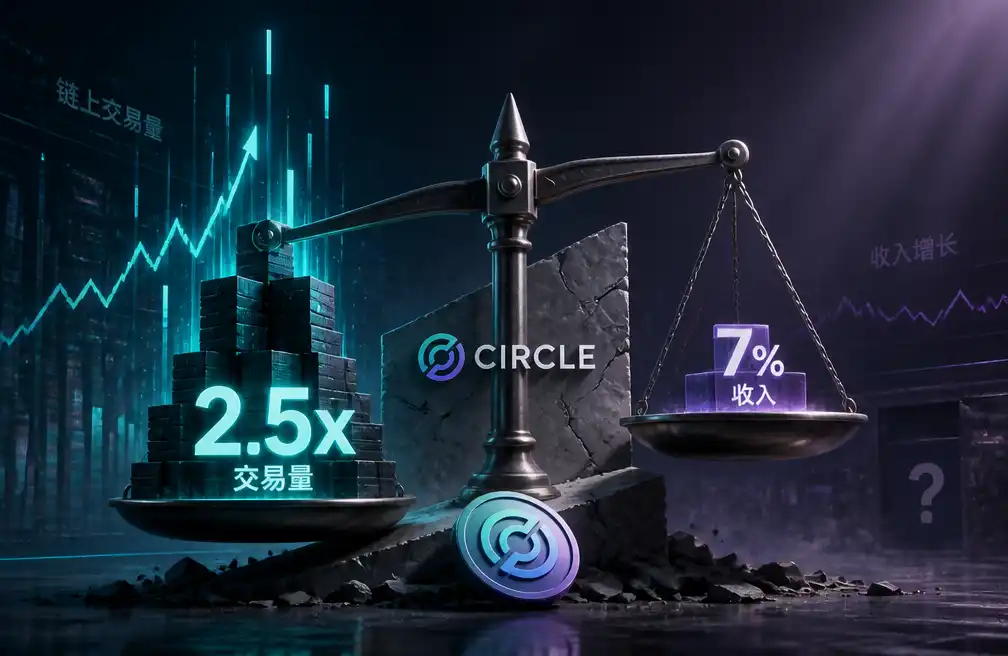
Trading Volume Increased by 2.5x, Why Did Circle's Revenue Only Grow by 7%?

Circle's Q2 performance presents a seemingly contradictory picture: the transaction volume of its stablecoin USDC surged 151% year-over-year to $14.8 trillion, while its "Total Revenue & Reserve Revenue" grew by only 7% to $701 million. This discrepancy highlights the core of Circle's business model. Revenue is primarily driven not by transaction volume, but by the average amount of USDC in circulation and the yield generated from its reserves. Key points: 1. **Revenue Drivers:** Over 90% of revenue comes from "reserve income," which is a function of average USDC circulation (up 25% YoY) and the reserve yield (which fell by 66 basis points). The net effect was a mere ~5% increase in reserve income. 2. **Transaction vs. Revenue:** High transaction volume indicates robust usage of USDC for payments and settlements, but does not translate directly to revenue. It must first convert into a sustained, average circulating balance. 3. **Cost Structure:** After accounting for distribution and other costs, the metric "Revenue Less Direct Costs" (RLDC) grew faster than total revenue, with its margin improving. However, rising operating expenses (up 23% YoY) meant that Adjusted EBITDA growth was limited to 8%. 4. **New Initiatives:** Circle reported progress on new networks like the Circle Payments Network and upcoming products (Arc, Agent Stack), but these are currently measured by adoption metrics (e.g., transaction run-rate, number of services) rather than material revenue contribution this quarter. In summary, the financial results are determined by the interplay of USDC circulation, reserve yields, and cost structures, while high transaction volume signals underlying network strength that has not yet fully flowed through to the income statement.

marsbit27 min fa

Trading Volume Increased by 2.5x, Why Did Circle's Revenue Only Grow by 7%?

marsbit27 min fa

Samsung China, Another Step Back

Samsung China Takes Another Step Back Samsung Electronics is further retreating from the Chinese consumer market. Following the exit of its home appliance business in May, its mobile phone division is now reportedly scaling down. Stores with monthly sales below 300,000 RMB are being closed in several cities. Data shows Samsung's smartphone market share in China has plummeted to 0.1% in Q2 2026, a stark contrast to its 22% global leadership. The decline is attributed to intense competition from domestic brands offering better value, higher specs (like faster charging), and superior localization in software and services. Samsung's premium pricing and less adapted One UI system have struggled against rivals like Huawei, Xiaomi, and Honor. This consumer electronics retreat coincides with Samsung's record-breaking semiconductor profits, driven by the AI boom. In Q2 2026, the chip division contributed nearly all operating profit, while the mobile and home appliance unit posted its first-ever operating loss. Internal dynamics, like the chip division charging market prices to the mobile unit, have increased cost pressures. Samsung's strategy now appears to be a focused retreat towards the ultra-premium segment in China, similar to its global push in high-end foldables like the Galaxy Z Fold8. The company is likely to retain only key stores in major cities to serve a niche, high-end clientele. While its deep semiconductor reserves offer a cushion, this shift away from mass-market consumer electronics reduces business diversification. The move is pragmatic but signifies a fundamental transformation; Samsung is ceding mass-market influence and betting heavily on its semiconductor strength and a narrowed premium product focus.

marsbit31 min fa

Samsung China, Another Step Back

marsbit31 min fa

Trading

Spot

Articoli Popolari

Come comprare MERL

Benvenuto in HTX.com! Abbiamo reso l'acquisto di Merlin chain (MERL) semplice e conveniente. Segui la nostra guida passo passo per intraprendere il tuo viaggio nel mondo delle criptovalute.Step 1: Crea il tuo Account HTXUsa la tua email o numero di telefono per registrarti il tuo account gratuito su HTX. Vivi un'esperienza facile e sblocca tutte le funzionalità,Crea il mio accountStep 2: Vai in Acquista crypto e seleziona il tuo metodo di pagamentoCarta di credito/debito: utilizza la tua Visa o Mastercard per acquistare immediatamente Merlin chainMERL.Bilancio: Usa i fondi dal bilancio del tuo account HTX per fare trading senza problemi.Terze parti: abbiamo aggiunto metodi di pagamento molto utilizzati come Google Pay e Apple Pay per maggiore comodità.P2P: Fai trading direttamente con altri utenti HTX.Over-the-Counter (OTC): Offriamo servizi su misura e tassi di cambio competitivi per i trader.Step 3: Conserva Merlin chain (MERL)Dopo aver acquistato Merlin chain (MERL), conserva nel tuo account HTX. In alternativa, puoi inviare tramite trasferimento blockchain o scambiare per altre criptovalute.Step 4: Scambia Merlin chain (MERL)Scambia facilmente Merlin chain (MERL) nel mercato spot di HTX. Accedi al tuo account, seleziona la tua coppia di trading, esegui le tue operazioni e monitora in tempo reale. Offriamo un'esperienza user-friendly sia per chi ha appena iniziato che per i trader più esperti.

414 Totale visualizzazioniPubblicato il 2024.12.12Aggiornato il 2026.06.02

Come comprare MERL

Discussioni

Benvenuto nella Community HTX. Qui puoi rimanere informato sugli ultimi sviluppi della piattaforma e accedere ad approfondimenti esperti sul mercato. Le opinioni degli utenti sul prezzo di MERL MERL sono presentate come di seguito.

活动图片