2026 TradFi x Crypto Outlook: 8 Macro Forces and 7 Investment Trends Driving 2026

marsbitPubblicato 2026-01-22Pubblicato ultima volta 2026-01-22

Introduzione

CoinFound's "TradFi x Crypto 2026 Outlook" report identifies 2025 as an inflection point of convergence and predicts an acceleration of "programmable finance" in 2026. It outlines eight key macro forces, including a fiat currency trust crisis driving demand for hard assets like Bitcoin, geopolitical shifts fostering parallel blockchain-based settlement systems, and AI automation necessitating machine-to-machine payments. The report also highlights seven major investment trends, forecasting a structural explosion in the RWA market, with stablecoins reaching a $320B base. Key developments include the evolution of stablecoins 2.0 competing for global payment infrastructure, rapid growth in tokenized stock liquidity, and a shift in private credit RWA towards asset-driven models due to default risks. A major prediction for 2026 is the shift of RWA from yield-bearing assets to high-frequency trading instruments, accompanied by credit expansion into riskier assets like corporate bonds. The overarching theme is the unification of TradFi and Crypto under "On-chain Finance," though the complexity of off-chain defaults triggering on-chain liquidations remains a significant systemic risk.

Author: CoinFound,A TradFi × Crypto Data Technology Company

On January 21, CoinFound officially released the "CoinFound Annual Report: TradFi x Crypto 2026 Outlook." This report focuses on the deep integration trends between TradFi and Crypto. Below is a summary of the report's content:

2025 is the "tipping point for integration," and 2026 will enter an acceleration period for "programmable finance."

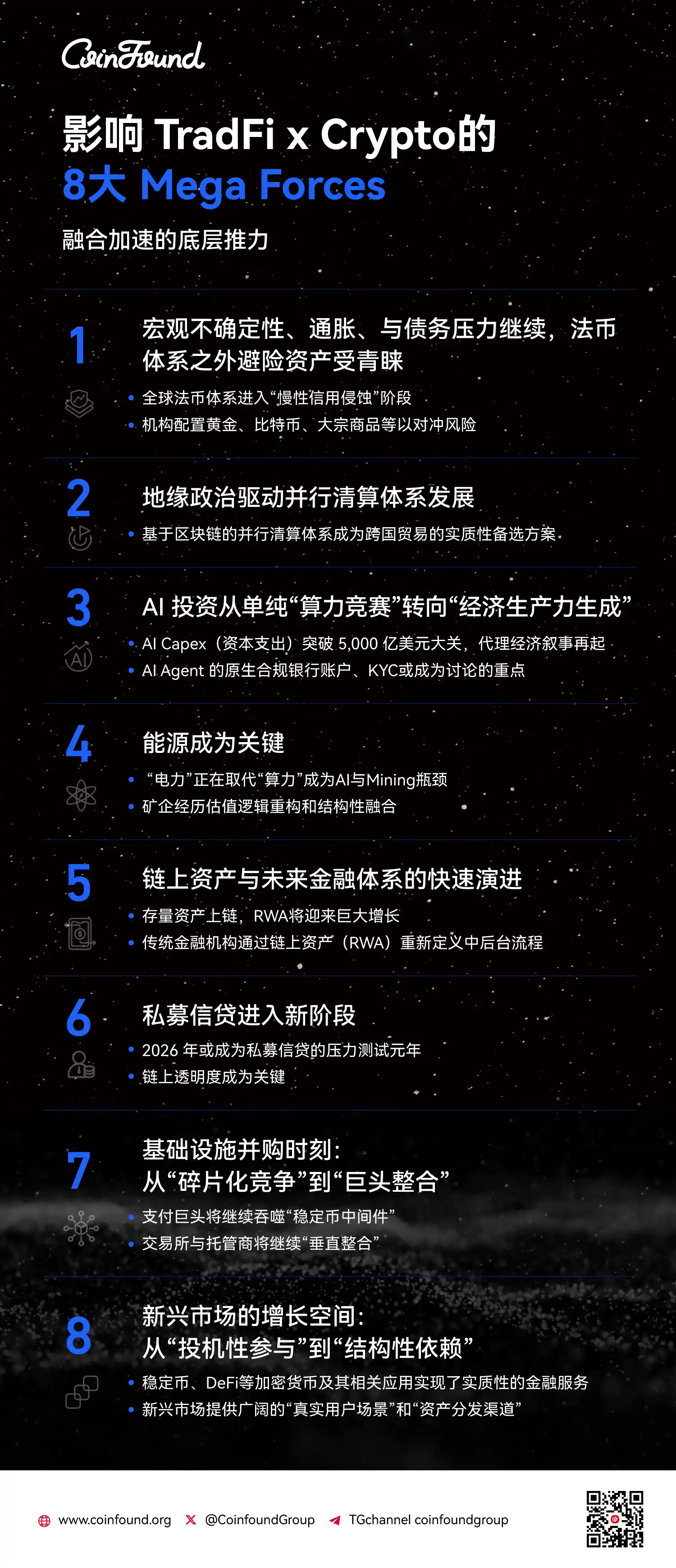
The report distills 8 Mega Forces and 7 trend outlooks: from Stablecoin 2.0 competing for global payment infrastructure, to RWA moving from "issuance" to "utility," and key variables such as stock tokenization, and the divergence and concentration of DATs.

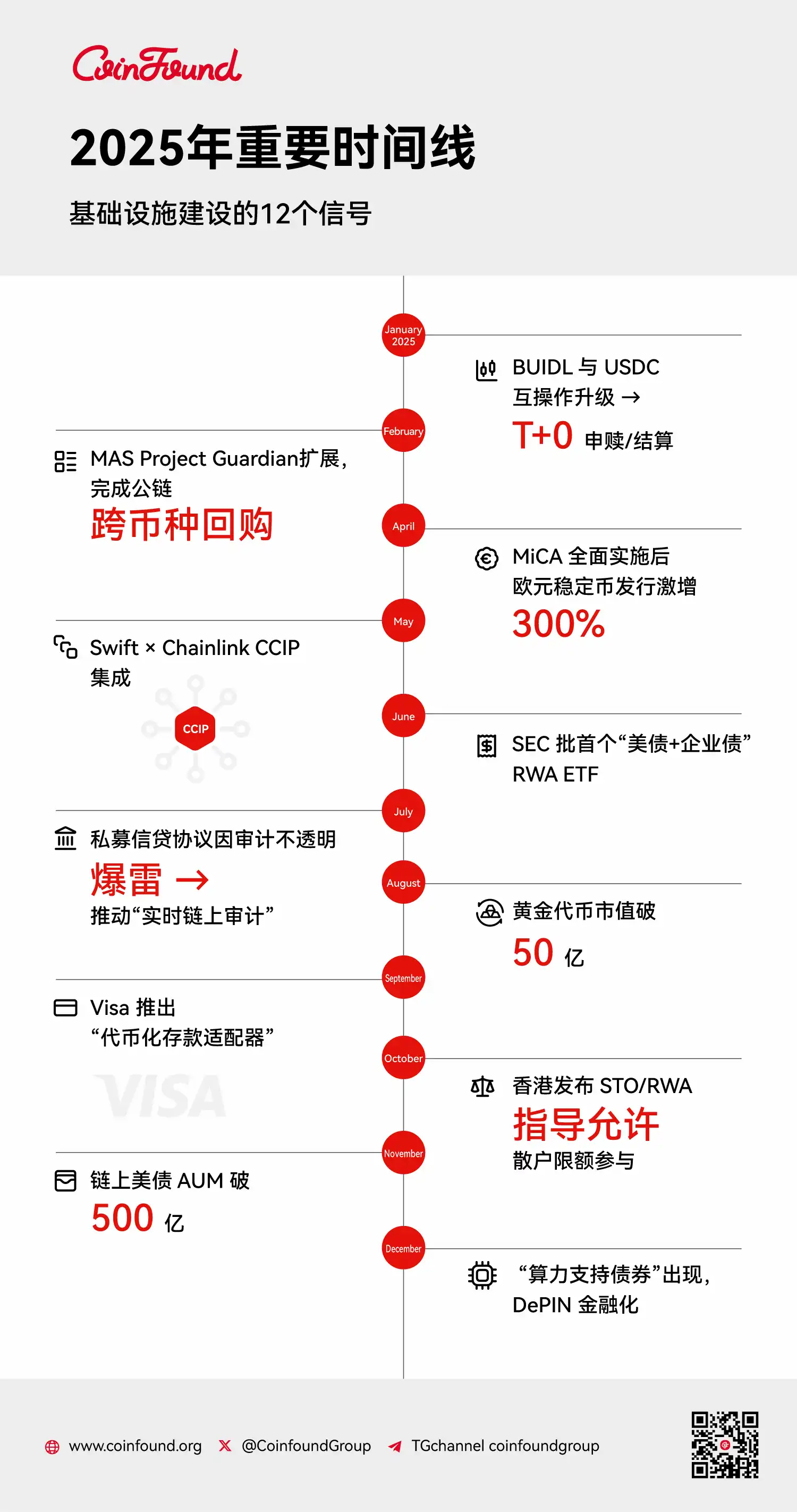
2025 Timeline of Key Events for Traditional Finance x Crypto
In 2026, the following macro trends will impact the TradeFi x Crypto field:

  • Fiat System Trust Crisis and Return to Hard Assets: Facing a global debt spiral and "fiscal dominance" risks, institutions are accelerating allocations to "hard assets" like gold, Bitcoin, and commodities to hedge against fiat currency credit erosion.
  • Geopolitics Driving the Implementation of Parallel Clearing Systems: The need for "de-weaponization" of financial infrastructure is pushing blockchain as an alternative settlement solution independent of SWIFT, with atomic settlement mechanisms effectively reducing trust and counterparty risks in cross-border transactions.
  • AI Productivity Monetization and the Rise of Machine Payments: The focus of AI investment is shifting from computing hardware to generating economic productivity, spurring a rigid demand from AI Agents for compliant stablecoins and on-chain automatic settlement to achieve value attribution between machines.
  • Energy as a Core Asset and the Infrastructure-ization of Mining Companies: Power shortages are driving mining companies to transform into "hybrid computing centers." Their scarce power access rights (Time-to-Power) are triggering acquisitions by tech giants, driving the revaluation of mining companies towards data center infrastructure.
  • On-Chain Assets (RWA) Moving from Issuance to Utility: Asset tokenization is entering the "programmable finance" stage. RWA is no longer just a digital certificate but serves as 24/7 core collateral, significantly enhancing the capital efficiency of repo markets and全域 liquidity.
  • Private Credit Faces Stress Tests and Transparent Transformation: The 2026 debt maturity wave may trigger default risks, forcing the industry to shift from "black boxes" to real-time on-chain transparent audits based on zero-knowledge proofs (ZK) to avoid DeFi chain liquidation crises.
  • Infrastructure Moves from Fragmented Competition to Giant Consolidation: The market is entering a consolidation period similar to the telecommunications industry. Payment and financial giants are acquiring stablecoin middleware and custodians to secure their positions, eliminating redundancy and building compliance moats. Emerging markets shift from speculation to structural dependence: Crypto assets have deepened into underlying tools for payments and remittances in emerging markets. Vast real-user scenarios make them a core hub connecting traditional financial assets with global retail liquidity.

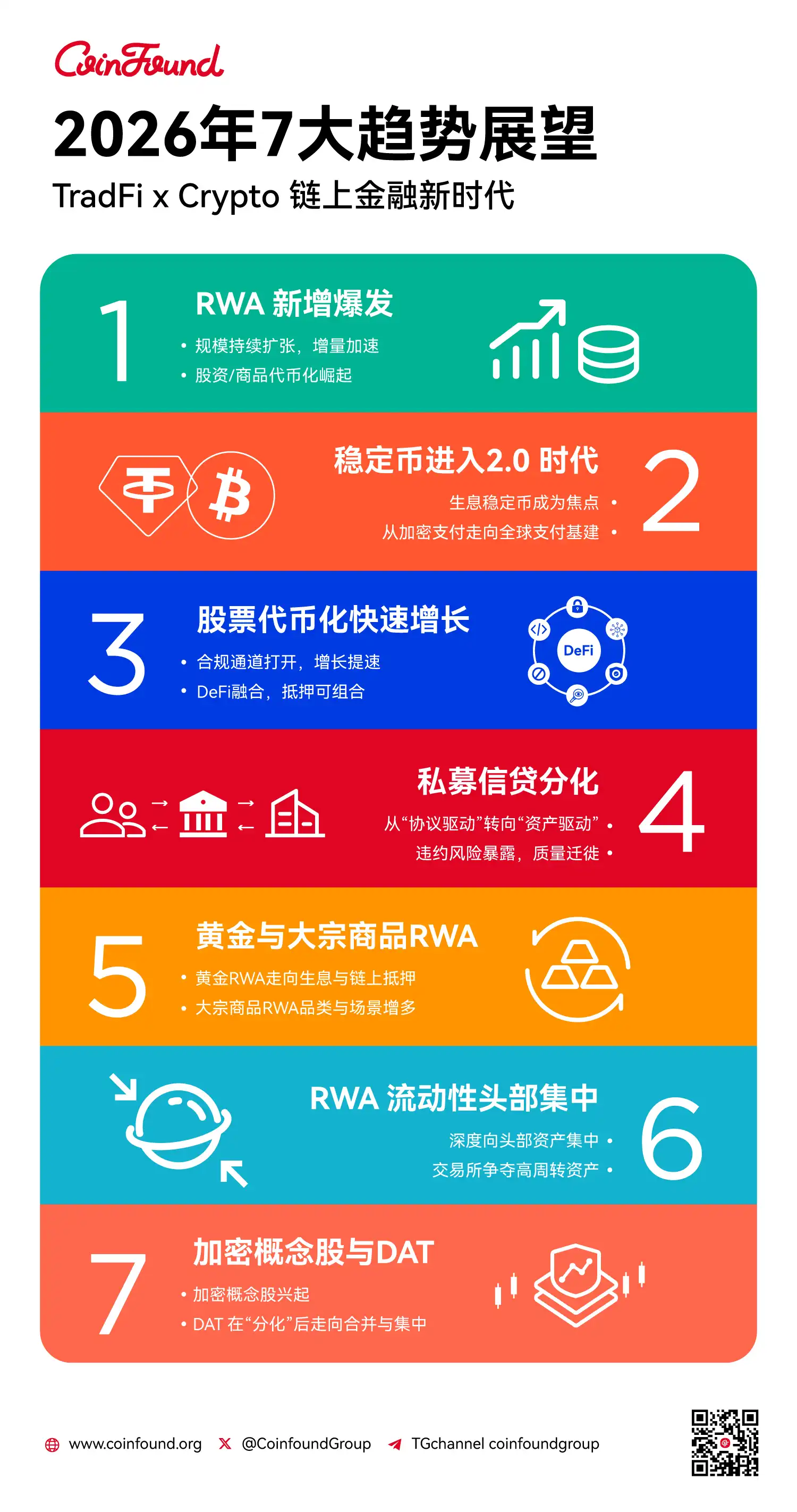
The trend outlook for 2026 is as follows:

1. Structural explosion in the RWA market, stablecoins forming a base of a 3200 billion market, equities and commodities becoming new growth points

2. Stablecoins enter the 2.0 era, moving from crypto payments to competing for global payment infrastructure

3. Stock tokenization liquidity may grow rapidly, DeFi integration will be key

4. Private credit RWA shifts to "asset-driven," may accelerate differentiation under "default" risk pressure

5. Gold and commodity RWA usher in a new era of "full asset collateral"

6. RWA liquidity will further concentrate, three types of RWA assets are gaining favor with exchanges

7. The "rise" of crypto concept stocks, the "divergence" and "concentration" of DATs
Summary

2025 Summary: 2025 was a year of "demystification and integration" for TradeFi and Crypto. Blockchain technology is being还原 (restored) from the光环 (halo) of "revolution" to an efficient bookkeeping and settlement technology. The success of treasury RWA proved the feasibility of putting traditional assets on-chain, and the full entry of giants like BlackRock provided irreversible credit endorsement for the industry.

2026 Prediction: 2026 will be a year of "secondary market explosion and credit expansion." We judge:

  • Liquidity Explosion: With the improvement of infrastructure, RWA will shift from "hold-to-earn" to "high-frequency trading."
  • Credit Downward Drift: Asset classes will drift down from high-credit government bonds to corporate bonds, stocks, and emerging market credit. Risk Premium will become a new source of yield.
  • Risk Warning: As the scale of RWA expands, the complexity of off-chain default transmission to on-chain liquidation will be the biggest systemic risk.

In 2026, both TradeFi and Crypto will be unified under the banner of "On-chain Finance."

Full report link for "CoinFound Annual Report: TradFi x Crypto 2026 Outlook": https://app.coinfound.org/zh/research/4


Domande pertinenti

QWhat are the 8 Mega Forces that will influence the TradFi x Crypto field in 2026 according to the CoinFound report?

AThe 8 Mega Forces are: 1. Fiat system trust crisis and the return to hard assets. 2. Geopolitics driving the implementation of parallel clearing systems. 3. AI productivity realization and the rise of machine payments. 4. Energy as a core asset and the infrastructuralization of mining companies. 5. On-chain assets (RWA) moving from issuance to utility. 6. Stress testing and transparency transformation in private credit. 7. Infrastructure moving from fragmented competition to giant integration. 8. Emerging markets shifting from speculation to structural dependence.

QWhat are the 7 key investment trends outlined for 2026 in the report?

AThe 7 key investment trends for 2026 are: 1. Structural explosion of the RWA market with stablecoins forming a $320B base. 2. Stablecoins entering the 2.0 era, competing for global payment infrastructure. 3. Rapid growth in stock tokenization liquidity, with DeFi integration being key. 4. Private credit RWA shifting to 'asset-driven' models, potentially accelerating differentiation under default risk. 5. Gold and commodity RWA ushering in a new era of 'full-asset collateralization'. 6. Further concentration of RWA liquidity, with three types of RWA assets favored by exchanges. 7. The rise of 'crypto concept stocks' and the 'differentiation' and 'concentration' of DATs.

QHow does the report summarize the key difference between 2025 and the predicted landscape for 2026?

AThe report summarizes 2025 as a year of 'disillusionment and integration' where blockchain technology was reduced from a 'revolutionary'光环 to an efficient bookkeeping and settlement technology. In contrast, it predicts 2026 will be a year of 'secondary market explosion and credit expansion', characterized by liquidity爆发 (shifting from 'holding for yield' to 'high-frequency trading'), credit下沉 (expanding from high-credit sovereign bonds to corporate bonds, stocks, and emerging market credit for risk premium), and new systemic risks from off-chain defaults triggering on-chain liquidations.

QWhat is identified as the major systemic risk associated with the growing RWA market in 2026?

AThe major systemic risk identified is the complexity of off-chain asset defaults (Off-chain Default) triggering chain上清算 (On-chain Liquidation) as the scale of Real-World Assets (RWA) expands.

QWhat overarching concept does the report predict will unify both TradFi and Crypto by 2026?

AThe report predicts that by 2026, both TradFi and Crypto will be unified under the banner of 'On-chain Finance'.

Letture associate

The Value Distribution of Stablecoins

**Summary: The Value Distribution of Stablecoins** The article argues that stablecoins are evolving from mere trading tools into broader channels for dollar access. It divides the stablecoin ecosystem into four layers to analyze how value is distributed: 1. **Issuance Layer:** Mints stablecoins, holds reserve assets, and captures the spread between reserve yield and user costs (e.g., Tether, Circle). This layer currently earns the largest profit margin. 2. **Infrastructure Layer:** Connects stablecoins to the traditional financial system, handling fiat on/off-ramps, banking integration, compliance (KYC/AML), and asset management (e.g., Bridge, BVNK). This is the "unglamorous" but critical work, building the essential bridges between crypto and real-world finance. 3. **Acquiring/Distribution Layer:** Integrates stablecoins into merchant systems, manages payment flows, and provides enterprise financial software (e.g., Stripe, Coinbase). They act as the access point for businesses. 4. **Application Layer:** The end-users and businesses that ultimately use stablecoins for payments, settlements, or as a store of value. They benefit from convenience but have little pricing power. The core thesis is that while the issuance layer currently dominates profits, the often-overlooked **infrastructure layer holds significant long-term potential**. The real challenge and barrier to mass adoption is not the on-chain transfer of stablecoins (which is simple), but the complex "last mile" integration into existing business workflows, banking systems, and regulatory frameworks across different countries. Companies in this layer are currently in a "land grab" phase, investing heavily to build networks, secure bank partnerships, and establish compliance pathways. While their position is currently pressured by the profitable issuers above and distribution platforms below, the article suggests that if stablecoins become a default financial rail for businesses, the infrastructure providers who have done the hard work of integration will ultimately gain strong pricing power and become entrenched, essential players.

marsbit8 min fa

The Value Distribution of Stablecoins

marsbit8 min fa

The Value Distribution of Stablecoins

The Value Distribution of Stablecoins The article argues that stablecoins are evolving from a mere trading tool into a broad "dollar channel." It analyzes the industry's value chain through four layers: 1. **Issuance Layer (e.g., Tether, Circle):** The top layer that mints stablecoins, holds reserve assets, and captures the thickest interest rate spread. 2. **Infrastructure Layer (e.g., Bridge, BVNK):** Connects stablecoins to the traditional financial system, handling critical but complex "dirty work" like fiat on/off-ramps, banking integration, compliance (KYC/AML), and cross-border settlement. 3. **Acquiring/Distribution Layer (e.g., Stripe, Coinbase):** Embeds stablecoins into merchant systems, manages payment flows, and integrates with enterprise software. 4. **Application Layer:** End-users and businesses that ultimately use stablecoins for payments, settlement, or storing value. The author posits that while the issuance layer currently captures the most profit, the most overlooked and potentially critical layer is infrastructure. The core challenge for stablecoin adoption isn't the on-chain transfer (which is simple), but bridging the gap between blockchain and the real-world financial system. This involves solving practical problems for businesses: fiat conversion, reconciliation, tax handling, and user onboarding. Infrastructure companies are currently in a difficult "land-grab" phase—building networks, securing banking relationships, and achieving compliance country-by-country. They face pressure from both the profitable issuance layer above and distribution platforms below. However, the author suggests this layer is building a crucial moat. Once stablecoins become a default business rail, the infrastructure players who have done the hard work of integration may gain significant, durable value and pricing power.

链捕手12 min fa

The Value Distribution of Stablecoins

链捕手12 min fa

How to Do Research Well: Deliberately Practice the Real Skills That Matter

No one truly teaches you how to do research. You're often given a desk, a pre-selected problem, and vague instructions to "create something new." Consequently, many people reverse-engineer the job based on visible outputs—papers, posts, announcements—learning only how to *appear* like a researcher rather than how to *become* one. True research capability is built from stacking small, trainable skills, nearly all of which can be developed through deliberate practice. **Pick Your Own Problem:** Most researchers absorb problems from advisors or trends, lacking the underlying reasoning. Choosing a problem you genuinely care about, as John Schulman advises, leads to original work. Develop "taste" like a muscle: predict experiment outcomes, guess paper results from methods, and track which findings remain important over time. **Upgrade Your Inputs:** Relying on shared reading lists (arXiv hot lists, filtered group chats) leads to unoriginal conclusions. Undervalued old literature often holds crucial insights (e.g., MoE, LSTM, backpropagation). Richard Sutton's "The Bitter Lesson" or Claude Shannon's 1952 talk on creative thinking are more predictive than lengthy modern surveys. Breadth matters as much as depth: draw from neuroscience, mechanism design, hardware knowledge, and honest statistics. Read papers directly, especially appendices and limitations sections. **Write Everything Down:** As Paul Graham noted, writing exposes flaws in seemingly mature ideas. Writing is the cheapest defense against self-deception. Following Feynman's principle, Darwin programmatically wrote down facts contradicting his theory to combat memory bias. Maintain a detailed log of hypotheses, setups, predictions, results, and updated understandings. Reviewing past logs fosters essential humility.

marsbit2 h fa

How to Do Research Well: Deliberately Practice the Real Skills That Matter

marsbit2 h fa

Trading

Spot
Futures
活动图片