2026: The Upcoming IPOs of Crypto Companies

marsbitPubblicato 2026-01-29Pubblicato ultima volta 2026-01-29

Introduzione

By 2026, multiple major crypto companies are preparing for IPOs, signaling a trend of crypto infrastructure firms entering public markets. Kraken, targeting a $20 billion valuation in H1 2026, has strong financials and backing from traditional market makers. Consensys, valued at $7 billion in 2022, plans a mid-2026 IPO, leveraging MetaMask's 30 million monthly users but faces challenges balancing token and shareholder interests. Ledger, aiming for a $4 billion valuation, is shifting from hardware sales to a software-focused model. Bithumb seeks a Korean listing to rebuild trust amid past governance issues. CertiK, valued at $2 billion, announced its IPO plans but must address reputational concerns from past security controversies. These moves reflect improved regulatory clarity and market maturity, though investors must differentiate between companies with solid fundamentals and those with unresolved risks.

Author: David, Deep Tide TechFlow

In 2025, crypto companies raised $3.4 billion in the U.S. stock market.

Circle and Bullish each raised over $1 billion, and Gemini rose 14% on its Nasdaq debut. By January 2026, BitGo rang the opening bell at the New York Stock Exchange, surging 24.6% on the first day, with a market cap of $2.6 billion.

These pioneers proved one thing: Wall Street is willing to pay for compliant crypto infrastructure.

The pipeline for 2026 is even bigger. Kraken, Consensys, and Ledger are all queuing up for IPOs, with valuations ranging from several billion to twenty billion dollars. Even CertiK, a security auditing firm, announced its IPO plans at Davos.

Exchanges, wallets, custody, security... The "water sellers" of the crypto industry are collectively moving toward public markets.

When will these companies go public, what are their valuations, and what are the risks? Let's look at them one by one.
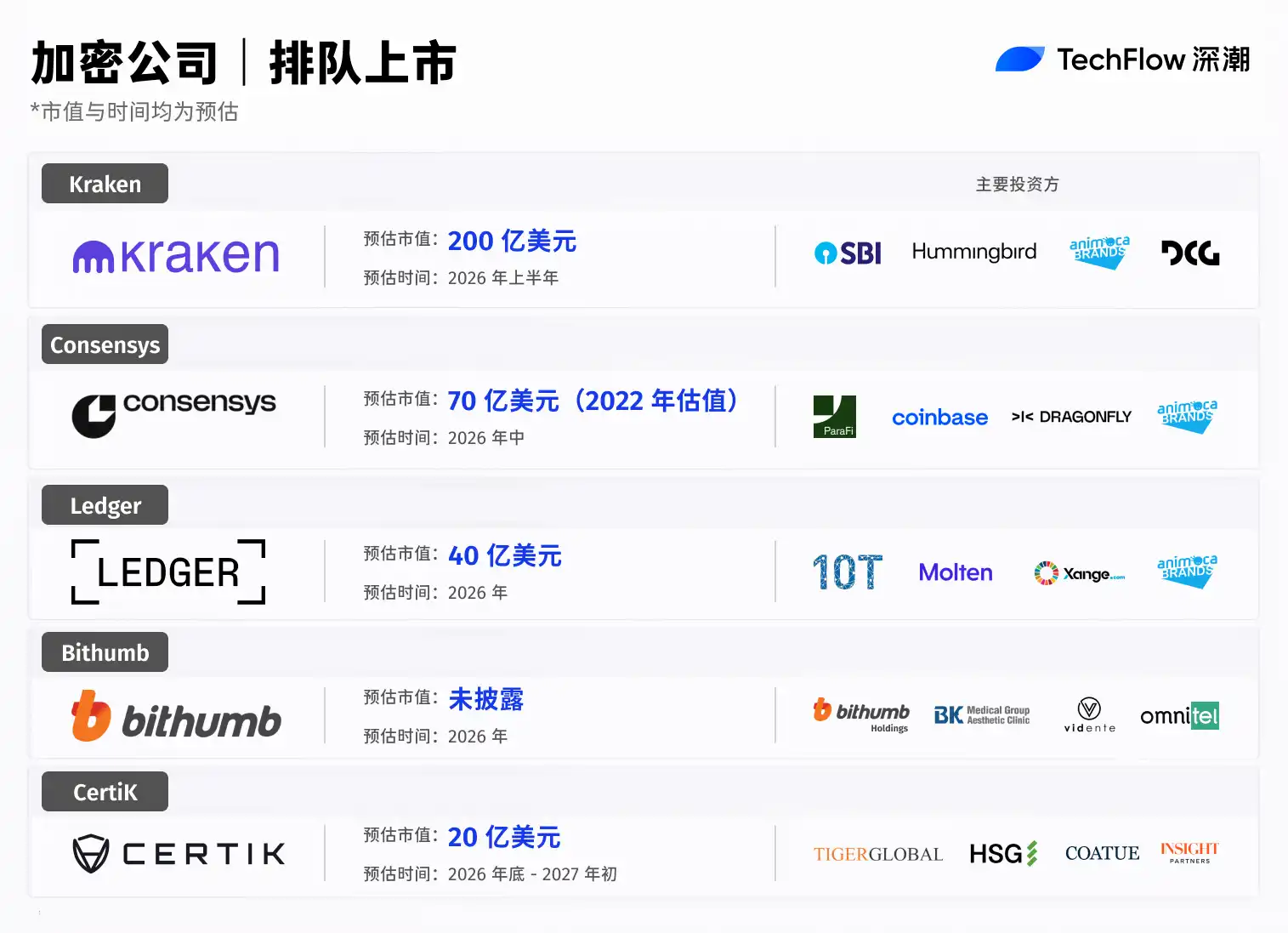
1. Kraken, The $20 Billion Compliance Case Study

Estimated Market Cap: $20 billion

Estimated Time: First Half of 2026

Kraken is one of the oldest crypto exchanges, founded in 2011, a year earlier than Coinbase. But its IPO timing is five years later than Coinbase's. During this gap, it experienced an SEC lawsuit, settlement negotiations, business restructuring, and finally obtained the result of the SEC dropping the case in March 2025.

The financial data is also solid:

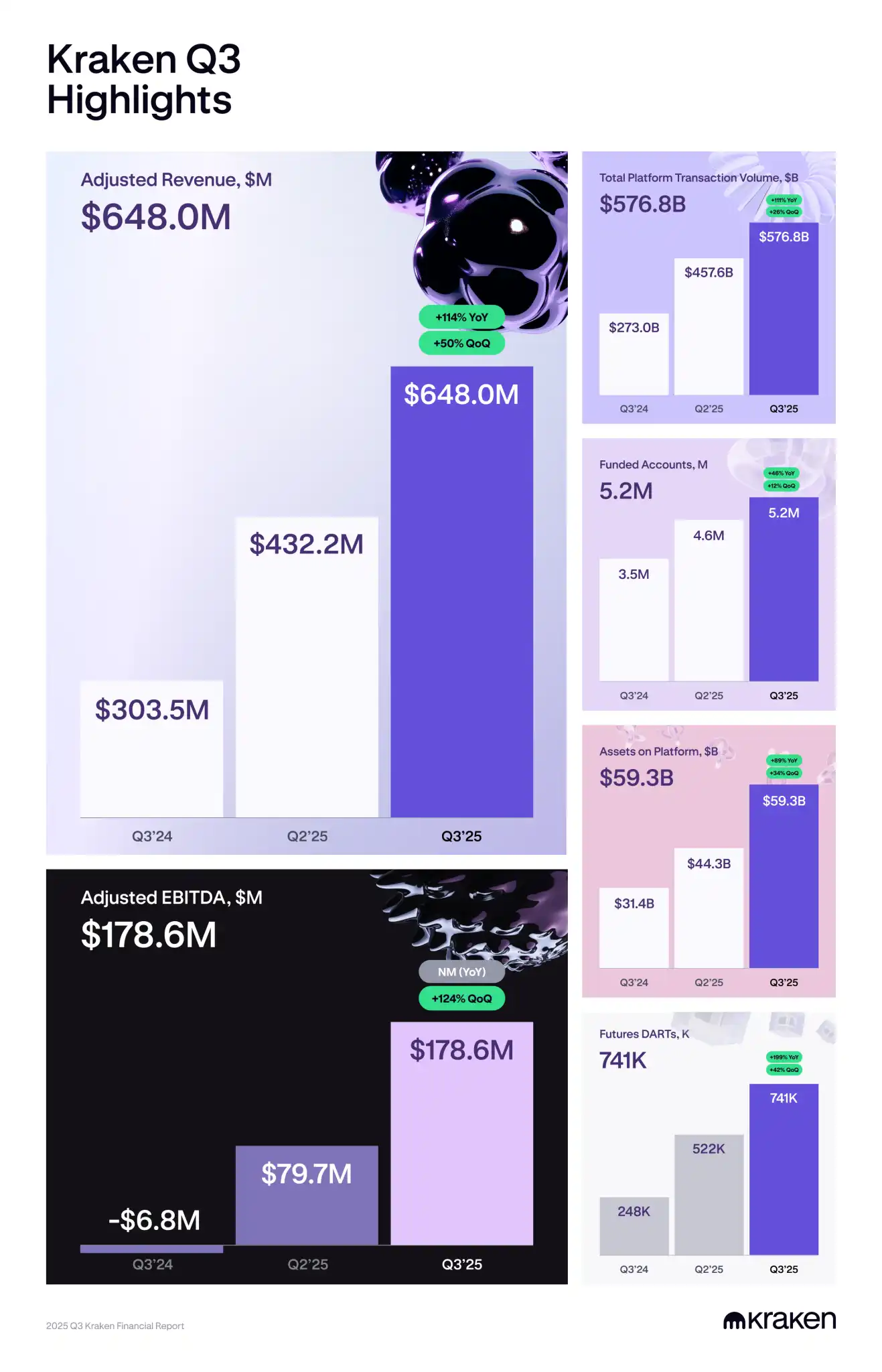
2024 revenue was $1.5 billion, with adjusted EBITDA exceeding $400 million. In Q3 2025, single-quarter revenue was $648 million, up 50% year-on-year. Platform assets under management were $59.3 billion, with quarterly trading volume of $576.8 billion.

In November 2025, Kraken completed an $800 million pre-IPO financing round, valuing the company at $20 billion. The investor list included Citadel Securities, Jane Street, and DRW. The entry of these top traditional finance market makers means they are betting that crypto exchanges will become part of the financial infrastructure.

In the same month, Kraken confidentially filed an S-1. The goal is to go public in the first half of 2026.

If successful, it will become the second major crypto exchange to list on the U.S. stock market after Coinbase, and the first company to complete the full IPO process in the "post-Gensler era."
2. Consensys, MetaMask's Parent Company Wants to Go Public

Estimated Market Cap: $7 billion (2022 valuation)

Estimated Time: Mid-2026

Consensys owns some of the most valuable products in crypto: the MetaMask wallet with 30 million monthly active users, the Infura node service supporting the底层 of most Ethereum dApps, and the Linea L2 network. It is the "plumber" of the Ethereum ecosystem; almost all developers use its tools.

The company was founded by Ethereum co-founder Joseph Lubin. It raised $450 million in 2022 at a $7 billion valuation. It is now working with J.P. Morgan and Goldman Sachs to prepare for an IPO, targeting mid-2026.

The prospectus is expected to highlight revenue from MetaMask Swaps. This feature allows users to trade tokens directly within the wallet, charging a 0.875% fee per transaction. In 2025, MetaMask also added native Bitcoin support, expanding from a pure EVM wallet to a multi-chain wallet, attempting to keep users within its ecosystem.

The suspense around Consensys' IPO lies in the fact that it is simultaneously working on a MASK token and an IPO. How will these two things be coordinated? Will the interests of token holders and shareholders conflict? This issue may become a new case study in crypto company governance.

3. Ledger, The Hardware Wallet Trying to Tell a Software Story

Estimated Market Cap: $4 billion

Estimated Time: 2026

Ledger has sold over 6 million hardware wallets, custoding over $100 billion in Bitcoin for users. But it doesn't want to just be a "device seller."

In the past two years, CEO Pascal Gauthier has frequently appeared in New York. The story he tells investors is: Ledger wants to become the "Apple of self-custody."

The key to the transformation is Ledger Live, an application that integrates hardware wallets, software wallets, staking, and DeFi interactions. It's shifting from selling hardware to selling subscription services, from one-time revenue to recurring revenue.

Wall Street bought this story.

On January 23, the Financial Times reported that Ledger is in talks with Goldman Sachs, Jefferies, and Barclays for a NYSE IPO, targeting a valuation of over $4 billion. This number is nearly triple its $1.5 billion valuation in 2023.

Supporting this valuation is performance.

2025 revenue reached hundreds of millions of dollars; Gauthier called it a "record year." After the FTX collapse, the phrase "Not your keys, not your coins" became popular again, and both institutions and retail are moving towards self-custody.

Last year, the amount stolen in the crypto industry hit a new high of $17 billion, which ironically became a selling point for Ledger.

However, hardware wallets are still too difficult for the average person to use. Ledger's growth ceiling depends on whether it can lower this barrier.

4. Bithumb, The South Korean Old Guard's Comeback

Estimated Market Cap: Undisclosed

Estimated Time: 2026

Listing Venue: South Korea KOSDAQ (also considered Nasdaq)

Bithumb was once South Korea's largest exchange but was later overtaken by Upbit. Now Upbit holds over 80% of the South Korean market, while Bithumb has only 15% to 20%.

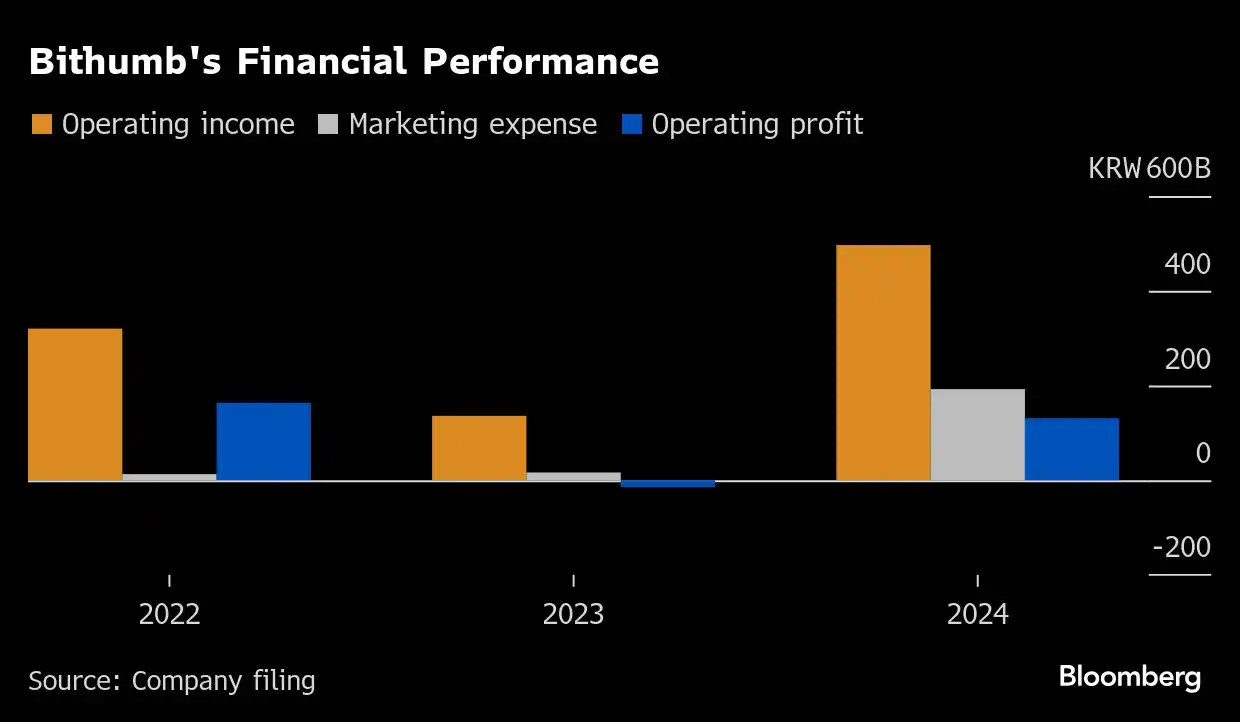
In 2024, Bithumb launched a zero-fee campaign, bringing its market share back to around 25%. This was a battle of burning money to gain users, perhaps to build momentum for the IPO.

Samsung Securities is the underwriter. The original plan was to list on the South Korean KOSDAQ in the second half of 2025, with Nasdaq also considered. Currently, the timeline appears delayed to 2026.

However, Bithumb says this IPO is not for fundraising. The company has over 400 billion won (approximately $3 billion) in financial assets on its books; it's not short on cash. The purpose of the listing is to "build market trust" by having its internal governance and finances subject to public audit.

The background to this statement is: Bithumb has had constant troubles in recent years.

In 2023, it was raided by the South Korean National Tax Service on suspicion of fraudulent trading. Several executives were investigated for alleged listing bribes, and former CEO Lee Sang-jun stepped down. A service outage in 2017 led to a six-year lawsuit, resulting in a ruling to compensate users.

For the IPO, the company made personnel changes. Former Chairman Lee Jung-hoon returned to the board; he was previously acquitted of fraud charges related to an acquisition. The new CEO is his close associate.

South Korea has 18 million crypto users, and daily trading volume often exceeds that of the stock market.

Bithumb's IPO is a signal of the institutionalization of the South Korean crypto market. But given its historical baggage, investors will scrutinize its governance issues.
5. CertiK, The Controversial Security Auditing Leader

Estimated Market Cap: $2 billion

Estimated Time: Late 2026 - Early 2027

On January 23 at the Davos Forum, CertiK CEO Ronghui Gu announced the company is advancing its IPO plans.

This is the largest security auditing company in the crypto industry, founded in 2018, headquartered in New York, serving over 5,000 clients, with audited code protecting assets worth approximately $600 billion.

The investor list is indeed impressive: Binance is the earliest and largest financial backer, with SoftBank Vision Fund, Tiger Global, Sequoia, and Goldman Sachs also involved. Its valuation reached $2 billion during the B3 funding round in 2022.

But CertiK is also one of the most controversial companies in the crypto space.

The Kraken incident last year was a big deal. CertiK found a vulnerability in Kraken that could credit accounts out of thin air and transferred about $3 million during testing. CertiK called it a "white hat operation"; Kraken called it extortion. The two sides had a public spat, the money was eventually returned, but CertiK's reputation was damaged.

Earlier, CertiK also audited Cambodia's Huione Guarantee. This platform was used for money laundering, buying and selling hacking tools and personal data, and even selling stun guns to scam compounds in Southeast Asia. CertiK later apologized, but this incident showed that the security company's own risk control also has problems.

Gu Ronghui said the IPO is the "natural next step for the continued expansion of products and technology."

But once the IPO prospectus is public, these controversies will be repeatedly questioned by investors. Whether CertiK can rebuild trust is the biggest test on its path to going public.

Overall, the cluster of crypto company IPOs in 2026 might not be a coincidence.

The regulatory environment is changing. SEC Chairman Gensler is gone; the new chairman is more friendly towards crypto; lawsuits against Kraken and Consensys were dropped. The window is open, and those who should are rushing.

The capital structure has also reached its limit. These companies have raised many rounds in the private market, with more and more shareholders, and employee options becoming harder to cash out. Coinbase has been public for five years, proving that crypto companies can survive in the public market. Those waiting in line have no reason to wait any longer.

However, for ordinary investors, this batch of IPOs needs to be differentiated.

Kraken and Ledger have real revenue and clear business models; Consensys has the gateway product MetaMask, but is simultaneously working on a token, and the relationship between shareholders and token holders is not yet sorted out. CertiK has brand recognition but controversy, and Bithumb is a purely South Korean domestic story.

When you can buy, first figure out what you are buying.

For the companies, going public is just the beginning.

Whether they can stand firm in the public market depends on whether these companies can replace the "crypto" label with "financial infrastructure." Coinbase took five years to convince Wall Street it was more than just a crypto trading platform.

For those following, the road is still long.

Domande pertinenti

QWhat is the estimated valuation and expected IPO timeline for Kraken in 2026?

AKraken is estimated to have a valuation of $20 billion and is expected to conduct its IPO in the first half of 2026.

QWhich company, known for its MetaMask wallet and Infura services, is planning an IPO in mid-2026?

AConsensys, the company behind MetaMask and Infura, is planning an IPO in mid-2026 with an estimated valuation of $7 billion (based on its 2022 valuation).

QWhat is Ledger's new strategic focus as it prepares for its IPO, and what is its target valuation?

ALedger is shifting its focus from selling hardware wallets to becoming a 'self-custody Apple' by offering integrated services like Ledger Live, targeting a valuation of over $4 billion for its IPO.

QWhy is Bithumb pursuing an IPO in 2026, and what challenges does it face?

ABithumb is pursuing an IPO primarily to build market trust and improve its governance and financial transparency, rather than for fundraising. It faces challenges related to past legal issues, including fraud investigations and service interruption lawsuits.

QWhat are the main controversies surrounding CertiK, and how might they impact its planned IPO?

ACertiK faced controversies including the Kraken 'white-hat' incident, where it transferred $3 million during a security test, and its audit of the controversial Huione Guarantee platform. These issues may impact investor trust and scrutiny during its IPO process.

Letture associate

KOL's Perspective: Why Is SOL Set to Rise from This Point?

**Summary: Why SOL is Positioned for Growth at This Level** The article argues that SOL is poised for an upward move from its current price point, citing several key factors. Primarily, SOL has just broken out of a 4-month consolidation phase. This breakout signals a return of risk appetite to the broader crypto market, as SOL is seen as a key indicator of overall crypto health. The token's ownership has reportedly shifted from short-term traders and tourists to long-term accumulators, leading to low volume. Any meaningful increase in trading activity could thus trigger significant upward momentum. Fundamental strengths include strong institutional adoption, integration with DeFi and RWAs (Real-World Assets), and the potential benefits from the Clarity Act. Despite its high volatility—having dropped 70% from its all-time high but still up 12x from its bear market low—SOL is highlighted as one of the few tokens from the last cycle to reach new highs. It boasts a robust ecosystem of applications, users, and protocols. Future catalysts include the expected influx of AI developers following the Miami Accelerate conference, which focused on AI on Solana. Furthermore, Solana is positioned as the premier chain for memecoin activity, a trend expected to continue and drive network usage and fees. The article concludes that recent price action reflects a healthy transfer to long-term holders, setting the stage for growth.

marsbit37 min fa

KOL's Perspective: Why Is SOL Set to Rise from This Point?

marsbit37 min fa

Those Pre-Bitcoin PoW Protocols Have Recently Been Reimplemented

This article details a recent surge in replicating pre-Bitcoin Proof-of-Work (PoW) protocols, specifically focusing on Hal Finney's 2004 RPOW (Reusable Proofs of Work). Within five days in May 2026, multiple independent builders in the Bitcoin/cypherpunk community launched projects inspired by this early electronic cash proposal. The initiative began with Fred Krueger's `rpow2.com`, a centralized but auditable system that replaced RPOW's original IBM 4758 hardware with Ed25519 signatures. Initially a faithful replica, it later adopted Bitcoin-like features (21M supply cap, difficulty adjustment) and a controversial 5.24% founder allocation. This sparked rapid forks, including `rpow4.com` which incorporated full Bitcoin parameters, a prediction market (`rpowmarket.com`), and a DEX (`rpow2swap.com`). Concurrently, Mike In Space created a prototype of Wei Dai's 1998 b-money proposal (`b-money.replit.app`), pushing the historical exploration even further back. The article contrasts these centralized, server-dependent experiments with Bitcoin's core innovation of decentralized, trustless consensus. It also highlights a parallel development: the `HASH` project on Ethereum, which uses smart contract hooks to enable a purely fair-launch, browser-mineable PoW token with 0% allocations to team or VCs. The collective activity is framed as a meme-driven, educational exploration of cypherpunk history rather than a serious financial movement, with all projects heavily disclaiming any investment value.

marsbit42 min fa

Those Pre-Bitcoin PoW Protocols Have Recently Been Reimplemented

marsbit42 min fa

South Korean Exchanges 'Battle' Regulators, Challenging the Boundaries of Enforcement and Legislation

South Korea's cryptocurrency industry is engaged in a rare, direct confrontation with regulators. The Financial Intelligence Unit (FIU), the primary anti-money laundering (AML) watchdog, has recently imposed heavy penalties on major exchanges like Upbit and Bithumb for alleged violations involving unregistered overseas VASPs and AML procedures. However, exchanges are now actively challenging these actions in court and through industry associations. In a significant shift, the Seoul Administrative Court ruled in favor of Upbit's operator, Dunamu, overturning part of an FIU-ordered business suspension. The court found the FIU's penalty criteria and justification insufficiently clear. Similarly, the court suspended the enforcement of a six-month business suspension against Bithumb pending a final ruling, citing potential irreversible harm to the exchange. Beyond legal battles, the industry is contesting proposed legislative amendments. The Digital Asset eXchange Alliance (DAXA) strongly opposes a draft rule that would mandate Suspicious Transaction Reports (STRs) for all crypto transfers over 10 million KRW (~$6,800). DAXA argues this "poison pill" clause violates legal principles and would overwhelm the STR system, increasing reports from 63,000 to an estimated 5.45 million annually for major exchanges, thereby crippling effective AML monitoring. This conflict highlights a structural tension in South Korea's crypto governance: comprehensive digital asset laws are still developing, while regulators rely heavily on AML enforcement. The industry's move from passive compliance to active legal and legislative challenges signifies a new phase, pressing for clearer rules and more proportionate enforcement. While short-term disputes may intensify, this clash could ultimately lead to a more mature and sustainable regulatory framework for South Korea's vibrant crypto market.

marsbit1 h fa

South Korean Exchanges 'Battle' Regulators, Challenging the Boundaries of Enforcement and Legislation

marsbit1 h fa

After 50x Storage Surge, Justin Sun Always Looks to the Next Decade

Sun Yuchen, known for his controversial stunts like a $30 million lunch with Warren Buffett (canceled due to a kidney stone) and eating a $6.2 million duct-taped banana, is often overshadowed by a significant fact: his decade-long track record of spotting major investment trends. In 2016, he famously advised young people to invest in Bitcoin, Nvidia, Tesla, and Tencent instead of buying property. A hypothetical $20,000 investment in Nvidia and Tesla from that list would now be worth over 50 million RMB. His latest major call was on November 6, 2025, predicting a "50x storage opportunity" tied to the AI boom, which materialized with Sandisk's stock surging nearly 50-fold by 2026. Looking ahead, Sun now focuses on the next frontier: Physical AI. He identifies four key areas: 1. **Embodied AI/Robotics**: He sees this reaching its "iPhone moment," with companies like UBTech and Galaxy General leading in commercialization. 2. **Drones**: Viewed as the first commercially viable form of Physical AI, revolutionizing sectors from warfare (e.g., AeroVironment's Switchblade) to logistics. 3. **Spatial Computing**: Beyond VR, it's about AI understanding physical space, a foundational technology for robotics and autonomous systems, exemplified by Apple's Vision Pro. 4. **Space Exploration**: After a 2025 suborbital flight with Blue Origin, Sun advocates for space as the ultimate frontier, discussing blockchain's potential role in space asset management and data transactions. His investment philosophy involves betting on entire, inevitable trends rather than single companies. For robotics, he sees Tesla (the body/manufacturer) and Nvidia (the brain/AI platform) as complementary plays. In defense drones, he highlights companies making tanks obsolete (AeroVironment) and those augmenting fighter jets (Kratos). For space, he participated in Blue Origin's flight and anticipates SpaceX's potential IPO to redefine the sector's valuation. Sun Yuchen's vision frames the next two decades not as a revolution in information flow (like the internet), but in the fundamental operation of the physical world through AI-powered robots, autonomous systems, and spatial intelligence, ultimately extending human and AI activity into space. While many still focus on conventional assets, he continues to look toward the next technological horizon.

marsbit2 h fa

After 50x Storage Surge, Justin Sun Always Looks to the Next Decade

marsbit2 h fa

Trading

Spot
Futures
活动图片





