Since the publication of "Where Should Chinese Prediction Markets Explore?", prediction markets have gained global prominence and truly entered the mainstream spotlight. Similar to Bitcoin and stablecoins, once crypto products achieve PMF (Product-Market Fit), they are recognized by the market as a new sector, attracting sustained capital inflows.
Thanks to the natural platform monopoly effect of prediction markets, providing peripheral services around them has become a consensus within the industry. This approach aims to cultivate prediction markets as a natural incubator for capturing external ecosystems, thereby building a hierarchical ecosystem comprising the core, periphery, and outer layers.
After outlining the basic landscape and direction of prediction markets in the previous article, let us now attempt to analyze their existing peripheral services. Beyond copycat platforms, tools, and rebates, what other directions can support high-market-value peripheral business models?
Premature Prediction Markets
The world may end, but progress marches on.
Prediction markets are markets with strong certainty amidst uncertainty. For events like the World Cup's schedule and participating teams, or the U.S. midterm elections and presidential elections, pre-participants and basic dates and rules are highly controllable.
However, the World Cup's winning team cannot be predetermined—otherwise, it would be rigged. Thus, it becomes an uncertain information game that evolves with the continuous addition of current information factors.
For instance, during the 2024 U.S. presidential election, a significant number of bets were placed within the five days leading up to the expiration date. In on-chain transactions, users' bullish or bearish sentiments directly impact long-short markets, converging into self-fulfilling prophecies.
Current prediction markets are developing in this direction. For example, Coinbase's CEO noticed that people were predicting his statements and thus "cooperated" to align with the final outcome.
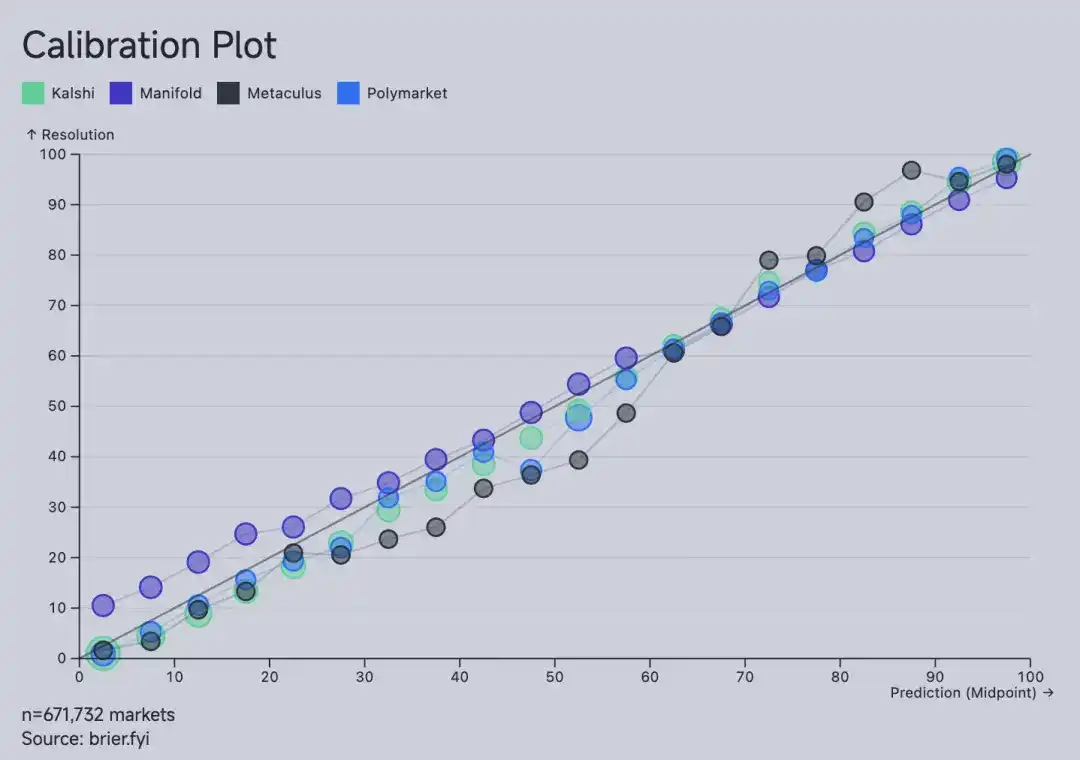
Image Caption: Predictions require data. Image Source: https://brier.fyi/
Before prediction markets, opinion polls and media played such roles. It was not that polls tested voters' tendencies but that polls guided people's choices. Thus, in a Western context, prediction markets are viewed as information tools, with additional functions like insurance, hedging, and taxation layered on top.
Therefore, prediction markets are far more sensitive than trading tools. Just as TikTok faced bipartisan scrutiny not for being a "pacifier," prediction markets inherently cannot be fragmented:
- Information discovery requires博弈 based on real-time, authentic data to improve final precision, which drives traffic to become more concentrated;
- The U.S. election market is highly mature and must operate within a Western context to achieve a relationship of "conflict without rupture" with the political system, becoming a new information channel.
Based on this, Polymarket and Kalshi are "born mature" information hubs. This is also why U.S. capital continues to invest and drive up their valuations, rather than employing a horse-racing mechanism like Binance.
Of course, all this has little to do with us. What matters to us is how to ride the wave of the prediction market FOMO (Fear Of Missing Out).
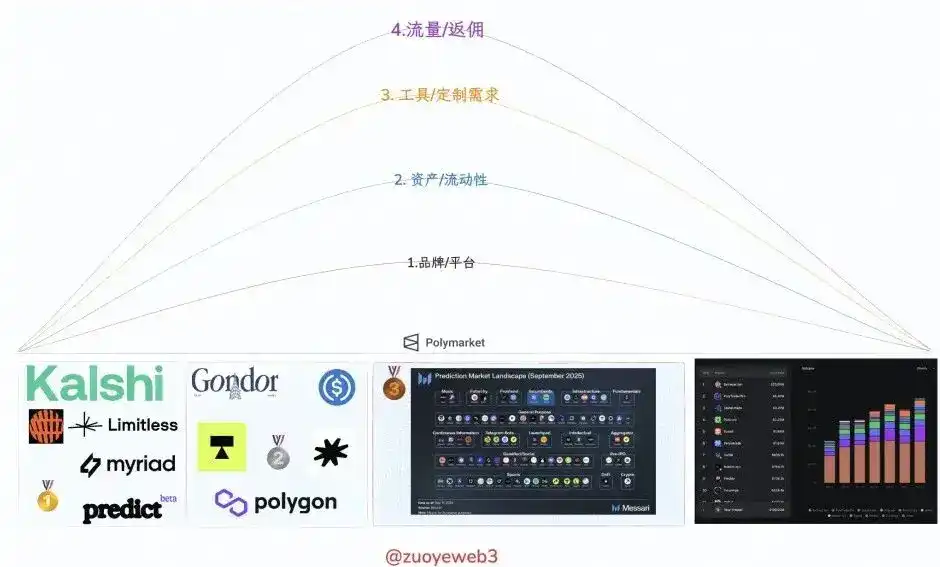
Image Caption: Prediction market peripherals. Image Source: @zuoyeweb3
Overall, the market has evolved four models:
- Copycat platforms outside Polymarket and Kalshi require Perp DEX-level investment and subsequent high compliance costs for the U.S. market. These will generally move toward the TGE track, with almost no real adoption rate;
- Asset-layer innovation targeting existing prediction platforms:
- DeFi-fying assets bet on prediction markets. For example, Gondor allows them to be used as collateral for lending, while Space adds 10x leverage to them. Essentially, this is violently injecting DeFi factors;
- Innovative asset prediction markets like 42 Space, which generate prediction topics directly from social media information flows, attempt to differentiate from existing platforms;
- Mainstream Web3/Web2 financial trading Super Apps like Coinbase/Robinhood, complementing their own transaction types.
- Tools customized for specific groups or needs in prediction markets, such as high-frequency trading, multi-platform arbitrage trading, or aggregated trading terminals, LP mining, or paid group tools, as well as prediction market data and information aggregation analysis platforms.
- KOLs and rebate platforms, such as Based and Phantom wallet and other mobile trading platforms, as well as various social fission rebate KOLs or communities.
Among these paradigms, the core prediction market requires excessive investment and, due to political considerations, almost offers no prospects for high valuations for new players. Secondly, tools and rebates will exhibit cyclical patterns along with capital investment and hotspot changes in prediction markets.
The only area worth business investment is the DeFi-fication of prediction platform assets. While awaiting results, bet assets remain in a沉淀 state, which might be the most noteworthy high-quality asset for DeFi.
Triple-Win Cross-Market Arbitrage Mechanism
Do DeFi the way Taobao traffic stations do it, not the way DeFi does DeFi.
Providing traffic services to giants has always been like dancing on the edge of a knife. On one hand, giants need third parties to boost platform traffic; on the other, they don’t want third parties to develop brand effects.
This was the dilemma of early e-commerce traffic stations. They had to maintain good relationships with platforms, sellers, and buyers. Sellers needed third-party traffic stations to enhance competitiveness, while buyers wanted discounted prices.
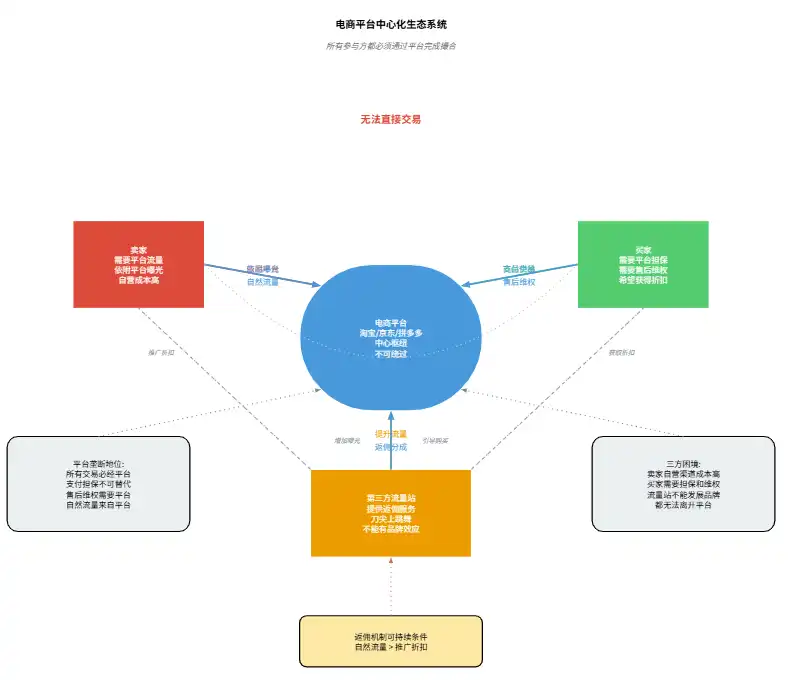
Image Caption: Third-party services. Image Source: @zuoyeweb3
Traffic stations start with rebates. Platforms develop corresponding sharing/purchase/rebate tools. As long as the natural traffic sellers gain from exposure outweighs the promotional discounts, the entire business can sustain itself.
- Sellers need to依附 platforms to承接 natural traffic; self-operated brands and channels are too costly.
- Buyers need platforms for after-sales services and rights protection; the payment process also requires platform guarantees.
Referencing the three-way battle among e-commerce platforms—Taobao, JD.com, and Pinduoduo—the market for new e-commerce platforms is excessively narrow. The e-commerce market inherently requires a dual structure of "brand merchants + long-tail traffic." Newcomers capturing brand merchants or focusing on niche markets cannot achieve scale effects.
Ultimately, Taobao relied on differentiating Tmall to retain high-end customers and capture the full spectrum of clients. Pinduoduo leveraged the national-level app WeChat to引流 from rural China to encircle the world. Only JD.com, focused on brands, found itself in a dilemma.
Let’s compare this with the rebate mechanisms of exchanges. Rebate KOLs and exchanges pursue the number of retail followers. Retailers' profits or losses do not affect the带单 mechanism, which differs from e-commerce rebates. Users themselves have an initial demand to purchase goods; giving users discounts benefits the promotional effects of traffic stations and sellers.
From this perspective, the Builder mechanisms of Hyperliquid and Polymarket do not solve the above problems. The growth promoted around them can only be growth in trading volume.
This isn’t to say that trading volume growth is unimportant, but it still results in wasted沉淀资金. Moreover, more trading volume leads to more沉淀资金, which, for the financial industry pursuing capital efficiency, is not a good thing.
If we cannot跳出 the growth logic limitations of CEX/DEX, prediction markets will quickly hit their peak because public events available for trading are ultimately limited. Smaller, more instantaneous events will favor house advantages, truly pushing prediction markets toward the exchange track.
Information博弈 is the essence of prediction markets. During the process from betting —> to expiration,资金沉淀 occurs. How to "activate" these沉淀资金 is the underlying motivation for prediction markets and DeFi to move toward each other.
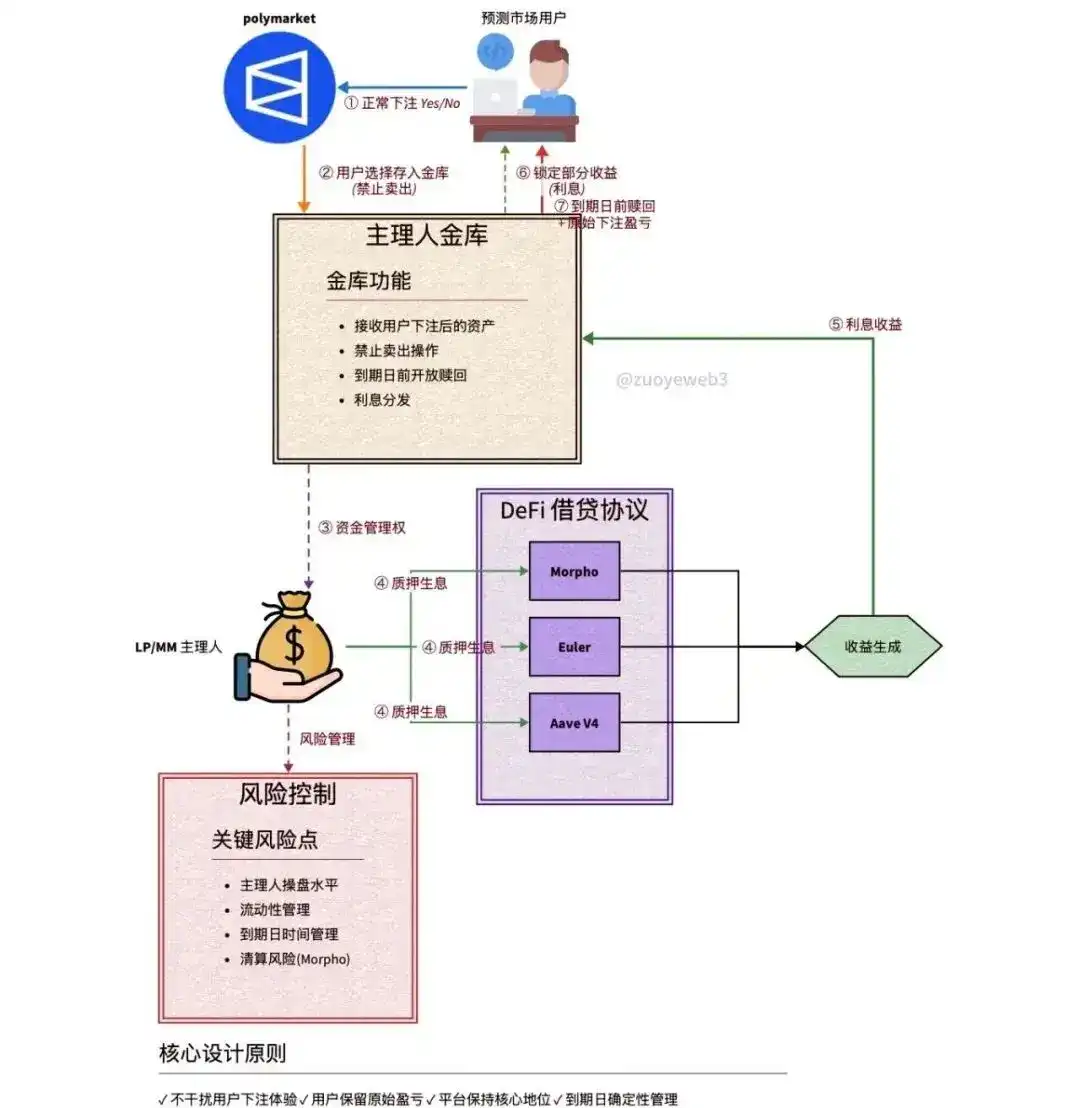
Image Caption: Adding leverage to prediction assets. Image Source: @zuoyeweb3
Do not attempt to interfere with users' normal betting experience. In current discussions about adding leverage in prediction markets, there are mainly two trends:
- Intercepting operations as represented by Gondor, where users deposit their positions into DeFi staking after betting. Regardless of liquidity management and APY calculations, simply changing users' purposes already doubles the difficulty, easily leading down the path of high-interest吸储.
- Messari’s Kaleb Rasmussen attempted to price the "Jump Risk" of prediction markets. As mentioned earlier, prediction market prices can instantly converge to 1 or 0 at expiration. The mathematical discussion is brilliant, but the practical financial engineering implementation is quite challenging.
Based on existing practices, I boldly propose a simpler combination method for achieving transparent DeFi leverage without interfering with user experience for founders' reference: a cross-market arbitrage mechanism模仿淘客, arbitraging between prediction market audiences and DeFi audiences.
- The platform provides prediction market代下单 services. Users place orders for 0 or 1 positions at discounted prices, obtaining better market prices. The platform gains lower financing costs, and prediction markets like Polymarket gain more traffic;
- The platform or prediction market LPs/MMs act as vault managers. After users place bets, they deposit into协议金库 cooperating with prediction markets, such as Morpho, to earn DeFi stack yields.
In the above process, users' betting experience is completely uninterfered with. As long as the platform's discounted price cost is less than the收益 from the DeFi stack, scale utility will take effect. Users will still ultimately receive their betting losses or profits, but unlike trading rebate mechanisms, users place orders based on their own judgments.
Unlike the infinite minting of xUSD引爆 leverage, Polymarket's USDC actually exists. The only risk point is the managers'操盘水平.
- Prediction market platforms: Embed themselves into a broader DeFi stack without compromising user experience while increasing platform trading volume;
- Managers + LPs/MMs: Activate沉淀资金, and funds with确定的到期日 can construct new models超越短期套利;
Just like third-party e-commerce traffic station rebates, buyers still engage in any transactional relationship with the platform and sellers. Similarly, the Yes/No bettors in prediction markets will have transactional relationships with Polymarket, unrelated to the vault managers.
Moreover, Polymarket remains at the core of the entire transaction process. Thanks to Morpho's open architecture, even if bad debts occur, they follow normal liquidation procedures, minimizing platform responsibility.
Conclusion
Arbitrage "traffic" with DeFi thinking; don’t buy DeFi volume with traffic thinking!
The true value of prediction markets lies in their沉淀资金, with clear expiration dates and corresponding asset reserves. If Polymarket wants to surpass Kalshi in capital efficiency, scale expansion has reached a阶段性极限.
In other words, compared to trading assets, Wall Street and the crypto circle are currently in an irrational狂热 phase regarding information pricing. Whether it’s TGE or IPO, issuing stablecoins or building L1/L2s, these are all常规动作 within expectations.
Before the uncertain-date TGE/IPO, Polymarket deterministically needs a strong peripheral ecosystem to繁荣交易量 and阻击 Kalshi. The programmability and composability of on-chain funds are the solution for Polymarket's外围流量.
The biggest financial opportunity in 2026 is the cyclically fluctuating midterm elections and the World Cup. FIFA讨好川宝, regulators greenlight DeFi and gambling—truly a major financial year.



















