Original | Odaily Planet Daily (@OdailyChina)
Author | Ethan (@ethanzhang_web3)
The crypto market is never short of deaths, but the way things die in 2026 is different.
Projects used to die dramatically: explosions, runaway founders, disappearing teams, always causing uproar on social media, always a spectacle worth watching. But in less than 90 days since the start of 2026, Odaily Planet Daily has noted that over 10 Web3 projects have publicly announced they are ceasing operations—their disappearances are unusually quiet: an announcement, servers shut down, funds run out, and then nothing.
Games, lending protocols, on-chain tools, infrastructure—almost every major sector has seen projects stall during this period, with a suspension notice appearing on the timeline on average every 9 days. This density feels more like a long-overdue collective reckoning than a normal market clearing. Below are some cases compiled by Odaily Planet Daily.
List of Suspended Projects
Games & Metaverse: The Collective Collapse of Play-to-Earn
GENSO Online
On February 26, 2026, the highly anticipated fantasy RPG GENSO Online regrettably announced it would shut down all core services by April 30, 2026, including game servers, the GENSO market, LAND Viewer, and the exclusive MV wallet.
The team disclosed in an AMA: Even after a series of downsizing自救 measures, the project's monthly fixed expenses still reached as high as 10 million JPY. Among these, cloud infrastructure (3.4 million JPY) and人力成本 (3 million JPY) were the largest items, while maintaining secondary market liquidity through listing maintenance and ROND token buybacks even consumed 1.3 million JPY.
In comparison, the total monthly revenue, including market fees, in-app purchases, and advertising, was only about 2 million JPY. Expenses were a full five times revenue, with no signs of narrowing. Under this极度失衡的现金流, although player-held NFTs and tokens (like MV and ROND) will remain on-chain, their value is濒临归零 as the game's utility is lost. The官方 also clearly stated that, according to the terms of service, no refunds will be provided. This experiment试图用 Web3 赋能传统游戏 was ultimately crushed by server bills.
Pixiland
On January 15, 2026, after struggling for two years on the Ronin ecosystem, the pixel strategy game Pixiland made a difficult and painful decision: to indefinitely suspend all Web3 plans and transition to a pure Web2 offline model. This means its Token Generation Event (TGE) was completely canceled. What made the community even more heartbroken was that the wPixi points players had accumulated day and night by "farming" for airdrops will never be converted into real crypto assets.
The team坦言, as an independent, self-funded small team, under the双重挤压 of drastic market fluctuations and regulatory uncertainty, the cost of maintaining on-chain infrastructure and interaction had far exceeded their承受极限. "Reverting to Web2" became a无奈之举 for断臂求生 for current Web3 games facing high trial-and-error costs.
Forgotten Runiverse
Similarly relying on the Ronin network's traffic红利, the fantasy MMORPG Forgotten Runiverse announced on January 27, 2026, that it would go offline indefinitely.
The official announcement委婉地归结 the suspension to "compound financial challenges"—frankly, a complete breakdown of the funding chain. Lacking sustainable造血能力, the team could no longer afford the most basic operational costs of maintaining the game. Although the official wording maintained the体面 of "may restart in the future if resources are obtained," in the industry's view, this "indefinite offline" has actually become the standard exit strategy for mid-sized game projects when funds are exhausted.
DeFi Lending & Derivatives: Liquidity Recedes, Who's Swimming Naked
ZeroLend
On February 17, 2026, ZeroLend, once seen as the leading lending protocol on Layer 2, announced it was entering an "honorable wind-down" phase, gradually ceasing out operations. There was a time when ZeroLend was immensely popular, with its Total Value Locked (TVL) once breaking $250 million, over 100,000 daily active users, and absolute dominance in ecosystems like zkSync and Linea.
However,盲目扩张最终反噬了自身. As early supported chains like Manta, Zircuit, and XLayer fell into生态衰退, the multi-chain strategy brought not scale effects but severely fragmented liquidity. Large amounts of assets were trapped in low-liquidity environments, becoming难以维护的“僵尸资产”. More致命的是, oracle service providers terminated their support, directly draining the pricing and liquidation foundation of the lending protocol. Coupled with the extremely thin profit margins of the lending market and the long-term threat of hacker fraud, the protocol fell into irreversible long-term losses.
Facing an unsolvable dilemma, ZeroLend chose a rare体面退出 in the industry: directly lowering the LTV (Loan-to-Value) ratio of most markets to 0%, forcibly closing borrowing functions, and only retaining withdrawals to guide users to safety. For the problem of枯竭 liquidity on some chains, the team conducted asset redistribution through smart contract upgrades; they even used the team's allocated LINEA airdrop份额 to provide partial refunds to LBTC suppliers on the Base chain. A three-year operation最终落幕 with a textbook "dignified shutdown."
Polynomial
On February 14, 2026, the DeFi derivatives protocol Polynomial, which had received a $1.1 million seed round investment from知名机构 like Archetype and the founder of Synthetix, announced an orderly wind-down of its business.
The team stated that although the on-chain derivatives market had grown 100-fold in recent years, and the赛道方向 was completely correct, their execution层面却严重未达预期. After evaluating the残酷现实 that their product had fallen into a "state of decay", the team decided to: actively call off the TGE originally planned for Q1 2026.
The team believed that强行发币 with an uncompetitive product was a worthless冒险 and simply transferring risk to the community. Instead, they chose to规范地清退资金 and systematically analyze the accumulated 27 million transaction data points from the past to find a true product moat. They promised that the project would be restarted by the original team when conditions were ripe, with priority given to old users. This attitude of "no harvesting, no lying flat" preserved a rare bottom line for Web3 entrepreneurs.
Step Finance
On February 24, 2026, Step Finance, a veteran DeFi platform on Solana that had received a $2 million investment from机构 like Alameda Research, along with its subsidiaries SolanaFloor and Remora Markets, announced an immediate and complete cessation of operations.
What broke this生态老将 was not a competitor, but an extremely basic yet致命运维安全 (OpSec) error. In late January 2026, a senior executive's personal device at Step Finance was compromised by hackers, directly leading to the theft of approximately $40 million in巨额资产 from the treasury. In the following weeks, the team tried every possible自救手段, seeking financing and acquisitions everywhere, but in this already liquidity-tight market, no one was willing to take on such a badly damaged project with such a huge security漏洞. All attempts failed.
Although the team eventually recovered about $4.7 million in related assets and promised partial buybacks for STEP holders based on a pre-incident snapshot, as well as initiating redemption processes for Remora rTokens (which still maintain 1:1 asset backing), this still could not挽回大局. One compromised personal computer instantly destroyed a project built over years, becoming the most惨烈注脚 for deaths due to internal mismanagement in the 2025-2026 Web3 space.
MilkyWay Protocol
On January 15, 2026, MilkyWay, a liquid staking protocol on the Celestia ecosystem, announced it was permanently shutting down and beginning a phased wind-down of operations.
MilkyWay's failure is a classic story of "poor execution" and "dragging itself to death." The project initially positioned itself in the Celestia modular ecosystem,切入 the liquid staking赛道, and successfully secured a $5 million funding round led by Binance Labs and Polychain in April 2024. However, the team's execution能力出现了严重脱节: the V1 launch and MILK token, originally scheduled for Q4 2023, were severely delayed until the second half of 2024 or even early 2025.
In the fast-changing Web3 market, being late is almost equivalent to being out. When the flagship product WayCard was finally slowly launched, it had long missed the early traffic红利期 of the Celestia ecosystem. Facing lower-than-expected actual demand and adoption rates, the protocol, relying solely on retaining 10% of liquid staking fees, simply could not generate enough cash flow to support the high daily operations. Ultimately, even $5 million could not save it from资金枯竭. As a final farewell, the team returned the fees (USDC) previously accumulated by the protocol proportionally to eligible MILK token holders,黯然退场.
Infrastructure & Tools: Some Lost to Competition, Some to "No Longer Needed"
Parsec
On February 20, 2026, the on-chain analytics tool Parsec regrettably drew a close to its five-year entrepreneurial journey. The team announced the cessation of all services and began processing refunds and subscription cancellations for users.
This was once a star project born with a "golden key". Parsec launched in early 2021, on the eve of the DeFi and NFT frenzy, aiming to provide users with highly customizable on-chain data visualization dashboards. With its product理念 that hit the pain point, it successfully secured a total of $5.25 million in seed and extension funding from top-tier institutions like Galaxy Digital, Polychain Capital, Robot Ventures, and Uniswap Ventures.
However, Parsec's lifecycle恰好跨越 a complete cycle from extreme狂热 to a prolonged deep bear market. When the tide receded and on-chain speculative activity plummeted, the demand from ordinary users for complex on-chain data analysis tools also saw a cliff-like decline. More致命的是, it was in a red ocean赛道卷到极致. Facing Dune's community ecosystem, Nansen's smart money labels, Arkham's intelligence bounties, and DeFiLlama's free comprehensiveness, Parsec始终未能建立起不可替代的护城河.
In 2026, with venture capital tightening comprehensively, infrastructure projects without sustainable cash flow造血能力 are destined not to survive. Parsec's体面退款关停 reveals a残酷的行业真相: top-tier capital can catalyze a good product, but it cannot buy a perpetual survival slot in a winner-takes-all存量市场.
ENS Layer 2 Namechain
If Parsec died from fierce商业竞争, then the proprietary Layer 2 network Namechain, whose development was halted by ENS on February 7, 2026, died entirely because it was "killed by underlying evolution".
In past years, to escape the高昂 Gas fees on the Ethereum mainnet, which often reached tens of dollars, the ENS team had grandly planned the proprietary L2 network Namechain,试图借此降低用户的注册门槛. However, with the successful landing of the Ethereum Fusaka upgrade in 2025, the mainnet's Gas limit was historically raised to 60 million. This底层突破 significantly enhanced Ethereum's transaction processing capacity, and the Gas cost for ENS mainnet registrations暴降了 99% over the past year, with average registration fees falling directly to below $0.05.
Facing this幸福的烦恼, ENS core developer nick.eth极其果断地砍掉了 Namechain, announcing that ENSv2 would be deployed directly back onto the Ethereum mainnet. This not only saved the huge costs of developing and maintaining an L2 but, more importantly, staying on L1彻底消除了 the additional trust assumptions brought by L2 cross-chain interactions, allowing identity domain names—this most core digital infrastructure—to continue enjoying Ethereum's highest level of security保障.
Even Vitalik Buterin personally commented: "This is a wise decision." Although abandoning the L2, the roadmap for ENSv2's experience optimizations like single-step registration and cross-chain stablecoin payments remains. Namechain did not die from code vulnerabilities or funding breakdowns, but from being "no longer necessary." Perhaps in the history of Web3, filled with unfinished projects and runaways, this counts as an极其罕见,甚至值得起立鼓掌的体面收场.
Reflection: What This Wave of Suspensions Is Saying
Putting these cases together, a few things become clear.
First, the lack of造血能力 is the underlying reason for all failures. GENSO Online's expenses were five times its revenue; MilkyWay, relying on截留 10% of staking fees, simply couldn't cover operational costs; Parsec couldn't find a sustainable cash flow source after on-chain activity declined. These projects share a common underlying logic: using financing to buy time, using token incentives to buy growth, but never establishing a造血机制 independent of external输血.
Second, multi-chain expansion is a repeatedly verified trap. ZeroLend deployed simultaneously on multiple chains like zkSync, Manta, Linea, Zircuit, XLayer, with TVL once exceeding $250 million, seeming like success. But multi-chain brought not scale effects but全面碎片化 of liquidity—it was spread too thin on each chain, and the生态衰退 of any one chain would directly affect the entire protocol. With limited resources, spreading wide is not as good as digging deep. This道理 is simple, but during the hottest days of the "multi-chain narrative" a few years back, almost no one was willing to take it seriously.
Third, security is a human problem, not just a code problem. The $40 million lost by Step Finance didn't vanish in a sophisticated smart contract漏洞, but on a poorly managed personal computer. In 2025, the entire Web3 industry lost nearly $4 billion due to hacker attacks, a significant proportion of which came from social engineering attacks and supply chain vulnerabilities—that is, from "human error," not "code error."
Fourth, capital is accelerating its concentration towards头部 with real demand. Stablecoins, RWA, and prediction markets showed clear product-market fit in 2026; BTC, ETH, and SOL-related assets continued to attract traditional incremental capital through ETF channels. Meanwhile, the落地 of regulatory frameworks like the 2025《GENIUS 法案》 further清退不合规的边缘项目 from the market. According to reliable research data, the liquidity space left for long-tail tokens and projects without real application scenarios is narrowing significantly, with the median decline of altcoins in the past year reaching 79%.
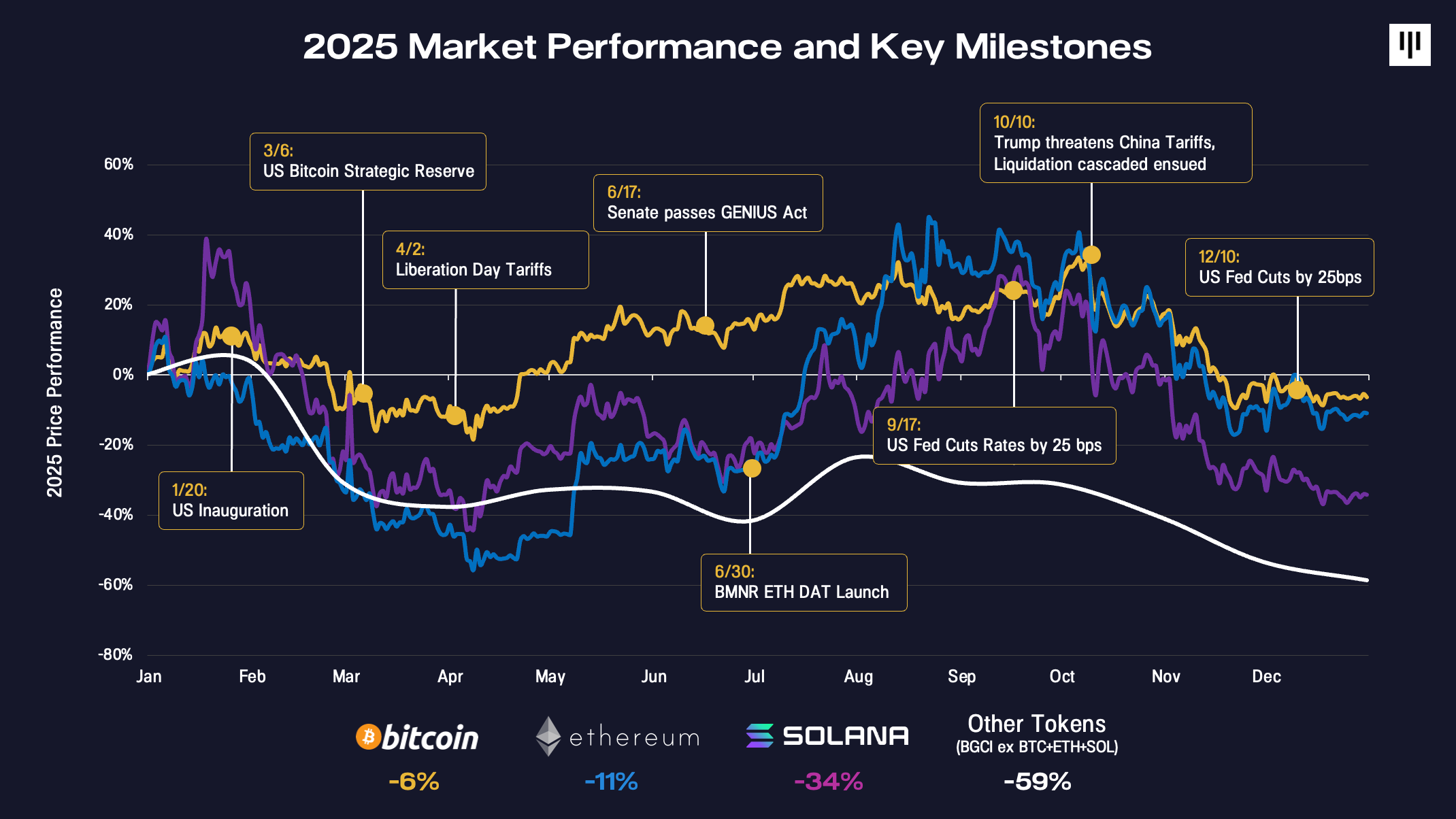
Of course, there is another side worth noting in these announcements. Polynomial not强行发币, ZeroLend using its own airdrop份额 to compensate affected users, ENS果断砍掉 Namechain the moment it became unnecessary—these choices are actually not common in this industry. The出清 is painful, but it is also筛选: leaving behind those teams truly willing to be responsible to users.
There are still over nine months left in 2026. This suspension list will most likely grow longer.
What exactly are the survivors relying on? That remains to be seen slowly......