2026 Crypto Market Off to a Strong Start: A Cautiously Bullish New Beginning

marsbitPubblicato 2026-01-07Pubblicato ultima volta 2026-01-07

Introduzione

The cryptocurrency market started 2026 on a strong note, with Bitcoin reaching $94,000 and the total market capitalization nearing $3.3 trillion. Despite geopolitical tensions, institutional interest returned as spot ETFs saw net inflows of approximately $400 million on January 5. Large Bitcoin holders reduced selling pressure, while retail investors continued accumulating. Derivatives markets indicated cautious optimism, with significant Bitcoin call open interest at the $100,000 strike and Ethereum calls at $3,500 for January expiries. Futures open interest also rebounded, though funding rates remained moderate. Meme coins like PEPE and BONK outperformed, alongside privacy-focused tokens and DeFi assets with clear revenue models. Stablecoin flows turned positive again in January, supporting further upside potential. However, ongoing tensions between the U.S. and Venezuela remain a short-term risk for global markets.

· At the beginning of 2026, the cryptocurrency market regained its upward momentum. Despite heightened geopolitical uncertainty, Bitcoin's price rose to $94,000, and the total market capitalization of cryptocurrencies approached $3.3 trillion.

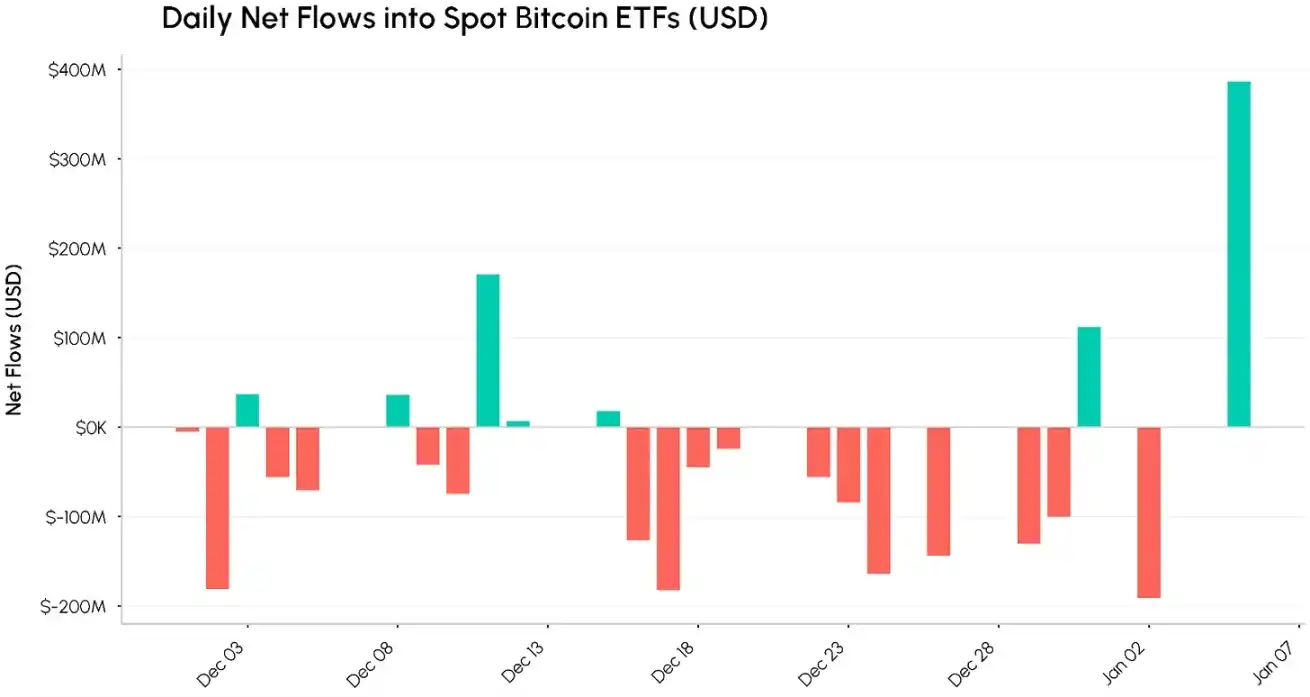
· Spot Bitcoin ETFs reversed the year-end outflow trend on January 5, with a net inflow of approximately $400 million; whale selling activity moderated, while retail investors actively accumulated positions.

· Derivative market positions indicate a cautiously bullish stance. Among the options contracts expiring at the end of January, Bitcoin call open interest is concentrated at the $100,000 strike price, while Ethereum call open interest is concentrated at the $3,500 strike price.

A Green Start to 2026

After several weeks of range-bound trading during the holiday season, the cryptocurrency market started the new year on a strong note. Bitcoin's price surged to $94,000, and the total market capitalization of cryptocurrencies approached $3.3 trillion.

Despite the escalation of geopolitical tensions due to U.S. military action against Venezuela, the cryptocurrency market remained resilient. As year-end prices for precious metals like gold and silver soared, crypto assets gradually recouped their losses. Additionally, the strength of some altcoins signaled a rise in market risk appetite. However, influenced by the evolution of the geopolitical situation, global markets may still experience significant volatility in the short term.
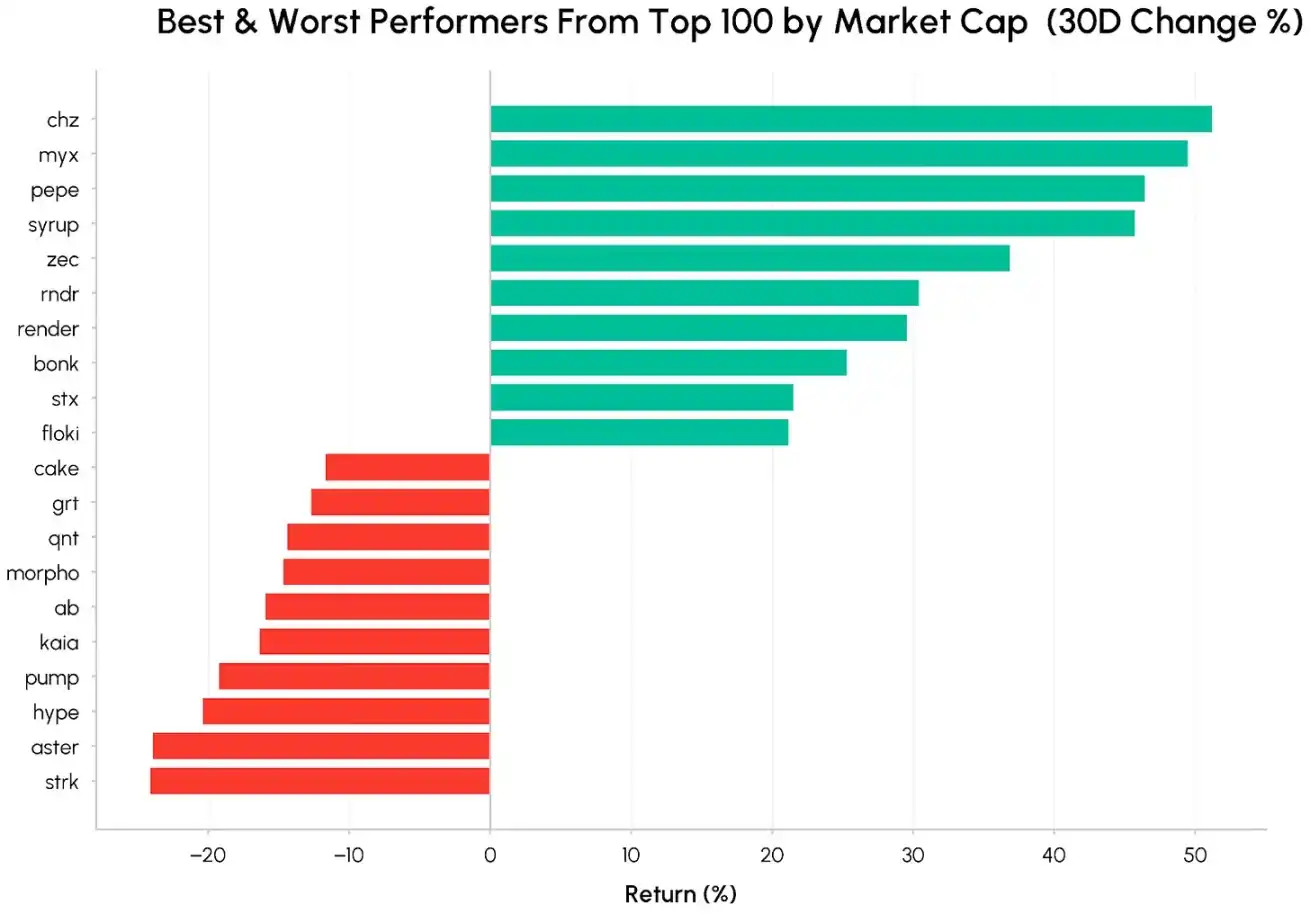
Over the past month, standout performers included Memecoins like PEPE and BONK, privacy-focused Zcash (ZEC), and the institutional credit platform Maple Finance (SYRUP). This trend indicates a resurgence of interest in Memecoins, privacy tokens, and DeFi tokens with clear profit-sharing mechanisms and visible cash flow growth.

In contrast, Hyperliquid (HYPE) and Aster (ASTER) underperformed. The reason lies in the diversion of market attention within the decentralized perpetual contract trading platform sector following the token airdrop by Lighter (LIT), a platform based on zero-knowledge Rollup technology. The decentralized lending protocol Aave (AAVE) also declined during this period due to intense community debate and multiple governance votes regarding token holder rights, profit distribution models, and the role of Aave Labs in the decentralized autonomous organization. This controversy reflects a broader trend across the DeFi industry: leading protocols like Uniswap and Aave are re-evaluating how value flows back to token holders.

Institutional Funds Return, Whale Selling Cools

Spot Bitcoin ETFs reversed the year-end outflow trend, with a single-day net inflow of over $350 million on January 5, marking the return of institutional funds to the crypto market. Around the New Year, spot Bitcoin ETFs had recorded net outflows exceeding $320 million. This reversal suggests a resurgence of institutional investor allocation interest as the first quarter of 2026 begins.

Institutional crypto asset reserves continue to expand: the U.S. Strategic Bitcoin Reserve added 1,287 Bitcoin, bringing its total holdings to 673,783; Bitmine increased its Ethereum reserves to 4.14 million, accounting for approximately 3.4% of Ethereum's total supply.
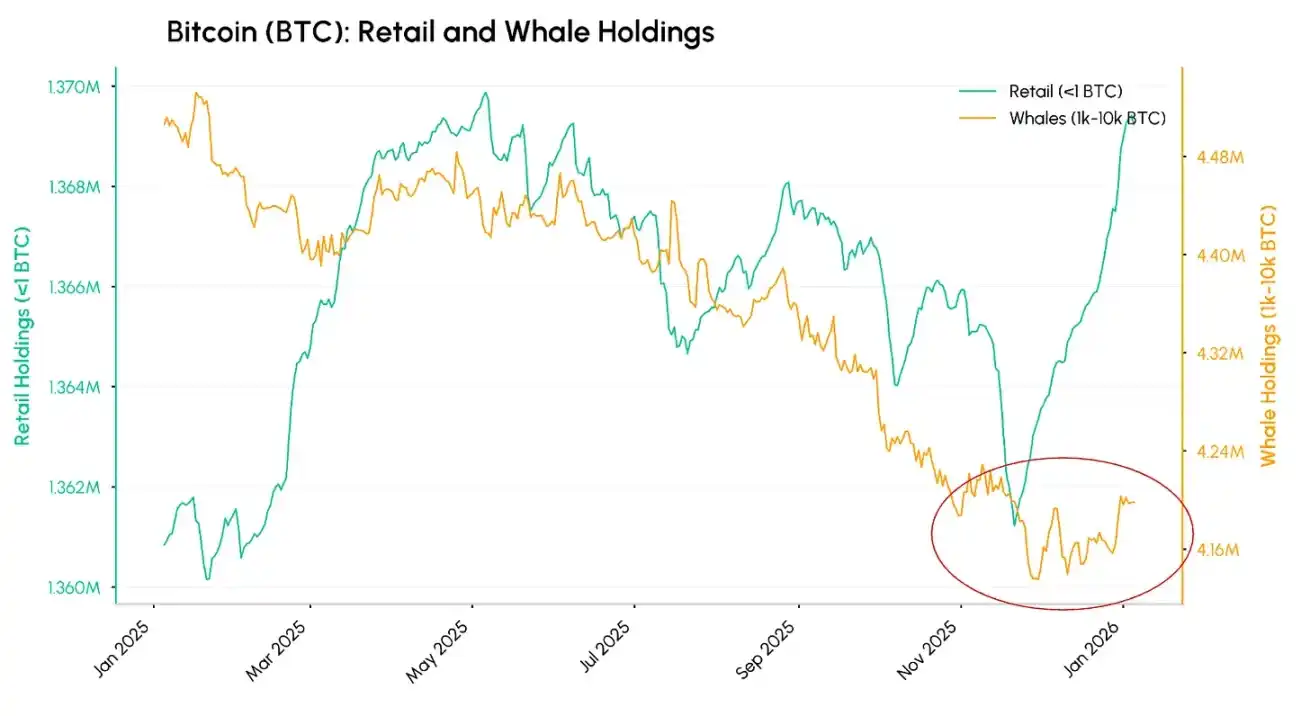
On-chain data shows that since the beginning of January, token selling by whale addresses holding 1,000-10,000 Bitcoin has significantly moderated, indicating reduced selling pressure from this group. Meanwhile, retail investors holding less than 1 Bitcoin have been accelerating their accumulation since mid-November last year. As cryptocurrency prices retreated from highs and consolidated, retail investors bought the dip. The combination of reduced whale selling and sustained retail buying creates a favorable market structure.
Derivatives Market Signals Cautious Optimism

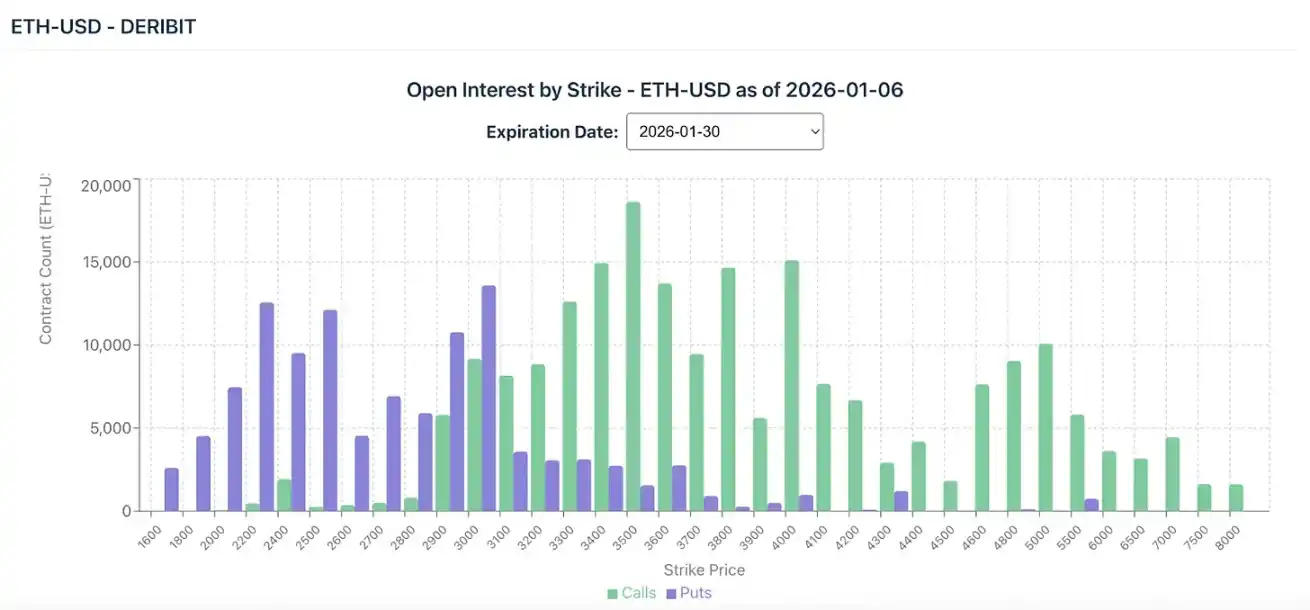
Derivatives market positions indicate a cautiously optimistic view of the Q1 2026 trajectory. The two charts below show the open interest by strike price for Bitcoin and Ethereum options contracts expiring on January 30, 2026, on the Deribit platform, visually reflecting option traders' bets on short-term market direction.
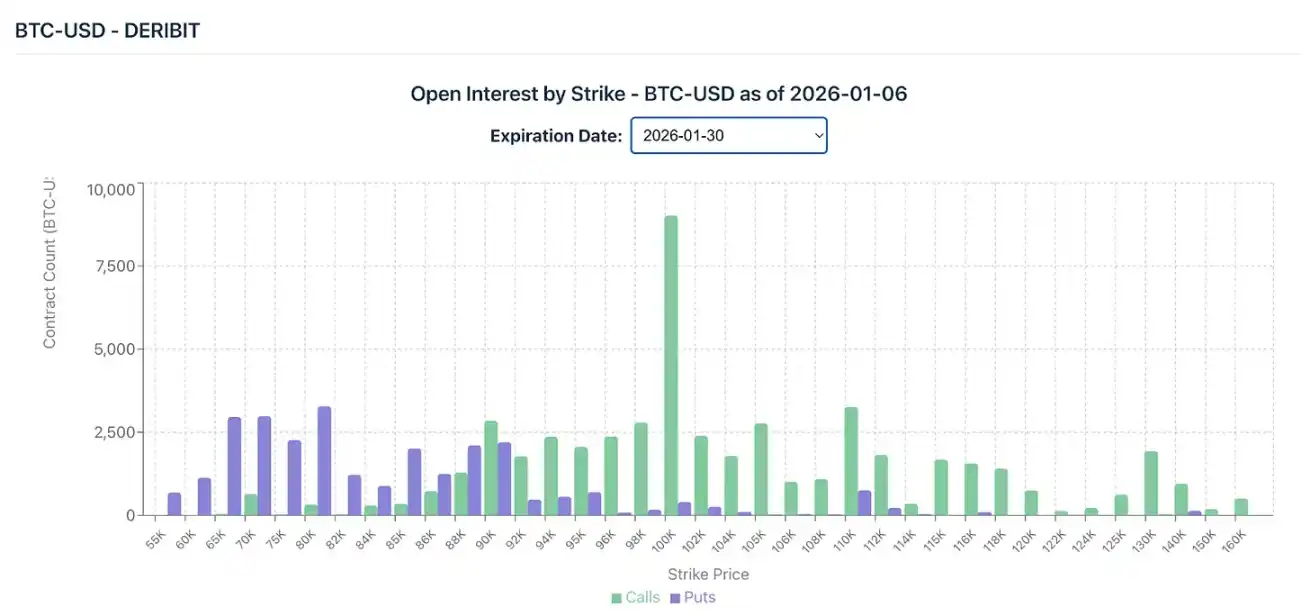
Options market data shows that for contracts expiring on January 30, Bitcoin call open interest is heavily concentrated around the $100,000 strike price, while Ethereum call open interest is concentrated around the $3,500 strike price. This indicates traders are betting on short-term upside potential but are not exhibiting excessive euphoria. Downside protection is also in effect: Bitcoin put open interest is notable in the $70,000 to $90,000 range, though the overall open interest structure remains skewed towards the long side.
The futures market conveys a similar signal. Year-end, Bitcoin and Ethereum futures open interest saw a slight pullback but quickly rebounded in January, with the nominal open interest on major exchanges nearing the highs of last December. In late December, influenced by broad market deleveraging, the funding rates for Bitcoin and Ethereum perpetual contracts briefly turned negative. However, they have since recovered to positive territory, with Ethereum's funding rate significantly stronger than Bitcoin's. Overall, the market is in a cautiously bullish state, not yet showing signs of being overextended.

Stablecoin Flows and On-Chain Activity

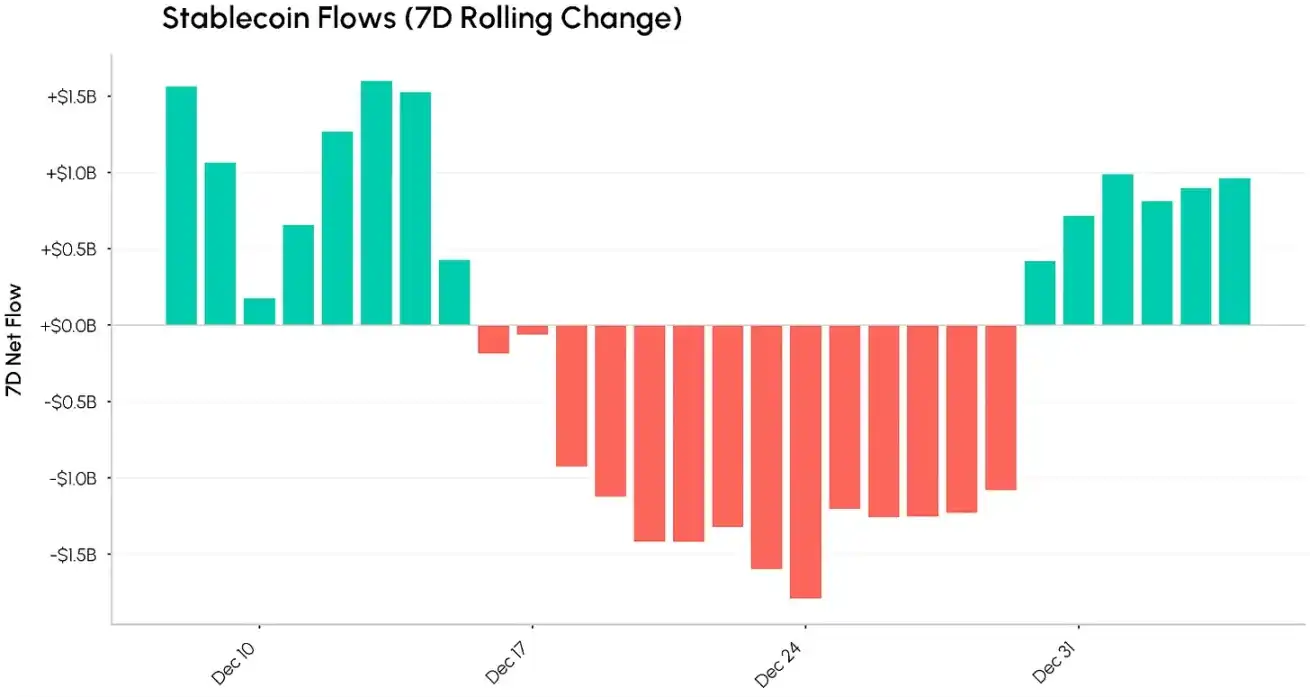
Stablecoin flow is a key indicator for observing capital movements into and out of the crypto market. In early December last year, the stablecoin market recorded sustained net inflows, but towards year-end, flows turned negative, with a single-week net outflow exceeding $1 billion. Entering January 2026, stablecoin flows stabilized and turned net positive again. If this trend continues, it will provide strong support for the sustained rise of the crypto market.
On-chain activity data further corroborates the positive market outlook. Following the implementation of the Ethereum Fusaka upgrade in December, Ethereum mainnet daily transaction volume hit a record high of 2.23 million, and the number of active addresses approached all-time peaks. Concurrently, stablecoin on-chain transfer volume also set a new record in December, indicating that capital flowing into the crypto market is not sitting idle but is actively circulating within the ecosystem.

Conclusion

Market data from the first week of 2026 paints a picture of cautious optimism, with the cryptocurrency market gradually finding its footing. The return of institutional funds, cooling whale selling, optimistic signals from the derivatives market, coupled with high on-chain activity and the return of net inflows into stablecoins, collectively support the market's upward movement. However, it is crucial to remain vigilant, as the geopolitical developments between the U.S. and Venezuela remain a potential risk factor that could trigger global market volatility in the short term.


Domande pertinenti

QWhat was the price of Bitcoin and the total market capitalization of the cryptocurrency market at the beginning of 2026?

AThe price of Bitcoin rose to $94,000, and the total cryptocurrency market capitalization approached $3.3 trillion.

QWhat trend reversal was observed in the spot Bitcoin ETF on January 5th, and what did it signify?

AThe spot Bitcoin ETF reversed its year-end outflow trend with a net inflow of approximately $400 million on January 5th, signaling a renewed interest in crypto asset allocation from institutional investors.

QAccording to the options market, what are the key strike prices where call option open interest is concentrated for Bitcoin and Ethereum expiring at the end of January?

AFor Bitcoin, call option open interest is concentrated around the $100,000 strike price. For Ethereum, it is concentrated around the $3,500 strike price.

QWhat on-chain behavior suggests that selling pressure from large holders (whales) has decreased?

AOn-chain data shows that token selling behavior from whale wallets holding 1,000 to 10,000 Bitcoin has noticeably收敛 (converged/subdued), indicating reduced selling pressure from this group.

QWhat is identified as a potential risk factor that could cause volatility in global markets in the short term?

AThe geopolitical situation between the United States and Venezuela is identified as a potential risk factor that could cause volatility in global markets in the short term.

Letture associate

Gensyn AI: Don't Let AI Repeat the Mistakes of the Internet

In recent months, the rapid growth of the AI industry has attracted significant talent from the crypto sector. A persistent question among researchers intersecting both fields is whether blockchain can become a foundational part of AI infrastructure. While many previous AI and Crypto projects focused on application layers (like AI Agents, on-chain reasoning, data markets, and compute rentals), few achieved viable commercial models. Gensyn differentiates itself by targeting the most critical and expensive layer of AI: model training. Gensyn aims to organize globally distributed GPU resources into an open AI training network. Developers can submit training tasks, nodes provide computational power, and the network verifies results while distributing incentives. The core issue addressed is not decentralization for its own sake, but the increasing centralization of compute power among tech giants. In the era of large models, access to GPUs (like the H100) has become a decisive bottleneck, dictating the pace of AI development. Major AI companies are heavily dependent on large cloud providers for compute resources. Gensyn's approach is significant for several reasons: 1) It operates at the core infrastructure layer (model training), the most resource-intensive and technically demanding part of the AI value chain. 2) It proposes a more open, collaborative model for compute, potentially increasing resource utilization by dynamically pooling idle GPUs, similar to early cloud computing logic. 3) Its technical moat lies in solving complex challenges like verifying training results, ensuring node honesty, and maintaining reliability in a distributed environment—making it more of a deep-tech infrastructure company. 4) It targets a validated, high-growth market with genuine demand, rather than pursuing blockchain integration without purpose. Ultimately, the boundaries between Crypto and AI are blurring. AI requires global resource coordination, incentive mechanisms, and collaborative systems—areas where crypto-native solutions excel. Gensyn represents a step toward making advanced training capabilities more accessible and collaborative, moving beyond a niche controlled by a few giants. If successful, it could evolve into a fundamental piece of AI infrastructure, where the most enduring value in the AI era is often created.

marsbit11 h fa

Gensyn AI: Don't Let AI Repeat the Mistakes of the Internet

marsbit11 h fa

Why is China's AI Developing So Fast? The Answer Lies Inside the Labs

A US researcher's visit to China's top AI labs reveals distinct cultural and organizational factors driving China's rapid AI development. While talent, data, and compute are similar to the West, Chinese labs excel through a pragmatic, execution-focused culture: less emphasis on individual stardom and conceptual debate, and more on teamwork, engineering optimization, and mastering the full tech stack. A key advantage is the integration of young students and researchers who approach model-building with fresh perspectives and low ego, prioritizing collective progress over personal credit. This contrasts with the US culture of self-promotion and "star scientist" narratives. Chinese labs also exhibit a strong "build, don't buy" mentality, preferring to develop core capabilities—like data pipelines and environments—in-house rather than relying on external services. The ecosystem feels more collaborative than tribal, with mutual respect among labs. While government support exists, its scale is unclear, and technical decisions appear driven by labs, not state mandates. Chinese companies across sectors, from platforms to consumer tech, are building their own foundational models to control their tech destiny, reflecting a broader cultural drive for technological sovereignty. Demand for AI is emerging, with spending patterns potentially mirroring cloud infrastructure more than traditional SaaS. Despite challenges like a less mature data industry and GPU shortages, Chinese labs are propelled by vast talent, rapid iteration, and deep integration with the open-source community. The competition is evolving beyond a pure model race into a contest of organizational execution, developer ecosystems, and industrial pragmatism.

marsbit13 h fa

Why is China's AI Developing So Fast? The Answer Lies Inside the Labs

marsbit13 h fa

3 Years, 5 Times: The Rebirth of a Century-Old Glass Factory

Corning, a 175-year-old glass company, is experiencing a dramatic revival as a key player in AI infrastructure, driven by surging demand for high-performance optical fiber in data centers. AI data centers require vastly more fiber than traditional ones—5 to 10 times as much per rack—to handle high-speed data transmission between GPUs. This structural demand shift, coupled with supply constraints from the lengthy expansion cycle for fiber preforms, has created a significant supply-demand gap. Nvidia has invested in Corning, along with Lumentum and Coherent, in a $4.5 billion total commitment to secure the optical supply chain for AI. Corning's competitive edge lies in its expertise in producing ultra-low-loss, high-density, and bend-resistant specialty fiber, which is critical for 800G+ and future 1.6T data rates. Its deep involvement in co-packaged optics (CPO) with partners like Nvidia further solidifies its position. While not the largest fiber manufacturer globally, Corning's revenue from enterprise/data center clients now exceeds 40% of its optical communications sales, and it has secured multi-year supply agreements with major hyperscalers including Meta and Nvidia. Financially, Corning's optical communications revenue has surged, doubling from $1.3 billion in 2023 to over $3 billion in 2025. Its stock price has risen nearly 6-fold since late 2023. Key future catalysts include the rollout of Nvidia's CPO products and the scale of undisclosed customer agreements. However, risks include high current valuations and potential disruption from next-generation technologies like hollow-core fiber. The company's long-term bet on light over electricity, maintained even through the telecom bubble crash, is now being validated by the AI boom.

marsbit13 h fa

3 Years, 5 Times: The Rebirth of a Century-Old Glass Factory

marsbit13 h fa

Trading

Spot
Futures
活动图片




