2026 Crypto Funding Reshuffle: Game and DePIN Are Dead, Prediction Market Duo Takes 18% of All Year's Funding with Two Deals

marsbitPubblicato 2026-05-08Pubblicato ultima volta 2026-05-08

Introduzione

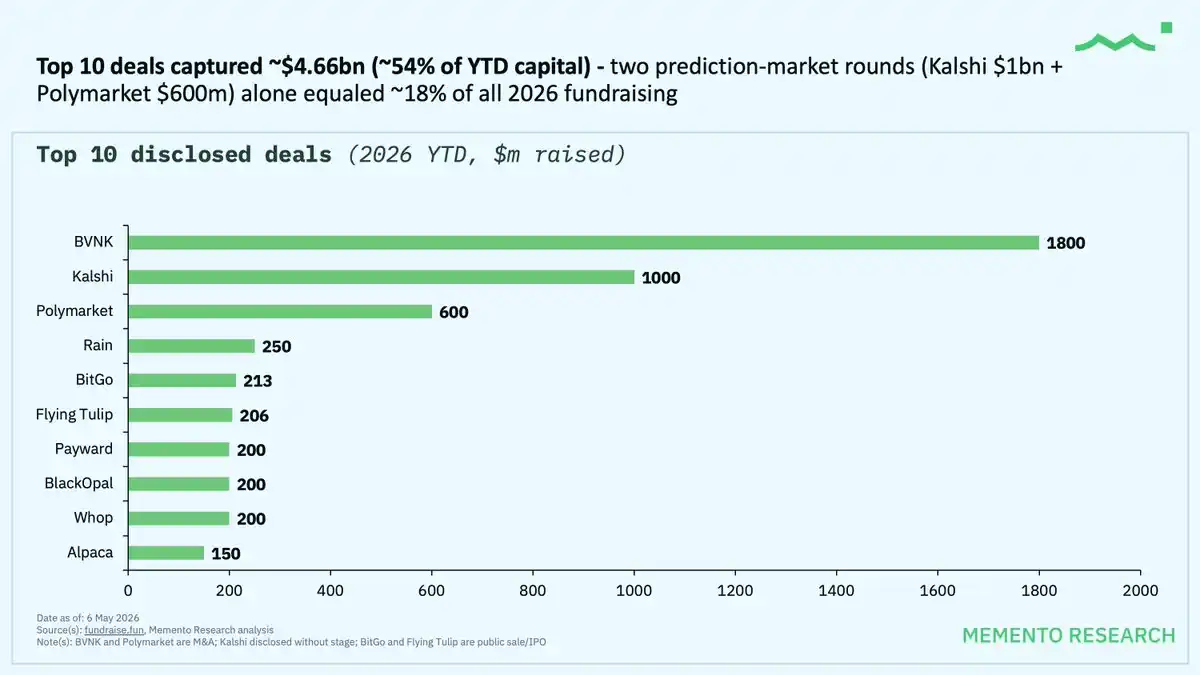
Cryptocurrency Funding in 2026: Gaming & DePIN Falter as Prediction Markets Dominate Data from the first four months of 2026 reveals a stark shift in crypto venture funding. The gaming and DePIN (Decentralized Physical Infrastructure Networks) sectors have seen capital nearly dry up. In contrast, the "Consumer" category, led by two massive deals for prediction market platforms Kalshi ($1B) and Polymarket ($600M), captured a significant share. These two deals alone accounted for 18% of the year's total $8.65 billion raised and exceeded the combined funding of all 47 DeFi projects. Overall, the $8.65B across 305 deals is misleading. A March surge to $4.57B was largely due to two major acquisitions (BVNK at $1.8B and Kalshi). Excluding these, the underlying monthly funding rate is approximately $1B, indicating continued softness. The "Payments" and "Consumer" sectors together consumed 72% of all capital. Another notable trend is the rise of mergers and acquisitions (M&A), with 48 deals nearly matching the 57 seed-round investments. This signals a market pivot from funding new ideas to consolidating around established leaders. The most active investors so far in 2026 are Coinbase Ventures (18 deals), Tether (13 deals), Animoca Brands (11 deals), and GSR (11 deals). Notably, a16z's pace has slowed significantly compared to previous years.

Author:Memento Research

Compiled by: Deep Tide TechFlow

Deep Tide TechFlow Introduction: Crypto funding data for the first four months of 2026 reveals a harsh reality: the Game and DePIN sectors are nearly starved of capital, while Kalshi and Polymarket, two prediction market companies, have taken more money than all DeFi projects combined for the entire year. More alarmingly, the number of M&A deals has already matched seed rounds, indicating a shift in capital from betting on new ideas to acquiring existing leaders.

Funding Overview: March's Surge Was an Illusion

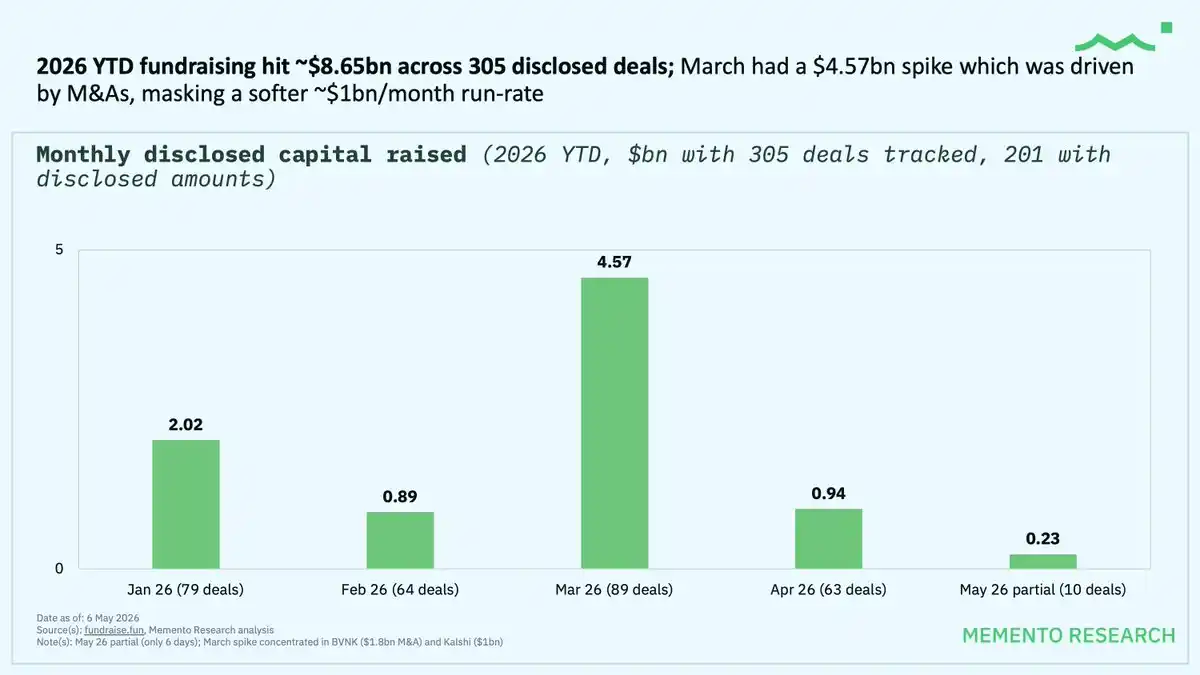
From January 1st to May 6th, 2026, the crypto industry completed 305 funding rounds, totaling $8.65 billion. However, the "surge" to $4.57 billion in March was actually just two massive M&A deals: BVNK's $1.8 billion and Kalshi's $1.0 billion.

Excluding these two deals, the real funding pace is about $1 billion per month, even weaker than at the end of 2025.

Capital Flow: Payments and Consumer Absorb 72%

By sector breakdown:

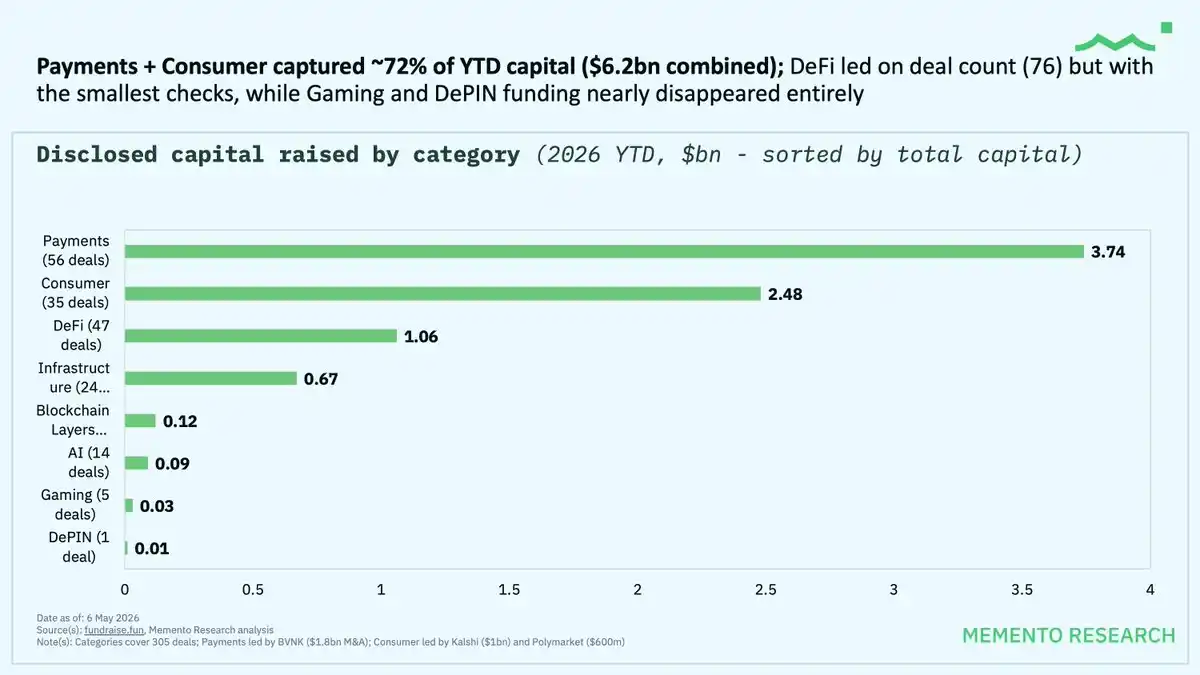
Payments: $3.74 billion (56 deals)

Consumer: $2.48 billion (35 deals)

DeFi: $1.06 billion (47 deals, the highest number of transactions)

The Payments and Consumer sectors combined account for 72% of the year's total funding. Funding for Game and DePIN has nearly vanished.

Prediction Markets Dominate the Consumer Sector

Two prediction market companies accounted for 18% of the year's total funding:

Kalshi: $1.0 billion

Polymarket: $600 million

These two deals totaling $1.6 billion exceed the sum of all 47 DeFi funding rounds.

M&A Becomes Mainstream

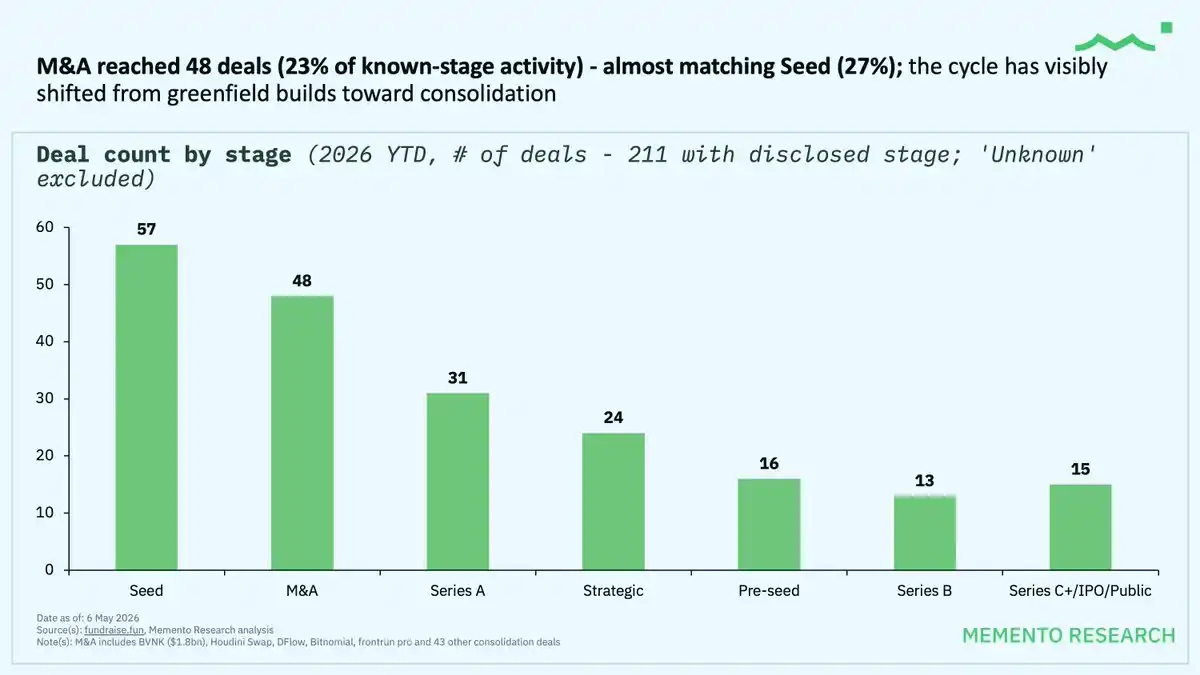
M&A deals reached 48 (accounting for 23% of known-stage transactions), nearly matching the 57 seed rounds (27%). This cycle has shifted from investing in new ideas in early stages to acquiring industry leaders.
Investor Rankings Reshuffled

Most active funds in 2026:

Coinbase Ventures: 18 deals (ranked second during 2021-26 period)

Tether: 13 deals (new top lead investor)

Animoca Brands: 11 deals (ranked first during 2021-26 period)

GSR: 11 deals

a16z: 7 deals (a significant drop compared to ~200 deals during 2021-26 period)

Domande pertinenti

QAccording to the article, which two sectors took the majority of crypto funding in early 2026?

AThe Payments and Consumer sectors took the majority of crypto funding, together accounting for 72% of the total capital raised.

QWhat significant trend does the data reveal about mergers and acquisitions (M&A) compared to seed funding?

AThe data shows that M&A deals reached 48 (23% of known-stage deals), almost catching up to seed rounds at 57 deals (27%). This indicates a shift in the investment cycle from funding new ideas to acquiring established industry leaders.

QWhy was the spike in funding for March 2026 described as an 'illusion'?

AThe spike to $4.57 billion in March was largely an illusion because it was driven by just two mega-deals: an $1.8 billion acquisition of BVNK and a $1 billion deal with Kalshi. Removing these two transactions reveals a slower, more sluggish monthly funding pace of around $1 billion.

QHow did the funding for prediction market companies compare to the total funding for all DeFi projects in the period covered?

AThe two prediction market companies, Kalshi ($1 billion) and Polymarket ($600 million), together raised a combined $1.6 billion. This amount exceeded the total raised by all 47 DeFi projects, which was $1.06 billion.

QWhich investment firms were the most active in terms of deal count during early 2026, and how did this compare to their historical activity?

AIn early 2026, the most active investors by deal count were Coinbase Ventures (18 deals, historically ranked 2nd from 2021-26), Tether (13 deals, new top investor), Animoca Brands (11 deals, historically ranked 1st), GSR (11 deals), and a16z (7 deals, showing a significant decline from its historical ~200 deals between 2021-26).

Letture associate

Agents Take Over Traffic Distribution Power: What Are Tencent, ByteDance, and Alibaba Competing For?

In the race to dominate the AI era's entry point, China's tech giants—Tencent, ByteDance, and Alibaba—are aggressively deploying AI Agents to control the future of traffic distribution. Alibaba is pursuing a dual-track "closed loop + openness" strategy. Its Qianwen app is evolving into a super-Agent integrated across its ecosystem (Taobao, Alipay, etc.) to handle complex tasks like travel planning. Concurrently, it is opening its platform to external brands (Luckin Coffee, KFC) and has launched a B2B Agent platform, "Wukong," targeting enterprise automation. Its other flagship, Quark, aims to be an "AI super search box" for information and tasks. ByteDance is executing an omnipresent "sprawl strategy." Its Doubao app boasts over 300 million monthly active users and is evolving into a default AI entry point for daily life, with plans for paid versions and e-commerce integration. Its core weapon is the Kouzi platform, a visual "AI assembly factory" for developers to build custom Agents. ByteDance is also pushing hardware integration, collaborating on AI phones and developing smart glasses to embed Doubao everywhere. Tencent is playing its long-held "ultimate card" by quietly embedding an AI Agent directly into WeChat. This Agent, accessible via a swipe, can understand user commands and automatically execute tasks by calling upon WeChat's millions of mini-programs (e.g., finding and ordering coffee). This leverages WeChat's unparalleled 1.4-billion-user ecosystem to position the app as an AI-powered "service operating system," a move that could dramatically reshape the competitive landscape. The core battleground is shifting from competing for "user screen time" to competing to be the "default execution layer" for user intent. The business model is evolving from an "attention economy" to an "intent economy," where the Agent that can most efficiently fulfill a user's need gains control over service access and token flow. This represents a fundamental change in how users connect with digital services, making the fight for the Agent入口 (entry point) a pivotal moment for redefining industry leadership in the AI age.

marsbit1 h fa

Agents Take Over Traffic Distribution Power: What Are Tencent, ByteDance, and Alibaba Competing For?

marsbit1 h fa

From Banning Doubao to Embracing Honor: Why Did WeChat Suddenly 'Change Its Face'?

The article explores the sudden shift in WeChat's strategy towards AI assistants from mobile phone manufacturers, transitioning from strict opposition to active collaboration. For over a year, WeChat fiercely resisted attempts by phone AI assistants (like ByteDance's Doubao in late 2025) to control its features via GUI automation ("simulated clicking"), citing security and data control concerns. This stance created a significant barrier for system-level AI integration. Now, Tencent has initiated A2A (Agent-to-Agent) partnerships with major phone brands like Honor, Xiaomi, OPPO, and vivo. This model allows a phone's system AI (e.g., Honor's YOYO) to parse a user's voice command and send a structured request directly to WeChat's own internal AI agent via secure APIs. WeChat then executes the action (e.g., sending a message) and returns the result. The article attributes Tencent's "change of face" to strategic pressure. While leading in social app usage, Tencent trails rivals like ByteDance and Alibaba in standalone AI app popularity. WeChat, with its vast mini-program ecosystem, is Tencent's key asset for an AI comeback. The upcoming WeChat AI agent aims to handle tasks like booking and payments within the app. However, phone system assistants remain the primary AI entry point for most users. The A2A collaboration allows Tencent to extend WeChat's AI reach to this crucial system layer while maintaining control over its core functions and data. For phone manufacturers, embracing A2A is a pragmatic move. The GUI route proved unviable due to WeChat's blocks. A2A offers a compliant path to integrate a vital service, enhancing their AI assistants' usefulness. It allows them to focus on developing their own AI ecosystems for other services while cooperating on WeChat access. The collaboration is framed as a mutual, strategic necessity: Tencent gains a distribution channel, and manufacturers gain a key functionality. The partnership relies on a "dual authorization" mechanism for security, requiring both user and app consent for each action. While questions about long-term data privacy practices remain, experts note A2A is more secure and compliant than GUI automation. Ultimately, this cooperation is seen as a tentative, calculated truce. Tencent's long-term goal is to make WeChat an AI-powered "service OS." Phone manufacturers aim to make their system AI the central user interface. Their paths may converge or clash in the future, but for now, the A2A deal represents the opening chapter in the battle for the AI-era user入口, driven by necessity and strategic calculus on both sides.

marsbit3 h fa

From Banning Doubao to Embracing Honor: Why Did WeChat Suddenly 'Change Its Face'?

marsbit3 h fa

Trading

Spot
Futures
活动图片