2026 Crypto Financing Reshuffle: Gaming and DePIN Are Dead, Two Prediction Market Deals Gobble Up 18% of Yearly Funding

marsbitPubblicato 2026-05-09Pubblicato ultima volta 2026-05-09

Introduzione

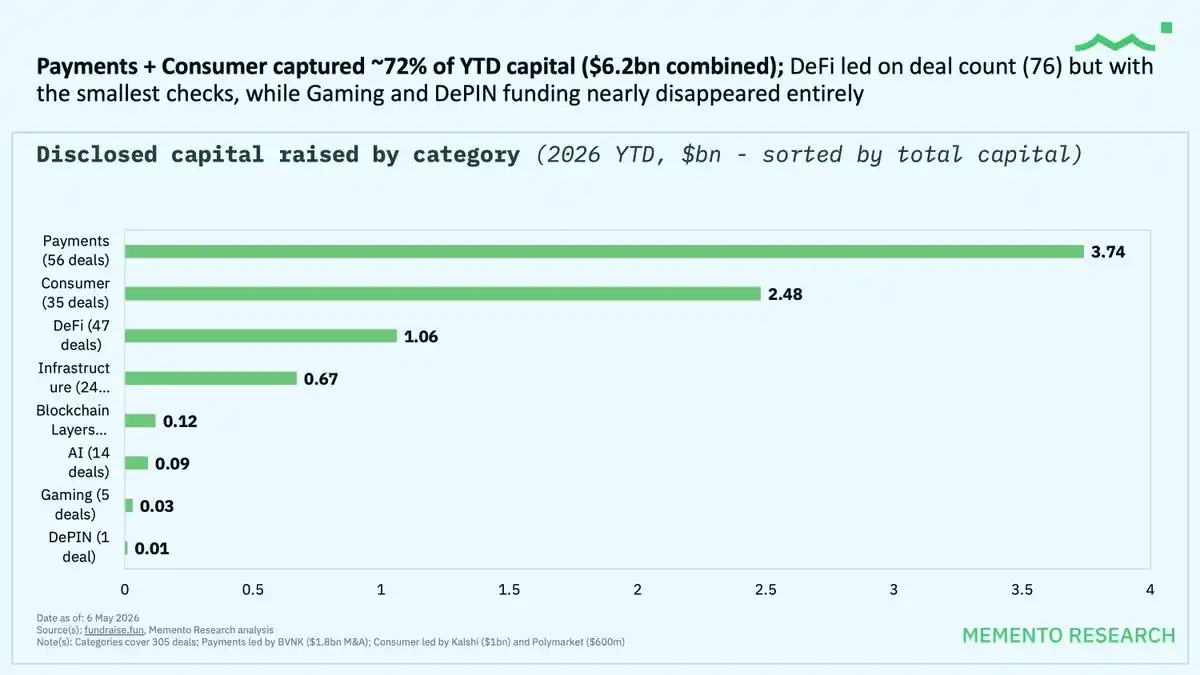
Crypto Funding Shakeup in 2026: Gaming & DePIN Fade, Prediction Markets Dominate Analysis of crypto funding from January 1 to May 6, 2026, reveals a major sectoral shift. The industry raised $8.65 billion across 305 deals. However, a March surge to $4.57 billion was largely due to two mega-deals: BVNK's $1.8 billion acquisition and a $1 billion raise by Kalshi. Excluding these, monthly funding is a sluggish ~$1 billion. Capital concentration is extreme. The Payments ($3.74B) and Consumer ($2.48B) sectors absorbed 72% of all funds. Within Consumer, prediction markets were dominant: Kalshi's $1B and Polymarket's $600M raises together accounted for 18% of the year's total, surpassing all 47 DeFi deals combined ($1.06B). In contrast, Gaming and DePIN sectors saw funding nearly vanish. A strategic pivot is underway. Merger & Acquisition (M&A) activity reached 48 deals, nearly matching the 57 seed-stage rounds. This indicates capital is increasingly flowing toward acquiring established leaders rather than betting on new ideas. The most active investors so far in 2026 are Coinbase Ventures (18 deals), Tether (13 deals), Animoca Brands (11 deals), and GSR (11 deals). Notably, a16z's pace has slowed significantly compared to its 2021-2026 average.

Author: Memento Research

Compilation: TechFlow Deep Tides

Deep Tides Intro: Crypto financing data from the first four months of 2026 reveals a brutal reality: funding for the gaming and DePIN sectors has nearly dried up, while Kalshi and Polymarket, two prediction market companies, have taken more money than all DeFi projects combined for the entire year. More alarmingly, the number of M&A deals has caught up with seed rounds, indicating that capital is shifting from betting on new ideas to acquiring existing industry leaders.

Financing Overview: The March Surge Was Just an Illusion

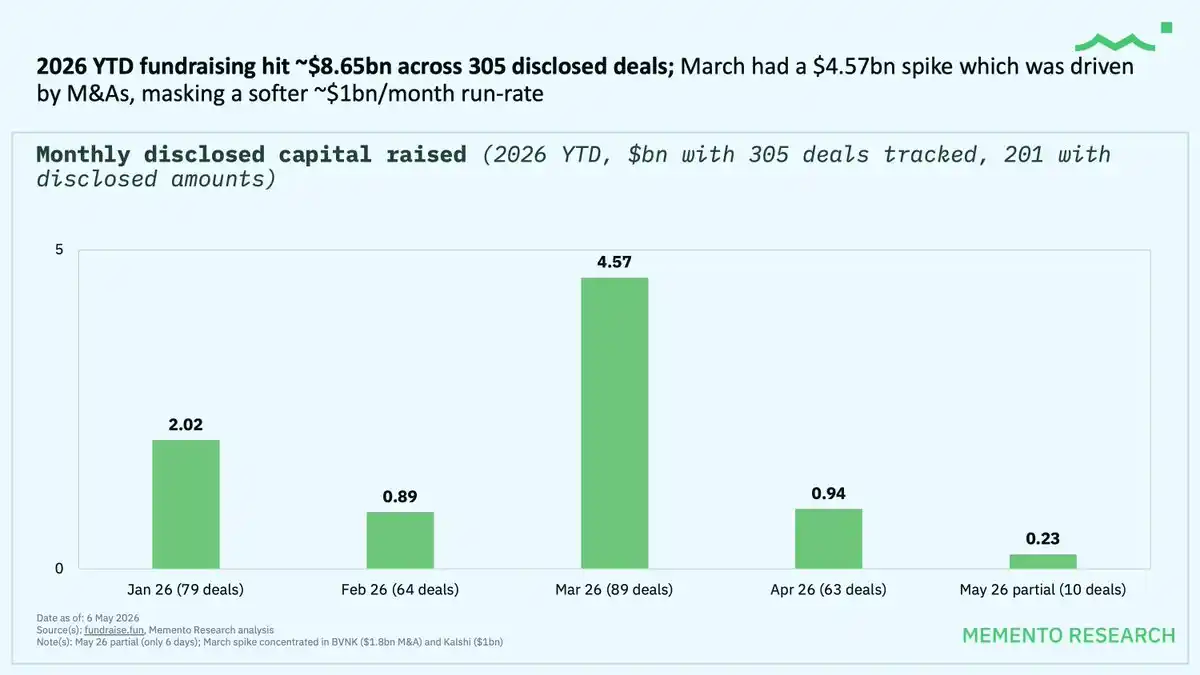
From January 1 to May 6, 2026, the crypto industry completed 305 financing rounds, totaling $8.65 billion. However, the "surge" of $4.57 billion in March was essentially just two mega M&A deals: BVNK's $1.8 billion and Kalshi's $1 billion.

Excluding these two, the real financing pace is about $1 billion per month, which is even weaker than at the end of 2025.

Fund Flow: Payments and Consumer Gobble Up 72%

By sector:

Payments: $3.74 billion (56 deals)

Consumer: $2.48 billion (35 deals)

DeFi: $1.06 billion (47 deals, the highest number of transactions)

The payments and consumer sectors together account for 72% of the year's funding. Financing for gaming and DePIN has almost vanished.

Prediction Markets Dominate the Consumer Sector

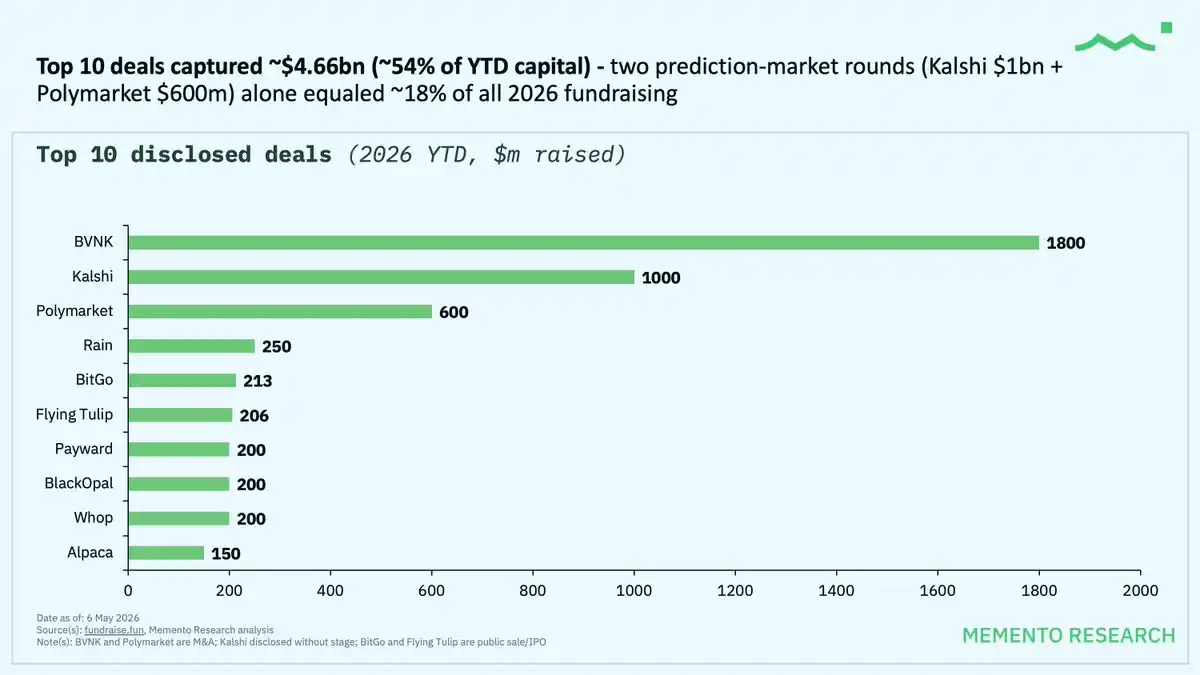
The two prediction market companies accounted for 18% of the year's total funding:

Kalshi: $1 billion

Polymarket: $600 million

These two deals total $1.6 billion, exceeding the combined total of all 47 DeFi financing rounds.

M&A Becomes Mainstream

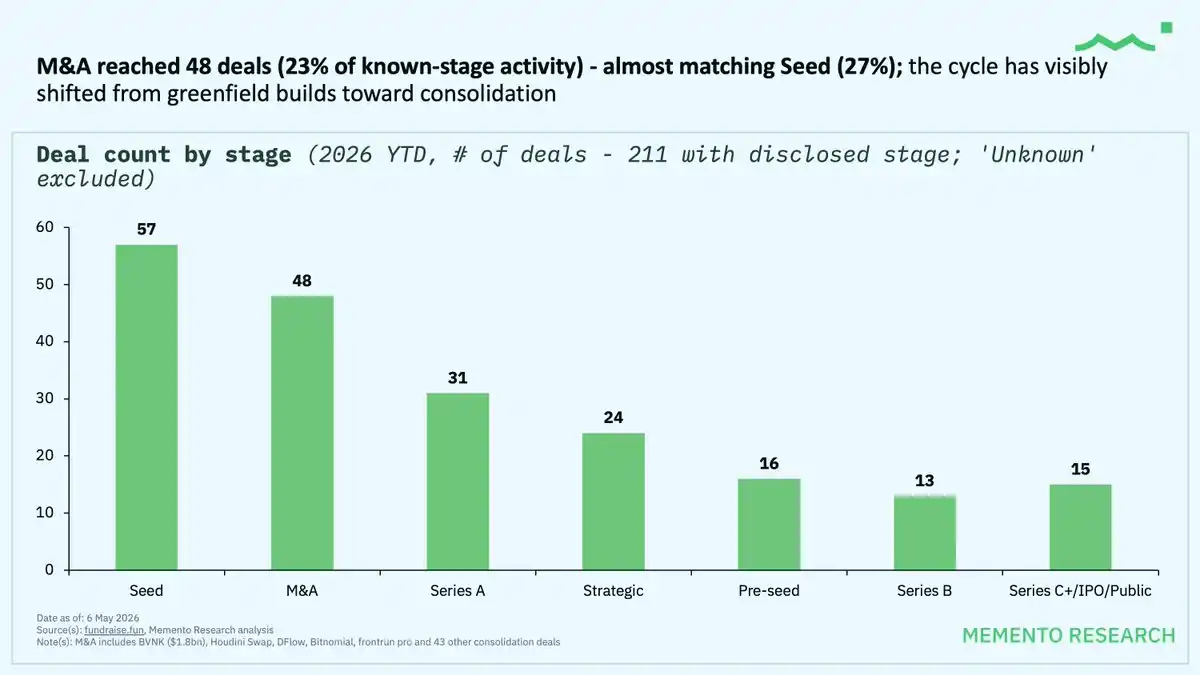
M&A deals reached 48 (23% of known-stage transactions), almost on par with 57 seed rounds (27%). This cycle has shifted from the early stage of investing in new ideas to acquiring industry leaders.
Investor Rankings Reshuffled

Most active funds in 2026:

Coinbase Ventures: 18 deals (Ranked 2nd during 2021-26)

Tether: 13 deals (New top lead investor)

Animoca Brands: 11 deals (Ranked 1st during 2021-26)

GSR: 11 deals

a16z: 7 deals (Significantly down from ~200 deals during 2021-26)

Domande pertinenti

QWhat were the two major M&A deals that dominated the funding figures for March 2026, and what were their values?

AThe two major M&A deals were BVNK, which raised $1.8 billion, and Kalshi, which raised $1 billion.

QWhich two sectors accounted for 72% of total funding in early 2026, and what were the respective funding amounts?

AThe Payments and Consumer sectors accounted for 72% of total funding. Payments raised $3.74 billion across 56 deals, while Consumer raised $2.48 billion across 35 deals.

QHow much funding did the prediction market companies Kalshi and Polymarket receive collectively, and what percentage of the year's total funds does this represent?

AKalshi and Polymarket collectively received $1.6 billion in funding, which represents 18% of the total funds raised in early 2026.

QWhat significant trend is highlighted by the number of M&A transactions (48) nearly matching the number of seed rounds (57) in early 2026?

AThe trend highlights a market shift where capital is moving away from funding new ideas (seed-stage investments) and towards acquiring existing market leaders (M&A).

QAccording to the article, which were the most active investment funds in early 2026 by number of deals?

AThe most active funds were Coinbase Ventures with 18 deals, Tether with 13 deals, and Animoca Brands and GSR with 11 deals each.

Letture associate

Missed Out on SpaceX's IPO? Take a Look at SpaceX's Complete Supply Chain

SpaceX is now public, but its high valuation and losses may deter some investors. However, the real opportunity, as seen with Apple, Tesla, and Nvidia, may lie in its extensive supply chain. SpaceX, funded primarily by its profitable Starlink service, spends hundreds of billions annually on components for its rockets, satellites, and planned orbital AI data centers, creating significant revenue streams for suppliers. Key suppliers are categorized by their indispensability. The first group includes irreplaceable players like **NVIDIA** (GPUs for AI supercomputers), **Eutelsat (SATS)** (spectrum rights), **Filtronic** (millimeter-wave amplifiers), **Materion (MTRN)** (beryllium alloys), and **STMicroelectronics (STM)** (phased array chips). The second category comprises suppliers costly to replace due to long certification cycles or deep integration, such as **Honeywell (HON)** (flight controls), **Carpenter Technology (CRS)** (specialty steel), **Hexcel (HXL)** (carbon fiber), **Broadcom (AVGO)** (data switching), and **Linde** (industrial gases). The third group involves high-volume, cost-critical manufacturers for mass-produced items like Starlink terminals. Major players here include Taiwanese contract manufacturer **Wistron NeWeb (6285)** and several Chinese-listed firms: **Sunway Communication (300136)**, **Parker Advanced Materials (605123)**, **Western Superconducting (002149)**, and **Yingliu Co., Ltd. (603308)**. Other niche providers include **Tianyin Electromechanical**, **Tongyu Communication**, **Trimble (TRMB)**, **Astronics (ATRO)**, and **CTSH**. The timing is now relevant because: 1) SpaceX's procurement is accelerating with plans for 100 launches in 2026, 30 million Starlink terminals, and orbital data centers. 2) Its IPO has brought unprecedented transparency to its supply chain. 3) This phase mirrors early days of the Tesla supply chain boom. The investment thesis shifts from betting on SpaceX's stock to betting on the steady, order-book-driven revenues of its essential suppliers. Risks remain, such as commodity cycles, geopolitical factors, and technological shifts, but the supply chain offers a potentially less speculative path to participate in SpaceX's growth.

marsbit12 min fa

Missed Out on SpaceX's IPO? Take a Look at SpaceX's Complete Supply Chain

marsbit12 min fa

Jane Street: The Most Powerful Behind-the-Scenes Operator in the Crypto Industry

Jane Street: Crypto's Most Powerful Behind-the-Scenes Operator A recent 13F filing revealed Jane Street, the secretive Wall Street quant giant, drastically reduced its Bitcoin ETF holdings while increasing stakes in Ethereum ETFs. This move highlights its role not as a directional investor, but as a critical infrastructure player extracting "tolls" from crypto's institutionalization. The firm, founded in 2000 and famously lacking a CEO, has systematically embedded itself across crypto markets. It acts as a key Authorized Participant (AP) and market maker for major Bitcoin and Ethereum ETFs, profiting from arbitrage between ETF shares and underlying assets. Its approach combines quantitative prowess with a willingness to hold positions for structural arbitrage, differing from pure high-frequency traders. Jane Street faces allegations related to the 2022 Terra (LUNA) collapse. A lawsuit claims it used non-public information to withdraw $85 million in UST minutes before a critical withdrawal by Terraform Labs, allegedly exacerbating the crash and avoiding over $200 million in losses. The company denies the claims. Further indicating its reach, a wallet suspected to be operated by Jane Street ("JaneStreetIndia") was identified on the prediction market Polymarket. This bot executed over 11,000 high-frequency trades on short-term crypto price movements with a near-perfect win rate, showcasing a套利 strategy divorced from traditional prediction. Beyond trading, Jane Street holds equity in crypto infrastructure like Kraken, 1inch, and Arbitrum, and mining stocks. Its strategy is clear: avoid betting on winners, but secure a position in the market's essential plumbing. By becoming a ubiquitous part of the liquidity infrastructure—from ETFs to OTC trading and potentially链上 markets—Jane Street operates as a market force itself, raising questions about whether crypto's decentralized,散户-friendly alpha is being permanently eroded by traditional finance's most sophisticated players.

Foresight News15 min fa

Jane Street: The Most Powerful Behind-the-Scenes Operator in the Crypto Industry

Foresight News15 min fa

U.S.-Iran Ceasefire: How Much of a Bitcoin Rally Can a Truce Agreement Support?

Headline: "U.S.-Iran Truce: How Much Can a Ceasefire Agreement Propel Bitcoin's Rebound?" On June 15th, Bitcoin rebounded to around $67,255, marking its first return to the $67,000 level since falling below $60,000 earlier in June. Ethereum and Solana also saw significant gains. The immediate driver for this market-wide recovery in crypto and global risk assets was the signing of a U.S.-Iran ceasefire memorandum, with a formal ceremony scheduled for June 19th. The agreement, which includes reopening the Strait of Hormuz, caused oil prices to plunge roughly 5%, easing inflation expectations and boosting prospects for Federal Reserve rate cuts. This macroeconomic shift fueled a rally in U.S. equities, with the Dow Jones hitting a record high. SpaceX's spectacular post-IPO performance further energized market sentiment. However, on-chain and derivatives data from Glassnode suggest this move is more indicative of a technical rebound from deeply oversold conditions rather than a confirmed trend reversal. The crypto market is undergoing noticeable capital rotation. While Bitcoin ETFs recently saw their worst outflows on record, the bleeding has slowed significantly. Meanwhile, new altcoin ETFs for assets like XRP and Solana are attracting substantial inflows, causing Bitcoin's market dominance to drop to 58%. Despite the rebound, the Crypto Fear & Greed Index remains in "Extreme Fear" territory at 22. The price quickly retreated after touching the $67,000 resistance level, indicating selling pressure persists. Analysis shows short-term speculative supply has been heavily washed out, with holder structure shifting toward a more long-term profile. While panic is subsiding and some on-chain metrics point to accumulation at lower prices, the market currently lacks the strong, sustained institutional buying needed to establish a new bullish trend.

Foresight News31 min fa

U.S.-Iran Ceasefire: How Much of a Bitcoin Rally Can a Truce Agreement Support?

Foresight News31 min fa

Copper, the Gold of 2026

Copper: The New Gold for 2026? Market focus has shifted from AI chips to underlying infrastructure, with copper emerging as a key narrative. Its role is evolving beyond "Dr. Copper"—a traditional indicator of economic cycles—due to structural demand growth from AI data centers (requiring massive electrical infrastructure), grid expansion, EVs, and re-industrialization. Estimates suggest data centers alone could require 300,000 tons of copper by 2050. The core bullish thesis is not just demand but a severe supply constraint. New copper mines take ~17 years to develop, while ore grades are declining and new discoveries are scarce, potentially leading to a 30% supply deficit by 2035. This supply rigidity, coupled with strategic importance, is giving copper a "gold-like" scarcity narrative. Major macro investors, including Stanley Druckenmiller, are allocating to copper as a hedge against dollar weakness and for its exposure to energy transition and geopolitics. Traders like Pierre Andurand have projected prices could reach $40,000/ton. Capital inflows are visible in surging futures trading volumes. Copper mining stocks act as leveraged plays on copper prices. Companies like Freeport-McMoRan (FCX) and Southern Copper (SCCO), as well as Chinese miners like CMOC, have seen significant volatility, offering high upside but also steep drawdowns, reflecting operational and geopolitical risks. While copper remains cyclical and won't fully replicate gold's monetary role, its long-term fundamentals have shifted. Its new scarcity premium, driven by a tightening supply structure and expanding electrical demand, suggests its "goldification" is just beginning.

marsbit38 min fa

Copper, the Gold of 2026

marsbit38 min fa

Trading

Spot
Futures
活动图片