2008-style crisis ahead? – How crypto investors are reacting to ‘zero rate cuts’

ambcryptoPubblicato 2026-03-21Pubblicato ultima volta 2026-03-21

Introduzione

With expectations of zero rate cuts and persistent inflation risks, crypto market dynamics are shifting toward capital preservation. While the total crypto market cap remains stable near $2.4 trillion, defensive positioning is evident as stablecoin supply hits a new all-time high of $316 billion. USDT outflows and declining exchange reserves indicate investors are moving liquidity into on-chain stablecoins, preparing to redeploy when risk appetite improves. Analysts warn that sustained high yields and borrowing costs could heighten systemic risks, echoing pre-crisis conditions. This cautious stance suggests stablecoins are becoming a key hedging tool amid deteriorating macro conditions.

Markets are now pricing in the “long-term” macro impact of the ongoing war.

Notably, one consistent theme across analysts is that expectations for rate cuts this year have effectively dropped to zero. Historically, crypto has thrived in low-rate environments, where cheap liquidity fuels risk-taking and makes leverage more accessible.

However, with inflation risks embedding deeper into the economy, the outlook for fresh capital inflows is clearly weakening. In fact, a recent Bloomberg report indicates that investors are pricing U.S. inflation above 5% over the next 12 months, based on the 1-year breakeven rate.
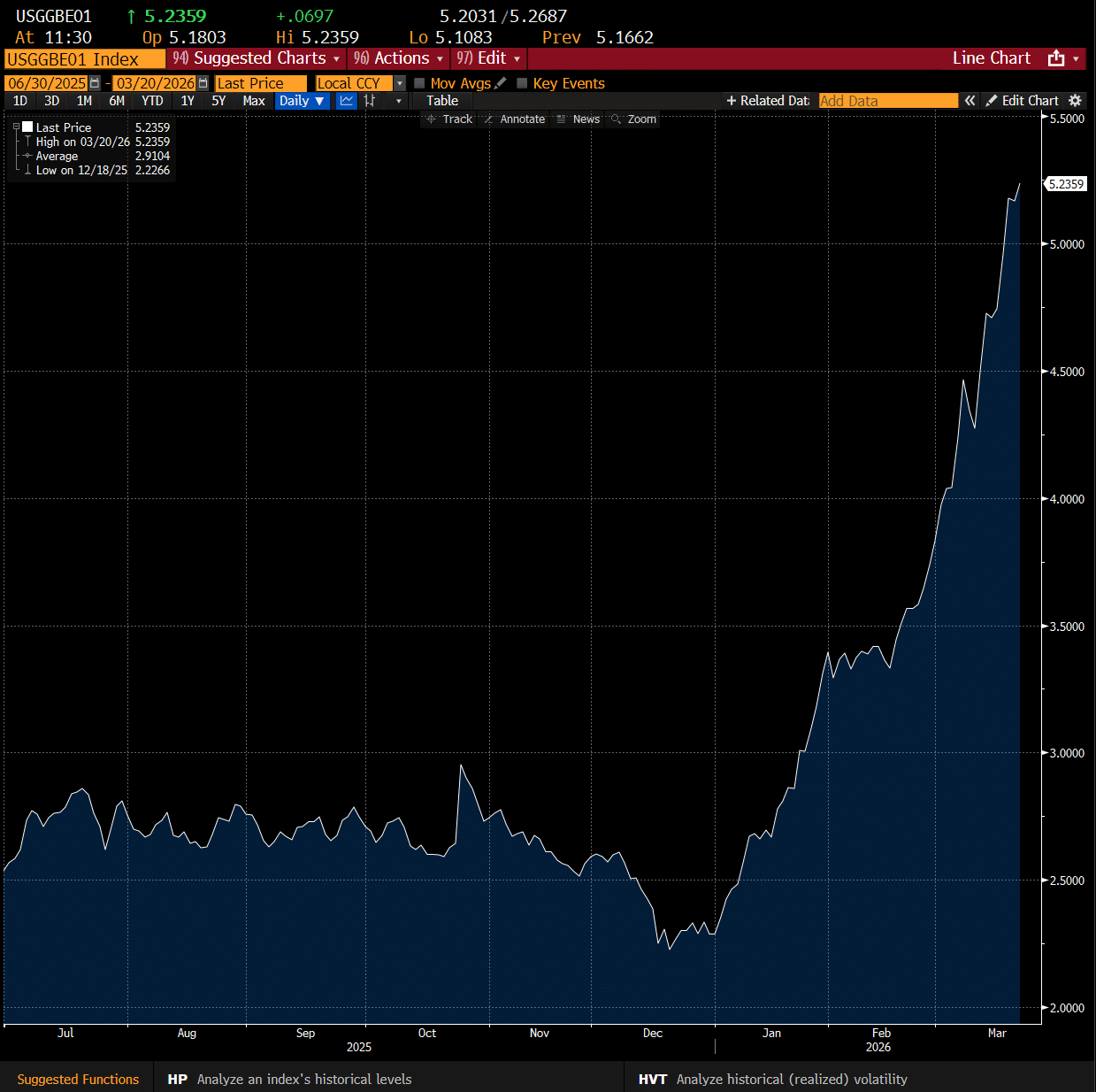
Source: X

So the natural question is, what does this mean for crypto?

Interestingly, some analysts are now flagging the risk of a 2008-style financial crisis. The pressure point here is the U.S. Treasury market, with yields pushing up to 4.37%, the highest level since July 2025. With debt levels already elevated, higher yields raise government borrowing costs, tightening the overall macro setup.

In short, if the Fed holds a zero rate-cut stance through the year, the risk of a crisis can’t be ruled out, especially with the data backing it. For crypto, that naturally shifts the focus toward hedging and capital preservation. So the question is, with macro tightening becoming structural, are stablecoins set to become the “long-term” parking zone for capital?

Defensive capital builds in crypto as macro conditions deteriorate

Zooming out, the long-term impact of the war still doesn’t appear to be fully priced into crypto markets.

Despite bearish macro commentary, total crypto market cap has held steady around the $2.4 trillion level, with no meaningful outflows. Large-cap assets continue to trade near key resistance zones without any significant rejection, indicating that conviction remains intact and risk hasn’t meaningfully unwound.

That said, the underlying data is starting to shift. Stablecoin market cap is up 2.22% this month, recently hitting a new all-time high of $316 billion. This points to liquidity building on the sidelines, with capital staying within crypto rather than rotating out.
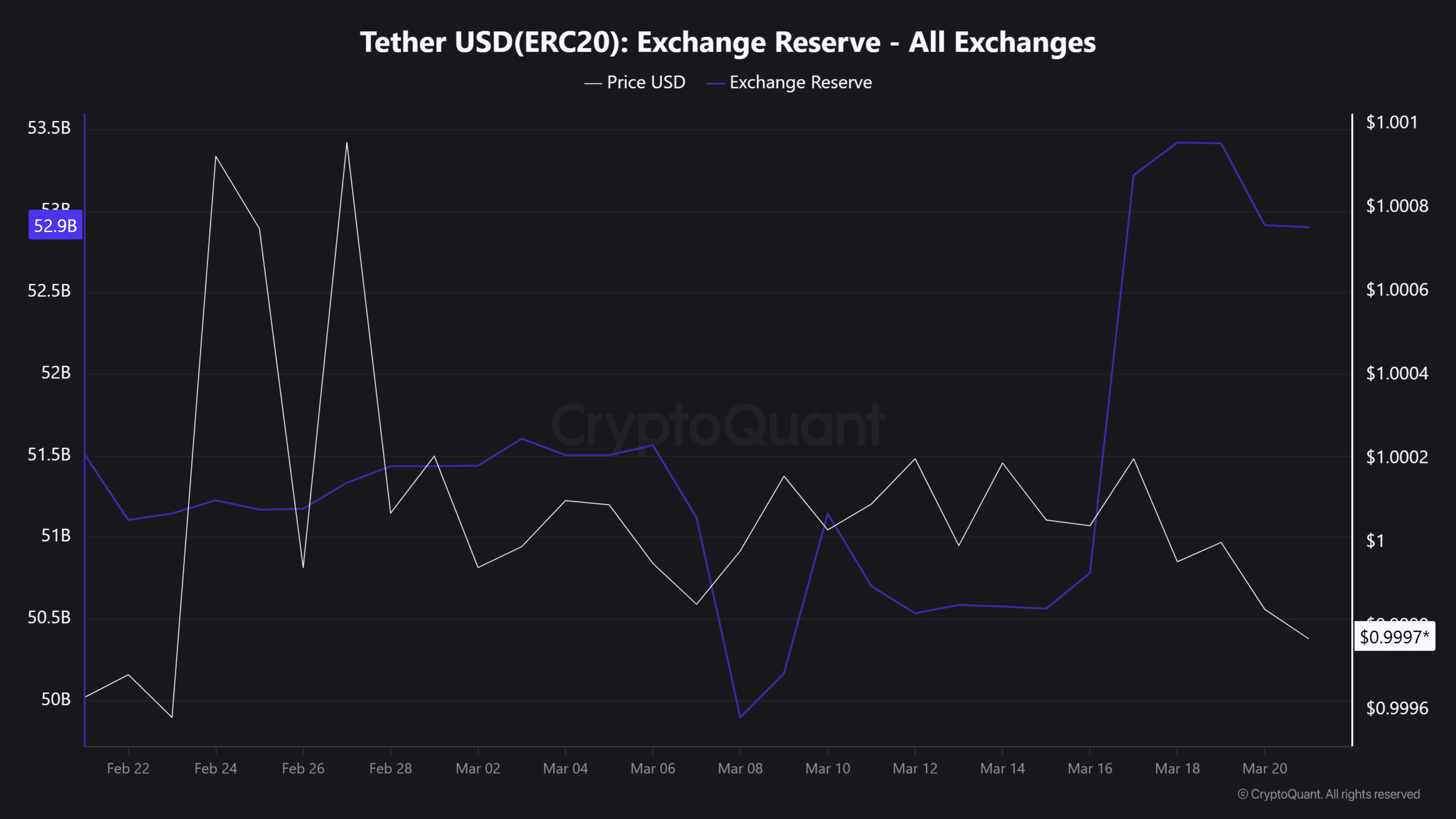
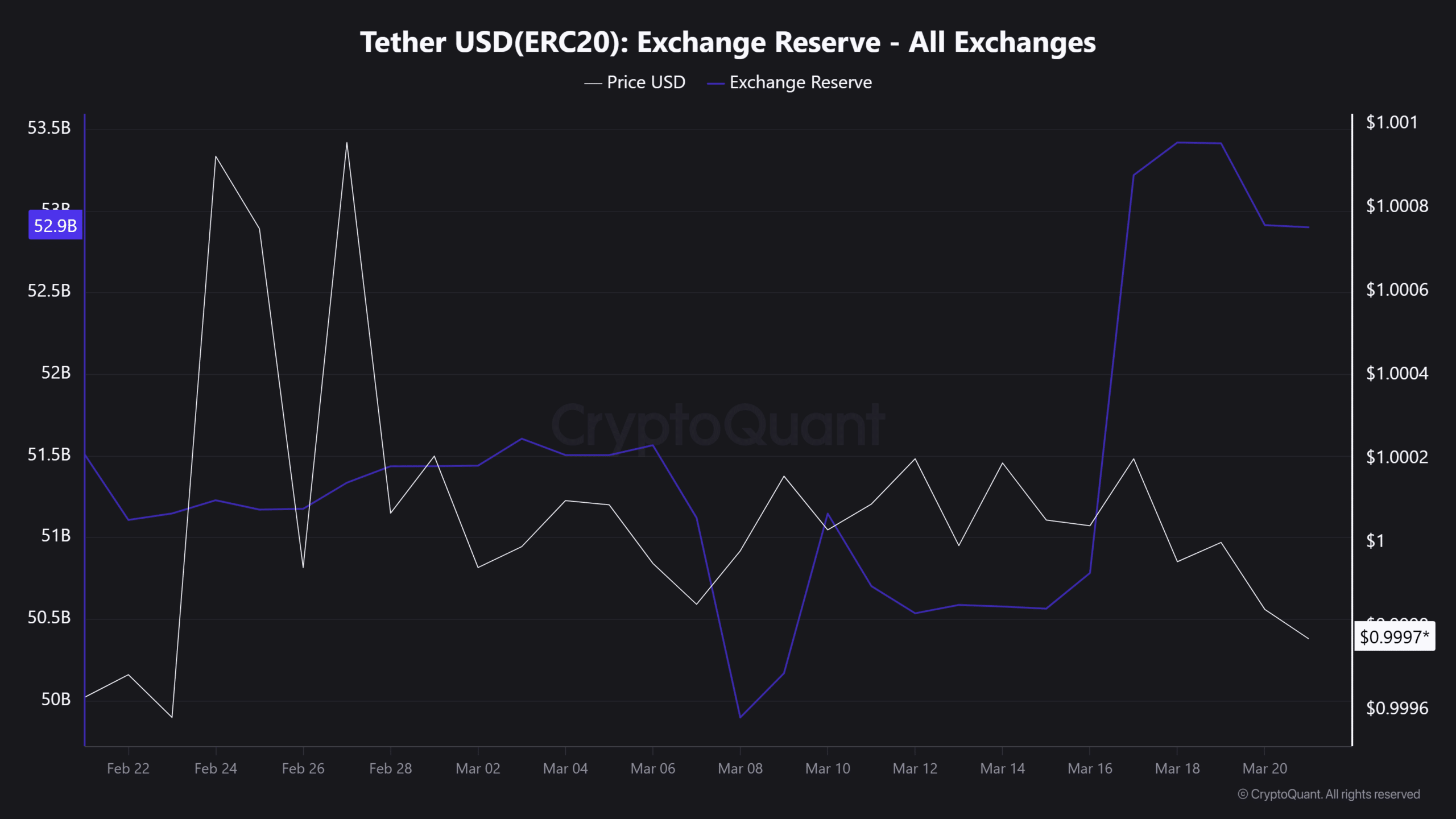
Source: CryptoQuant

Supporting this trend, USDT netflows, according to CryptoQuant, have recorded their first significant outflow of over $500 million in nearly two weeks, pushing exchange reserves down by approximately 0.97% over the past three days.

From a technical perspective, this suggests sideline capital is starting to move off exchanges, with investors rotating into safe positions. Against the backdrop of a bearish macro environment, the market clearly appears to be in a “cautious” positioning phase, with liquidity being preserved on-chain.

For crypto’s long-term outlook, that’s a constructive signal. With the war keeping rate-cut expectations low and U.S. economic risks at historically high levels (supported by analyst forecasts and hard data), investors piling into stablecoins are likely staging capital to deploy once risk appetite returns, making it a trend to watch closely.


Final Summary

  • High inflation, rising U.S. Treasury yields, and zero rate-cut expectations are creating a risk-off environment, prompting crypto investors to preserve capital.
  • Rising stablecoin supply and USDT outflows show investors are staging capital on-chain, ready to deploy once risk appetite returns.


Domande pertinenti

QWhat is the main concern for crypto investors according to the article, and how are they reacting?

AThe main concern is the combination of high inflation, rising U.S. Treasury yields, and expectations of zero interest rate cuts, creating a risk-off environment. Crypto investors are reacting by preserving capital, moving it into stablecoins as a defensive strategy.

QHow does the article link the current macroeconomic situation to a potential 2008-style crisis?

AThe article links it through the pressure on the U.S. Treasury market, with yields reaching a high of 4.37%. With elevated debt levels, higher yields increase government borrowing costs, tightening the overall macroeconomic environment and raising the risk of a financial crisis if the Fed maintains a zero rate-cut stance.

QWhat does the recent growth in stablecoin market capitalization indicate about investor behavior?

AThe stablecoin market cap hitting a new all-time high of $316 billion, along with USDT netflows moving off exchanges, indicates that investors are building liquidity on the sidelines. This shows a shift towards cautious, defensive positioning, with capital being preserved on-chain and staged for future deployment when risk appetite returns.

QDespite bearish macro conditions, what does the steady total crypto market cap around $2.4 trillion suggest?

AIt suggests that conviction among crypto investors remains intact and that risk hasn't meaningfully unwound. Large-cap assets are holding near key resistance levels without significant rejection, indicating that there have been no major capital outflows from the crypto market overall.

QWhat is the 'constructive signal' for crypto's long-term outlook mentioned in the article?

AThe constructive signal is that investors are piling into stablecoins, staging capital on-chain. This indicates that liquidity is being preserved within the crypto ecosystem and is poised to be deployed back into risk assets once macroeconomic conditions improve and risk appetite returns.

Letture associate

How Many Tokens Away Is Yang Zhilin from the 'Moon Chasing the Light'?

The article explores the intense competition between two leading Chinese AI companies, DeepSeek and Kimi (Moon Dark Side), and the mounting pressure on Yang Zhilin, the founder of Kimi. While DeepSeek re-emerged after 15 months of silence with its powerful V4 model—boasting 1.6 trillion parameters and low-cost, long-context capabilities—Kimi has been focusing on long-context processing and multi-agent systems with its K2.6 model. Yang faces a threefold challenge: technological rivalry, commercialization pressure, and investor expectations. Despite Kimi’s high valuation (reaching $18 billion), its revenue heavily relies on a single product with low paid conversion rates, while DeepSeek’s strategic silence and open-source influence have strengthened its market position and valuation prospects, now targeting over $20 billion. Both companies reflect broader trends in China’s AI ecosystem: Kimi aims for global influence through open-source contributions and agent-based advancements, while DeepSeek prioritizes foundational innovation and hardware independence, notably shifting to Huawei’s chips. Their competition is seen as vital for China’s AI progress, with the gap between top Chinese and U.S. models narrowing to just 2.7% on the Elo rating scale. Ultimately, the article argues that this rivalry, though anxiety-inducing for leaders like Zhilin, is essential for driving innovation and solidifying China’s role in the global AI landscape.

marsbit4 h fa

How Many Tokens Away Is Yang Zhilin from the 'Moon Chasing the Light'?

marsbit4 h fa

TechFlow Intelligence Bureau: ChatGPT Helps Amateur Mathematician Crack 60-Year-Old Problem, CFTC Sues New York Regulator Over Coinbase and Gemini

An amateur mathematician, with the assistance of ChatGPT, has solved a combinatorial mathematics puzzle originally proposed by Hungarian mathematician Paul Erdős in the 1960s. This marks another milestone in AI-aided mathematical research, demonstrating the evolving capabilities of large language models in formal reasoning. In other AI developments, OpenAI introduced a new privacy filter tool for enterprise API usage, automatically screening sensitive data. Meanwhile, the Qwen3.6-27B model achieved 100 tokens per second on a single RTX 5090 GPU using quantization, significantly lowering the cost barrier for local AI deployment. In crypto and Web3, the U.S. CFTC sued New York’s financial regulator, challenging its oversight of Coinbase and Gemini—a first-of-its-kind federal-state regulatory clash. Following a vulnerability, KelpDAO and major DeFi protocols established a recovery fund. Tether froze $344 million in assets linked to Iran’s central bank upon U.S. Treasury request, highlighting the centralized control risks in stablecoins. Separately, Litecoin underwent a 3-hour chain reorganization to undo a privacy-layer exploit. In the U.S., former President Trump invoked the Defense Production Act to address power grid bottlenecks affecting AI data centers and dismissed the entire National Science Board, raising concerns over research independence. A retail trader gained 250% on a $600k Intel options bet amid AI-related speculation. Xiaomi announced its first performance electric vehicle, targeting rivals like Tesla. Meanwhile, iPhone users reported devices automatically reinstalling a hidden app daily, suspected to be MDM-related. A Chinese securities report noted that A-share institutional crowding has reached its second-longest streak since 2007, signaling high valuations and potential style rotation. The day’s developments reflect a dual narrative: AI is enabling unprecedented individual breakthroughs, while centralized power structures—whether governmental or corporate—are becoming more assertive, underscoring that decentralization is as much a political-economic challenge as a technical one.

marsbit5 h fa

TechFlow Intelligence Bureau: ChatGPT Helps Amateur Mathematician Crack 60-Year-Old Problem, CFTC Sues New York Regulator Over Coinbase and Gemini

marsbit5 h fa

Trading

Spot
Futures

Articoli Popolari

Come comprare WAR

Benvenuto in HTX.com! Abbiamo reso l'acquisto di WAR (WAR) semplice e conveniente. Segui la nostra guida passo passo per intraprendere il tuo viaggio nel mondo delle criptovalute.Step 1: Crea il tuo Account HTXUsa la tua email o numero di telefono per registrarti il tuo account gratuito su HTX. Vivi un'esperienza facile e sblocca tutte le funzionalità,Crea il mio accountStep 2: Vai in Acquista crypto e seleziona il tuo metodo di pagamentoCarta di credito/debito: utilizza la tua Visa o Mastercard per acquistare immediatamente WARWAR.Bilancio: Usa i fondi dal bilancio del tuo account HTX per fare trading senza problemi.Terze parti: abbiamo aggiunto metodi di pagamento molto utilizzati come Google Pay e Apple Pay per maggiore comodità.P2P: Fai trading direttamente con altri utenti HTX.Over-the-Counter (OTC): Offriamo servizi su misura e tassi di cambio competitivi per i trader.Step 3: Conserva WAR (WAR)Dopo aver acquistato WAR (WAR), conserva nel tuo account HTX. In alternativa, puoi inviare tramite trasferimento blockchain o scambiare per altre criptovalute.Step 4: Scambia WAR (WAR)Scambia facilmente WAR (WAR) nel mercato spot di HTX. Accedi al tuo account, seleziona la tua coppia di trading, esegui le tue operazioni e monitora in tempo reale. Offriamo un'esperienza user-friendly sia per chi ha appena iniziato che per i trader più esperti.

130 Totale visualizzazioniPubblicato il 2024.12.11Aggiornato il 2026.04.23

Come comprare WAR

Discussioni

Benvenuto nella Community HTX. Qui puoi rimanere informato sugli ultimi sviluppi della piattaforma e accedere ad approfondimenti esperti sul mercato. Le opinioni degli utenti sul prezzo di WAR WAR sono presentate come di seguito.

活动图片