20% of Americans Are on the Fence: The Next Wave of Crypto Market Lies Here

marsbitPubblicato 2026-03-05Pubblicato ultima volta 2026-03-05

Introduzione

A study reveals that 20% of U.S. adults are considering cryptocurrency adoption, representing a critical intermediate group between outright rejecters and current holders. The research frames crypto acceptance as a three-stage process: rejection, consideration, and ownership. Key findings show that factors influencing the "consideration" phase (e.g., conservative ideology, support for tech innovation) differ from those driving "actual ownership" (e.g., existing stock ownership, higher risk tolerance). This intermediate group is essential for market growth, regulatory policy, and public opinion, as they represent the tipping point for broader adoption. The study emphasizes that understanding this gradual behavioral process—rather than a binary holder/non-holder view—is crucial for accurately predicting market and political trends.

Written by: Kyle Saunders

Compiled by: Chopper, Foresight News

Most research revolves around a simple question: Who holds it? Who doesn't?

Admittedly, this is a reasonable starting point for research. Holding behavior is observable, quantifiable, and actual. But for a market with a market cap in the trillions, it might not be the most critical question.

If you are concerned with market development, regulatory policy, political discourse, or the future direction of crypto assets, there is a question that might be more practically significant: Who is considering acquiring cryptocurrency?

Because the acceptance and adoption of an asset is never a binary, either-or choice, but a gradual process.

If you only study the final stage of this process, you miss the entire conversion funnel.

Rejection → Consideration → Holding: The Three Stages of Crypto Acceptance

In a new paper I recently co-authored with Erin Fitz, we did not treat crypto acceptance as a black-and-white outcome, but defined it as a gradual process.

From late 2024 to 2025, we conducted three independent representative surveys of US adults. Based on the results, we categorized respondents into three groups:

  • Do not hold and have no intention to hold cryptocurrency
  • Do not hold but are considering holding cryptocurrency
  • Currently hold cryptocurrency

Our first finding was straightforward yet crucial: About one-fifth of Americans do not hold cryptocurrency but are considering it.

This group is by no means an insignificant niche, a statistical error, or a group 'destined to hold.' They are a distinct segment with unique psychological characteristics and behavioral patterns, and this attribute makes them critically important.

Why is the 'Potential Holder' Group So Critical?

If the research perspective is limited to the binary comparison of 'holders' vs. 'non-holders,' it assumes all those not in the market are an undifferentiated whole.

But real-world behavioral choices are never like that.

The classic social psychology Theory of Planned Behavior posits that human behavior evolves through a series of preceding stages: beliefs, attitudes, perceived control, behavioral intention. One first 'considers' before forming a 'behavioral intention'; a 'behavioral intention' precedes taking actual action. And each stage does not necessarily transition to the next.
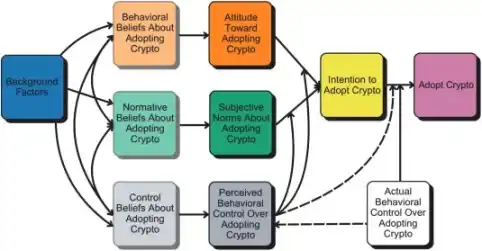
In other words, all holders were once potential holders; but not all potential holders will ultimately become actual holders.

When we view people's engagement with cryptocurrency as an ordered, gradual process rather than a binary characteristic, an interesting conclusion emerges: The factors influencing 'consideration to hold' are not entirely the same as those driving 'actual holding.'

There is a filtering mechanism at work in this conversion funnel.

Which Factors Influence 'Consideration'? Which Drive 'Actual Holding'?

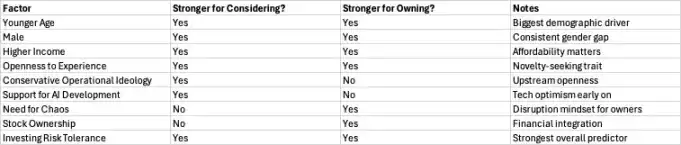
Some common influencing factors aligned with expectations: Younger individuals, men, those more open to new experiences, and those with a higher tolerance for financial risk were more likely to cross both the 'rejection→consideration' and 'consideration→holding' thresholds.

But two sets of significantly different patterns are worth highlighting.

Factors more strongly associated with 'Consideration to Hold':

  • More conservative operational ideology
  • Support for AI technology development

These factors play a role in the early stages of the crypto acceptance process, explaining why people might be open to cryptocurrency, but not necessarily pushing them to take the final step to 'actually hold.'

Factors more strongly associated with 'Actual Holding':

  • Already hold stocks
  • Need for chaos

Risk tolerance was the most influential factor overall: From the lowest to the highest levels, the probability of behavioral choice changed dramatically, with the probability of rejecting crypto decreasing by 32 percentage points and the probability of actually holding crypto increasing by 27 percentage points.

Here is a brief summary of the core differences:
Our survey data also aligns closely with the actual crypto market landscape: Bitcoin dominates overwhelmingly among both 'potential' and 'actual' holders (with Ethereum second), and many are open to multiple cryptocurrencies. The market itself corroborates this finding.
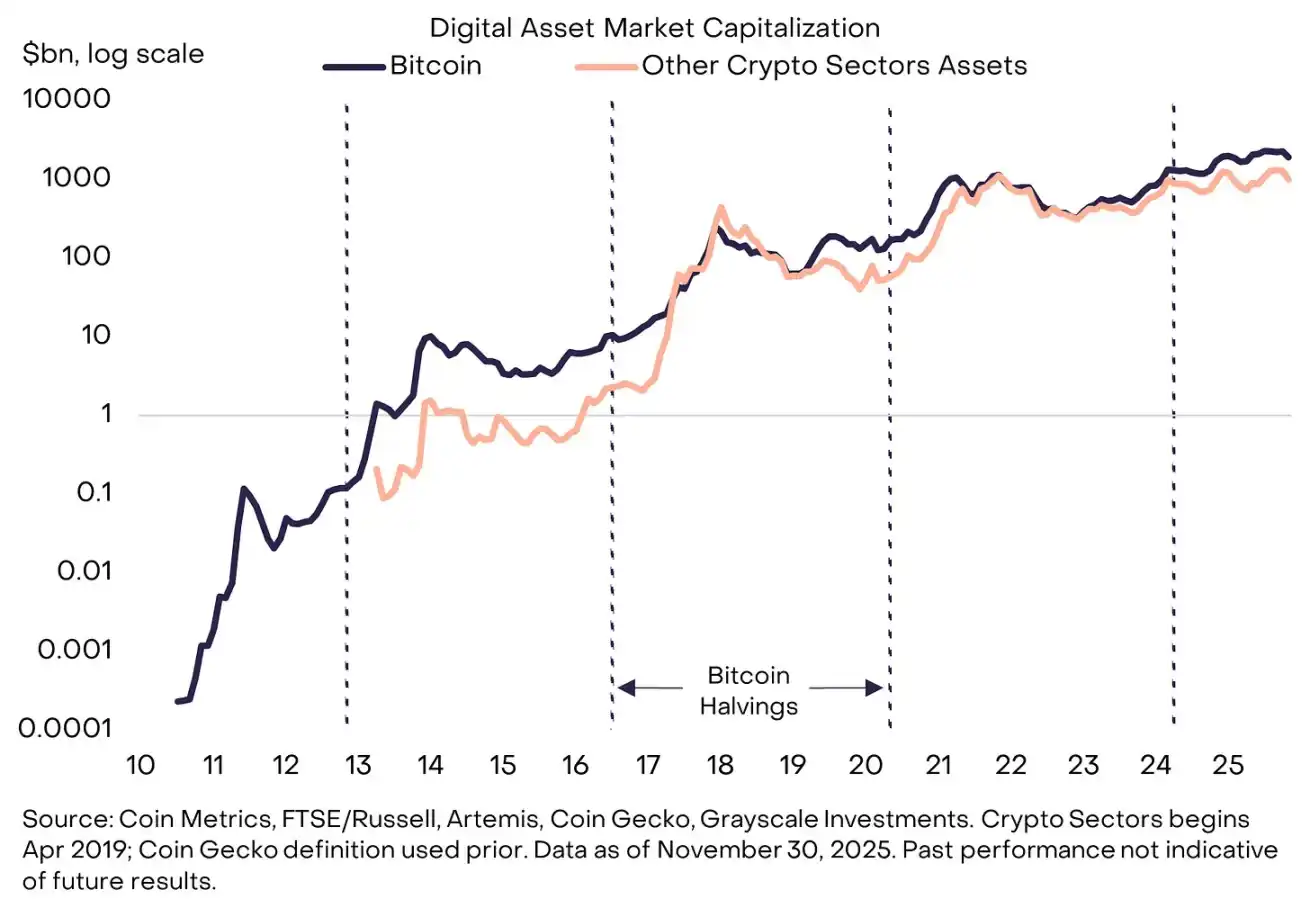
To understand how this landscape fits the broader technology diffusion curve (and why the 'potential holder' stage will determine whether crypto development stalls or scales), one can compare Bitcoin's adoption trajectory with that of the early internet. Survey data shows AI technology acceptance in the US reached about 55% in 2026.
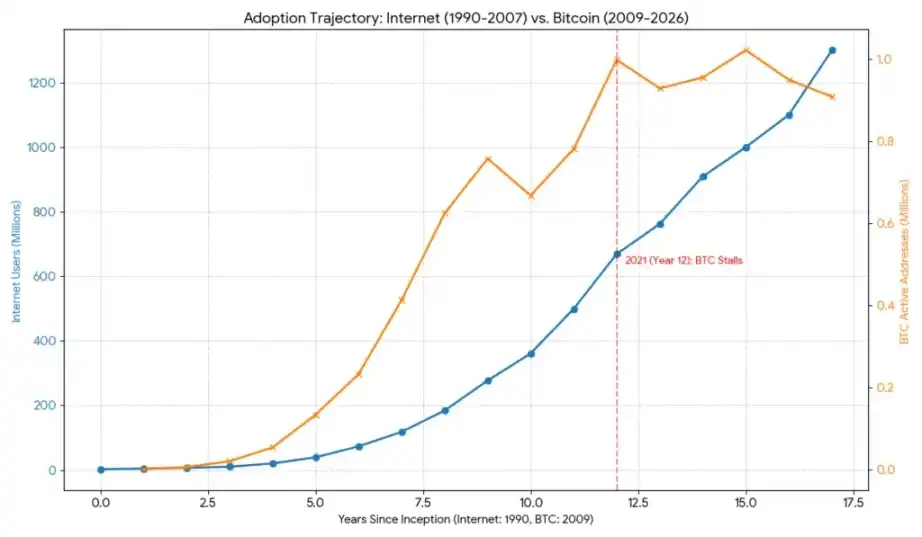
Furthermore, this chart from the paper shows how crypto acceptance fits the Rogers Diffusion of Innovations curve:
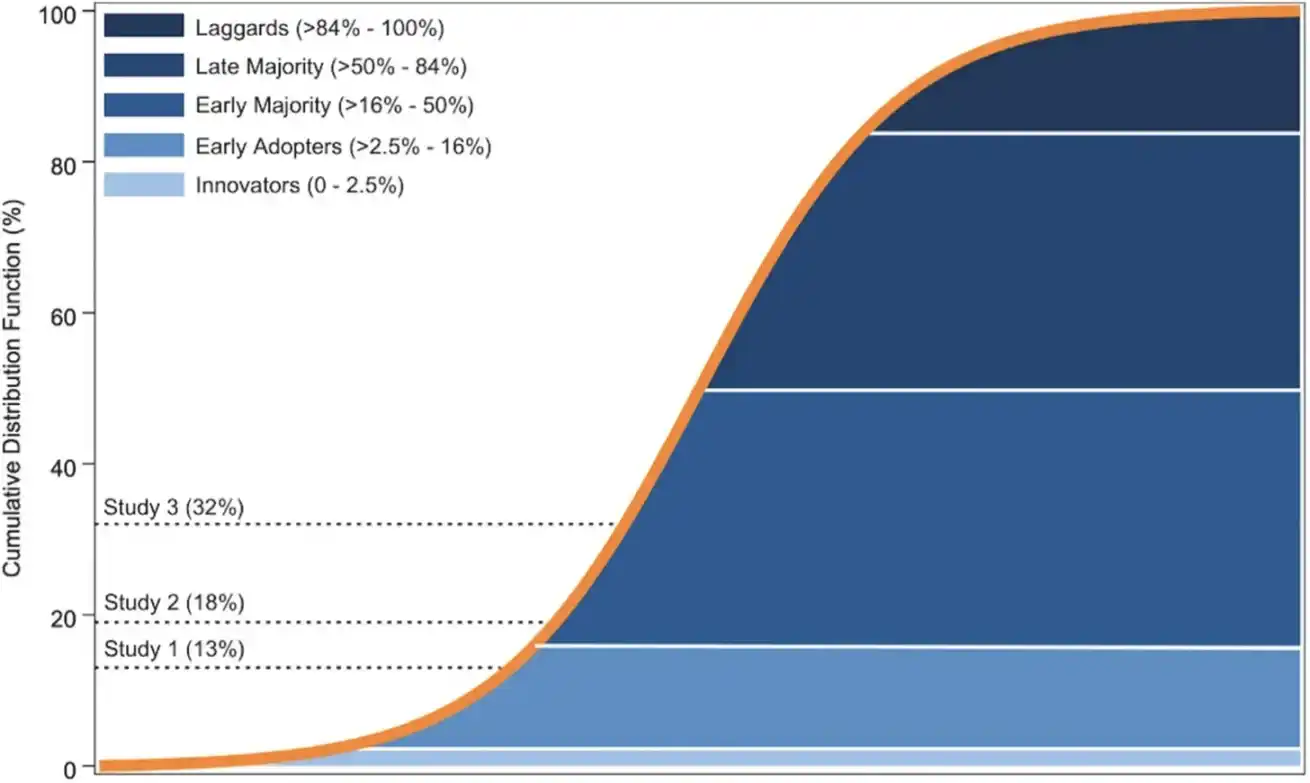
This is an adapted version of Rogers' 2003 Diffusion of Innovations curve. The solid orange line is the S-curve (the cumulative distribution function, with the scale on the left vertical axis). The blue area under the curve represents the probability distribution of the five adopter categories in Rogers' model, divided based on standard deviations from the mean in a normal distribution. In a normal distribution, these areas represent the probability proportion of each category in the whole population: Innovators (2.5%, 0 to mean minus 2 SD), Early Adopters (13.5%, mean minus 2 SD to mean minus 1 SD), Early Majority (34%, mean minus 1 SD to mean), Late Majority (34%, mean to mean plus 1 SD), Laggards (16%, mean plus 1 SD to 100%). The black dashed lines represent the self-reported cryptocurrency holding rates from our three studies (Study 1: 13%, Study 2: 18%, Study 3: 32%).

The Implications of These Findings Extend Beyond Crypto

You could interpret these results narrowly as consumer segmentation, but they have broader significance.

For Market Growth

The expansion potential of the crypto market lies not in converting staunch 'rejecters' into holders, but in figuring out what prevents potential holders from becoming actual holders. This barrier might not be ideological, but rather people's perception of their behavioral control, concerns about market volatility, or issues with asset liquidity.

For Regulatory Policy

If policymakers view only current cryptocurrency holders as the group with political influence, they misjudge the market's current state. The policy direction in the digital asset space will likely be determined by these open-minded yet undecided potential holders. Their preferences, risk profiles, and trust in institutions are critically important, especially as the crypto regulatory framework takes shape in 2026.

For Public Discourse

Online discussions often fall into polarization: either pro-crypto or anti-crypto. But our survey data shows a large, psychologically distinct middle group exists in reality. Historical experience suggests that it is this middle group, not the early adopters, that ultimately determines whether an innovation achieves widespread adoption, stalls, or triggers a backlash.

Acceptance and adoption are inherently gradual processes.

The core insight of this research is not just specific to the crypto space, but also a shift in research methodology and perspective.

When we simplify complex behaviors into binary, either-or choices, we risk conflating the behavioral rules of different stages. The factors that make people open to a new thing are not necessarily the same ones that drive them to take actual action.

This applies not only to cryptocurrency but also to the acceptance of AI technology, political participation, trust in institutions, and many other behavioral choices I've explored in this column.

The overlooked middle stage often holds the most intriguing behavioral patterns.

The acceptance and adoption of cryptocurrency is never simply a personality trait or an ideological signal, but a step-by-step behavioral process.

If you ignore this intermediate 'potential holding' stage, you will misjudge both the true direction of the market and the underlying political and social logic.


Domande pertinenti

QAccording to the research, what percentage of Americans are considered 'potential adopters' of cryptocurrency?

AApproximately one-fifth (20%) of Americans are potential adopters, meaning they do not currently hold cryptocurrency but are considering it.

QWhat is the key difference between the factors that influence 'considering adoption' and those that drive 'actual adoption' of crypto?

AFactors like a more conservative operational ideology and support for AI development are more strongly associated with the 'considering adoption' phase. In contrast, factors like already holding stocks and a 'need for chaos' are more strongly linked to taking the final step into 'actual adoption'.

QWhy is the 'potential adopter' group so crucial for understanding the crypto market's future?

AThis group is crucial because market growth depends on converting them into actual holders, not on convincing those who firmly reject crypto. Their preferences and perceived barriers (like concerns about volatility or liquidity) will determine if the market expands or stagnates.

QHow does the acceptance of cryptocurrency fit into Rogers' Diffusion of Innovations curve?

AThe research data shows that crypto adoption follows the S-curve of the Diffusion of Innovations model. The 'potential adopters' represent the large middle groups (early and late majority) whose adoption is critical for moving the technology from early adopters to mainstream普及.

QBeyond market growth, what other significant implications does the 'potential adopter' group have?

AThe group has major implications for regulatory policy, as their trust in institutions and risk profile will influence the shaping of crypto regulation. It also impacts social discourse, as this large middle group, not the polarized extremes, often determines whether an innovation is widely accepted or faces a backlash.

Letture associate

Breaking: OpenAI Undergoes Major Reorganization, President Brockman Assumes Command

OpenAI has announced a major internal reorganization just months before its anticipated IPO. The company is merging its three flagship product lines—ChatGPT, Codex, and the API platform—into a single, unified product organization. The most significant leadership change involves co-founder and President Greg Brockman moving from a background technical role to take full, permanent control over all product strategy. This follows the indefinite medical leave of AGI Deployment CEO Fidji Simo. Additionally, ChatGPT's longtime lead, Nick Turley, has been reassigned to enterprise products, with former Instagram executive Ashley Alexander taking over consumer offerings. The consolidation, internally framed as a strategic move towards an "Agentic Future," aims to break down internal silos and create a cohesive "Super App." This planned desktop application would integrate ChatGPT's conversational abilities, Codex's coding power, and a rumored internal web browser named "Atlas" to autonomously perform complex user tasks. The reorganization occurs amid significant internal and external pressures. OpenAI has recently seen a wave of high-profile departures, including Sora co-lead Bill Peebles and other senior technical leaders, leading to concerns about a thinning executive bench. Externally, rival Anthropic recently secured funding at a staggering $900 billion valuation, surpassing OpenAI's own. Google's upcoming I/O developer conference also poses a competitive threat. Analysts suggest the dramatic restructure is a pre-IPO move to present a clearer, more focused narrative to Wall Street—streamlining operations and demonstrating decisive leadership under Brockman to counter internal turbulence and intense market competition.

marsbit58 min fa

Breaking: OpenAI Undergoes Major Reorganization, President Brockman Assumes Command

marsbit58 min fa

Two Survival Structures of Market Makers and Arbitrageurs

Market makers and arbitrageurs represent two distinct survival structures in high-frequency trading. Market makers primarily use limit orders (makers) to profit from the bid-ask spread, enjoying high capital efficiency (nominally 100%) but bearing inventory risk. This "inventory risk" arises from passive, fragmented, and discontinuous order fills in the limit order book (LOB). This risk, while a potential cost, can also contribute to excess profit if managed within control boundaries, allowing for mean reversion. Market makers essentially sell "time" (uncertainty over execution timing) to the market for price control and low fees. In contrast, cross-exchange arbitrageurs typically use market orders (takers) to exploit price differences or funding rates, resulting in lower nominal capital efficiency (requiring capital on both exchanges) and higher transaction costs. Their risk exposure stems from asymmetries in exchange rules (e.g., minimum order sizes), execution latency, and infrastructure risks (e.g., ADL, oracle drift). These exposures are active, exogenous gaps that primarily erode profits rather than contribute to them. Arbitrageurs essentially sell "space" (capital sunk across venues) for localized, immediate certainty. Both strategies engage in a trade-off between execution friction and residual risk. Optimal systems allow for temporary, controlled risk exposure rather than enforcing zero exposure at all costs. Their evolution converges towards hybrid models: arbitrageurs may use maker orders to reduce costs, while market makers may use taker orders or hedges for risk management. Ultimately, both use different forms of risk exposure—market makers exposing inventory, arbitrageurs immobilizing capital—to extract marginal, hard-won certainty from the market.

链捕手59 min fa

Two Survival Structures of Market Makers and Arbitrageurs

链捕手59 min fa

Who Will Define the Rules of the AI Era? Anthropic Discusses the 2028 US-China AI Landscape

This article, based on Anthropic's analysis, outlines the intensifying systemic competition between the U.S./allies and China for AI leadership by 2028. It argues that access to advanced computing power ("compute") is the critical bottleneck, where the U.S. currently holds a significant advantage through chip export controls and allied innovation. However, China's AI labs remain competitive by exploiting policy loopholes—via chip smuggling, overseas data center access, and "model distillation" attacks to copy U.S. model capabilities—keeping them close to the frontier. The piece presents two contrasting scenarios for 2028. In the first, decisive U.S. action to tighten compute controls and curb distillation locks in a 12-24 month AI capability lead, cementing democratic influence over global AI norms, security, and economic infrastructure. In the second, policy inaction allows China to achieve near-parity through continued access to U.S. technology, enabling Beijing to promote its AI stack globally and integrate advanced AI into its military and governance systems, altering the strategic balance. Anthropic contends that maintaining a decisive U.S. lead is essential for shaping safe AI development and governance. The core recommendation is for U.S. policymakers to urgently close compute and model access loopholes while promoting global adoption of the U.S. AI technology stack to secure a lasting strategic advantage.

marsbit3 h fa

Who Will Define the Rules of the AI Era? Anthropic Discusses the 2028 US-China AI Landscape

marsbit3 h fa

Trading

Spot
Futures
活动图片




