1inch Team Accused of Dumping, On-Chain Data Reveals Sophisticated Trading Strategies of Large Positions

Odaily星球日报Pubblicato 2026-01-29Pubblicato ultima volta 2026-01-29

Introduzione

1inch Team Accused of Dumping Tokens, But On-Chain Data Reveals Complex Trading Patterns Three wallets labeled as "1inch Team" sold 36.36 million 1INCH tokens (worth $5.04 million), causing the token’s price to drop 16.7% to $0.1155. The tokens were initially acquired in late November 2024 at around $0.42 each, meaning the sale resulted in an estimated loss of over $10 million for that batch. However, this selling behavior contradicts the team’s historical trading strategy. Earlier in the year, the 1inch investment fund demonstrated sophisticated market timing—accumulating 1INCH at lows near $0.20, buying more during a July rally that pushed prices to $0.206, and later taking partial profits at around $0.33. Similar strategies were applied to ETH and WBTC, yielding significant gains through disciplined entry and exit points. 1inch officially denied involvement, stating that the wallets in question were not controlled by the team, foundation, or treasury, and that the selling was likely from a third-party holder. The incident highlights the risks of misinterpreting on-chain labels and the impact of large sell-offs in low-liquidity markets. Despite the denial, the event further pressured 1INCH, which has declined significantly from its all-time high of $6.

Original | Odaily Planet Daily (@OdailyChina)

Author | Ethan (@ethanzhang_web3)
Large sales marked as "1inch team" have once again sparked criticism.

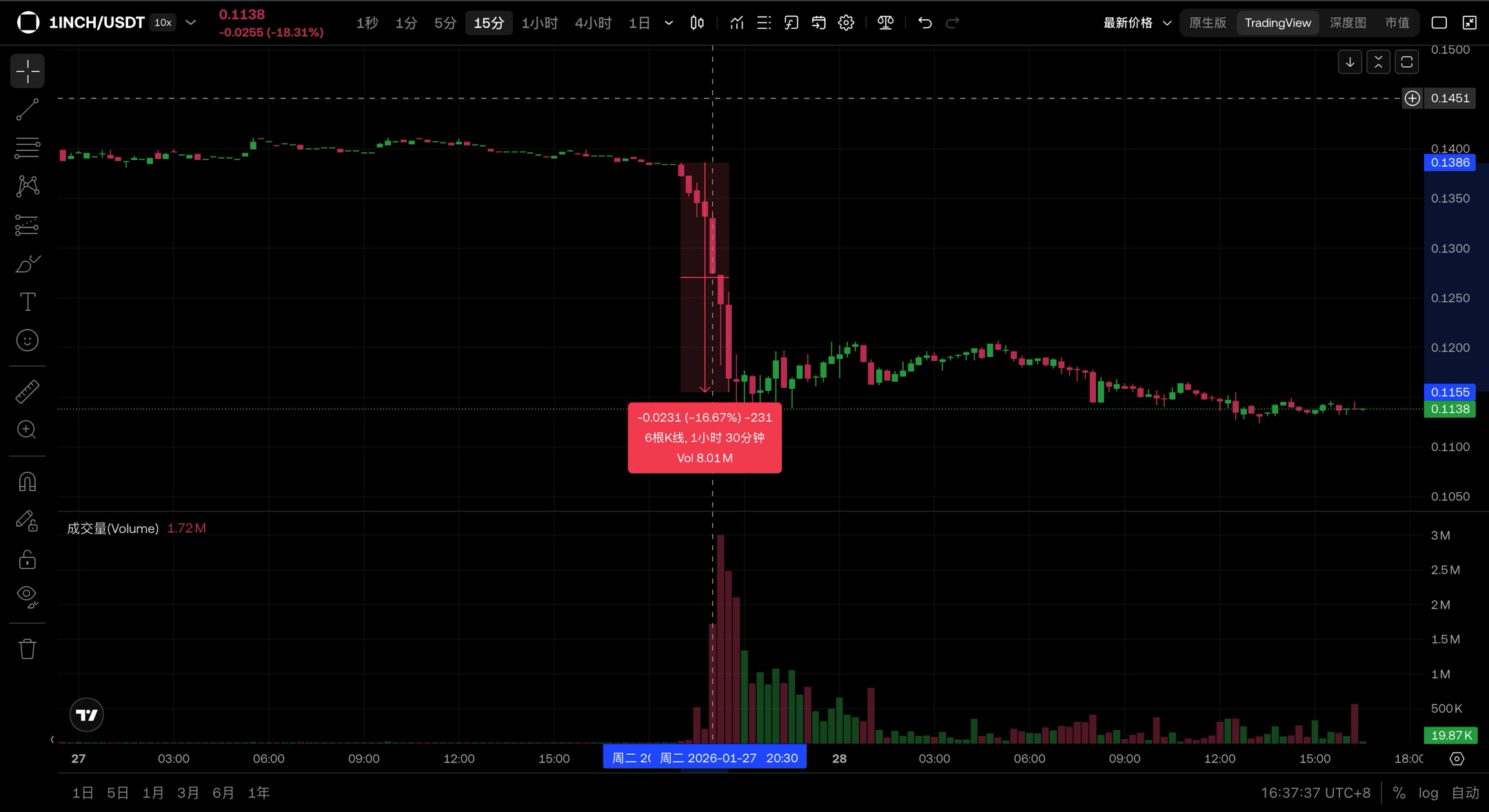
Recently, the on-chain data platform ARKHAM showed that three wallets marked as "1inch team" sold a total of 36.36 million 1INCH tokens, worth $5.04 million. According to OKX market data, affected by this, the price of 1INCH token fell 16.7% to $0.1155 in a short time, and is currently reported at $0.1164. Surrounding this sale, a question was quickly thrown to the market: Is this really the project team itself dumping?

Judging from this sale itself, the result was not ideal. On-chain data shows that the aforementioned 1INCH tokens were mainly transferred to the relevant addresses in late November 2024. Based on the price estimate at that time, the cost was around $0.42, corresponding to a value of approximately $15.27 million. Before this sale, the price of 1INCH had fallen back to around $0.14. Combined with the slippage impact due to the large volume during the selling process, the actual loss for this batch of positions alone may exceed $10 million.
Reference: The Trading Style of the 1inch Team in the Past

Previously, the on-chain operations of the 1inch team investment fund during multiple market fluctuations were once regarded by the market as the existence of a "professional trading team".

As early as the period from February to April, the 1inch team investment fund had begun to continuously accumulate 1INCH at low levels. At that time, market sentiment had not yet warmed up, and 1INCH hovered around $0.2 for a long time. During this stage, the team invested a total of approximately $6.648 million to buy 33.19 million 1INCH tokens, with an average building price of about $0.2.

However, this round of buying did not cause significant price fluctuations. What really caught the market's attention was the concentrated buying in early July. From July 6 to 9, the 1inch team investment fund made another move, adding an investment of approximately $4.4 million in just a few days to buy 22.99 million 1INCH tokens. As buying continued, the price of 1INCH rose from around $0.18 to $0.206, a阶段性涨幅 of about 14%. During this period, the team transferred 3 million USDC to Binance and withdrew 1INCH in batches back to its own addresses. The relevant funds were not used up at once, perhaps waiting for the right time, and were still being bought continuously.

After entering July 10, the pace of operations明显加快. On the afternoon of July 10, the team again bought about 4.12 million 1INCH tokens for approximately $880,000, while simultaneously补充 2 million USDT to Binance to prepare ammunition for subsequent transactions. On the evening of July 11, on-chain monitoring showed that the team疑似 bought another 11.81 million 1INCH tokens at a higher price range, with the transaction price already rising to around $0.28. By this point, the address's holdings had once increased to 83.97 million 1INCH tokens, with a book value exceeding $23 million. On July 13, the team continued to withdraw 6.334 million 1INCH tokens from Binance.

If we trace the timeline back to early February, the 1inch team investment fund has累计投入 approximately $13.64 million since the beginning of the year to buy 55.85 million 1INCH tokens, with a comprehensive cost of about $0.244. Against the backdrop of the 1INCH price soaring above $0.39 in mid-July, these positions had浮盈 millions of dollars.

It is worth noting that the team is not "only buying and not selling". On the evening of July 13, it began to小规模兑现收益, selling about 904,000 1INCH tokens at a price of $0.33, exchanging for $298,000; and at an earlier stage, it had already sold部分 1INCH tokens in batches at around $0.28.

At the same time, the team also同步对 another important position进行止盈: the ETH previously bought at an average price of $2577 in February had begun to be sold in batches above $4200, with the ETH position alone realizing profits of millions of dollars.

On August 11, according to on-chain analyst余烬监测, the 1inch team investment fund had begun to兑现部分前期仓位 on-chain. Data showed that it sold 5000 ETH at an average price of $4215, exchanging for 21.07 million USDC;同时 sold 6.45 million 1INCH tokens at an average price of $0.28, exchanging for about 1.8 million USDC.

Judging from the building costs, the aforementioned ETH was bought by the 1inch team in February this year at an average price of about $2577; the corresponding 1INCH was mainly built in July, with a comprehensive cost of about $0.253.仅就本次已卖出的 ETH and 1INCH positions计算, the 1inch team investment fund has realized approximately $8.36 million in账面收益.
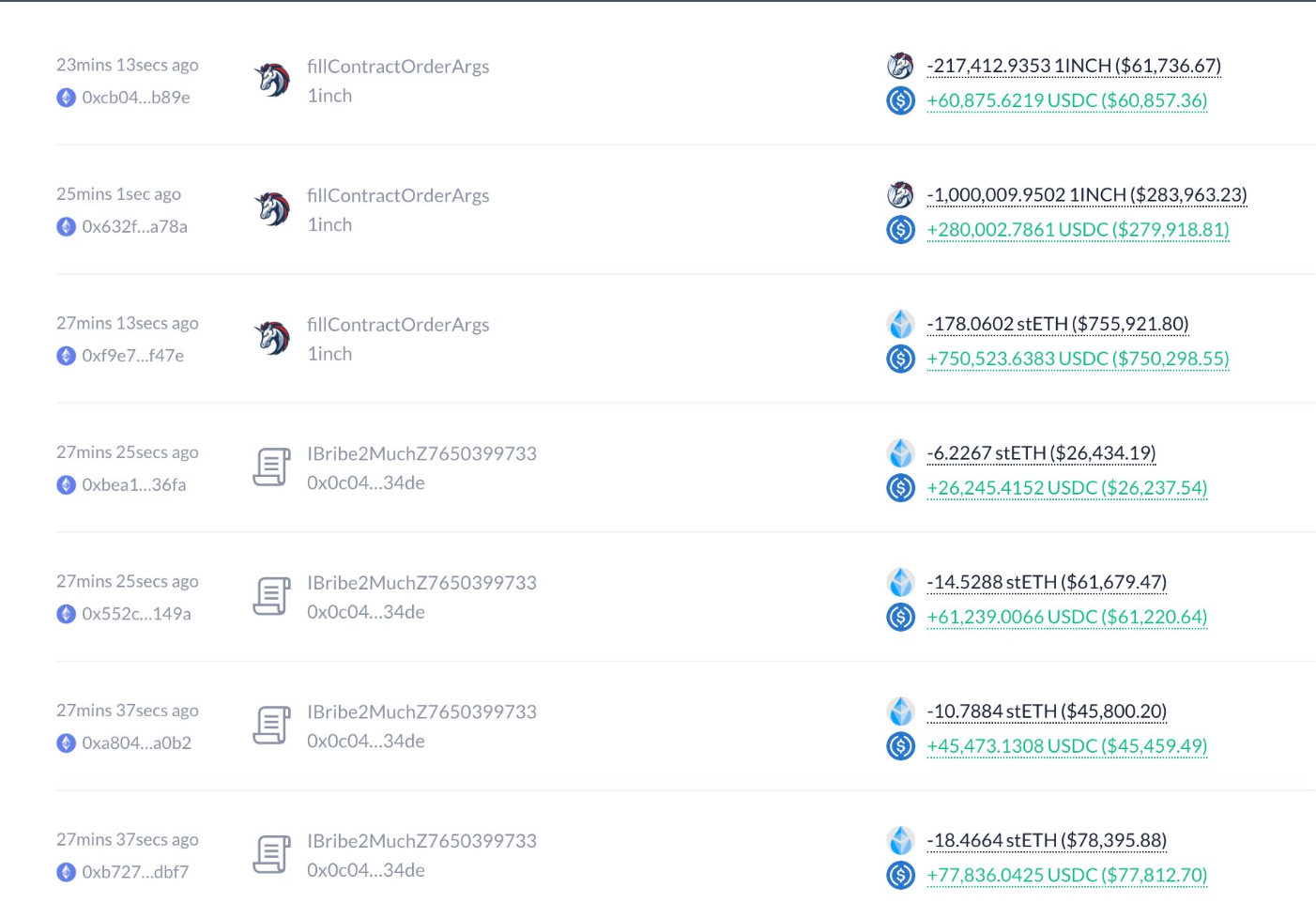
If we look further back, the 1inch team's operation path of "buying against the trend and selling with the trend" on BTC is同样清晰. During the period from February to March this year, it bought 160.8 WBTC at an average price of about $88,000 during the BTC回调阶段, and completed清仓 in May when BTC再次逼近 the $100,000 mark, realizing a total profit of nearly $1 million.

综合 BTC, ETH, and 1INCH asset线索来看, the on-chain operations of the 1inch team investment fund are more like a set of capital strategies that have been反复演练: Complete building during market adjustment stages, continuously add positions during the上涨过程, and分批兑现收益 after prices enter high ranges.

But This Time, Was It Really Them Operating?

It should be pointed out that if we compare this large sale that occurred around $0.14 with the past on-chain operations of the 1inch team investment fund, we find: If this sale was indeed directly led by the team, then its execution method itself明显背离 its past trading logic. Whether in the operations of BTC, ETH, or 1INCH history, the team's more common practice is to兑现收益 in batches after the price trend is confirmed, rather than集中抛售 in明显的低流动性区间.

Because of this, some market participants began to question: Was this selling behavior marked as "1inch team" really出自 the team or wallets directly controlled by it.

Subsequently, 1inch official also responded to the relevant controversy. In a statement, it clearly stated that this selling behavior did not occur in any wallet controlled by the 1inch team, entity, or treasury multi-signature, and the team could not interfere with the asset allocation and trading decisions of third-party holders.

In other words, the关联关系 pointed to by on-chain labels does not equate to actual control权. Judging from the execution rhythm and price range, this sale is more likely to come from a third-party holder who has脱离 project control, rather than a shift in the 1inch team's own trading logic.

In a stage with inherently limited liquidity, a single large sale being quickly equated to "team dumping" is itself an interpretation of information that is过度压缩. It ignores the天然断层 between address labels and real control权 after long-term circulation of tokens.

Back to 1inch itself. The official emphasized in the statement that this market fluctuation did not change its core business and long-term direction. Since 2019, 1inch has累计撮合交易量接近 $800 billion, and even during market downturns, it can maintain a daily trading volume of hundreds of millions of dollars. The team also stated that it plans to重新审视代币经济模型 this year to improve overall韧性 in low liquidity and下行周期. Against this background, the discussion surrounding "whether the 1inch team dumped" is more like a误读放大 by on-chain labels, liquidity environment, and emotional interpretation.

However, even if it is eventually proven to be a misreading, this sale still constituted a real secondary impact on the already持续走弱 price of 1INCH. Since the last cycle high of $6, 1INCH has experienced a long-term unilateral decline and is now hovering around $0.11.
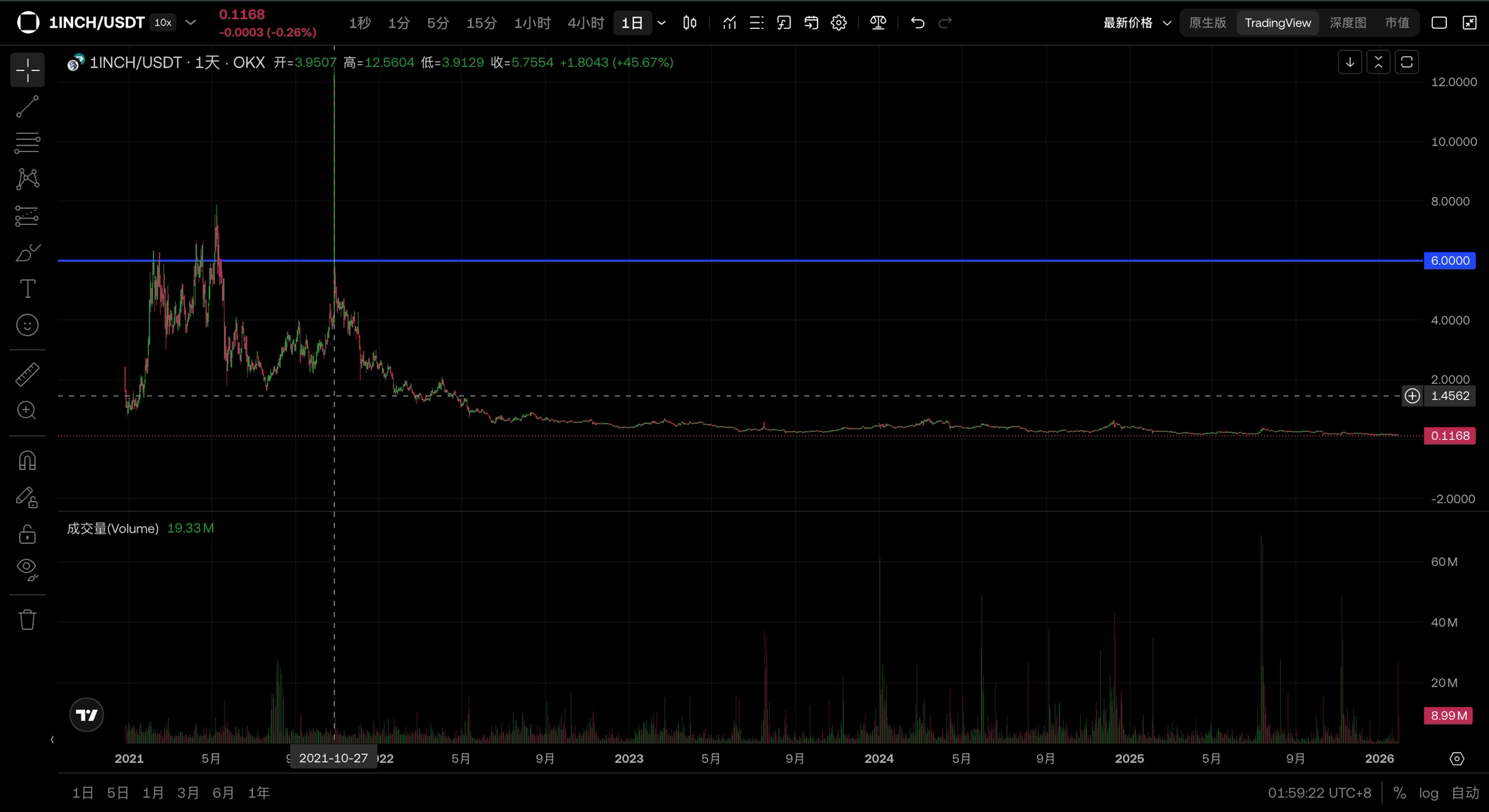
On such a trend, the market显然已没有足够的缓冲空间 to消化任何一次突发的卖出信号. This type of放大 selling event ultimately承受情绪冲击的, often falls on the end with the weakest risk tolerance—retail investors.


Domande pertinenti

QWhat was accused of the 1inch team regarding their token sales, and what was the actual outcome according to the article?

AThe 1inch team was accused of conducting large sell-offs (dumping) of their tokens, causing a price drop. However, the article clarifies that the selling was not actually performed by the 1inch team or any wallets controlled by them, but rather by third-party holders, making it a misinterpretation amplified by on-chain labels and market sentiment.

QHow did the recent large sale of 1INCH tokens affect the token's price, and what was the estimated financial loss from this sale?

AThe recent sale of 36.36 million 1INCH tokens, worth $5.04 million, caused a short-term price drop of 16.7% to $0.1155. The estimated financial loss from this batch of tokens, considering the purchase cost of around $0.42 per token in late 2024, was over $10 million due to the lower selling price and slippage.

QDescribe the typical trading strategy of the 1inch team investment fund as highlighted in the article.

AThe 1inch team investment fund typically follows a strategy of accumulating tokens during market downturns, increasing positions during upward trends, and gradually taking profits when prices reach higher levels. This was demonstrated in their operations (e.g., buying BTC, ETH, and 1INCH at low points and selling at peaks), resulting in significant realized gains.

QWhat was 1inch's official response to the allegations of team-led token dumping?

A1inch officially stated that the sell-off did not occur in any wallets controlled by the 1inch team, entity, or treasury multisig. They emphasized that they cannot interfere with the asset allocation and trading decisions of third-party holders, indicating that the on-chain labels did not reflect actual control by the team.

QWhat long-term trend has the 1INCH token price experienced, and how does the recent event impact its market performance?

AThe 1INCH token has been in a long-term downward trend since its all-time high of around $6, currently trading near $0.11. The recent selling event, even if misinterpreted, further weakened the price and negatively impacted market sentiment, particularly affecting retail investors with lower risk tolerance.

Letture associate

Gensyn AI: Don't Let AI Repeat the Mistakes of the Internet

In recent months, the rapid growth of the AI industry has attracted significant talent from the crypto sector. A persistent question among researchers intersecting both fields is whether blockchain can become a foundational part of AI infrastructure. While many previous AI and Crypto projects focused on application layers (like AI Agents, on-chain reasoning, data markets, and compute rentals), few achieved viable commercial models. Gensyn differentiates itself by targeting the most critical and expensive layer of AI: model training. Gensyn aims to organize globally distributed GPU resources into an open AI training network. Developers can submit training tasks, nodes provide computational power, and the network verifies results while distributing incentives. The core issue addressed is not decentralization for its own sake, but the increasing centralization of compute power among tech giants. In the era of large models, access to GPUs (like the H100) has become a decisive bottleneck, dictating the pace of AI development. Major AI companies are heavily dependent on large cloud providers for compute resources. Gensyn's approach is significant for several reasons: 1) It operates at the core infrastructure layer (model training), the most resource-intensive and technically demanding part of the AI value chain. 2) It proposes a more open, collaborative model for compute, potentially increasing resource utilization by dynamically pooling idle GPUs, similar to early cloud computing logic. 3) Its technical moat lies in solving complex challenges like verifying training results, ensuring node honesty, and maintaining reliability in a distributed environment—making it more of a deep-tech infrastructure company. 4) It targets a validated, high-growth market with genuine demand, rather than pursuing blockchain integration without purpose. Ultimately, the boundaries between Crypto and AI are blurring. AI requires global resource coordination, incentive mechanisms, and collaborative systems—areas where crypto-native solutions excel. Gensyn represents a step toward making advanced training capabilities more accessible and collaborative, moving beyond a niche controlled by a few giants. If successful, it could evolve into a fundamental piece of AI infrastructure, where the most enduring value in the AI era is often created.

marsbit6 h fa

Gensyn AI: Don't Let AI Repeat the Mistakes of the Internet

marsbit6 h fa

Why is China's AI Developing So Fast? The Answer Lies Inside the Labs

A US researcher's visit to China's top AI labs reveals distinct cultural and organizational factors driving China's rapid AI development. While talent, data, and compute are similar to the West, Chinese labs excel through a pragmatic, execution-focused culture: less emphasis on individual stardom and conceptual debate, and more on teamwork, engineering optimization, and mastering the full tech stack. A key advantage is the integration of young students and researchers who approach model-building with fresh perspectives and low ego, prioritizing collective progress over personal credit. This contrasts with the US culture of self-promotion and "star scientist" narratives. Chinese labs also exhibit a strong "build, don't buy" mentality, preferring to develop core capabilities—like data pipelines and environments—in-house rather than relying on external services. The ecosystem feels more collaborative than tribal, with mutual respect among labs. While government support exists, its scale is unclear, and technical decisions appear driven by labs, not state mandates. Chinese companies across sectors, from platforms to consumer tech, are building their own foundational models to control their tech destiny, reflecting a broader cultural drive for technological sovereignty. Demand for AI is emerging, with spending patterns potentially mirroring cloud infrastructure more than traditional SaaS. Despite challenges like a less mature data industry and GPU shortages, Chinese labs are propelled by vast talent, rapid iteration, and deep integration with the open-source community. The competition is evolving beyond a pure model race into a contest of organizational execution, developer ecosystems, and industrial pragmatism.

marsbit8 h fa

Why is China's AI Developing So Fast? The Answer Lies Inside the Labs

marsbit8 h fa

3 Years, 5 Times: The Rebirth of a Century-Old Glass Factory

Corning, a 175-year-old glass company, is experiencing a dramatic revival as a key player in AI infrastructure, driven by surging demand for high-performance optical fiber in data centers. AI data centers require vastly more fiber than traditional ones—5 to 10 times as much per rack—to handle high-speed data transmission between GPUs. This structural demand shift, coupled with supply constraints from the lengthy expansion cycle for fiber preforms, has created a significant supply-demand gap. Nvidia has invested in Corning, along with Lumentum and Coherent, in a $4.5 billion total commitment to secure the optical supply chain for AI. Corning's competitive edge lies in its expertise in producing ultra-low-loss, high-density, and bend-resistant specialty fiber, which is critical for 800G+ and future 1.6T data rates. Its deep involvement in co-packaged optics (CPO) with partners like Nvidia further solidifies its position. While not the largest fiber manufacturer globally, Corning's revenue from enterprise/data center clients now exceeds 40% of its optical communications sales, and it has secured multi-year supply agreements with major hyperscalers including Meta and Nvidia. Financially, Corning's optical communications revenue has surged, doubling from $1.3 billion in 2023 to over $3 billion in 2025. Its stock price has risen nearly 6-fold since late 2023. Key future catalysts include the rollout of Nvidia's CPO products and the scale of undisclosed customer agreements. However, risks include high current valuations and potential disruption from next-generation technologies like hollow-core fiber. The company's long-term bet on light over electricity, maintained even through the telecom bubble crash, is now being validated by the AI boom.

marsbit8 h fa

3 Years, 5 Times: The Rebirth of a Century-Old Glass Factory

marsbit8 h fa

Trading

Spot
Futures

Articoli Popolari

Come comprare 1INCH

Benvenuto in HTX.com! Abbiamo reso l'acquisto di 1inch (1INCH) semplice e conveniente. Segui la nostra guida passo passo per intraprendere il tuo viaggio nel mondo delle criptovalute.Step 1: Crea il tuo Account HTXUsa la tua email o numero di telefono per registrarti il tuo account gratuito su HTX. Vivi un'esperienza facile e sblocca tutte le funzionalità,Crea il mio accountStep 2: Vai in Acquista crypto e seleziona il tuo metodo di pagamentoCarta di credito/debito: utilizza la tua Visa o Mastercard per acquistare immediatamente 1inch1INCH.Bilancio: Usa i fondi dal bilancio del tuo account HTX per fare trading senza problemi.Terze parti: abbiamo aggiunto metodi di pagamento molto utilizzati come Google Pay e Apple Pay per maggiore comodità.P2P: Fai trading direttamente con altri utenti HTX.Over-the-Counter (OTC): Offriamo servizi su misura e tassi di cambio competitivi per i trader.Step 3: Conserva 1inch (1INCH)Dopo aver acquistato 1inch (1INCH), conserva nel tuo account HTX. In alternativa, puoi inviare tramite trasferimento blockchain o scambiare per altre criptovalute.Step 4: Scambia 1inch (1INCH)Scambia facilmente 1inch (1INCH) nel mercato spot di HTX. Accedi al tuo account, seleziona la tua coppia di trading, esegui le tue operazioni e monitora in tempo reale. Offriamo un'esperienza user-friendly sia per chi ha appena iniziato che per i trader più esperti.

122 Totale visualizzazioniPubblicato il 2024.12.10Aggiornato il 2025.03.21

Come comprare 1INCH

Discussioni

Benvenuto nella Community HTX. Qui puoi rimanere informato sugli ultimi sviluppi della piattaforma e accedere ad approfondimenti esperti sul mercato. Le opinioni degli utenti sul prezzo di 1INCH 1INCH sono presentate come di seguito.

活动图片