On April 26, the Bank of Spain published a report elaborating on how Spaniards and Europeans have been using cryptocurrencies during the last year.
The report explains that Europeans prefer decentralized services and unbacked crypto-assets such as Bitcoin (BTC) and Ethereum (ETH). In addition, the Central Bank of Spain noted that the volume of cryptocurrency transactions in the European Region increased at an accelerated rate over the last year, reaching almost €845 billion—surpassing that of the United States.
“Over the past year, the volume of transactions in Europe was nearly €845 billion in cryptoassets (4.9% of GDP, 0.9% of total financial assets), representing 25% of the global total, ahead of North America.”
Unbacked Cryptocurrencies and Decentralized Services Are Hot Among Europeans
According to the report, Europeans have a greater interest in using unbacked cryptocurrencies, with transactions in BTC and ETH accounting for approximately 60% of all transactions made over the last year. Backed cryptocurrencies accounted for 25%, with an overall Interest in altcoins other than ETH reaching about 15%.
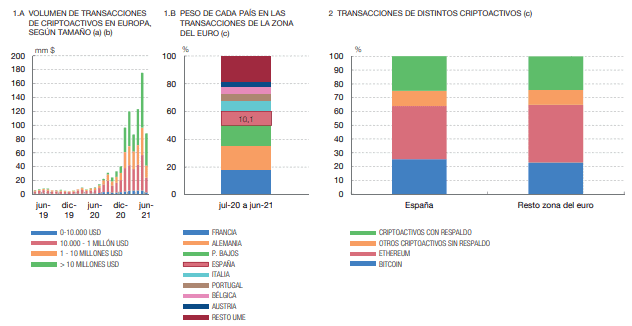
Cryptocurrency transactions in Spain and the rest of Europe. Source: Central Bank of Spain On the other hand, the ECB reported that 64% of Spaniards prefer to use decentralized services (which do not need an intermediary) to carry out their transactions. In comparison, in the rest of Europe, the average use of these services is 53%.
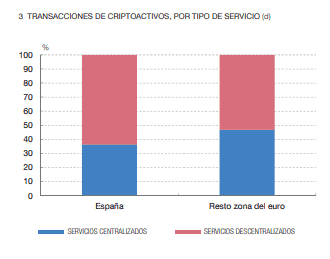
Cryptoasset transactions, by type of service. Source: Central Bank of Spain This means that, despite the boom that centralized exchanges like Binance or Bit2me are having in Europe, the legal background encourages citizens to seek alternatives to transact and trade. Uniswap, Pancakeswap, Sushiswap, and other similar services fill that gap.
It seems like criminals are not really into cryptocurrencies. The report says that only 1% of the total cryptocurrency transactions between July 2020 and June 2021 involved illegal activities such as theft, scams, and frauds, among others.
Which Are The Most Crypto-friendly Countries in Europe?
According to the report, France ranks first in Europe regarding transaction volume, with Germany, the Netherlands, and Spain positioned in second, third, and fourth place.
These results are to be expected. A different report by the online investment news and education platform, Invezz, France is the “best nation to trade bitcoin.”
In addition to this, the re-elected President of France, Emmanuel Macron, is one of the few pro-bitcoin presidents in Europe. During an interview for a local media, he talked about creating a European metaverse where cryptocurrencies are regulated without affecting or slowing down their development.
“Building a European metaverse also means producing, promoting and mastering our cultural and creative content. The metaverse has enormous potential in culture and entertainment thanks to its applications in music, concerts, art exhibitions, etc. We cannot consider our cultural policy without this revolution”.
And so, France could become a leader in the European cryptocurrency —Should Macron fulfills his promises of setting up a legal framework that boosts the crypto industry and promotes innovation in the WEB3 area.