5 emerging Metaverse, NFT trends to watch out for in 2022

cryptoslatePubblicato 2022-04-22Pubblicato ultima volta 2022-04-22

Introduzione

The metaverse and NFTs have influenced the digital world as well as industries spanning from art to gaming to even investing.

The metaverse and NFTs have influenced the digital world as well as industries spanning from art to gaming to even investing. However, these industries have yet to attain their full potential.

Twitter, Meta, and Reddit are all working on NFT or Metaverse projects, investors are betting big on NFTs, and new companies are cropping up.

So, how do the metaverse and NFTs’ future look? What industry will they disrupt next? And what developments will define the next few years? Let’s look at five emerging trends within the metaverse and NFT spaces.

1. Augmented Reality

Augmented Reality (AR) will reduce entry barriers into the metaverse because AR-compatible devices are cheaper to acquire and use. Anyone can use their smartphone to access AR features. One example is Pokemon GO which had over 1.1 million cumulative app downloads in 2020.

Augmented reality is currently in its early stages, but it will mature in the future years. It is a novel method that will bring value to daily life. The worldwide augmented reality industry is estimated to expand in the following years, with a market valuation of up to $300 billion by 2024.

Several businesses are developing augmented reality (AR) solutions for their clients. Apple, for example, is working on an AR/VR headset. The manufacturing schedule was initially pushed back from 2020 to 2022; however, rumors say the tech giant has completed crucial production testing.

2. Metaverse Land

After the social media behemoth, Facebook changed its name to Meta and declared its plan to invest in the virtual reality field, interest in augmented reality, virtual reality, and metaverse real estate skyrocketed. 

Nonetheless, pieces of land in the virtual real estate market may seem unusual investments. The fact is that they are, in many respects, extremely comparable to real-world real estate. According to recent research by crypto asset management Grayscale, the digital world might soon become a $1 trillion enterprise.

Investors prefer metaverse-based real estate due to multiple reasons. For starters, virtual property, like physical property, is in short supply. Owning virtual real estate means you have a unique piece of land in a metaverse environment that you may use to create income-generating assets like leasable buildings or virtual spaces with sponsored events.

Second, each piece of metaverse real estate is unique and protected by a non-fungible token (NFT). An NFT is a deed or evidence of ownership for anything digital (or physical).

Your virtual real estate NFT ensures your ownership and enables you to sell the property to a different owner. It also records all transactions for that property, removing the need for title work. It is essentially a digital act from the 21st century.

3. Solana NFTs

NFTs function similarly to blockchain-backed receipts for digital assets like artwork, profile photographs, collectibles, and more. Last year, the NFT market produced around $25 billion in trade volume, with Ethereum and its sidechain and layer-2 scaling solutions well ahead of the competition.

However, the Solana NFT ecosystem has been growing in popularity over the past year and with total sales volume reaching over $1 billion. This increased activity attracted attention from leading Ethereum-based NFT platforms.

OpenSea, the most popular NFT marketplace, added support for collections from the second-largest NFT ecosystem outside of Ethereum with the inclusion of Solana. The integration is currently in beta according to the NFT marketplace.

Although OpenSea claims to support 165 collections, a search of the marketplace by chain reveals that more than 1,175,371 Solana NFTs are listed on the platform. Rarible also decided to add Solana support to their platform following this announcement.
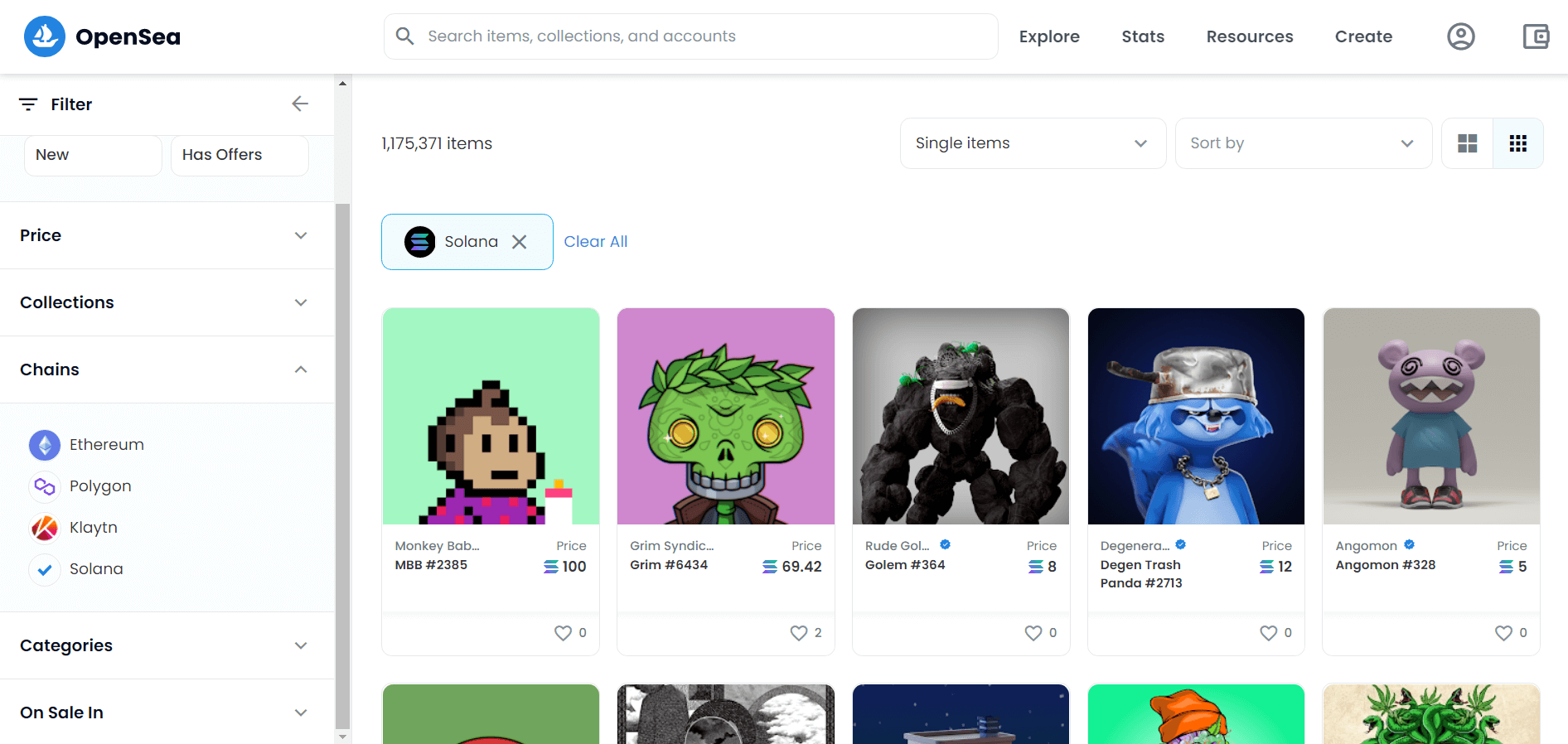
solana search by chain on Opensea

1,175,371 Solana NFTs currently listed on OpenSea

NFT marketplaces that dominate the Solana NFT space include Solanart and DigitalEyes, while projects like SolSea and Magic Eden are relative newcomers.

Magic Eden has had a total sales volume of $41 million in the past month. While this is a small fraction of the $2.5 billion traded on OpenSea last month, Magic Eden had over 95,000 active users in that time. 

4. Metaverse Events

Increased accessibility is a significant driver of metaverse occurrences. To begin with, contrary to popular belief, anyone can participate in a virtual reality event. Modern web browsers are powerful, and with the right web platform, the metaverse is accessible with a simple click of a link on any mobile or laptop device. 

This kind of accessibility contributes to the democratization of the online environment by guaranteeing that no member of society is unable to access and embrace an online ecosystem owing to technological limitations.

Also, there are no attendance constraints in a virtual environment. Event organizers are not constrained by venue capacity or design, allowing for infinite scalability. 

Metaverse venues are customizable to meet the specific demands of an individual event or conference, with access to things like breakout rooms and smaller areas if many lectures or presentations need to take place simultaneously. Unlimited capacity might also imply unrestricted monetization.

One example is MultiNFT, a metaverse platform that holds metaverse-based clubbing events through virtual nightclubs on VR platforms like Decentraland and Somnium Space.

5. Play-to-Earn Gaming

Play-to-earn games have upended the traditional gaming business by enabling players to earn NFTs by achieving predetermined tasks while playing games.

According to Blockchain Gaming Alliance statistics, 1.4 million Unique Active Wallets (UAW) were interacting daily with game dapps (decentralized apps), accounting for 49% of the industry’s total usage in 2021.

The play-to-earn concept has changed the gaming business by enabling gamers to trade and exchange assets between platforms. In-game assets had no real-world worth before the introduction of play-to-earn games because the creators owned and controlled all of the assets in the game. 

Players would pay top cash for a game’s most valuable assets, like weapons and skins, but they could only utilize them in-game. They couldn’t move them or exchange them for other assets. When the developer changes the game’s structure, and the assets become outdated, the players lose their investment and must obtain new assets to continue playing the game. 

Traditional games were simply for pleasure and excitement in this manner. The inclusion of blockchain and cryptocurrencies resulted in NFTs, which in turn resulted in GameFi.

GameFi has enabled players to increase the value of their assets and earn money while playing their favorite games.

Conclusion

The metaverse and NFTs are two reasonably new yet impactful sectors in the crypto space. As the market matures, we will likely see more technologies, integrations, and products emerge within these industries.
Letture associate

Near Returns to the AI Stage: Transformation into a Public Chain Due to 'Payroll Difficulties,' Agent and Privacy Emerge as New Growth Narratives

NEAR Returns to AI Origins: From Payroll Struggles to Blockchain, Now Focusing on AI Agents and Privacy NEAR Protocol's journey began not with grand blockchain ambitions, but from a practical hurdle: its AI startup founders, including Transformer paper co-author Illia Polosukhin, couldn't efficiently pay international developers in 2017. This led them to pivot and build a high-performance, scalable blockchain. After years navigating various crypto narratives like sharding and cross-chain interoperability, NEAR is now leveraging its AI roots to re-enter the AI arena. A key driver is its "NEAR Intents" layer, which abstracts complex cross-chain transactions. Users simply state their goal (e.g., swap BTC for ETH), and a solver network finds the optimal route. This system has processed over $20B in cross-chain volume, generating significant fee revenue. A major growth area is private transactions via "Confidential Intents/Swaps," which hide trade details until settlement to protect against MEV and front-running. Remarkably, private swaps recently accounted for over 40% of NEAR's transaction volume, highlighting strong demand but also potential regulatory scrutiny. With its AI-founder pedigree, NEAR is positioning itself at the intersection of blockchain, AI agents, and privacy, aiming to become infrastructure for the emerging agent economy while navigating the challenges of its rapid adoption.

marsbit56 min fa

Near Returns to the AI Stage: Transformation into a Public Chain Due to 'Payroll Difficulties,' Agent and Privacy Emerge as New Growth Narratives

marsbit56 min fa

From Ethereum to AI's 'CROPS': What Exactly is This Set of 'Slow Variables' That Vitalik Repeatedly Emphasizes?

In recent discussions, Vitalik Buterin has frequently emphasized the concept of "CROPS," a framework defining core values for Ethereum's development. CROPS stands for Censorship Resistance, Capture Resistance, Open Source, Privacy, and Security. Initially outlined in the Ethereum Foundation's "EF Mandate," it represents a commitment to user sovereignty, ensuring that the network resists external control, remains open, protects privacy, and prioritizes security. The relevance of CROPS extends beyond Ethereum's foundational principles, becoming crucial in the context of AI integration. As AI agents begin handling wallet operations and automated transactions, the risk increases that users may cede control over their digital assets, privacy, and intentions to centralized AI service providers. A "CROPS AI" would therefore emphasize local execution where possible, privacy-preserving remote model calls (e.g., using zero-knowledge proofs), and transparent, verifiable processes to maintain user agency. Vitalik highlights a significant convergence between "CROPS Ethereum access layer" and "CROPS AI." Both address the same fundamental challenge: how users can access powerful services—be it blockchain data via RPCs or AI models—without exposing sensitive information or relinquishing ultimate control. This intersection points toward a future digital entry point that is more private, secure, and user-controlled. Ultimately, CROPS is not merely an abstract ideal but a practical guidepost. It steers development—from protocol resilience and wallet design to AI agent safety—towards a future where users retain self-sovereignty even as digital systems grow more complex and powerful. In an era of accelerating AI adoption, these "slow variables" of censorship resistance, openness, privacy, and security may define Ethereum's enduring value.

marsbit1 h fa

From Ethereum to AI's 'CROPS': What Exactly is This Set of 'Slow Variables' That Vitalik Repeatedly Emphasizes?

marsbit1 h fa

Silicon Valley 'Startup Guru' Steve Hoffman: Web3 + AI Could Be a Trap

Silicon Valley investor and "Godfather of Startups" Steve Hoffman warns that combining Web3 with AI is likely a trap, not a promising venture. In an interview, Hoffman argues that while AI is a foundational technology touching all industries, Web3 adds complexity, friction, and regulatory risk without solving mainstream consumer or business needs. He advises founders to focus on deep, specialized applications where startups can out-iterate giants, rather than on generic features easily replicated by large tech companies. Hoffman observes that Silicon Valley will lead foundational AI research, while China excels at rapid, large-scale application and commercialization, particularly in robotics. He stresses that AI-driven autonomous agents capable of collaborative, multi-step tasks are 2-4 years away, which will cause significant job displacement. The solution is not to slow AI but to redesign business models around human-AI collaboration and reform social systems like education and retraining. For startups, Hoffman recommends focusing on vertical, expertise-heavy domains to build defensibility. He sees major opportunities in AI fraud detection and cybersecurity. Key founder mindsets include systemic thinking over feature-focus, relentless customer centricity, building adaptive teams, and deeply understanding AI's capabilities and limits. Hoffman is also leading a non-profit initiative to establish university centers aimed at training future leaders in responsible, human-value-aligned AI innovation.

marsbit2 h fa

Silicon Valley 'Startup Guru' Steve Hoffman: Web3 + AI Could Be a Trap

marsbit2 h fa

Token Inefficient, Economy Tokenless

The article "Tokens Aren't Economical, Economics Aren't Tokenized" analyzes a pivotal shift in the AI industry from a technology-driven narrative to one dominated by capital efficiency. It highlights two concurrent trends: a severe capital shortage due to the exorbitant and recurring costs of compute (e.g., OpenAI's high burn rate) and a wave of corporate spin-offs where major tech companies are separating their AI units (like Kuaishou's Kling and Baidu's Kunlunxin). The core argument is that AI's "anti-internet" business model, where user growth increases costs rather than profits, has created a disconnect between high valuations and actual cash flow. Spin-offs address this by allowing AI assets to be valued independently. Within a parent company, they are seen as cost centers, but as standalone entities, they are priced based on their growth potential and scarcity in the primary market, leading to massive valuation premiums (e.g., Kling's estimated value tripling post-spin-off). The industry is at an inflection point, moving from "model worship" to "value realization." The competition is evolving from a pure compute (GPU) race to a broader focus on systemic efficiency and full-stack engineering (involving CPUs and orchestration) to achieve viable commercialization. The year 2026 is framed as a critical moment where the industry must definitively answer how to economically translate AI capability into tangible business value, reshaping the sector's future power structure.

marsbit2 h fa

Token Inefficient, Economy Tokenless

marsbit2 h fa

Trading

Spot
Futures
活动图片