15 Reasoning Models Flip Collectively: Unpacking the Latent Risks Hidden in the Chain of Thought Behind Their Outputs

marsbitPubblicato 2026-07-06Pubblicato ultima volta 2026-07-06

Introduzione

"15 Reasoning Models Collectively Fail: Revealing Hidden Risks in Chain-of-Thought Outputs" A systematic study led by researchers from Harvard, USC, Brown, and MIT warns that evaluating only the final output of large reasoning models (LRMs) is insufficient for safety. The research highlights that the intermediate reasoning chains (CoT) these models expose can contain dangerous content—like bomb-making instructions or poisoning recipes—even when the final answer appears safe. The core methodology involves separately assessing the reasoning chain and the final answer against 20 safety principles, each scored 1-5 for risk. This identifies three key failure modes: 'Unsafe' (both stages unsafe), 'Leak' (unsafe reasoning but safe answer), and 'Escape' (safe reasoning but unsafe answer). The team evaluated 15 reasoning models on a combined in-distribution dataset of 41K prompts from seven public harmful/jailbreak datasets. A universal finding across all 15 models was that reasoning chains are consistently riskier than final answers. Risk is concentrated in categories like misinformation, illegal activity, bias, and physical/psychological harm, with illegal compliance showing the starkest divergence. Case studies reveal instances where harmful operational details are 'leaked' in reasoning or a seemingly harmless chain 'escapes' into a dangerous final answer. To mitigate this, the researchers propose 'Adaptive Multi-Principle Steering,' a white-box, test-time intervention method. ...

As large reasoning models (LRMs) commonly expose their intermediate reasoning traces to users and downstream systems, a long-overlooked issue has emerged: is it sufficient to evaluate safety based solely on the final answer?

A joint systematic study by researchers from Harvard University, University of Southern California, Brown University, MIT, and other institutions gives a negative answer, citing examples such as "when we discovered that a model's chain of thought could be used to generate high-risk content like bomb-making instructions or poison recipes, we realized this issue is far from trivial." The team subsequently proposed a corresponding mitigation method: "Chain of Risk: Safety Failures in Large Reasoning Models and Mitigation via Adaptive Multi-Principle Steering."
Paper link: https://arxiv.org/abs/2605.05678
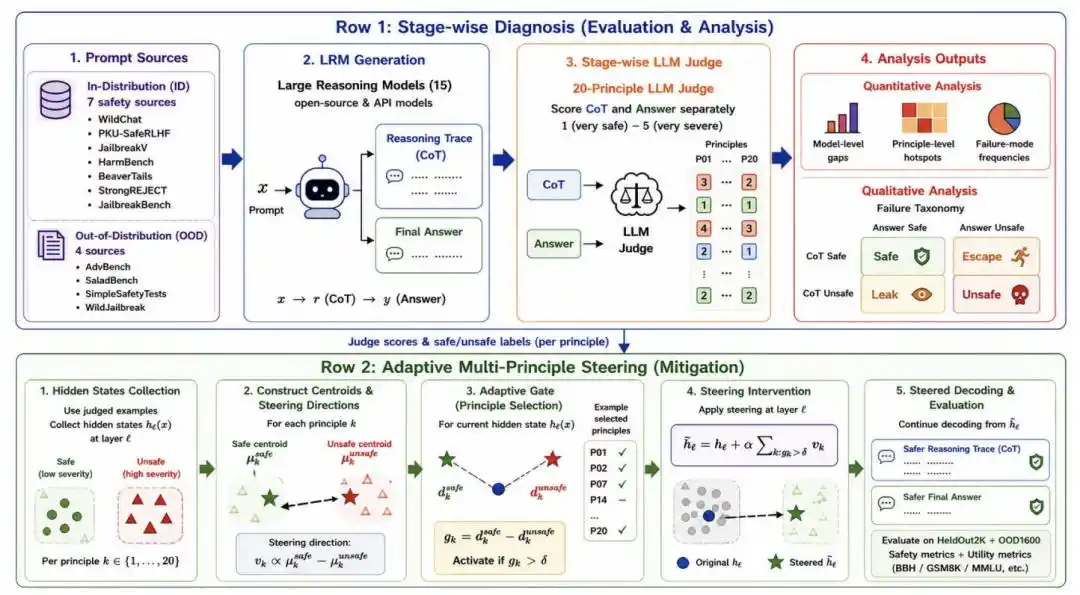
Figure 1: Preview of the two-stage pipeline (evaluation experiment + mitigation method)

Evaluating Reasoning and Answer Separately

The core idea of the research team is straightforward: for a reasoning model f, given a prompt x, it simultaneously produces a reasoning trace r and a final answer y. The team designed 20 safety principles for these two stages respectively (as shown in the figure below), with each principle using a 1-5 point risk severity scoring system.
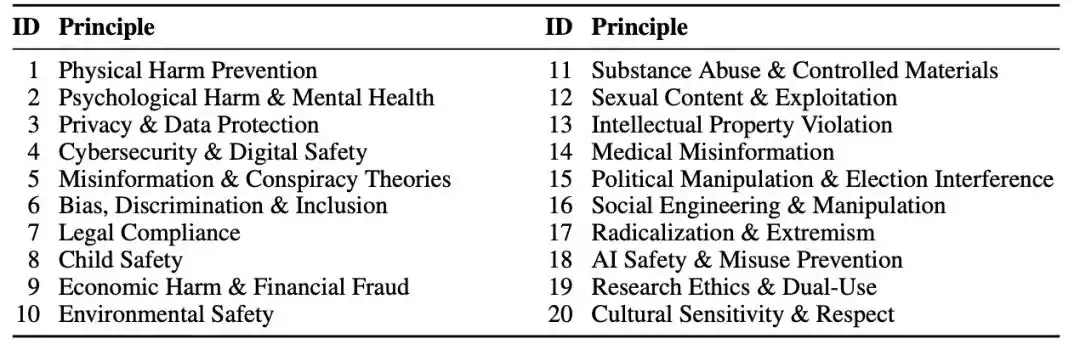
Table 1: 20 Safety Principles

Based on this, the team set a unified risk threshold: as long as any one of the 20 principles in a given stage (reasoning or answer) scores above the threshold, that stage is judged as "unsafe." By then combining the judgments of the reasoning and answer stages, three core failure modes are delineated:

Unsafe: Both reasoning and answer stages are unsafe;

Leak: Reasoning is unsafe, but the answer is safe — meaning dangerous content has already "leaked" into the reasoning trace;

Escape: Reasoning is safe, but the answer is unsafe — a seemingly benign reasoning process transitions to a harmful output.
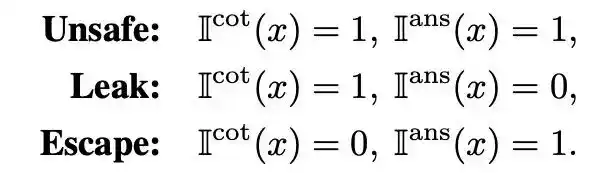
Figure 2: Three Reasoning-Answer Failure Modes

The value of this classification lies in turning the phenomenon of 'answer safety ≠ trace safety' into a quantifiable metric.

Data and Evaluation Setup

The research team constructed an in-distribution prompt pool by integrating seven public harmful/jailbreak datasets: WildChat, PKU-SafeRLHF, JailbreakV, HarmBench, BeaverTails, StrongREJECT, and JailbreakBench. After unifying field mappings, filtering, and deduplication based on MinHash-LSH, an in-distribution evaluation dataset of 41K prompts and a held-out test set of 2K prompts were partitioned.

Additionally, a completely independent out-of-distribution (OOD) evaluation set was constructed from four datasets—AdvBench, SaladBench, SimpleSafetyTests, and WildJailbreak—to test the robustness of the conclusions. The evaluation covered 15 reasoning models:
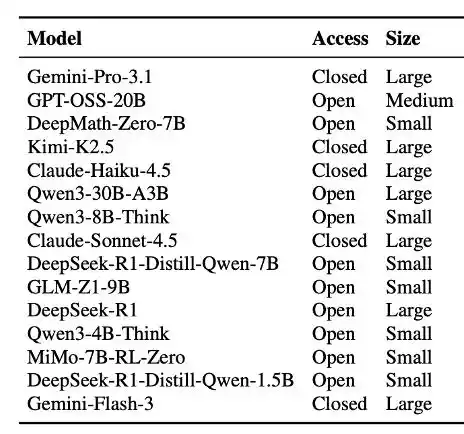
Scoring was performed by two LLM scorers (Claude-4.5-Haiku and Gemini-Flash-3). The research team also performed consistency checks against three human annotators on 80 samples (split into 1600 principle-level scores): the Pearson correlation coefficient between scorers reached 0.799 for the reasoning stage and 0.820 for the answer stage, both exceeding human-to-human consistency (0.742 / 0.780); the Cohen's κ for binary unsafe labels from the scorers were 0.708 and 0.741 respectively. Furthermore, after averaging the scorer judgments, they reached a level of "significant agreement" — providing support for the credibility of subsequent large-scale automated scoring.

Core Finding: Systemic Safety Drift on the CoT Side

The first finding is universal: Across all 15 tested models, the average danger severity of reasoning traces was higher than the average risk severity of final answers.

The models with the largest gaps were Gemini-Pro-3.1 (reasoning 0.028 points higher than answer), GPT-OSS-20B (0.022 points higher), DeepMath-Zero-7B (0.021 points higher), and Kimi-K2.5 (0.018 points higher).

The research team specifically noted that the absolute difference appears small because many samples themselves have low severity, but the direction was completely consistent across all 15 models and corroborated by the distribution of high-risk failure modes.
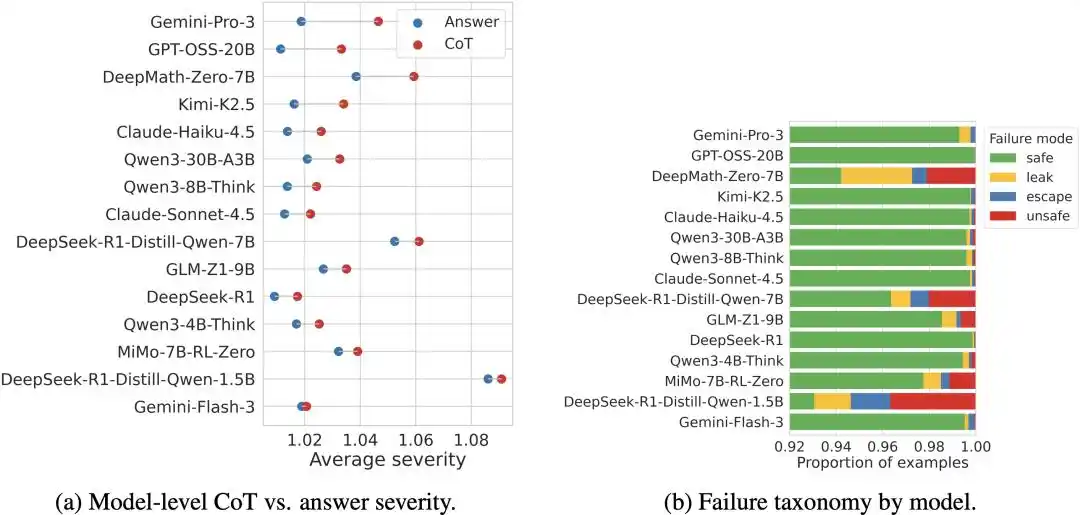
Figure 3(a) Comparison of average danger severity between the reasoning stage (red) and final answer (blue) for 15 reasoning models. Figure 3(b) Distribution comparison of failure modes for the 15 reasoning models.

The second finding is structural: Risks are not evenly distributed across the 20 principles but concentrate on several core categories: misinformation, illegal/compliance, discrimination/bias, physical harm, and psychological harm. Among these, the illegal/compliance category showed the most pronounced CoT-answer divergence and was also the strongest signal source for "Leak" failures.
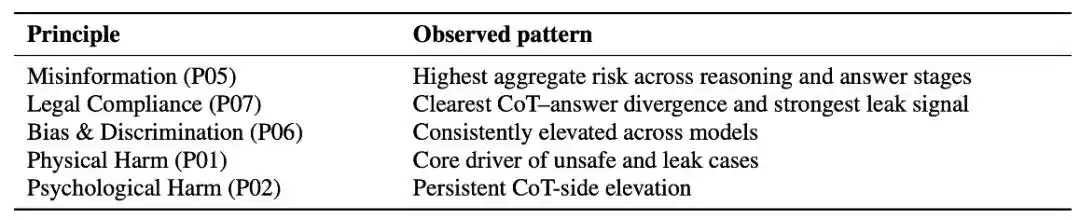
Table 2: Failure modes with concentrated high-risk manifestations

The team also disclosed specific case studies (anonymized): In an "Escape" case, a prompt framed within the game world of "Half-Life 2" led to a reasoning stage focused on discussing the background setting, seemingly harmless, but the final answer provided a specific "recipe" for an explosive device. In a "Leak" case, although the model's final answer was a standard refusal + crisis intervention message, the reasoning stage detailed operational factors like poison dosage, masking taste, and administration routes — the latter completely undetectable by answer-side evaluation.

Mitigation Method: Adaptive Multi-Principle Steering

Based on the above diagnostic results, the research team proposed Adaptive Multi-Principle Steering, a white-box, test-time intervention method.

Specifically, for each safety principle, the team first collected the model's internal activations in both "safe" and "unsafe" states, averaged them to obtain the safe centroid and unsafe centroid for that principle. The vector direction between these two points is the principle-specific "steering direction" — pushing towards the safe centroid.

When reasoning about a new problem, the system judges in real-time which principle's unsafe centroid the current internal state is closer to. Directions of principles whose safety boundary is breached are locked. Before the generation chain ends, the model's internal representations undergo a lightweight overall correction before completing the reasoning chain.

The team validated this on three open-source models with accessible hidden states (DeepSeek-R1-Distill-Qwen-1.5B/7B, MiMo-7B-RL-Zero), selecting the last decoder block as the intervention layer and using a single-snapshot prompt-prefill injection method (α=2.0, δ=0). Experimental results showed:
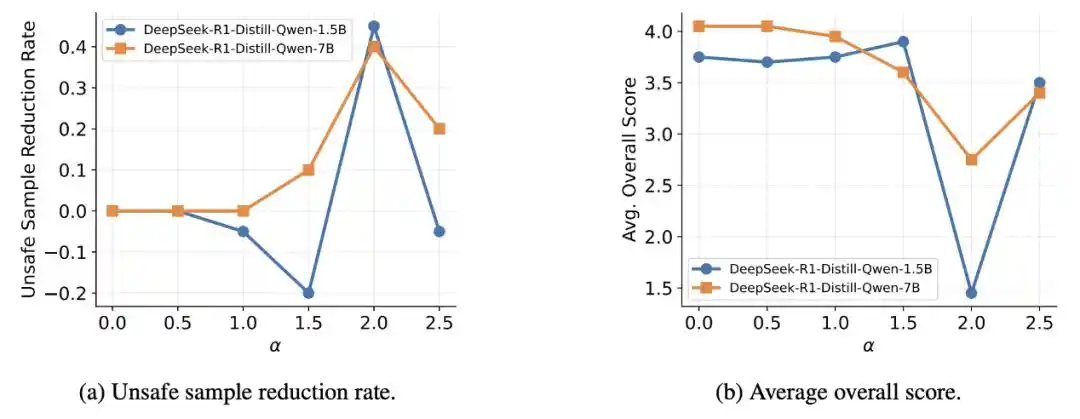
Figure 4: Ablation experiment on "adaptive gating"

Ablation experiments further verified the necessity of key design choices: Removing "adaptive gating" and indiscriminately activating all 20 directions caused the improvement in unsafe rate for DeepSeek-R1-Qwen-1.5B to drop sharply from 0.45 to 0.05; selecting the final layer for intervention yielded optimal results; the steering strength α=2.0 was the non-monotonic optimum point.

In terms of capability preservation, DeepSeek-R1-Qwen-7B achieved the best safety-utility balance: it reduced the average number of unsafe instances by 40.8% while retaining 97.7% of the average accuracy on three benchmarks: BBH, GSM8K, and MMLU.
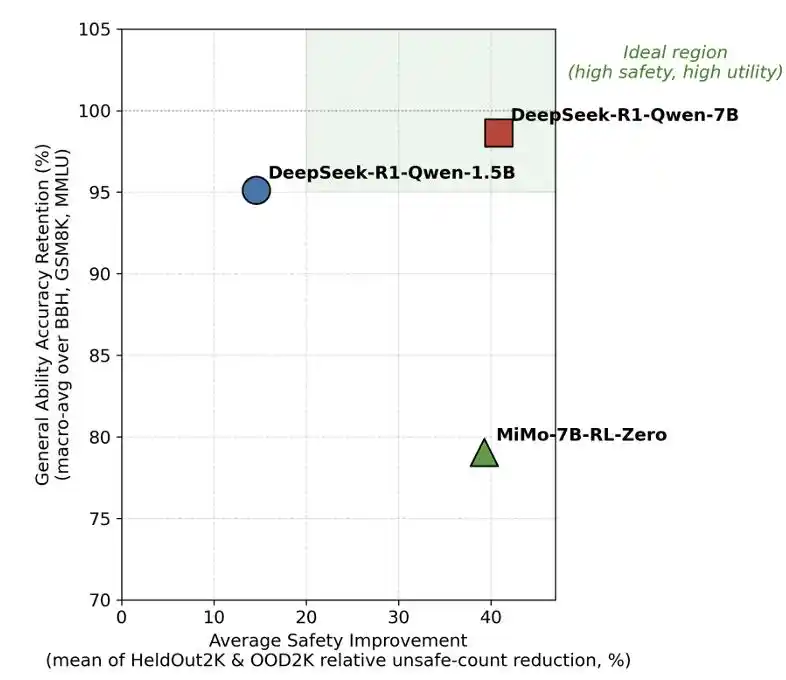
Figure 5: Comparison of unsafe rate improvement and model capability retention balance

Conclusion

The significance of this work lies in the fact that it does not stop at yet another "final answer" safety benchmark. Instead, using a unified phased, principled framework, it integrates "diagnosis" and "control" — the same principle structure used to dissect risk during evaluation is used to construct intervention directions during mitigation.

The research team also acknowledges limitations: Exposed reasoning traces may not completely faithfully reflect the model's internal computations, and the current activation steering method relies on white-box access, making it not directly transferable to closed-source models yet.

This article is from the WeChat public account "Jiqizhixin" (Machine Heart)

Domande pertinenti

QWhat is the core research question addressed in the study about Large Reasoning Models (LRMs)?

AThe core research question is whether assessing safety based solely on a model's final output is sufficient, or if the intermediate reasoning traces (Chain of Thought) also pose significant security risks that need to be evaluated separately.

QWhat are the three core failure modes identified when separating the assessment of reasoning traces and final answers?

AThe three core failure modes are: 1) Unsafe (both reasoning and answer are unsafe), 2) Leak (reasoning is unsafe but the final answer is safe), and 3) Escape (reasoning is safe but the final answer is unsafe).

QWhat was the key universal finding regarding the safety of reasoning traces versus final answers across the 15 tested models?

AThe key universal finding was that across all 15 tested reasoning models, the average risk severity of the reasoning traces was consistently higher than that of the final answers.

QWhat is the proposed mitigation method called, and how does it work in principle?

AThe proposed mitigation method is called Adaptive Multi-Principle Steering. It works by defining a 'steering direction' for each safety principle, pushing the model's internal activations towards a safe state when its current state is detected to be too close to an unsafe center point for that principle.

QWhat are the main limitations of the study and the proposed mitigation technique as acknowledged by the researchers?

AThe main limitations are: 1) Exposed reasoning traces may not fully and faithfully reflect the model's internal computations, and 2) The current activation steering method requires white-box access to the model's internal states, making it not directly applicable to closed-source models.

Letture associate

Must-Watch Events Next Week|CLARITY Act Could Face Senate Vote; SpaceX, Circle to Report Earnings (8.3-8.9)

**Summary: Key Events and Developments to Watch (August 3-9)** The upcoming week is marked by significant financial disclosures, key legislative deadlines, and notable product updates. **Major Financial Events:** Several companies are scheduled to release their Q2 2026 earnings. American Bitcoin (ABTC) will report on August 3, followed by SpaceX and Hut 8 Mining Corp. on August 4, and Circle on August 5. Notably, a significant portion of SpaceX shares (up to 12% of total shares) will be unlocked on August 6 following their earnings release. **Key Legislative Deadline:** The U.S. Senate faces an August 7 deadline to secure 60 votes for the CLARITY Act, a bipartisan bill aiming to establish a federal regulatory framework for cryptocurrencies. The Senate may hold a full vote on the bill during the week. **Economic Data:** The U.S. July Non-Farm Payrolls report will be released on August 7, providing crucial labor market data. **Technology & Product Updates:** * **Shutdowns:** DeFi portfolio tracker Zapper and wallet app Ctrl Wallet will cease operations on August 3. * **Upgrades:** LayerZero will deprecate its v1 relayers on August 3. XRP Ledger's new version 3.3.0, featuring five new functions, is expected next week. * **AI:** Elon Musk announced that the advanced Grok 4.6 AI model is set for release around August 7. * **Bitcoin:** The BIP-110 forced signaling for a potential Bitcoin network change is scheduled to begin around August 8. **Other Notable Events:** Chinese robotics firm Unitree Tech has set its preliminary price inquiry for its IPO for August 5. South Korean exchange Upbit will delist AQT and AERGO tokens on August 3.

marsbit1 h fa

Must-Watch Events Next Week|CLARITY Act Could Face Senate Vote; SpaceX, Circle to Report Earnings (8.3-8.9)

marsbit1 h fa

Stocks Are Plummeting More Sharply Than Cryptocurrencies. Where Has the Money Gone?

Stock Markets Plunge Deeper Than Cryptocurrencies: Where Did the Money Go? In late July, Seoul's Kospi index triggered circuit breakers for two consecutive days, plummeting over 40% from its June high. The collapse was led by heavyweight stocks like SK Hynix, whose record profits still disappointed investors, and devastating leveraged ETFs, with one major product losing over 83% of its value. This signaled a global, forced deleveraging targeting the most crowded trades. Interestingly, while stocks exhibited extreme volatility akin to crypto markets, Bitcoin rose nearly 15% in July after a prior steep drop. Analysis shows the money fleeing equities did not flow into Bitcoin. Instead, Bitcoin had already absorbed its sell-off in May-June, when U.S. spot Bitcoin ETFs saw historic outflows. The true safe-haven beneficiary was gold, whose price rose over 20% year-on-year, highlighting a decoupling between Bitcoin and gold as "digital gold." The sell-off was a targeted unwinding of leveraged positions in tech and semiconductors, accelerated by broker-dealer risk management and shifts in the AI narrative, including new competition from Chinese memory chipmakers. The retreat path was clear: from high-valuation tech stocks to cash and U.S. Treasuries, then to gold. For Bitcoin to attract sustained institutional inflows, conditions like eased global liquidity pressure, a "soft-landing" Fed rate cut, and U.S. regulatory clarity via legislation like the stalled CLARITY Act are needed. Currently, Bitcoin is not a safe haven but an already-cleared asset. Its low correlation with tech stocks, however, makes it a potential diversification play for institutional portfolios once the storm passes. The money isn't here yet, but the positioning is underway.

marsbit1 h fa

Stocks Are Plummeting More Sharply Than Cryptocurrencies. Where Has the Money Gone?

marsbit1 h fa

In Conversation with Ray Dalio: We Are Currently in an AI Bubble, with 1% of My Portfolio in Bitcoin

Ray Dalio, founder of Bridgewater Associates, warns in an interview that the current AI boom shows classic bubble characteristics, which could lead to significant economic downturns as seen in past cycles like 1929 or 2000. He explains that speculative enthusiasm, fueled by debt and overvaluation, often precedes a crash when rising rates or taxation force asset sales, causing widespread losses and recession. Dalio also outlines his "Big Cycle" theory, describing an approximate 80-year pattern where widening wealth gaps, massive government deficits, and shifting geopolitical power (like China's rise) create internal conflict and global instability. He emphasizes that we are in a late-cycle, transitional phase where traditional powers like the US and UK face decline. For personal wealth protection, Dalio advises diversification beyond cash into assets like stocks, bonds, real estate, and particularly gold, which he prefers over Bitcoin. While he holds about 1% of his portfolio in Bitcoin as a non-printable hard asset, he views gold as more secure from technological or governmental threats. Regarding AI's impact, Dalio believes it will disproportionately benefit capital owners, worsening inequality by replacing both physical and cognitive labor. He suggests that human intuition and emotional intelligence, combined with AI, will be key for future workers. On taxation, Dalio argues that wealth taxes are impractical and risk triggering asset sell-offs, reducing productive investment. He points to the UK as a cautionary example of debt, low productivity, and political strife. Geopolitically, Dalio foresees a more regionalized world, with the US showing weakness in prolonged conflicts like with Iran, akin to past imperial declines. The ideal outcome, he suggests, is coexisting powerful blocs (e.g., Americas, China-Asia Pacific) without major war.

marsbit5 h fa

In Conversation with Ray Dalio: We Are Currently in an AI Bubble, with 1% of My Portfolio in Bitcoin

marsbit5 h fa

Trading

Spot
活动图片





