147 Trillion vs 70 Billion: The Rise of On-Chain 'Risk Managers' and the Potential Dawn of a New Era in DeFi Asset Management

marsbitPubblicato 2026-05-21Pubblicato ultima volta 2026-05-21

Introduzione

"147 Trillion vs 70 Billion: The Rise of On-Chain 'Risk Managers' and the Potential Dawn of a New Era in DeFi Asset Management" Key Points: The role of professional asset managers is emerging in DeFi, ending the era where protocols and governance dictated everything. While early DeFi protocols like Aave and Compound bundled risk management within their code, innovations like Morpho have separated infrastructure from risk judgment. This allows specialized "Risk Managers" to operate independent lending vaults, acting as on-chain asset managers. The market, though early with ~$7B in assets under management (AUM), is rapidly consolidating around top performers like SteakhouseFi (RWA focus), SentoraHQ (AI-driven models), and Gauntlet (crisis management). This modular structure mirrors TradFi's division of labor: distributors (e.g., exchanges) source capital, Risk Managers design strategies and set standards, and underlying protocols handle custody and execution. For traditional asset managers, this familiar structure presents clear entry paths: 1) **Distribution**: Partnering with Risk Managers as a backend service. 2) **Supply**: Bringing real-world assets (RWA) on-chain as collateral. 3) **Operation**: Becoming a Risk Manager themselves (e.g., Bitwise). The core competency required is shifting from coding to traditional risk underwriting and financial expertise—areas where established institutions hold a natural advantage. While the current DeFi market (~$80B) is minuscule co...

Authored by: Tiger Research

Compiled by: AididiaoJP, Foresight News

The weight of DeFi lending is shifting from protocols to risk managers who possess the power of choice. Entering the market boils down to one decision: to borrow this judgment, to provide it, or to own it yourself.

Key Takeaways

  • The role of asset manager is emerging in DeFi. The era where protocols and governance decided everything is over.
  • The market is still early, but capital and distribution channels are starting to concentrate towards leading managers, whose track records are becoming institutional benchmarks.
  • There are three paths to entry: distribution (risk manager as backend), supply (bringing assets on-chain), and operation (becoming a risk manager).
  • The chosen path determines the level of control gained, the capabilities required, and the risks assumed.
  • The core question is not *whether* to enter DeFi, but *which* judgment calls to delegate and which to retain.

1. Risk Managers: On-Chain Asset Management Specialists
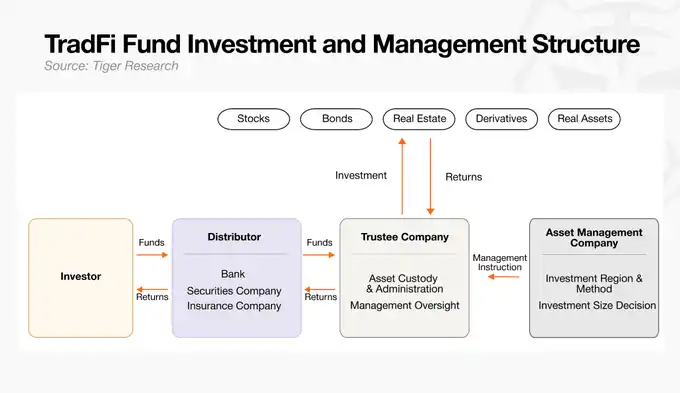
Just as traditional finance long ago separated judgment from execution, the crypto market has matured to a point where each function is handled by specialized players. The division of labor in TradFi is as follows:

  • Asset Manager: The "brain" of the fund, formulating strategies and issuing specific instructions to the custodian.
  • Custodian: Holds the assets, executes investments per the manager's instructions, and provides oversight.
  • Distributor: Distributes fund products to investors and raises capital.

The crypto market has corresponding roles. DeFi was initially designed to rely entirely on smart contract code, but over time it became clear that code alone cannot fully control on-chain risks.

To safely operate on-chain lending, a class of professionals specializing in assessing and coordinating complex risks emerged. They are called risk managers and have de facto taken on the role of asset managers within the on-chain ecosystem.

2. Early DeFi Had No Professionals
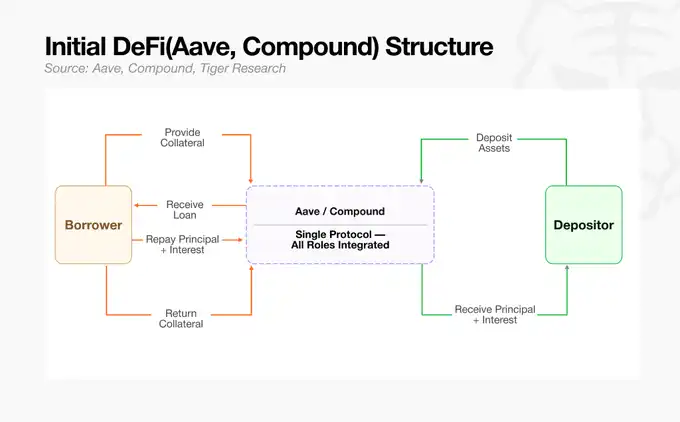
Early DeFi protocols like Aave and Compound bundled lending infrastructure and risk standards into a single structure. Risk managers existed back then, but because all assets were in one giant pool, their role was limited to being a "risk manager" at the system level, adjusting the protocol's overall risk parameters. As high-volatility assets flowed in, the single-pool design meant one bad asset could spread losses throughout the entire system. Someone had to manage this contagion risk.
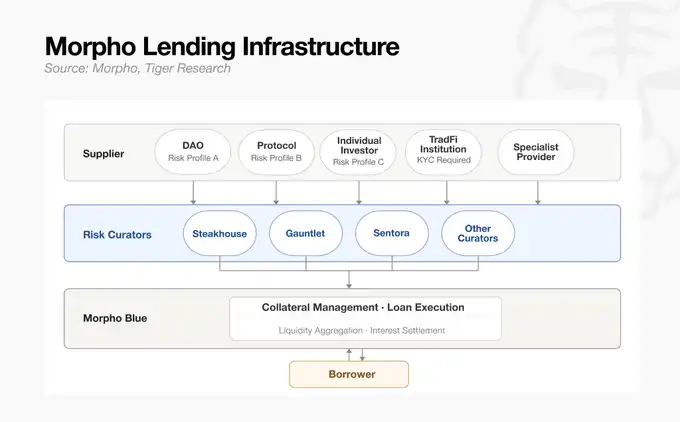
This changed with the advent of Morpho, which separated collateral assets and loan terms into independent markets. By replacing the single giant pool with a multi-vault structure, asset management strategies became modular, and the role of the risk manager transformed completely. They were no longer passive risk managers within a single protocol's fixed framework; they became external professionals able to design and operate independent lending vaults according to their own criteria.

With infrastructure and risk judgment fully separated, risk managers evolved from system-level risk managers into "asset managers" for the crypto market, actively operating multiple vaults.

3. Current Market Leaders
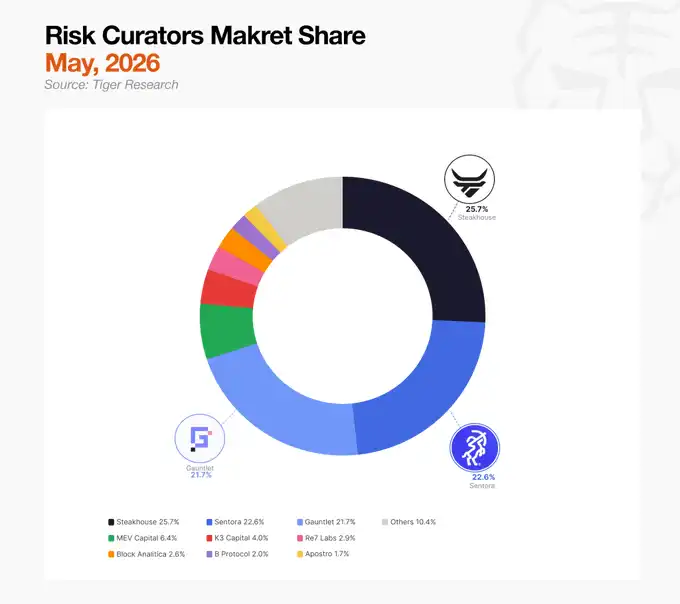
As of May 2026, the risk manager market manages roughly $70 billion in assets, with the top three teams accounting for 70% of that share. This market only truly entered the institutional arena in 2025, yet capital has quickly concentrated, indicating capital is chasing teams with reliable track records. The three leading teams reached the top via different paths:
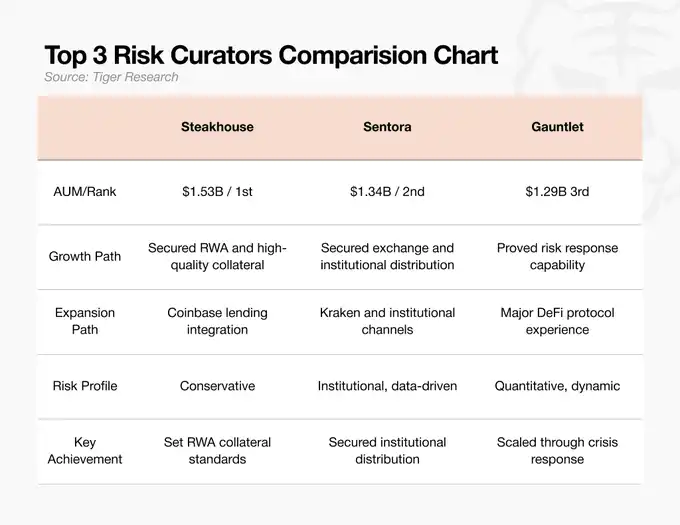
  • SteakhouseFi: A conservative risk manager leading the adoption of high-grade real-world assets (RWAs, like US Treasuries). As the backend for Coinbase's lending service, it unlocked distribution channels and currently ranks first in AUM ($15.3B as of Feb 2026). Beyond AUM, this team sets industry standards for which RWAs qualify as legitimate DeFi collateral.
  • SentoraHQ: A team built on AI risk models and institutional-grade data infrastructure. As Kraken's backend, it has secured institutional capital pipelines, ranking second in AUM ($13.4B). It won the channel connecting exchanges to institutional clients.
  • Gauntlet: Initially an on-chain quant analytics firm simulating risk parameters. In October 2025, when one of its vaults saw an influx of $775M, the team normalized collapsing APYs within 10 days, proving its capabilities. Ranking third in AUM ($12.9B), it is recognized as the strongest team in risk defense and crisis response to massive inflows.

At this stage, the risk manager market is no longer a simple TVL race but a competition to establish standards first: collateral standards, distribution channels, and risk response capabilities.

4. Traditional Asset Management vs. DeFi Risk Managers
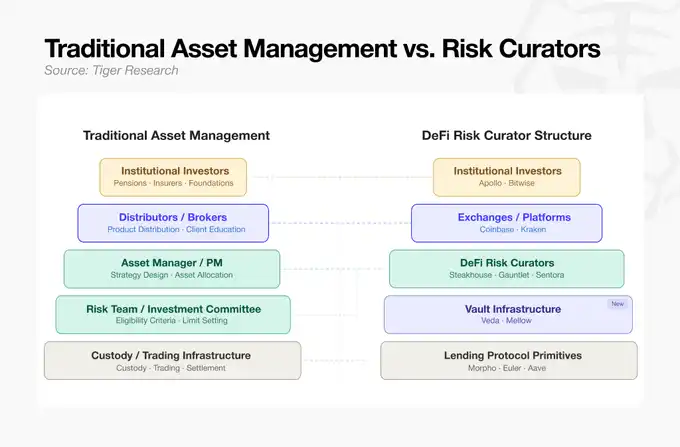
As Morpho fragmented the market, each collateral type required professional judgment. Specialist risk teams like Steakhouse entered as DeFi risk managers. Through this shift, DeFi began to approximate the traditional asset management process.

Reading the chart from top to bottom shows how today's DeFi infrastructure replicates the labor division of TradFi on-chain:

  • Capital Sourcing & Distribution (Top): Institutional investors are at the top as capital sources. Their large capital pools flow into the on-chain ecosystem via major CeFi exchanges and platforms, which assume the role of TradFi distributors (brokers).
  • Strategy Design & Risk Control (Middle): Below are the DeFi risk managers who decide how the incoming capital is managed. Analogous to TradFi asset managers' portfolio managers (PMs) and risk committees, they set asset eligibility criteria and limits and design the overall investment strategy.
  • Product Assembly & Custody (Bottom): The risk managers' strategies become investable on-chain products via the vault infrastructure below. At the very bottom are lending protocol primitives, which hold assets and execute settlements in code, replacing TradFi's custody and trading infrastructure.

From capital sourcing to management to custody, the entire workflow now mirrors the labor division of traditional finance. For traditional TradFi institutions, on-chain lending is no longer a foreign domain but a structured market with a familiar architecture, creating natural entry points.

5. A TradFi-Like Industry: Where Are the Opportunities?

As on-chain lending infrastructure adopts a labor division akin to TradFi asset management, the door is open for institutional entry. But not every layer has the same entry barriers.

  • Distribution Layer: The customer-facing, front-end market. Highly saturated, making it inefficient for TradFi institutions to compete head-on here.
  • Management Layer: An area driven entirely by financial expertise and human judgment. Assessing, controlling, and packaging asset risk is the core work of traditional asset managers. They can apply existing risk management capabilities to already-built, modular infrastructure without constructing complex systems, instantly gaining a business model.
  • Custody & Infrastructure Layer: Asset custody and transaction processing are technology-intensive, requiring deep blockchain engineering capabilities. It is unrealistic for TradFi institutions to build their own systems and compete here.

Unlike other layers requiring technical or platform-first advantages, the management layer presents the clearest window of opportunity where TradFi institutions can achieve market leadership using the very risk management capabilities they already possess.
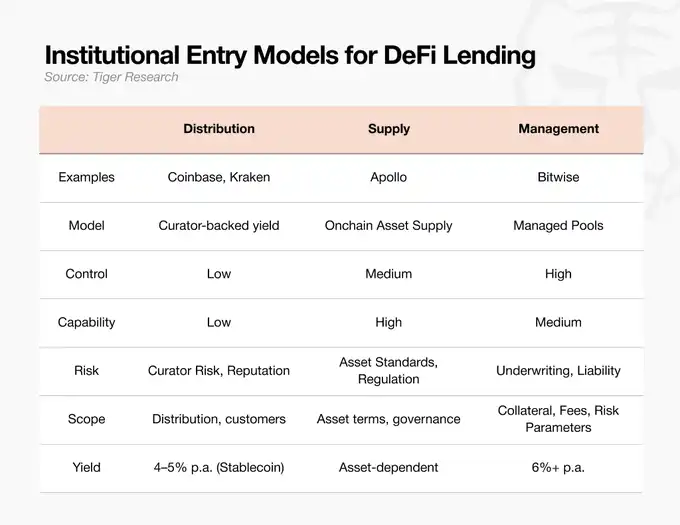
Institutions currently enter the DeFi market through three paths: distribution, supply, and operation. Regardless of the path chosen, the engine driving the market is the asset manager's "risk curation" ability.

Distribution: Risk Manager as Backend
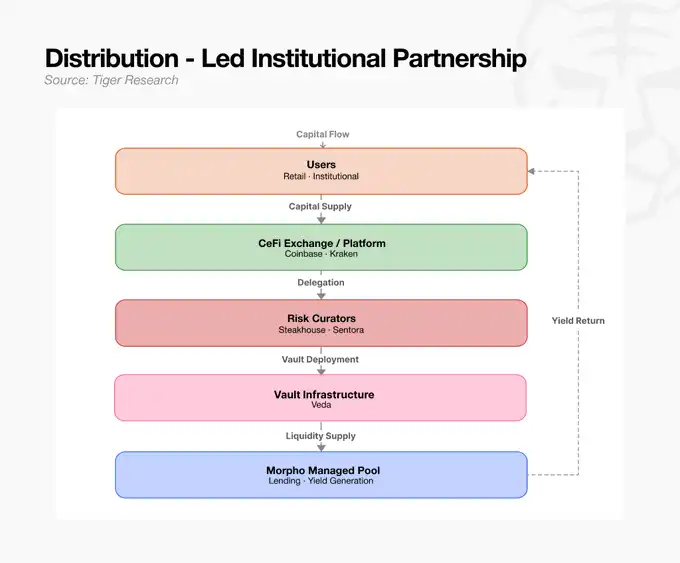
Connect with proven external risk managers as a backend for quick market entry. This suits exchanges and fintech companies with client channels but lacking internal management capabilities. Strategy is outsourced, but reputational risk and accountability for the chosen risk manager remain with the distributor.

This is the path chosen by centralized exchanges with strong client touchpoints but unwilling to directly manage the complexities of on-chain lending risk. They connect to proven external risk managers as backends and launch lending services. The exchange distributes large capital pools through its own platform, while collateral evaluation and risk management are entirely handed over to the partner risk manager.

Supply: Pushing Assets onto On-Chain Rails

Asset managers holding RWAs or credit assets directly supply these assets to the market. Like Apollo, they can acquire governance tokens of protocols like Morpho while supplying assets, thereby shaping infrastructure standards (e.g., collateral standards). The challenge lies in asset standardization and regulatory infrastructure development.

Large private equity funds or institutions holding real-world assets directly place their own capital on the on-chain rails. Apollo not only simply supplies assets but also acquired governance tokens of a major lending protocol. This move aims to push rules and standards so that its RWAs are recognized as superior, safer "official collateral" in the on-chain market.

But asset suppliers cannot arbitrarily register any asset as collateral. Someone must calmly assess whether the asset is truly safe and whether it can be liquidated immediately in an on-chain liquidation event. This requires the rigorous evaluation and endorsement capabilities of a risk manager. Ultimately, the supply path also must rely on the asset manager's risk validation capability to be viable.

Operation: Becoming a Risk Manager (Bitwise)
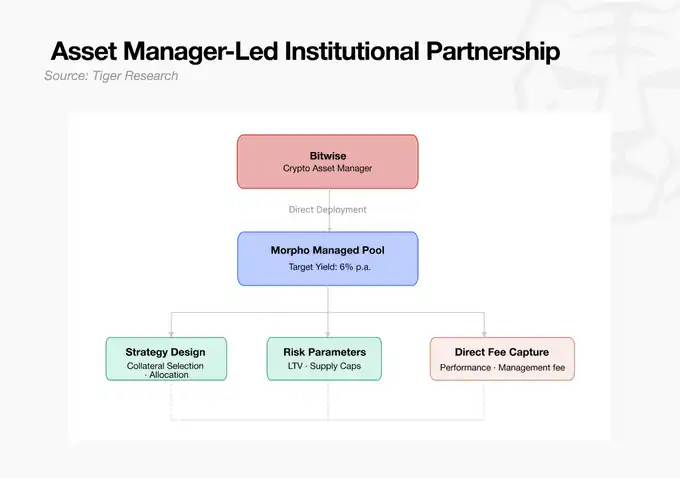
The asset manager designs its own strategy and operates its own vault. Bitwise defined on-chain vaults as "ETF 2.0" and entered directly. This path offers the strongest control over fees and collateral standards, but the manager bears full responsibility for operational failure. It suits asset managers with in-house risk teams.

This is the path where a traditional asset manager itself enters as a risk manager, without relying on external platforms. Bitwise defined the on-chain lending vault structure as "ETF 2.0" and entered the market directly. Leveraging its own portfolio construction capabilities and risk control systems, it designs and controls vaults itself, directly establishing a management fee model on-chain.

6. Before the Capital Arrives

Given the current trajectory, traditional asset managers are most likely to gain an advantageous position as on-chain lending matures. With the DeFi ecosystem's modularization and labor division, the capabilities truly needed by the market have shifted. Not the ability to write code, but the traditional financial expertise of underwriting collateral and setting risk limits. The competitive advantage of institutions with decades of experience can directly extend on-chain.

But today's DeFi market is still too small for global mega-managers. The global traditional asset management market is approximately $147 trillion, with BlackRock alone managing $14 trillion. In contrast, the entire DeFi market is around $80 billion, with the portion managed by risk managers at only $70 billion. This is merely 1/2000th of BlackRock's AUM.

Yet, it is precisely this massive scale gap that reveals the runway for growth. Institutional capital will not flow where risks are uncontrolled. Once risk managers lay secure on-chain rails for capital and regulatory frameworks take shape, the story changes. Even a tiny fraction flowing in from the $147 trillion could rapidly expand the $80 billion market.

Some opportunities exist only while the market is still small. Currently, the main players in the risk manager market can be counted on one hand. Institutions going on-chain need rails, and the teams that lay these rails first will set the standards.

Institutions entering later will find a safer, clearer market, but they will also become one of many players within already-established standards.

Domande pertinenti

QWhat fundamental shift is happening in DeFi lending according to the article?

AThe weight in DeFi lending is shifting from the protocols themselves to risk managers who possess decision-making power. The market is evolving from a model where protocols and governance decided everything to one where specialized asset manager roles are emerging.

QWhat are the three primary paths for traditional institutions to enter the DeFi market as described in the article?

AThe three primary entry paths are: 1. Distribution: Acting as a front-end and using proven external risk managers as the back-end. 2. Supply: Bringing real-world assets (RWA) on-chain as collateral. 3. Operation: Becoming a risk manager themselves by designing strategies and operating their own vaults.

QHow did the role of 'risk managers' in DeFi evolve, and what platform catalyzed this change?

AInitially, risk managers in protocols like Aave and Compound were limited to adjusting system-wide parameters within a single giant pool. Their role evolved fundamentally with the advent of Morpho, which introduced isolated markets and a multi-vault structure. This modularity allowed risk managers to become external professionals who design and operate independent lending vaults based on their own standards, effectively becoming crypto's 'asset managers'.

QAccording to the article, which layer of the DeFi lending stack represents the clearest opportunity window for traditional financial (TradFi) institutions and why?

AThe management layer represents the clearest opportunity. This layer is driven entirely by financial expertise and human judgment for assessing, controlling, and packaging asset risk—the core competency of traditional asset managers. Unlike the distribution or infrastructure layers, TradFi institutions can leverage their existing risk management capabilities on the already-built modular infrastructure without needing to develop complex technical systems.

QWhat key comparison does the article make to highlight the potential growth runway for DeFi asset management?

AThe article compares the massive scale of the traditional asset management industry (approximately $147 trillion) and a single giant like BlackRock ($14 trillion AUM) to the current size of the DeFi risk manager market (~$70 billion in AUM). This vast disparity shows the significant growth potential. Once risk managers establish safe on-chain 'rails' and regulatory frameworks mature, even a small fraction of the traditional capital flowing in could rapidly expand the DeFi market.

Letture associate

SpaceX, OpenAI, Anthropic: The Three AI Giants Racing for IPO, Which One Is Worth Betting On?

SpaceX, OpenAI, and Anthropic are poised for historic IPOs within weeks, potentially raising a combined $180 billion—a sum exceeding the entire internet bubble's fundraising. The hosts of the Limitless Podcast argue this isn't just individual company financing but an unprecedented capital concentration for AI infrastructure, driven by an insatiable need for compute, data centers, power, and chips. SpaceX's IPO is notable for reportedly changing market index rules to allow faster inclusion, potentially funneling trillions in passive retirement funds into its stock, despite its unproven space-based data center business model. In contrast, Anthropic demonstrates explosive growth, with ARR reportedly hitting $45 billion and approaching profitability, fueled by strong enterprise adoption of products like Claude Code. Google's separate $80 billion raise highlights the immense capital pressure, even for giants. The discussion acknowledges bubble risks but leans optimistic. The hosts contend the massive spending is building essential physical infrastructure for the next technological era. A key bottleneck isn't capital but the real-world limits of chip manufacturing and construction speed. As long as demand for AI compute outstrips supply, this investment cycle represents a foundational build-out rather than a purely financial bubble. All three companies are seen as foundational bets on the future, with Anthropic often cited as the most immediately compelling due to its proven revenue trajectory.

marsbit34 min fa

SpaceX, OpenAI, Anthropic: The Three AI Giants Racing for IPO, Which One Is Worth Betting On?

marsbit34 min fa

From 'Old Guys' to 'New Favorites': How AI Is Revaluing Old Infrastructure from Dell to Nokia?

From "Vintage Tech" to "New AI Darlings": How AI Revalues Old Infrastructure One year ago, tech giants like Dell, Nokia, Cisco, and Western Data were seen as slow-growth, low-valuation stories, far from the AI spotlight dominated by players like Nvidia. Now, these legacy tech stocks are gaining market attention, sparking debate on whether this is genuine industry revaluation or a temporary narrative. As AI moves from model parameters to real-world data centers, the market is recognizing companies with proven delivery and infrastructure capabilities. This shift marks a change in the AI investment thesis: from pure model and GPU focus to the complex systems engineering required for deployment. Companies like Dell, HPE, and Corning are being revalued not for being "sexy" AI innovators, but for their decades of accumulated expertise in supply chains, enterprise delivery, and infrastructure—assets that have become critical in the AI buildout phase. The revaluation is unfolding across three key infrastructure lines: 1. **Servers & System Integration:** Dell and HPE are emerging as crucial system integrators or "general contractors" for AI data centers, translating GPU orders into complete, deployable server racks integrated with power, cooling, and networking. 2. **Networking & Connectivity:** AI's scale demands robust high-speed connections. Corning (fiber optics), Nokia (AI-RAN, 6G), and Cisco (data center switches) are gaining importance for enabling efficient data transfer within and between AI clusters. 3. **Storage:** Beyond high-speed memory (HBM/DRAM), the AI data explosion is driving demand for high-capacity hard drives (HDDs) from companies like Western Digital and Seagate to handle training data, logs, and cold storage cost-effectively. For this revaluation to be substantive and not just a narrative, three criteria are key: 1) Concrete AI-related order and revenue growth (e.g., Dell's AI server sales), 2) Upward revisions to company financial guidance, and 3) Sustainable improvements in profit quality, not just top-line revenue spikes. In essence, AI's transition to a real construction phase is re-pricing "old assets" against "new demand." The opportunity, however, is selective. Only those legacy firms that are demonstrably integrated into the capital expenditure chains of data center and enterprise AI deployment are likely to experience a true "logic re-rating" rather than just a temporary valuation bounce.

marsbit40 min fa

From 'Old Guys' to 'New Favorites': How AI Is Revaluing Old Infrastructure from Dell to Nokia?

marsbit40 min fa

The Merger of Codex and ChatGPT Marks the Beginning of a Major Reshuffle in Programming Tools

OpenAI is shifting its strategic focus from ChatGPT to Codex, merging them along with the browser tool Atlas into a unified desktop super-app. This move signals an internal belief that Codex, originally a programming tool, represents the next evolution of AI more than conversational models like ChatGPT. Over the past year, Codex's weekly active users have surged past 5 million. The key distinction is that while ChatGPT answers questions, Codex executes tasks. Enterprises increasingly value this ability to get work done over simply receiving advice. Consequently, Codex is attracting professionals beyond developers, including analysts, bankers, marketers, and product managers. OpenAI's reorganization and increased investment in Codex stem from recognizing that the future of AI competition lies in execution capabilities, not just conversation. The company is launching role-specific plugins (e.g., for data analysis, sales, design) to transform Codex into a broad knowledge work platform that automates and redefines white-collar workflows. Beyond being a tool, Codex reflects OpenAI's ambition to redefine software. New features like "Sites"—which generates interactive websites from documents—and collaborative "Annotations" aim to create a paradigm where the AI understands the goal and handles the tools and steps, functioning more like a digital colleague than traditional software. The ultimate goal is a unified experience where the user cares only about the completed task.

marsbit50 min fa

The Merger of Codex and ChatGPT Marks the Beginning of a Major Reshuffle in Programming Tools

marsbit50 min fa

Interpreting Investment Opportunities in the Age of Great Navigation, Invesco Great Wall Fund Releases '2026 Report on Chinese Enterprises Going Global'

Invesco Great Wall Fund has released its "2026 China Corporate Globalization Report," titled "The 'Great Navigation Era' of Chinese Enterprises." The report analyzes the new trends and investment opportunities as Chinese companies expand globally, moving from simple product exports to comprehensive overseas operations involving services, branding, and local production. Driven by factors like trade friction, the pursuit of higher profit margins abroad, and policy support, globalization is becoming essential for Chinese companies. The report outlines an evolution: from early product export ("Globalization 1.0") to the current "Globalization 2.0," characterized by overseas capacity, capital goods investment, consumer brand expansion, and service exports. Chinese firms' competitive advantages are highlighted, including a vast engineer talent pool, low-cost and robust infrastructure, and complete industrial clusters. Specific sectors with significant出海 potential are identified: * **Capital Goods** (e.g., engineering machinery, power equipment): Benefiting from global demand, especially in Belt & Road markets and the AI-driven power grid upgrade cycle. * **Consumer Brands**: Transitioning from cost to brand advantage, leveraging供应链 efficiency. * **Technology & Innovation**: Including AI applications, optical modules within global tech supply chains, and new energy vehicles focusing on local production. * **Pharmaceuticals**: Chinese biotech firms are becoming preferred partners for global pharma, with potential for breakthrough drugs in areas like oncology and weight loss. The report concludes that corporate globalization represents a sustained, core theme for China's capital markets, though companies must navigate challenges like geopolitics and localization.

marsbit1 h fa

Interpreting Investment Opportunities in the Age of Great Navigation, Invesco Great Wall Fund Releases '2026 Report on Chinese Enterprises Going Global'

marsbit1 h fa

Trading

Spot
Futures

Articoli Popolari

Come comprare ERA

Benvenuto in HTX.com! Abbiamo reso l'acquisto di Caldera (ERA) semplice e conveniente. Segui la nostra guida passo passo per intraprendere il tuo viaggio nel mondo delle criptovalute.Step 1: Crea il tuo Account HTXUsa la tua email o numero di telefono per registrarti il tuo account gratuito su HTX. Vivi un'esperienza facile e sblocca tutte le funzionalità,Crea il mio accountStep 2: Vai in Acquista crypto e seleziona il tuo metodo di pagamentoCarta di credito/debito: utilizza la tua Visa o Mastercard per acquistare immediatamente CalderaERA.Bilancio: Usa i fondi dal bilancio del tuo account HTX per fare trading senza problemi.Terze parti: abbiamo aggiunto metodi di pagamento molto utilizzati come Google Pay e Apple Pay per maggiore comodità.P2P: Fai trading direttamente con altri utenti HTX.Over-the-Counter (OTC): Offriamo servizi su misura e tassi di cambio competitivi per i trader.Step 3: Conserva Caldera (ERA)Dopo aver acquistato Caldera (ERA), conserva nel tuo account HTX. In alternativa, puoi inviare tramite trasferimento blockchain o scambiare per altre criptovalute.Step 4: Scambia Caldera (ERA)Scambia facilmente Caldera (ERA) nel mercato spot di HTX. Accedi al tuo account, seleziona la tua coppia di trading, esegui le tue operazioni e monitora in tempo reale. Offriamo un'esperienza user-friendly sia per chi ha appena iniziato che per i trader più esperti.

345 Totale visualizzazioniPubblicato il 2025.07.17Aggiornato il 2026.06.02

Come comprare ERA

Discussioni

Benvenuto nella Community HTX. Qui puoi rimanere informato sugli ultimi sviluppi della piattaforma e accedere ad approfondimenti esperti sul mercato. Le opinioni degli utenti sul prezzo di ERA ERA sono presentate come di seguito.

活动图片