This Is the Most Crypto-Friendly Country in the World, According to Analysis Firm Coincub

Daily HodlPubblicato 2022-04-16Pubblicato ultima volta 2022-04-16

Introduzione

A new study from crypto insights firm Coincub is shedding light on the most accommodating...

A new study from crypto insights firm Coincub is shedding light on the most accommodating markets in the world for the digital asset industry.
Coincub’s latest report says that Germany has now replaced Singapore as the most crypto-friendly country on earth.
The analytics firm highlights a number of key developments over the past year that have helped Europe’s largest economy to overtake Singapore.
“Germany is already one of the world’s most crypto-friendly countries. The country also has the highest number of Bitcoin nodes besides the US, but with a smaller population and GDP demonstrating an even greater commitment to crypto. There have been several positive developments over the last few months.
The Federal Financial Supervisory Authority issued a crypto custody business license for Coinbase’s German arm earlier this year. German stock market operator Deutsche Boerse has also listed more than 20 crypto exchange-traded products on its digital exchange, Xetra. The Sparkasse savings bank looking into offering wallets to trade crypto is a huge step for institutional acceptance.”
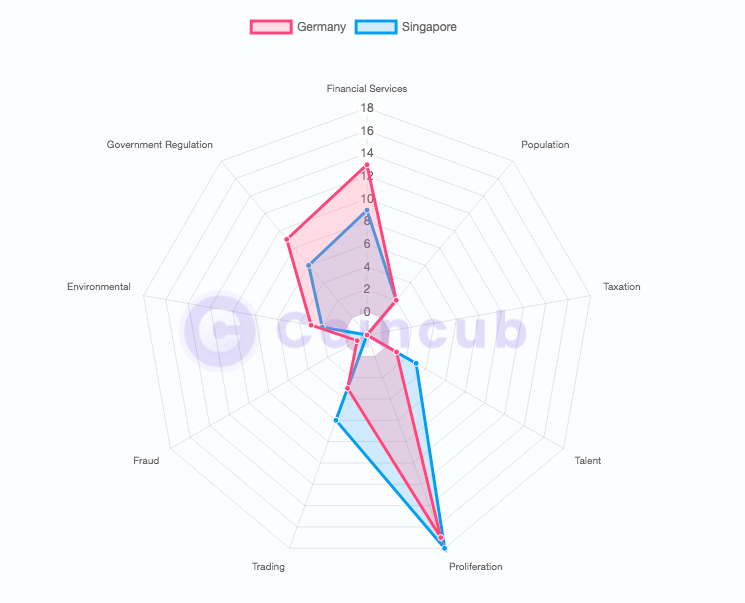
Source: Coincub With Singapore now ranked second, the United States now sits in third, followed by Australia, Switzerland and Hong Kong.
Coincub says that the United Arab Emirates (UAE) has become a new country on the list, appearing at number 22 after previously taking a hard stance against crypto with bans on trading and other activity. India has moved up to number 19, but as Coincub says, suffers from indecisive government policy.


Letture associate

Dalio Warns: AI Boom Shows Signs of a Bubble, Day of Reckoning Will Be the Time of Burst

Ray Dalio, founder of Bridgewater Associates, warns that the current artificial intelligence investment boom shows classic signs of a bubble, which he expects will eventually burst. In a Bloomberg Television interview, he noted that great technological revolutions often lead to capital inflows that create bubbles, making it difficult for investors and companies to calibrate their spending accurately—either overspending to capture market share or underspending and losing their competitive position. This caution comes amid significant rallies in AI-related assets, particularly chipmakers, driven by soaring demand for data centers and high-bandwidth chips, raising debates about overheating valuations. In contrast, Nvidia CEO Jensen Huang recently asserted that investors embracing the AI wave would see "crazy" returns and dismissed concerns over return on investment for data center spending as outdated. Dalio, however, focuses on the risks in the profit realization phase. He argues that bubbles tend to show signs of破裂 when markets transition from investment to the need for tangible returns, describing the burst as a process of converting paper wealth into cash. While acknowledging AI's intrinsic value, he expressed concern over the future profitability of some AI companies, suggesting the market is repeating a familiar pattern. The 76-year-old billionaire, who fully exited Bridgewater in 2025, has a net worth estimated at $21.5 billion according to the Bloomberg Billionaires Index.

marsbit13 min fa

Dalio Warns: AI Boom Shows Signs of a Bubble, Day of Reckoning Will Be the Time of Burst

marsbit13 min fa

Privacy Coin Crisis of Confidence! ZEC Plunges Over 56% in a Single Day

Zcash (ZEC), a leading privacy-focused cryptocurrency, experienced a severe crash on June 5th, plummeting over 56% in a single day and erasing nearly two months of gains. The flash crash was triggered by the disclosure of a critical zero-knowledge proof vulnerability within Zcash's Orchard privacy pool, which had existed since the pool's launch in May 2022. The flaw theoretically allowed an attacker to forge unlimited ZEC undetectably due to the pool's privacy features. The vulnerability was discovered on May 29th by independent security researcher Taylor Hornby during a proactive audit commissioned by Shielded Labs, utilizing AI-assisted analysis. The Zcash development team responded swiftly, implementing an emergency soft fork to disable Orchard transactions on June 2nd and executing a permanent hard fork fix (NU6.2) on June 3rd. Despite the technical fix, a major crisis of confidence emerged. The core issue is that Orchard's privacy design makes it cryptographically impossible to prove whether the vulnerability was exploited over the past four years, casting permanent doubt on the historical supply integrity of ZEC. While Shielded Labs argues exploitation was unlikely, the inability to provide definitive proof has severely damaged market trust. This sentiment was exacerbated when BitMEX co-founder Arthur Hayes, a prominent ZEC supporter, announced he was selling his entire position. He stated that privacy assets require "perfect security" rather than "probable safety." The combined effect of the disclosure and Hayes's exit ignited widespread panic selling, leading to massive liquidations and significant price decline. Analysts note the event highlights a fundamental tension within privacy coins: the conflict between verifiable supply and cryptographic privacy.

链捕手16 min fa

Privacy Coin Crisis of Confidence! ZEC Plunges Over 56% in a Single Day

链捕手16 min fa

Trading

Spot
Futures
活动图片