杀出新机遇? 争议纷纷的 Bitcoin Rollup 是什么?

MarsBitPubblicato 2023-07-12Pubblicato ultima volta 2023-07-13

Introduzione

Ordinals 协议带出的 Bitcoin NFT 热潮,正在引导 Bitcoin 生态发生新的转变,越来越多的参与者开始探讨 Bitcoin 的可扩展性问题。

.details .details-cont p, p {word-break: normal; text-align: unset} p img {text-align: center !important;} Ordinals 协议带出的 Bitcoin NFT 热潮,正在引导 Bitcoin 生态发生新的转变,越来越多的参与者开始探讨 Bitcoin 的可扩展性问题。 
在之前的文章中,我们介绍过「闪电网络」等 Bitcoin 第 2 层扩容解决方案。除上述解决方案外,在 Bitcoin 上应用 Rollup 协议提升可扩展性,也正在吸引更多的关注。
Bitcoin 的 Rollup
讲到 Rollup,通常都会联想到以太坊。
但在 2022 年 10 月,John Light 已发布了报告Validity Rollups on Bitcoin,展示了 Bitcoin 上应用 Rollup 协议的可行性规划和应用方法。
注:Validity Rollups on Bitcoin 报告可通过下方网址查阅:https://bitcoinrollups.org
Bitcoin 搭建的是相对简单的区块链架构,并希望让所有用户都可以在链上运行「节点」,在有需要或必要的时候,用户也可以轻松成为链上区块的开发者。
但是,如果一条区块链致力于要实现能让「所有」用户都轻松地运行完整节点,它一定需要设立规则限制这条链上验证区块时的计算量。
这样的矛盾,其实是去中心化与算力分布规模的矛盾。伴随 Bitcoin 的发展,这种紧张关系愈发明显,而能够缓和这种紧张关系的关键解决办法,就在于区块链可扩展性的提升。
提升可扩展性,目前关注度较高的解决方案包括通过分片、链上优化或链下设置通道解决。「闪电网络」就是在链下搭建支付通道,汇总到链上结算,通过减少交易次数实现扩展的解决方案;而应用 Rollup 协议的解决方案则是一种试图在链上放置尽可能少的数据,同时保持交易执行在链外的解决方案。
两者的区别在:「闪电网络」的大量交易数据保存在链下,但部署 Rollup 协议并不是将大量交易数据放在链下处理,它依旧是一种在链上进行数据优化的扩展解决方案。
数据

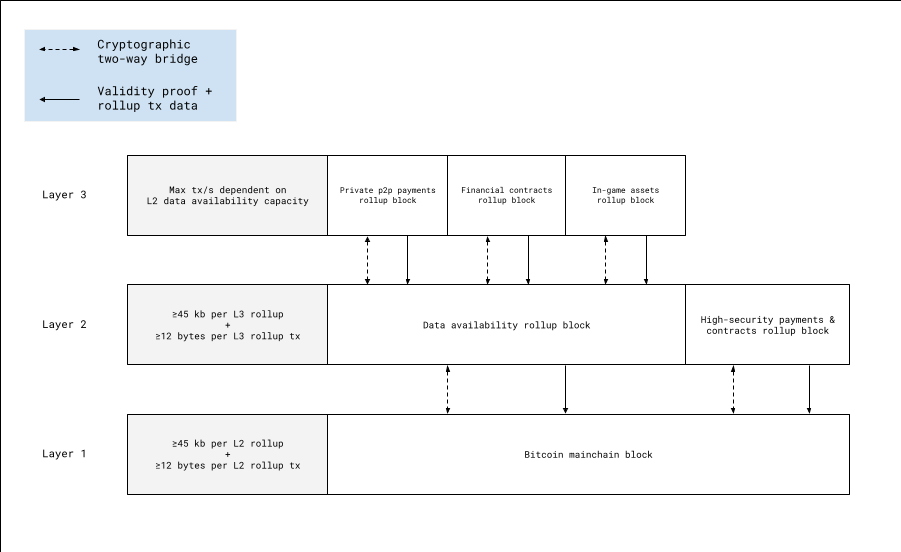
△ Bitcoin Rollup 分层展示示例图
图源/bitcoinrollups.org
上图展示了 Rollup 协议在 Bitcoin 上的分层应用:在 Bitcoin 的第 2 层有 2 个 Rollup 协议, 一个用于提供数据可用性,一个用于提供安全性支付和合约;在 Bitcoin 的第 3 层也有 3 个 Rollup 协议,也分别用于不同的用例 ,包括 P2P 支付、金融合约、游戏资产转让。
Rollup 的类型  
目前,应用在 Bitcoin 上的 Rollup 解决方案,讨论热度最高的是  Sovereign Rollup 解决方案(常译作「主权 Rollup」) ,与过去常见的经典 Rollup 协议,两者的主要区别在于如何利用主网、是否独立于主网
应用经典 Rollup 协议的解决方案,使用区块链的第 1 层(即「主网」)作为数据的可用层和结算层,相关数据不仅会存放在主网上,第 2 层相关数据也会写入到第 1 层。同时,交易由主网上的智能合约进行验证,比如以太坊上的知名 Rollup 项目 Arbitrum、Optimism 等。
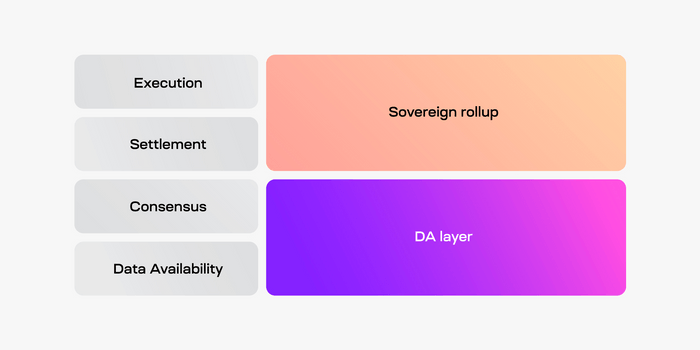
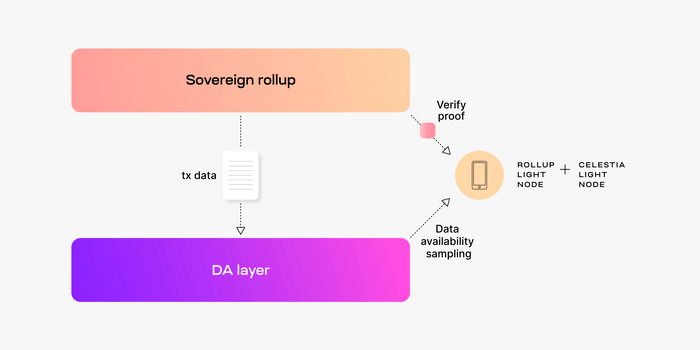
应用 Sovereign Rollup 的解决方案,仅使用区块链的第 1 层作为数据的可用层,但不使用第 1 层执行结算。存放在第 2 层的数据,不会被写入到第 1 层,有一定的独立性。同时,交易由 Sovereign Rollup 上的节点进行验证,即使用 Sovereign Rollup 所在的第 2 层进行执行结算。
数据


数据

△ Sovereign Rollup 在链上的分层结构图 & 验证逻辑展示图
图源/celestia.org
Sovereign Rollup 运作方式的价值在于:无论第 1 层主网是遭遇了黑客攻击,还是需要进行技术升级,第 2 层都不受影响;其次,第 2 层并没有丢失第 1 层的数据安全性和抗审查性——这样的运作方式,对于 Bitcoin 这条主网算力受限的区块链而言,无疑是更可取的。
了解 Rollkit   
Bitcoin 社区对 Sovereign Rollup 的关注兴起于 2023 年 3 月。
彼时,Celestia 开发的开源技术框架 Rollkit 刚刚宣布完成了一项能将 Rollup 数据直接存储在 Bitcoin 链上的研究。此后,开发人员能够使用 Rollkit 在 Bitcoin 上部署 Rollup 协议提升可扩展性,并且最大限度地降低网络操作成本。
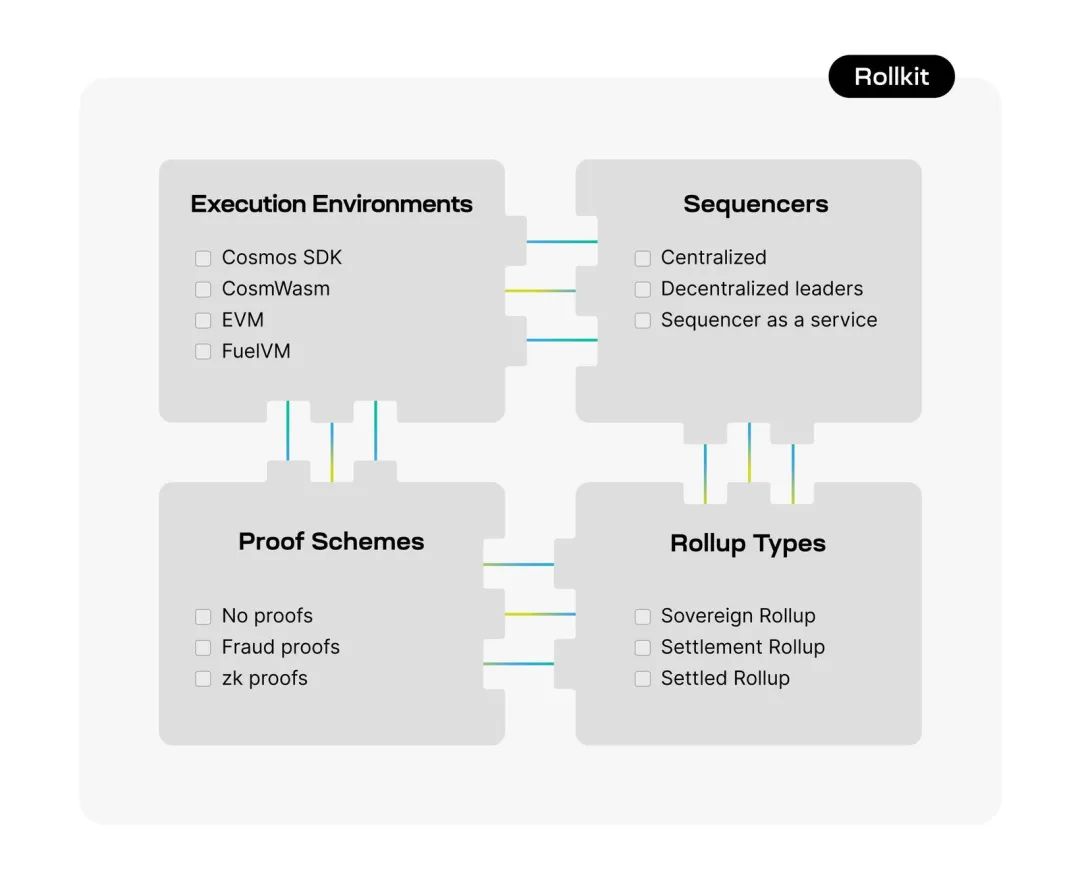
而 Rollkit 框架最大的特点之一是:可以允许开发人员自定义选择数据可用性层和执行层,同时支持开发人员进行 Sovereign Rollup 的部署。
数据

△ Rollkit 模块化开发框架
图源/rollkit.dev
应用展望 
Rollup 在以太坊上的积极应用部署,已经在逐步改变区块链用户对于以太坊上交易、数据存储、链上验证的感知。
虽然,Rollup 在 Bitcoin 上的部署尚处于起步阶段,但伴随 Rollkit 等开发工具的功能演进,也许在不久的将来,Rollup 同样会给 Bitcoin 社区带来更多值得探索的新范式。

Letture associate

A Nation Blocks Chips, a Giant Buys a Nuclear Power Plant: Why It's Time to Seriously Consider DeAI

**Title: Great Powers Blockade Chips, Giants Buy Nuclear Plants: Why It's Time to Seriously Consider DeAI** In May 2026, the US closed loopholes for Chinese firms to acquire advanced NVIDIA chips via overseas subsidiaries. That same month, Kenya halted a $1B geothermal data center project involving Microsoft, fearing its immense energy consumption. Meanwhile, Huawei announced mass production of its Ascend AI chip. These disparate events underscore a new reality: the competition for computing power ("compute") has escalated beyond the tech industry, becoming a geopolitical and infrastructural battleground. A new era of oligopoly is forming, with control over the AI stack—from GPU chips (NVIDIA) and cloud platforms (AWS, Azure, Google Cloud) to foundational models (OpenAI, Anthropic)—concentrating in a few Western "AI Octopus" corporations. This centralization creates systemic risks: pricing power and platform lock-in for users, infrastructure fragility, and a widening "compute divide" that threatens to marginalize nations without independent AI capacity. An "AI Iron Curtain" is deepening through export controls. In response, some nations like Saudi Arabia and the UAE are investing heavily to buy compute power, aiming to transition from oil to AI economies. The EU seeks to triple its compute capacity by 2030 to reduce dependency. However, the spending gap is vast, with four US tech giants alone planning ~$750B in AI capex for 2026. The race is increasingly constrained by energy, with AI tasks consuming up to 1000x more power than web searches, pushing firms to even acquire nuclear plants. This landscape is fueling interest in Decentralized AI (DeAI). It proposes a third way: using open protocols to coordinate a global network of idle GPUs, independent developers, and data centers, creating an AI infrastructure without a single controlling entity. Leveraging blockchain and cryptographic verification, DeAI aims to break market concentration, disperse energy demands, reduce geopolitical dependencies, and enhance transparency. While still nascent in performance and stability, DeAI's core promise is not immediate superiority but providing a crucial alternative architecture to resist monopoly, censorship, and centralized power. As specialized AI hardware costs fall and open-source models flourish, the window to build this foundation is open. The very existence of such competition serves as a vital check against the inevitable abuse of concentrated power.

marsbit5 min fa

A Nation Blocks Chips, a Giant Buys a Nuclear Power Plant: Why It's Time to Seriously Consider DeAI

marsbit5 min fa

Outpoll Review: A Prediction Market Platform Built for Active Traders

Outpoll Review: A Prediction Market Platform Built for Active Traders In recent years, prediction markets have grown from a niche sector to a mainstream arena, attracting billions in trading volume and institutional capital. However, the user experience and tools for traders have not kept pace. Outpoll, a new global prediction market platform, aims to fill this gap by providing enhanced trading infrastructure for active and professional traders. Built on standard prediction market principles, Outpoll allows users to trade on the outcome of specific events. It uses fully collateralized contracts with USDC settlement, charges a competitive 0.1% fee per trade, and provides clear settlement rules upfront to minimize disputes. A key focus for Outpoll is its professional-grade trading tools. The platform supports limit and market orders, as well as take-profit and stop-loss orders for open positions—features uncommon in prediction markets. For automated trading, Outpoll offers comprehensive REST and WebSocket APIs, enabling portfolio management, price arbitrage, and integration with existing tools. The platform also features a creator-led market model, where approved experts and community leaders can create and manage markets for niche topics under platform supervision. Its integrated interface combines news feeds directly with trading functions, allowing users to monitor events and manage positions seamlessly. Outpoll launched with a native Android app (available on Google Play) and plans an iOS version later this year. In summary, Outpoll distinguishes itself with trader-focused tools, practical APIs, transparent and collateralized markets, integrated news, and an expanding creator program. For active traders, its advanced order types and API access alone make it a platform worth watching. Outpoll is now globally accessible via outpoll.com and Google Play.

marsbit13 min fa

Outpoll Review: A Prediction Market Platform Built for Active Traders

marsbit13 min fa

Bitwise: Crypto Becomes a Contrarian Investment, Three Logics to Understand the Current Market

**Summary** Matt Hougan, Bitwise's CIO, analyzes the current crypto market through three key lenses, arguing it has shifted from a momentum-driven to a contrarian investment. **1) Crypto Becomes a Contrarian Play:** The market is weak, with major assets like Bitcoin and Ethereum down significantly. Capital has moved to hot sectors like AI, leaving crypto as an "unloved" asset class. This transforms crypto investing from trend-following to a test of patience and fundamental analysis. Investors now favor projects with solid fundamentals (e.g., Hyperliquid) over speculative ones. **2) Regulatory Overhang:** The uncertain fate of the U.S. CLARITY Act, a major crypto regulatory framework, is a key headwind. With its passage in 2024 seen as far from guaranteed (estimates range from 30-55%), institutional capital remains on the sidelines, choosing less risky alternatives like AI stocks. The market needs clarity—whether the bill passes or fails—more than any specific outcome to move decisively. **3) Capital Rotates to New Fundamentals:** This cycle differs from past bear markets where money fled to Bitcoin. Now, capital seeks smaller assets with strong use cases. While major cryptos fell in May 2024, tokens like Hyperliquid (+72%), Zcash (+50%), and XLM (+44%) rallied on their specific fundamentals. This rotation confirms the new contrarian, fundamentals-driven logic and signals the bear market may be in its later stages. **Conclusion:** Short-term pressure persists due to regulatory uncertainty and competition from AI narratives. Investing in crypto now requires a contrarian mindset—acting against the crowd and focusing on fundamental value. Patience and targeting high-quality projects based on their merits are essential for capturing long-term gains.

marsbit56 min fa

Bitwise: Crypto Becomes a Contrarian Investment, Three Logics to Understand the Current Market

marsbit56 min fa

ChatGPT Might Be Disappearing Soon

OpenAI announced at its "Intelligence at Work" event that its coding assistant, Codex, will be fully integrated into the ChatGPT app within weeks. This move marks a strategic shift from a conversational AI (Chat) towards a unified "agentic" platform capable of execution. Codex, originally launched to compete with Anthropic's Claude Code, has grown rapidly to 5 million weekly active users, with 20% being non-developers like analysts and designers. Its enterprise revenue now constitutes 40% of OpenAI's total. The integration is the first step in creating a super-app combining ChatGPT (interface), Codex (execution engine), and the Atlas browser (web access). OpenAI also unveiled new Codex features: specialized Agent plugins for six professional roles, an "Annotations" tool for direct document editing, and a "Sites" function to turn work into shareable web apps. Internally, this reflects a power shift; the Codex team now leads core product strategy. While the ChatGPT brand remains for its vast user base, the platform's future is focused on autonomous agents that perform tasks, not just chat. The article notes that competition with Claude Code pushed OpenAI's development, with Codex competing on cost-effectiveness and accessibility rather than raw coding quality. It concludes that the essence of "ChatGPT" is evolving from a chatbot into an AI agent platform, with the name potentially becoming a legacy symbol of its original function.

marsbit1 h fa

ChatGPT Might Be Disappearing Soon

marsbit1 h fa

Trading

Spot
Futures
活动图片