Analyst PlanB Says One Signal Suggests ‘Accelerated’ Bull Market Ahead for Bitcoin (BTC)

dailyhodlPubblicato 2023-06-27Pubblicato ultima volta 2023-06-27

Introduzione

Quant analyst PlanB says there's an indicator suggesting that Bitcoin (BTC) is ready for an...

Quant analyst PlanB says there’s an indicator suggesting that Bitcoin (BTC) is ready for an accelerated bull market.
In a new strategy session on YouTube, PlanB tells his 51,600 subscribers that Bitcoin’s realized cost price, which is the average value of BTC supply calculated at the price at which coins were last moved, is signaling that a more pronounced bull market is likely underway.

PlanB says price moving above the two-year realized cost price has historically suggested big moves to the upside.
The important thing that we see is that the Bitcoin price, the red dots, crossed over the two-year realized cost price, and it already crossed the realized cost price, and it already crossed the five-month, short-term cost price. So now, it’s a new thing… It crossed the two-year realized price, and that’s an important signal. Of course, the month is not over, so we’ll wait and see how [June] closes.”
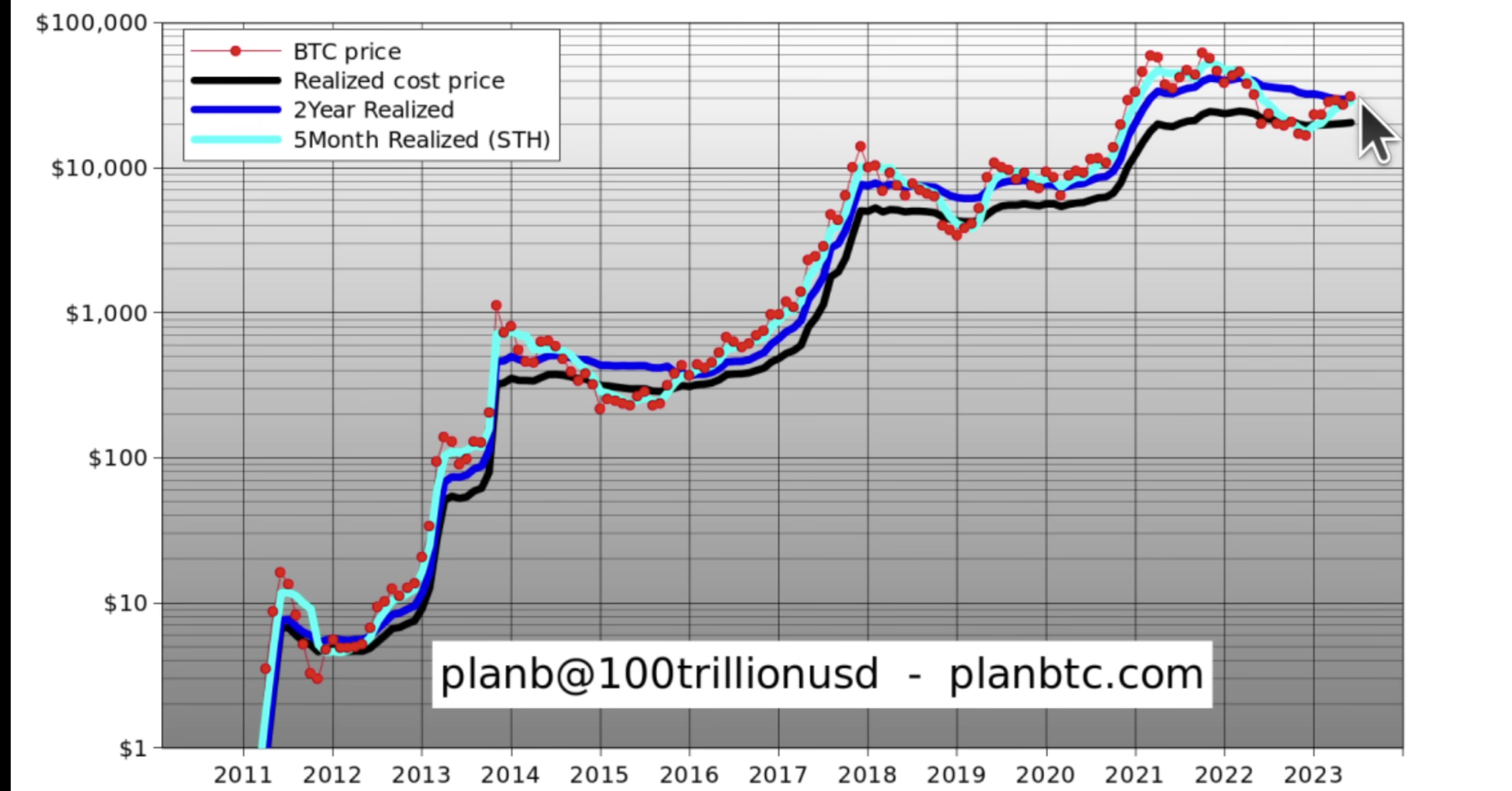
Source: PlanB/YouTube PlanB also notes that the realized cost price readings are all moving up together after years of remaining stagnant.
“In history, closing above the two-year realized price was a signal that the bull market [was about to] accelerate. Same here in 2016 and 2019 was a bit of a weird year with the Covid black swan…
So it’s very interesting and one more thing that is also very interesting, the realized price, the black line, and the two-year realized price, the blue line, started to increase again since a long time. I think it declined for about a year, and now for the first month, it’s increasing again, and that’s when things become really interesting, so we’ll have to see what Bitcoin will do.”
At time of writing, Bitcoin is trading for $30,183.

I


Letture associate

6 Questions to Understand the Business Trends of AI

The AI industry has entered its "summer" phase, according to a six-dimensional scoring framework assessing its development cycle. Each dimension—narrative vs. delivery, system connectivity, delivery capability, ROI rationalization, common industry trends, and capital environment—scores 1 point, totaling 6 points. This places the industry firmly in summer (5-7 points), characterized by a coexistence of grand promises and tangible deliverables, with increasing pressure to demonstrate value and profitability. Key signals mark this shift. ByteDance's Doubao launched paid subscriptions, while OpenAI introduced an advertising platform. These moves are driven by dual forces: immense cost pressures from scaling user bases and massive compute requirements, and the maturation of commercial opportunities. Major players like Anthropic report explosive growth, highlighting AI's transition into core productivity infrastructure. For businesses, the path forward involves three strategic steps. First, identify a small, high-impact use case to quickly demonstrate a closed-loop value proposition, such as automating customer service or content generation. Second, systematically replicate successful pilots across the organization by standardizing processes, building shared AI capabilities, and aligning talent, incentives, and leadership. Finally, move beyond simply adding AI to existing workflows and undertake systemic reconstruction—redesigning processes for parallel AI-human collaboration, implementing real-time dashboards, and establishing automated trigger chains. The era where storytelling alone secured funding is over. The focus has shifted to delivering measurable efficiency gains, cost savings, and new revenue streams, as evidenced by real-world implementations in companies like Semir, Anta, and Midea. Success now depends on starting with a focused proof point, scaling it organization-wide, and ultimately allowing AI to redefine operational paradigms.

marsbit5 h fa

6 Questions to Understand the Business Trends of AI

marsbit5 h fa

US Government Lifts Ban on Crypto Perpetual Contracts for the First Time: What Does It Mean for the Market?

The U.S. Commodity Futures Trading Commission (CFTC) has issued guidance permitting 24/7 trading and clearing for crypto asset derivatives, effectively opening the U.S. market to crypto perpetual contracts for the first time. This move ends the previous ban and allows American individuals and institutions to trade these instruments around the clock. Direct beneficiaries include Kalshi, which received approval to list a Bitcoin perpetual contract; Coinbase, now the first CFTC-regulated futures commission merchant for U.S. clients to access global crypto derivatives; and CME, which will transition its Bitcoin futures and options to 24/7 trading. The CFTC emphasized this is a specific allowance for crypto assets, noting that traditional commodities like agriculture may not be suitable for non-stop trading. It also requires platforms to undergo case-by-case reviews for compliance and risk management. Industry leaders like Michael Saylor and Brian Armstrong praised the decision for integrating Bitcoin into capital markets and granting U.S. users access to a major global market segment. However, consumer advocacy group Better Markets criticized the CFTC for allegedly neglecting investor protection and favoring the industry it regulates. Other platforms like Kraken have announced plans to launch regulated perpetual futures for the U.S. market. The policy shift is expected to redirect significant liquidity and institutional participation to the newly accessible U.S. crypto derivatives landscape.

Odaily星球日报16 h fa

US Government Lifts Ban on Crypto Perpetual Contracts for the First Time: What Does It Mean for the Market?

Odaily星球日报16 h fa

Trading

Spot
Futures
活动图片