Are You Missing Out? 6 Highlights From CoinGecko’s Q1 Crypto Report

newsbtcPubblicato 2023-04-19Pubblicato ultima volta 2023-04-19

Introduzione

The first quarter of 2023 has been significant for the crypto industry, with the market making a strong comeback after a turbulent end of 2022. According to Coingecko's first-quarter report,...

The first quarter of 2023 has been significant for the crypto industry, with the market making a strong comeback after a turbulent end of 2022. According to Coingecko’s first-quarter report, the crypto market has outperformed traditional assets, with Bitcoin leading the charge. 
Crypto – The Best Performing Sector Of The Global Economy
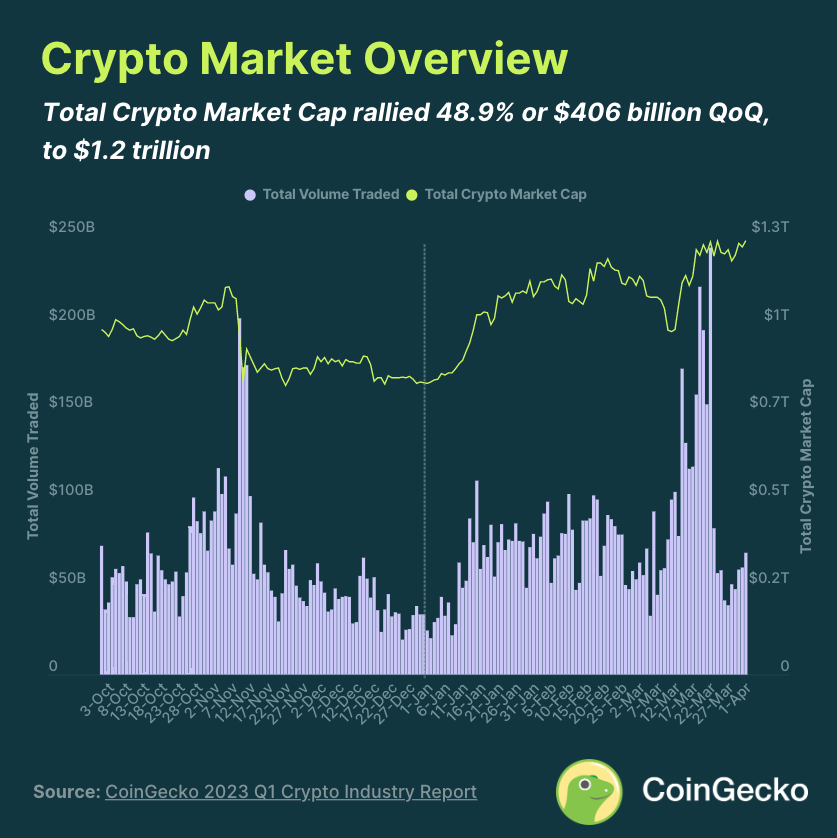
The first quarter of 2023 has been an exciting time for the cryptocurrency market, as it started strong with a 48.9% gain in the overall market cap. According to the Coingecko report, the total market capitalization of cryptocurrencies increased from $800 billion to $1.2 trillion in just three months, showing a remarkable recovery from the 2022 turbulence.
Crypto

Total crypto market cap increase. Source: Coingecko Along with the growth in market cap, the Coingecko report also highlights the increase in average daily trading volume, which rose by 30% quarter-over-quarter. The report notes that the trading volume peaked in early March, coinciding with the banking crisis that saw several banks collapse due to insolvency. 
On the same note, Bitcoin, the largest cryptocurrency by market capitalization, has outperformed traditional assets like gold and the S&P 500, with a gain of over 70% during Q1 2023. The report attributes this success to several factors, including the increasing acceptance of Bitcoin as a legitimate investment asset and its growing adoption by institutions and retail investors.
Another report highlight is the resurgence of non-fungible tokens (NFTs), which saw a significant increase in trading volume during Q1 2023. NFTs are unique digital assets verified on a blockchain, making them unique and valuable. The report suggests that the resurgence in NFT trading volume results from increased interest and adoption of decentralized applications (dApps) and gaming.
The Coingecko report also notes the growing popularity of decentralized finance (DeFi) protocols, which have seen a surge in adoption and usage during Q1 2023, fueled by liquid staking, which led to a rise of 65% for the DeFi market. 
eFi protocols are built on blockchain technology and offer users a decentralized alternative to traditional financial services. The report suggests that the growth of DeFi is due to the increasing demand for decentralized services and the potential for high returns.
Increased Demand For Stablecoins And DEXs
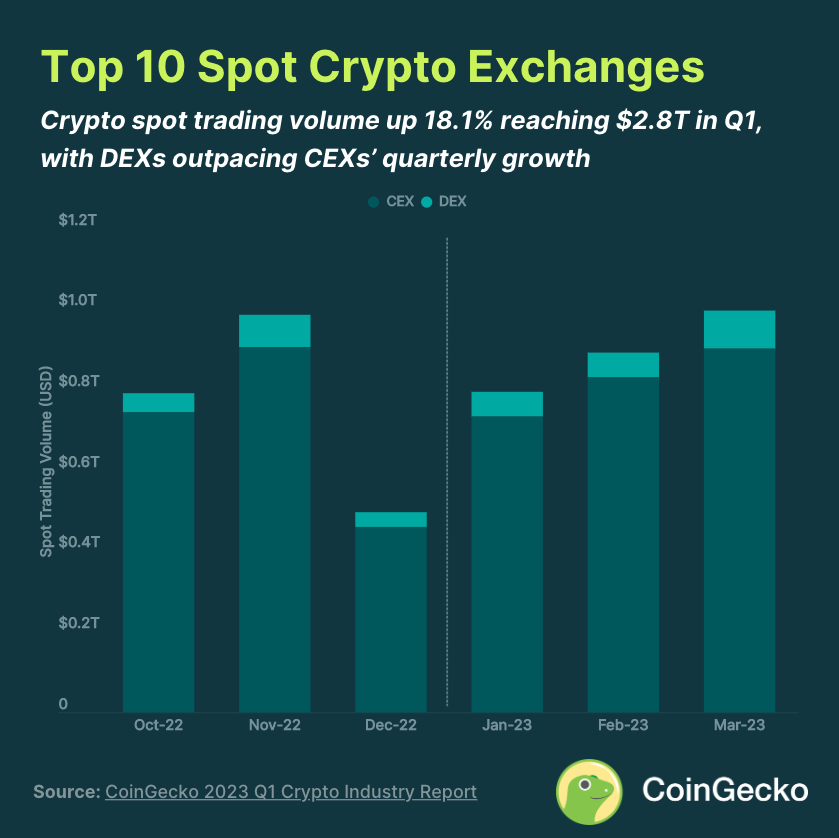
The first quarter of 2023 has seen a surge in crypto spot trading volume, with an 18.1% increase compared to the previous quarter. According to Coingecko, the total spot trading volume reached $2.8 trillion, a significant increase from the previous quarter’s volume.
Interestingly, the report notes that decentralized exchanges (DEXs) outpaced centralized exchanges (CEXs) in growth, with DEXs experiencing a larger increase in trading volume than their centralized counterparts. This trend indicates the growing popularity of DeFi protocols, which offer users a more decentralized and transparent alternative to traditional financial services.

crypto

Top 10 spot crypto exchanges. Source: Coingecko Despite the increase in trading volume, the report notes that the monthly trading volume has yet to reach the heights of the first half of 2022, where the average monthly trading volume exceeded $1 trillion. However, the report suggests that this is likely due to the market correction and turbulence that occurred in the latter half of 2022, which decreased trading activity.
Furthermore, The first quarter of 2023 has seen a shakeup in the stablecoin market, as the top 15 stablecoins shed $6.2 billion in market capitalization. According to Coingecko, stablecoins such as USDC and BUSD experienced the largest declines in market cap, while Tether (USDT) gained dominance with a 20.5% increase in market cap.
Overall, the Coingecko Q1 Crypto Industry Report paints a positive picture of the cryptocurrency market, with a strong market cap and trading volume gains.  As the industry continues to grow and evolve, it will be interesting to see how these trends develop and what new opportunities and challenges arise.
Related Reading: Bitcoin Supply Structure Very Similar To Early 2019, Bull Run Ahead?

crypto

BTC is consolidating above $30,000 on the 1-day chart. Source: BTCUSDT on TradingView.com Featured image from Unsplash, chart from TradingView.com
T


Letture associate

First Long-Horizon Doc2Repo Training Dataset: Code Agents Move Beyond Bug Fixing and Begin Creating Repositories

With the advancement of LLM Code Agents, the research focus is shifting towards long-horizon, real-world tasks, moving beyond simple bug fixes to full repository generation. To address this, researchers from Renmin University of China introduced the DeNovoSWE dataset. This dataset focuses on long-term software engineering tasks, specifically the "document-to-repository" challenge—generating an entire, executable code repository from a task description. The DeNovoSWE construction method employs a Divide & Conquer approach. It breaks down target repositories into core capabilities and uses a multi-agent Draft-Critic-Repair workflow to automatically generate high-quality, evaluation-aligned task documents. The dataset also implements difficulty-aware filtering to balance quality and diversity. The result is a high-quality, anti-leakage dataset of 4,818 instances. Experiments show that models trained on DeNovoSWE achieve significant improvements in long-horizon repository generation. For instance, Qwen3-30B-A3B-Instruct's performance on the BeyondSWE-Doc2Repo benchmark increased from 5.8% to 47.2%, and on NL2RepoBench from 4.3% to 23.0%. Similar gains were observed with stronger backbones, demonstrating that dedicated long-horizon training data is crucial for advancing Code Agents from maintainers to architects capable of planning and building complete software projects from scratch.

marsbit16 min fa

First Long-Horizon Doc2Repo Training Dataset: Code Agents Move Beyond Bug Fixing and Begin Creating Repositories

marsbit16 min fa

Even CZ Praised Hyperliquid as 'Awesome', But Its Biggest Moat Might Also Be Its Biggest Risk

In an episode of Galaxy Brains, Binance founder CZ praised Hyperliquid as "awesome" but clarified that while its product is strong, Binance cannot compete in its specific niche due to Hyperliquid's no-KYC, decentralized model. CZ noted he would not personally operate such a model, highlighting the inherent legal and compliance risks tied to its access advantage. The discussion underscores a core market structure conflict: on-chain perp platforms like Hyperliquid thrive on open, low-barrier access, which regulated exchanges like Binance cannot replicate without abandoning their global compliance posture. However, this very advantage makes Hyperliquid a clear target for regulatory scrutiny. The UK FCA has already issued a warning against Hyperliquid for potentially offering unauthorized services to UK users, framing it as a financial services provider rather than neutral infrastructure. Historical cases like the CFTC's action against bZeroX and Ooki DAO further illustrate that regulators may pursue decentralized structures if they facilitate leveraged trading for retail users without proper controls. Meanwhile, regulated venues like Cboe are developing US-compliant "continuous futures" that mimic perpetual exposure, narrowing the product gap. Hyperliquid's long-term edge may increasingly hinge on its access model—the very feature most exposed to regulatory pressure. The key question is whether its "access premium" can withstand escalating legal challenges as on-chain perps gain mainstream attention.

marsbit34 min fa

Even CZ Praised Hyperliquid as 'Awesome', But Its Biggest Moat Might Also Be Its Biggest Risk

marsbit34 min fa

A Hard-Fought Battle to Defend Par Value: STRC Drifts Further Away from $100

STRC, the dividend-paying stock issued by Michael Saylor's bitcoin reserve firm Strategy (formerly MicroStrategy), is trading far below its intended $100 par value, closing recently at $80.84. With a key dividend snapshot date approaching, Saylor aims to pull the price back to $100, as per SEC filings stating the company's goal to stabilize the stock near that level. The situation is complicated by the June volume-weighted average price (VWAP) falling below $95, triggering an internal rule that mandates the next dividend increase to be at least double the standard 0.25% per cycle, potentially pushing the annualized dividend yield to 12%. However, attracting buyers with this higher yield faces challenges: the payout is spread over 24 bi-monthly installments, the board can alter or suspend dividends at any time, and there is no guarantee against further price declines. Beyond raising dividends, Strategy has limited tools to boost the stock. These include direct share buybacks (never utilized), halting new share issuances above $100 (which currently cap the price), selling ordinary MSTR shares to build a cash buffer for dividends (with limited effect so far), or announcing special shareholder benefits. Historically, STRC has reclaimed the $100 mark, such as in October last year, driven by a combination of dividend fulfillment, a rate hike, and a pause in share sales. The core question remains how much cost and effort Strategy is willing to bear to attract the necessary buying pressure to restore the $100 par value.

Foresight News1 h fa

A Hard-Fought Battle to Defend Par Value: STRC Drifts Further Away from $100

Foresight News1 h fa

Fable 5 is about to make a comeback, code exposed? Anthropic CEO kicked out of the White House

Fable 5, a previously restricted AI model from Anthropic, appears poised for a comeback. Evidence from leaked code in the Claude Code v2.1.190 version suggests a shift in its business model from a separate purchase to a potentially limited weekly usage allowance within standard Claude subscriptions. Furthermore, the model has reportedly reappeared in Amazon Bedrock documentation. This potential revival coincides with significant internal changes at Anthropic. According to a report by The Wired, CEO Dario Amodei was reportedly sidelined from negotiations with the Trump administration over Fable 5's export restrictions. Government officials found him difficult to communicate with. Co-founder Tom Brown and policy head Sarah Heck took over discussions, leading to more productive technical talks aimed at addressing White House security concerns about the model being "jailbroken." External pressure is mounting as a bipartisan group of US lawmakers has demanded answers from the Commerce Department by a June 26 deadline regarding the criteria and timeline for potentially reinstating public access to Fable 5. The potential return of Fable 5 comes as competitors OpenAI and Google have reportedly delayed their own major model releases. If Anthropic successfully navigates the government's security review, Fable 5 could gain a significant "safety-certified" advantage in the enterprise market. The countdown to the June 26 deadline is now underway.

marsbit1 h fa

Fable 5 is about to make a comeback, code exposed? Anthropic CEO kicked out of the White House

marsbit1 h fa

Trading

Spot
Futures
活动图片