When Bitcoin plunged from around $30,000 to below $20,000 in little more than a week last year, Three Arrows Capital co-founder Su Zhu described the tailspin as the “nail in the coffin” for his hedge fund.
Fast forward to today, and the largest cryptocurrency has just retraced that path from $20,000 back to $30,000 in the past month — but the industry is a shadow of what it was the last time the token crossed that milestone. That’s because several more caskets were hammered shut in the domino-like wave of bankruptcies that followed Three Arrows’ collapse: Voyager Digital, Celsius, FTX, Blockfi, Genesis Global, and other formerly high-flying startups.
It’s clear that while the mood has improved compared with last year’s apocalyptic vibe, the promising Bitcoin rebound alone won’t be enough to fix all of the damage from last year’s scandal-filled downturn.
“The sentiment here doesn’t seem like the last few weeks mean that we can pretend that the last 10 months never happened,” said Oliver Linch, the chief executive officer of the trading platform Bittrex Global, speaking on the sidelines of a crypto conference in Paris. “But there is certainly a feeling that maybe this signals that a line can be drawn under those scandals and we can get back to assessing – and valuing – crypto without all the noise from the rumors and wrongdoing.”
That alleged wrongdoing has drawn a deluge of regulatory scrutiny and high-profile enforcement actions in the US.
Among the most prominent: FTX’s Sam Bankman-Fried is awaiting trial on fraud charges; Do Kwon, co-founder of the Terra blockchain, is facing prosecution for his role in that project’s collapse; Binance and its CEO Changpeng “CZ” Zhao have been sued by the Commodity Futures Trading Commission for a variety of alleged violations; and Coinbase Global Inc. has received notice that the Securities and Exchange Commission intends to sue the company. Binance and Coinbase have denied any wrongdoing; Bankman-Fried has pleaded not guilty.

Sam Bankman-Fried arrives at court in New York, US, on Thursday, March 30, 2023. Photographer: Angus Mordant/Bloomberg
Then there is the recent failure of the crypto-friendly banks Silvergate Capital Corp., Signature Bank and Silicon Valley Bank. While often cited as a bullish catalyst for Bitcoin, since they revived its origin story as an alternative to untrustworthy banks, the downfall of those lenders also severed key links to the US financial system, helping to make the once-promising future of the crypto industry as uncertain as ever.
Many of the retail investors burned by last year’s plunge in prices appear to be licking their wounds, rather than taking on new risk, because the amount of money involved in decentralized finance projects remains subdued. While the total value of coins locked into DeFi projects is up more than 25% since the beginning of January, at about $50 billion it is still a fraction of the $180 billion peak reached in December 2021, according to the DeFiLlama website.
At the same time, thousands of jobs have been lost in the industry and hiring has not picked back up. In a sign of supply for talent still outstripping demand, blockchain project Concordium received more than than 350 applications for a couple of recent job openings, said its co-founder and chairman Lars Seier Christensen. "The space is maturing a bit, realizing that the money tree available a couple of years ago has withered a bit," he said.
Investments from venture-capital firms have slowed dramatically. Private funding for crypto startups globally fell to $2.4 billion in the first quarter, an 80% decline from its all-time high of $12.3 billion during the same period last year, according to PitchBook.
Global Crypto VC Funding Plummets
Venture capitalists continue to pull back from crypto startups in the wake of last year's string of blowups, including FTX
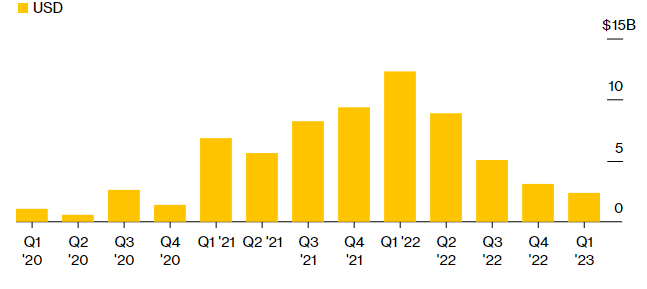
Source: PitchBook
“A lot of the industry is still in wait-and-see mode,” said Matteo Dante Perruccio, international president at crypto wealth manager Wave Digital Assets. “There has been a flight to quality and the beneficiaries are those companies that weren’t hit by the crypto winter.”
Another way this move higher is different: The eye-popping 83% rally in Bitcoin this year has not been matched by newer coins. Ether, which greatly outperformed Bitcoin from 2020 and 2021, is up 71% this year. The Bloomberg Galaxy DeFi Index that tracks the largest decentralized-finance protocols has recoupled only about one-tenth of last year’s 2,000-point drop.
Horse Race
Ether has rallied this year, but not as much as Bitcoin has
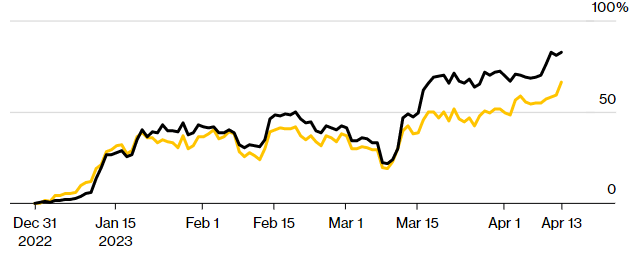
Source: Bloomberg
“We could be seeing a case of seller exhaustion combined with a renewed bullish narrative following the banking crisis, all mixed with generally low liquidity that has helped BTC’s price toward the upside,” said Clara Medalie, director of research at market-data provider Kaiko.
Despite all of the gloom and uncertainty, progress in the evolution of the industry has continued. Ethereum this week completed what appears to be a successful upgrade to its network. The so-called Shanghai update, which enables investors to withdraw Ether coins that they had locked up in exchange for rewards as part of a “proof-of-stake” system to safeguard the network, could lure billions of dollars into Ether even after SEC Chair Gary Gensler indicated he believes that token ought to be regulated as a security. The price of Ether rose back above $2,000 this week for the first time in six months.
"I don't think there's the mania or gusto we saw at $30k or $40k, but there is still, behind the scenes, quiet progress," said Simon Taylor, head of strategy at Sardine, a fraud prevention startup whose clients include fintech and crypto companies.
The macro picture has also changed, potentially for the better. A year ago, the Federal Reserve and other central banks were only beginning what would become a series of interest-rate hikes that reversed a years-long policy of easy money. With the end of that tightening cycle now closer at hand, the conditions may once again be ripe for a crypto boost.
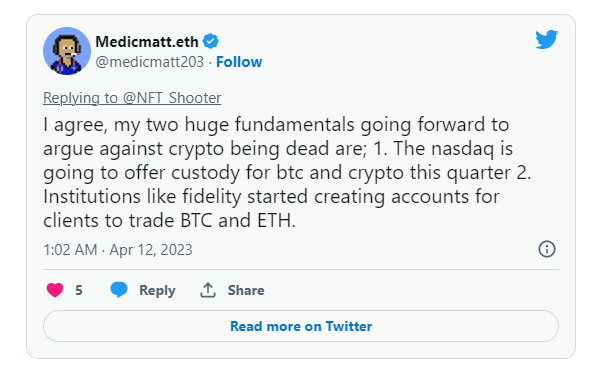
One big question is how enthusiastic traditional financial institutions will be going forward, and whether they’ll be willing to step in to fill the roles once played by failed crypto startups like FTX. There are some indications that could be happening. Nasdaq Inc., for example, expects its custody services for digital assets to launch by the end of the second quarter.
Over the long haul, as much as $5 trillion may transition into new forms of money, such as central bank digital currencies and stablecoins, by 2030, according to a Citigroup research study. Another $5 trillion worth of traditional financial assets could be tokenized, helping drive mass adoption of blockchain technologies, according to the report.
Even so, for Michael Purves, the chief executive officer of Tallbacken Capital Advisors, the “‘show me’ threshold” will be higher this time around for institutional investors, considering the role crypto is meant to play in a portfolio is a moving target. Once touted as a hedge against inflation — like an Internet-age gold — it instead tumbled during the worst consumer-price surge since the 1980s.
“Institutions started to take Bitcoin seriously after Bitcoin broke $20,000 in 2020 and played a key role in the subsequent rally to $69,000,” he wrote in a recent note to clients. “However, this time around, its longer-term history of not providing portfolio diversification will weigh heavily on institutions, which probably have bigger headaches to worry about.”
— With assistance by Hannah Miller