获得辉瑞投资的VitaDAO能否开启去中心化科学新叙事?

吴说区块链Pubblicato 2023-02-01Pubblicato ultima volta 2023-02-01

Introduzione

本文将以 VitaDAO 为例从生物科技领域出发,简析 DeSci 领域。

1 月 30 日,DeSci 赛道长寿初创公司 VitaDAO 宣布完成了融资 410 万美元,融资方包括 Coinbase 的前首席技术官 Balaji Srinivasan、全球最大的药企辉瑞的投资部门 Pfizer Ventures,这也是辉瑞在 Web3 领域的首笔投资。VitaDAO 将会利用这笔资金进一步资助长寿研究项目和将于明年从 DAO 中剥离出来的生物技术初创公司。受该消息影响,VitaDAO 治理 Token VITA 在短时间内上涨 60%。

“”

DeSci(Decentralized Science)是一项旨在建立公共基础设施以使用 Web3(包括 NFT、智能合约和 DAO 在内的工具)公平公正地资助、创建、审查、记入、存储和传播科学知识的行动。尽管人类在最近两百年经历了一波指数级别的科技发展,但在现实中还有各种资金、信息获取壁垒,科技与 Web3 的结合或是解决痛点的途径之一。以太坊创始人 Vitalik Buterin 也曾在一次关于去中心化科学的节目中谈到了利用二次方融资以及类似于 VitaDAO 等 DAO 工具来资助和组织科学项目。本文将以 VitaDAO 为例从生物科技领域出发,简析 DeSci 领域。
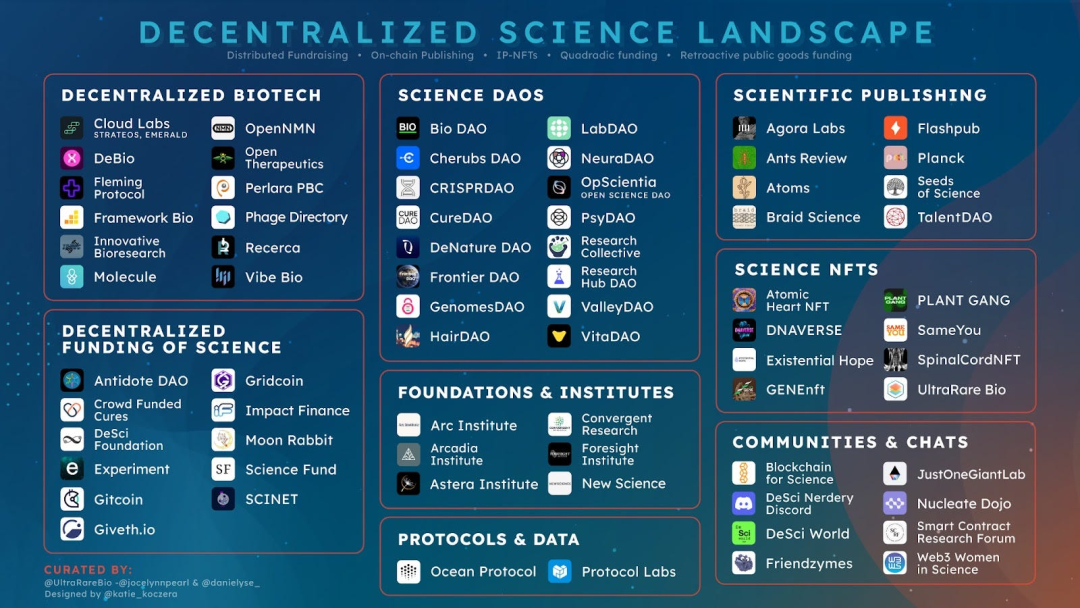
融资

“”

长期以来,许多生物科技组织只能通过股权融资、银行贷款、政府资助等传统渠道进行融资,但由于大部分生物科技初创公司或组织的研发程序繁琐,即使该组织最终取得成功也需要比较长的周期。如果在经济繁荣情景下,融资机构会保持足够的耐心,甚至大胆向一些只有概念无产品的初创公司大胆投资,但在过去一年美联储加息抑制货币流动性的背景下,热钱会流出这些高风险的初创公司。“木头姐” Cathie Wood 的生物科技基金 ARKG 在 2022 年糟糕的表现进一步佐证了资本对科学发展的限制,许多该领域公司唯有通过裁员、减少开发成本等手段减少支出以存活下来,但同时也会拖累了行业的发展。

“”

VitaDAO 在过去一年的时间里资助超过 15 个研究衰老疾病的项目总金额超过 350 万美元以上,而这些生物技术公司或组织在 Web3 领域尝试进行融资可以说是一项巨大革新。一方面可以体现在融资渠道的改变,初创公司通过 DAO 组织获得 Token 持有者大多数投票便可以获得融资。VitaDAO 通过传统的股权方式或通过发行并出售旨在代表知识产权的 NFT 为初创公司提供资金。作为对研究资金的回报,DAO 成员成为研究产生的知识产权的共同所有者。另一方面则是改善冷门项目研究状况,一改过去只能由机构的资本决定研究方向,更加偏向资助研发周期短或影响力大的项目,让一些冷门但可能是颠覆性的方向研发受阻的状况将会有所改善。
”“

信息交流

”“

当今科学信息输出或获取受限很大程度可以归根于企业、政府垄断信息数据,类似于知网、爱思唯尔付费门槛阻断人们的访问,而政府则有可能对科学信息进行政治干预,挫伤人们获取或输出知识的热情。

”“

去中心化模式不仅降低了组织的准入门槛,也降低个人输出或获取专业信息的难度,帮助消除信息孤岛。首先,DeSci 的出现可以帮助消除科研研究者和评审人之间的中间商,使知识传播更具有包容性。当信息不再具有垄断性时,不仅相关领域的专业人士受益,甚至没学习过相关领域知识的业余人士也可以获得信息,进一步促进了知识平权。其次,社区激励也会助推信息积极输出,VitaDAO 对于贡献数据或专业知识的研究人员和工作组,不仅会给予一定的 VITA Token 激励,还会提供额外的治理权限。此外,利用区块链的抗审查特性、去中心化存储技术,使科学家或特定的社区可以真正的拥有科学数据。

”“

过去我们只能看到 DeSci 更多出现在学术研究和出版领域,而 VitaDAO 与 Mantis Photonics 进行临床实验、获得哥本哈根大学的 Morten Scheibye-Knudsen 实验室和纽卡斯尔大学的 Victor Korolchuk 实验室的新数据等拓宽了 DeSci 的应用场景,使 DeSci 发展进入下一个阶段。随着 VitaDAO 、Antidote DAO、Dynamiculture 这些 DeSci 组织的规模壮大,未来我们不仅能看到场景进一步延伸,更有有机会看到跨国界、跨学界的合作项目。类似于能让全球受益的 Covid-19 疫苗,但被受困于种种因素的不能共享的项目也许在未来会有所突破。

”“

问题

”“

需要明确的是,DeSci 仍然处于初期阶段,该领域仍然存在“DeSci 最终会为谁的利益服务?”“DeSci 是否缺乏一套明确的共同价值观?”等普遍性问题。而这些问题中最需要深虑的是,人们构建 DeSci 最终目的是什么?正如认知神经科学家 Sarah Hamburg 所言,DeSci 只是为科学提供的工具,让科学家无缝集成到日常工作中。DeSci 应该专注于赋予科学家做好科学研究的能力,回归科学,而不是让人们过分关注这些新工具本身,让这些工具沦为被利用的炒作的金融产品。


Letture associate

Peeking Through Windows, Precision Hijacking? Two Giants of Prediction Markets Engage in Corporate Espionage

Polymarket, a prediction market platform, is investigating a suspected corporate espionage case involving its main rival, Kalshi. Polymarket accuses Kalshi of stealing business information and copying product launches through potentially illicit means, compiling a "plagiarism file" documenting over a dozen suspiciously coincidental product releases and marketing campaigns. Key incidents include a February 2026 free-grocery pop-up event, where Kalshi launched an almost identical campaign just nine days before Polymarket's scheduled launch, seemingly to siphon attention. Furthermore, an article leaked Kalshi's plans for a perpetual futures trading product merely an hour before Polymarket's own planned announcement for a similar tool in April 2026. Polymarket executives suspect either an internal mole or physical surveillance, noting that the office of Paradigm—a Kalshi investor—directly faces their Manhattan workspace, leading them to install dark window film. Both Paradigm and Kalshi have dismissed the allegations as baseless and ridiculous. Kalshi claims its product developments are independent and coincidental timing is merely market-driven. The rivalry intensifies as both companies secure significant funding, with Polymarket seeking a $15 billion valuation and Kalshi valued at $22 billion amid growing regulatory scrutiny of the prediction market industry.

foresightnews_api7 min fa

Peeking Through Windows, Precision Hijacking? Two Giants of Prediction Markets Engage in Corporate Espionage

foresightnews_api7 min fa

Hyperliquid, Wall Street's All-Day Trading Convenience Store

**Hyperliquid: Wall Street's 24/7 Trading Convenience Store** Written by Vicky Ge Huang, Wall Street Journal. Hyperliquid, a decentralized crypto trading platform, has become a go-to venue for Wall Street traders, especially during weekends when traditional U.S. markets are closed. Operating 24/7, it allows traders to pre-position or close trades ahead of market opens, capitalizing on events like geopolitical news. The platform, founded by former Hudson River Trading quant Jeff Yan, offers perpetual contracts on a wide range of assets, including Bitcoin, the S&P 500, oil, and even pre-IPO companies like SpaceX. Its growth exemplifies the merging of traditional finance and crypto markets, attracting significant volume from professional traders seeking leverage and constant access. A key differentiator, according to Yan, is user self-custody of assets—a necessity highlighted by the FTX collapse. Despite U.S. regulatory restrictions, some American users reportedly access the platform via VPN, drawn by its ease of use, lack of stringent KYC, and strong community culture on platforms like Discord and X. The platform is not without risks. Perpetual contracts are complex and highly leveraged, leading to massive liquidations during market volatility. Hyperliquid itself saw $10 billion in liquidations during a market crash in October last year. Regulatory warnings emphasize insufficient risk disclosure for retail investors. With about 11 employees, Hyperliquid and its associated blockchain reportedly generated around $800 million in revenue last year. Its native token, HYPE, has surged over 100% since late 2024. The platform plans to expand into prediction markets and options trading, aiming to become a hub for all financial activity.

foresightnews_api9 min fa

Hyperliquid, Wall Street's All-Day Trading Convenience Store

foresightnews_api9 min fa

Former Bankless Member Lucas: Why I Still Bullish on Ethereum

Former Bankless member Lucas explains why he remains bullish on Ethereum despite widespread pessimism. He acknowledges ETH's poor price performance over the past five years compared to Bitcoin and traditional markets, but draws parallels to historical multi-year consolidations seen in tech giants like Amazon and NVIDIA before major breakouts. Fundamentally, Ethereum is stronger than ever: record-high daily transactions (2.27 million in May 2026), significantly lower average gas fees ($0.27), over 400 million total addresses, and more than 32% of ETH staked, securing the network. Lucas's core thesis remains unchanged: all valuable assets will eventually be tokenized, Ethereum will become the primary settlement layer for these assets, and ETH will capture the resulting value. This transition is already underway. Stablecoins, the first proven tokenized real-world asset (RWA), have a $300+ billion market cap, with 54% settled on Ethereum. The broader RWA sector has surpassed $30 billion, with over 53% deployed on Ethereum. He compares the current RWA adoption phase to early DeFi in 2019-20, suggesting immense growth potential. Key catalysts like the potential passage of the U.S. CLARITY Act in 2026 could accelerate institutional adoption. While other blockchains will share the market, Lucas argues that traditional finance prioritizes Ethereum's security, stability, and established ecosystem for trillion-dollar asset tokenization. He concludes that as global assets migrate on-chain, the market will reprice ETH accordingly.

foresightnews_api13 min fa

Former Bankless Member Lucas: Why I Still Bullish on Ethereum

foresightnews_api13 min fa

Trading

Spot
Futures
活动图片



