10000 Hours of Human Data, Trains the World's First Whole-Body Mobile Manipulation Implicit World-Action Model

marsbitPubblicato 2026-07-15Pubblicato ultima volta 2026-07-15

Introduzione

"Being-M0.7" is the world's first latent world-action model for whole-body mobile manipulation in humanoid robots, developed by Zhi Zai Wu Jie (Beyond Being). Trained on over 10,000 hours of human-centric multimodal data, it aims to overcome key industry challenges: the high cost and scarcity of real robot demonstration data, the computational inefficiency of pixel-level video prediction models, and the lack of full-body coordination in existing approaches. The model is based on a Vision-Motion Mixture-of-Transformers (MoT) architecture, which allows training on a mixture of paired video-motion data, pure video data, and pure motion sequences. A key design is a unified motion representation that bridges human and robot morphology, enabling knowledge transfer from vast human behavioral data to specific robot control. After pre-training on human data, the model is adapted to a real robot (Unitree G1) using a small amount of teleoperated demonstration data via a lightweight "Action Expert" module. This process decouples low-frequency world planning from high-frequency motion control. The model was tested in four challenging real-world demos: fishing a toy fish from water (liquid interaction), retrieving an object using a mirror (visual reasoning), a multi-step pick-and-place task, and obstacle avoidance while carrying a box. In comparative tests against other models, Being-M0.7 showed stronger performance in tasks requiring indirect reasoning and full-body coordination. This...

Over the past two years, the competitive focus in the humanoid robot sector has been shifting from the hardware of the entire machine further to model capabilities.

Manufacturers have been releasing new products intensively, with videos of backflips, dancing, and marathon running frequently dominating social feeds. Behind the fanfare, however, the industry has gradually reached a consensus: what determines the upper limit of a humanoid robot's ability is no longer just its joints and motors. The capacity to understand the environment, predict changes, and coordinate the entire body to complete tasks is becoming the key to achieving generality.

World models, VLA, and humanoid robot foundation models have thus become some of the most important technical directions in this field over the past two years.

Amidst this excitement, three major challenges have remained.

First, the cost of collecting real-world demonstration data for humanoid robots is high. Collection requires synchronous recording of first-person video, proprioceptive data, and executable whole-body commands. Constrained by teleoperation difficulty, safety risks, hardware availability, and environmental diversity, it is difficult to accumulate large-scale, high-quality data in a short time.

Second, many existing world-action models follow the pixel-level video prediction approach, which is computationally expensive, with significant capacity consumed by image details weakly correlated with control. The robot's own rapid movement and viewpoint jitter further amplify visual prediction noise.

Third, many existing solutions still model upper-limb manipulation and lower-body locomotion separately, resulting in insufficient coordination between the upper and lower body and difficulty in supporting natural, fluid whole-body control.

Against this backdrop, Embodied Intelligence company Zhi Zai Wu Jie has released Being-M0.7. This is the world's first Latent World-Action Model (Latent WAM) for whole-body mobile manipulation of humanoid robots, and it is also the industry's first time extending the capabilities of latent world models from desktop dexterous manipulation to whole-body mobile manipulation.
  • Paper Link: https://research.beingbeyond.com/being-m07/being-m07.pdf
  • Project Page: https://research.beingbeyond.com/being-m07

It was pre-trained on over 10,000 hours of human-centric mixed-modal data, then adapted to a specific embodiment using a small amount of real-world demonstration data, and has successfully completed multiple challenging whole-body mobile manipulation tasks on a physical humanoid robot.

From Being-H to Being-M: A Continually Materializing Technical Path

Behind Being-M0.7 lies a technical path that Zhi Zai Wu Jie has steadfastly pursued for years.

This company is one of the earliest embodied intelligence firms globally to bet on the large-scale human video training path, concurrently developing two main model lines: general dexterous manipulation and general mobile dexterous manipulation. It is also the first team in China to launch a natively embodied implicit world-action model.

The core judgment of this path is that real-world robot demonstration data is expensive and scarce, making it difficult to scale continuously like internet text and video. In contrast, humans interact with the physical world from a first-person perspective daily. This vast amount of human behavioral data contains rich priors about scene evolution, object dynamics, and body coordination. Rather than waiting for robot data to slowly accumulate, it is better to first let models learn how the world works from human experience, and then transfer this knowledge to specific robot embodiments.

Being-H0.7, released in April this year, validated the feasibility of this judgment for dexterous manipulation. The model scaled training data to 200,000 hours of human video, achieved an overall first-place ranking globally in 6 international benchmarks, topping 4 of them, and became the first general embodied world model covering seven key dimensions: cross-embodiment, cross-scenario, continuous dynamics, fluids, deformable objects, physical laws, and contextual reasoning.
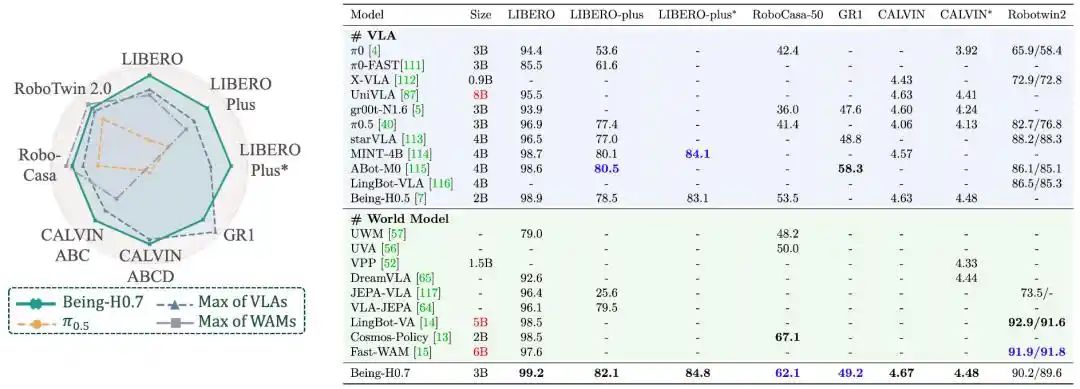
Being-M0.7 is the latest result of this implicit world-action model path.

If the Being-H series answers how hands manipulate the world, Being-M0.7 answers how the entire body coordinates locomotion and task execution in the world. Humanoid robot mobile manipulation (loco-manipulation) requires the model to simultaneously decide where to go, how to orient the body, how to coordinate arms and legs, and how to maintain posture stability. This is a problem highly coupled in both the temporal and body dimensions, and a critical hurdle that general-purpose humanoid robots must overcome.
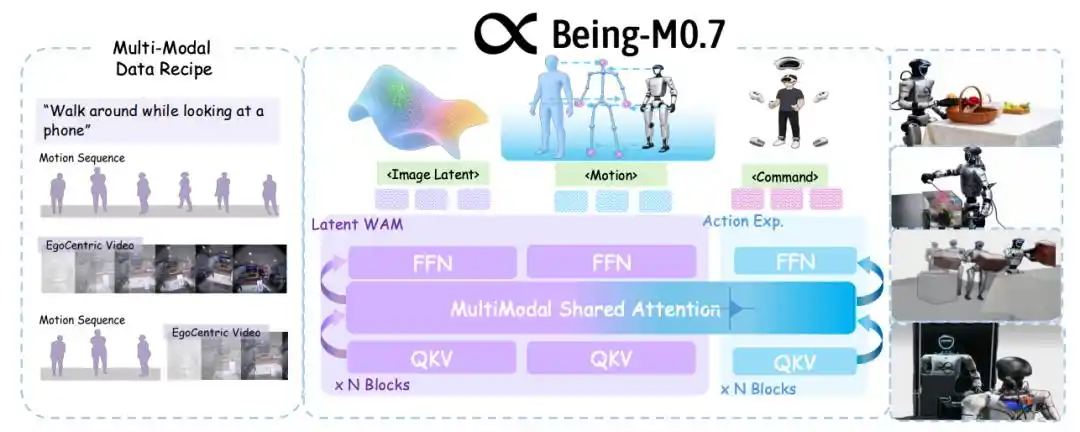
Being-M0.7 is an implicit world-action model. It is first pre-trained on first-person video and human motion data using a Mixture of Transformers (MoT) architecture; then, through action expert post-training, it is adapted for control on robot trajectory data from diverse whole-body manipulation tasks.

Unlike many world models relying on pixel-level video generation, Being-M0.7 predicts future environmental states in a latent space and couples them with a compact whole-body motion representation. Pixel-level prediction is computationally expensive, with much computational power wasted on appearance details weakly related to control. Severe self-motion and viewpoint jitter in the first-person perspective further fill predictions with noise. Latent space prediction focuses modeling capacity on semantic states, object layout, and scene evolution—structural elements truly relevant to control—retaining the essence of a world model anticipating the future while significantly reducing computational overhead.

How Does Physical Understanding Translate into Whole-Body Action?

Whether the model truly possesses whole-body mobile manipulation capabilities ultimately must be tested in real-world scenarios.

Zhi Zai Wu Jie released four real-world demos centered around Being-M0.7, covering four highly challenging scenarios: liquid interaction, mirror reasoning, long-horizon tasks, and obstacle avoidance with occlusion.

These tasks collectively examine one question: Can the robot, based on predictions of the environment and its future changes, continuously generate whole-body actions appropriate to the current scene?.

Fishing in a Fish Tank

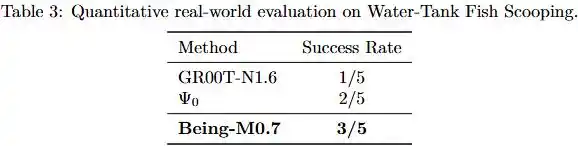
The robot walks to an aquarium and uses a handheld net to scoop a toy fish from the water. Liquids have no fixed shape, flow, exert buoyancy and drag on immersed objects, and water surface refraction causes the visual position of underwater targets to shift. The robot must understand the interaction between water, net, and fish, coordinating its arm to complete a tool-based capture of a dynamic target while visual information is distorted by the water. This task precisely tests future state prediction, tool use, and motion coordination under uncertain object dynamics.

For the fish-scooping segment of the task, Being-M0.7 succeeded in 3 out of 5 tests. In comparison,

was 2/5, while GR00T-N1.6 was 1/5.
Mirror Object Retrieval

A box sits in front of the robot, open only on the back and sides. The item inside is completely invisible from the robot's own perspective; the only clue is the reflection in a mirror ahead. The robot needs to infer the hidden object's position in real 3D space based on the mirrored view, then approach the box and reach in to grab it. This requires the model to understand the spatial relationships and principles of mirror reflection among the mirror, box, and object, converting indirect visual evidence into executable actions under partially observable conditions.

In real-world comparative tests with

and GR00T-N1.6, under two distance settings of 0.5 meters and 1 meter, Being-M0.7 succeeded in 3 out of 5 and 1 out of 5 tests respectively, overall 4/10;

and GR00T both achieved an overall score of 1/10.
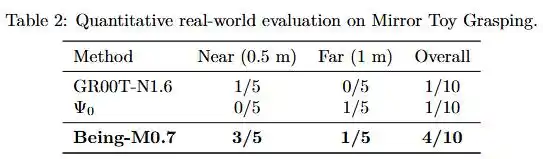
This result indicates that Being-M0.7 demonstrates stronger adaptability in partially observable tasks requiring indirect visual reasoning, whole-body approach, and fine grasping.

Mobile Object Transfer and Retrieval

The robot walks to a table, transfers a baguette from one basket to another, then picks up a bouquet from a basket and turns to leave. The task consists of multiple sub-tasks strung together. The robot needs to continuously switch between walking, grasping, transferring, turning, etc., while maintaining an ongoing understanding of the scene throughout. It tests not just single-grasp success rate, but also state maintenance in long-horizon tasks, object-level spatial reasoning, and whole-body synergy between locomotion and dexterous manipulation.

Box Carrying with Obstacle Avoidance

The robot walks forward carrying a box. When an obstacle appears ahead, it doesn't completely stop to re-plan, but adjusts its body orientation to sidestep through the narrow space between obstacles. Carrying the object partially occludes the first-person view and also alters the robot's load and center of gravity. The model needs to combine prior environmental information with real-time feedback to judge passable areas, adjust walking direction and whole-body posture, while maintaining its own balance and the stability of the carried object. Multi-directional movement, obstacle avoidance, and load-aware manipulation are unified into one closed-loop behavior here.

These demonstrations illustrate that the robot does not execute according to a fixed, open-loop trajectory, but rather continuously generates and corrects whole-body actions by combining current observations, real-time feedback, and predictions of the future.

MoT Architecture and Unified Motion Representation: Solving the Embodiment Data Scarcity Challenge

Supporting the above capabilities is a set of key designs in data and architecture for Being-M0.7.

Humanoid robots need to perform spatial perception via first-person visual information and also output future motion and control commands. High-quality human motion data typically requires motion capture equipment, while first-person paired data where vision and motion are strictly aligned is even scarcer.

If a model can only use data containing both vision and motion, the scale of trainable data would be severely limited. The problem Being-M0.7 solves is precisely how to let paired data, pure video data, and pure motion data all participate in training.

Zhi Zai Wu Jie's choice is the Vision-Motion MoT (Mixture-of-Transformers) architecture. Vision-Motion MoT retains separate modality-specific projection and processing modules for vision and motion, while enabling cross-modal interaction through shared multimodal attention. Visual state changes and continuous motion have different data distributions and need not be forced into identical parameter systems; when both modalities are present, they can exchange information within a shared context.

This allows the model to simultaneously handle three types of data.

For video-motion paired data, the model jointly learns future environmental states and motion trajectories; for pure video data, only the visual branch's training objective is computed; for pure motion data, only the motion branch is trained. Data from different sources jointly constrain the model through the same training objective, without needing to train multiple isolated single-modal systems separately.

From a probabilistic modeling perspective, paired data characterizes the joint relationship between vision and motion, while single-modal data provides marginal constraints for this joint distribution. Even data with incomplete modalities can be incorporated into the same training framework.
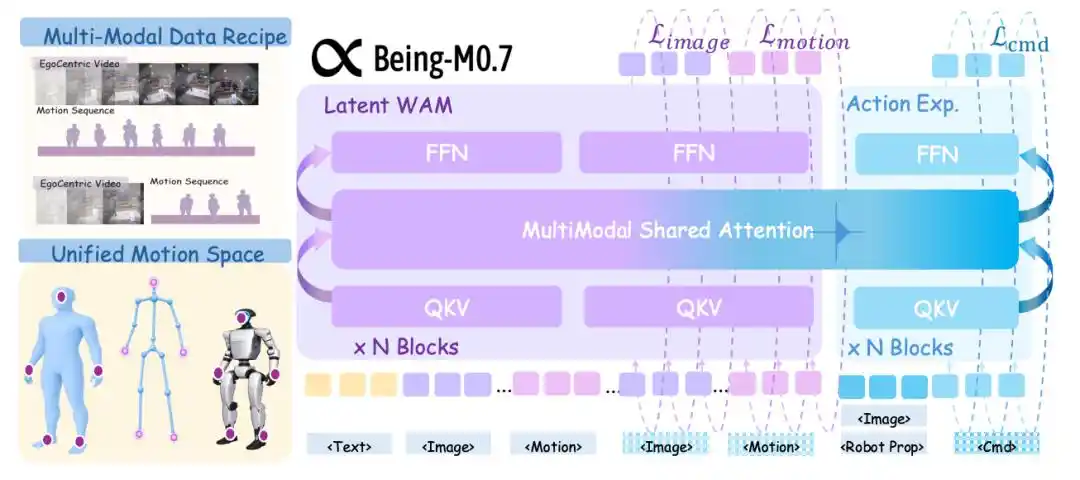
Overview of the Being-M0.7 training framework. Top Left: Pre-training data consists of video-motion paired data, pure video data, and pure motion data. Bottom Left: The research team constructed a unified motion representation shared between humans and humanoid robots, providing richer supervision signals and feedback for training and inference. Right: The overall model architecture of Being-M0.7.

Based on this architecture, the team built a mixed-modal pre-training dataset exceeding 10,000 hours, covering human first-person videos, first-person video-motion paired data, and pure human motion sequences.
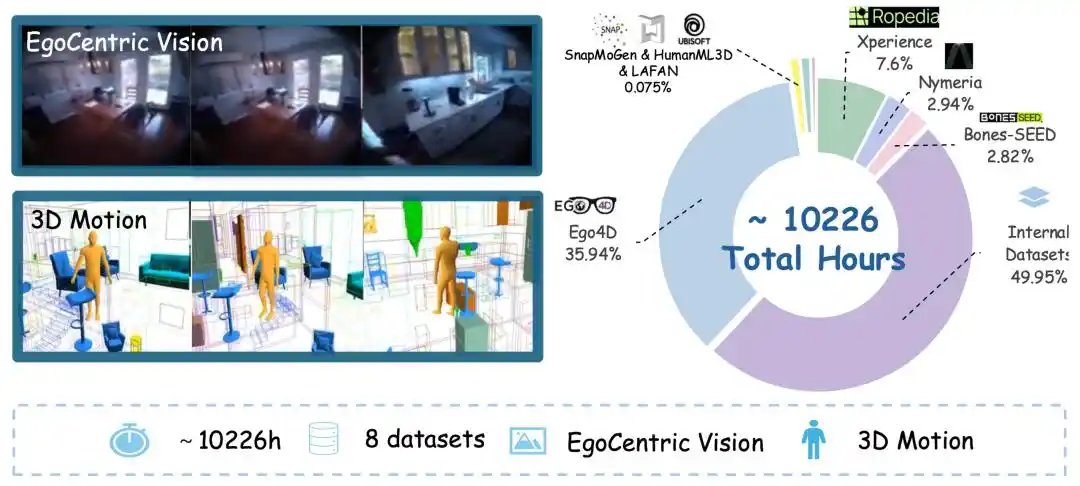
Being-M0.7's Data Recipe. The pre-training corpus is sourced from multiple external public datasets, including Ego4D, Xperience, Nymeria, Bones-SEED, SnapMoGen, HumanML3D, and Lafan1; it also includes internal datasets.

Another key design is the unified motion representation shared between humans and humanoid robots.

Being-M0.7 proposes a unified action representation that transforms human motion data from different sources into a unified representation with the head as the root node, naturally aligning it with first-person vision. Through standardization processes like unifying coordinate systems and removing initial orientation, it reduces distribution differences between datasets and improves cross-source consistency.

Furthermore, Being-M0.7 employs a compact motion representation that retains only the head, both hands, and both feet. While preserving key interaction and contact information, it effectively bridges the morphological gap between humans and robots. This representation not only provides richer supervision signals than action labels for robot post-training but also offers motion-level feedback during inference, supporting whole-body coordinated control.

During pre-training, the model maps images to latent space via a visual encoder and uses the compact unified motion representation. The model is trained with a Flow Matching objective to jointly predict future state changes and motion trajectories based on a short segment of visual-motion history and task instructions.

For real-world robot data collection, the team set up a whole-body teleoperation system based on PICO VR. An operator wears a PICO headset, two ankle trackers, and two handheld controllers. The VR system estimates the human pose in real-time, which is then converted into executable 29-degree-of-freedom whole-body control commands for the Unitree G1 via a whole-body motion controller. While the robot executes actions via teleoperation, it simultaneously records onboard RGB camera first-person view images, proprioception, and motion control commands. This serves as the post-training fine-tuning data for Being-M0.7 on specific tasks.
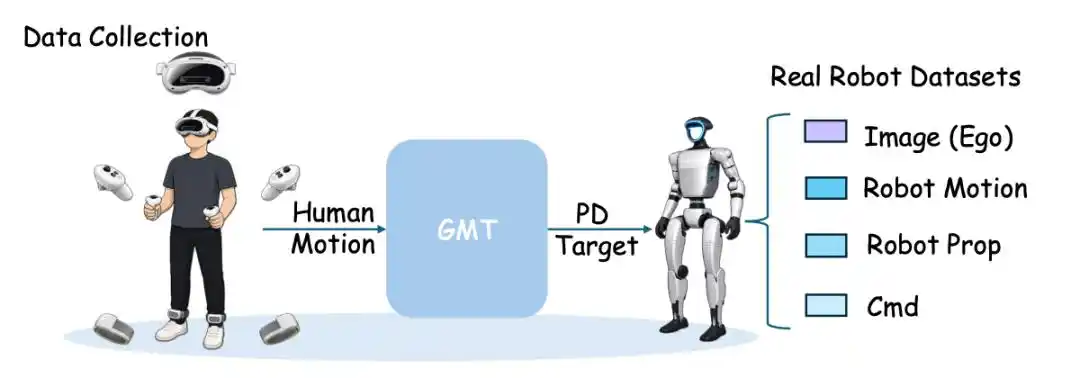
Being-M0.7 real-world robot data collection system. The operator provides whole-body motion commands via VR devices; the system converts human poses into robot control commands and synchronously collects first-person images, proprioception, and motion trajectories.

Since the model has already established visual-motion priors during pre-training, the real-world robot data no longer needs to teach all motion patterns from scratch; it primarily serves two purposes: first, to ground the pre-trained priors into the specific control space of the humanoid robot; second, to learn the low-level control commands and feedback mechanisms required by the real robot. This process is handled by a lightweight Action Expert. The Action Expert reads the intermediate hidden states of the Latent WAM as high-level planning context, then combines them with current visual observations, proprioceptive information, and execution progress to generate action chunks directly executable by the robot.

During inference, the model generates future video-motion plans at a low frequency and converts their intermediate hidden states into reusable policy caches (KV Cache). The unified motion representation not only fuses visual and proprioceptive feedback but also uses the robot's latest motion state to correct the predicted whole-body motion plan, enabling the policy to promptly respond to deviations in body and end-effector motion. The Action Expert then reuses the current KV Cache to continuously generate actions at a high frequency, seamlessly incorporating the latest robot feedback when the cache refreshes. This design decouples low-frequency world planning from high-frequency action control, ensuring real-time performance while keeping the robot consistently guided by both long-term planning and real-time feedback.

A Scalable Fusion Paradigm, Towards More General Embodied Intelligence

The significance of the Vision-Motion MoT architecture extends beyond solving the training problem for Being-M0.7 alone; it establishes a sustainable, extensible multimodal fusion paradigm.

The most direct change from this paradigm occurs at the data level.

Over 10,000 hours of mixed-modal data expand the sources of supervision signals available for training humanoid robot models from expensive, scarce real-world robot demonstrations to vast human behavioral data. Loosening the data bottleneck is a prerequisite for any Scaling Law to hold.

Simultaneously, Being-M0.7 also adjusts the sequence of model learning.

Before being adapted into robot-executable commands, the model first learns visual context, future dynamics, and humanoid kinematic structure from large-scale human-centric data. Subsequently, the Action Expert translates these predictions and motion priors into control commands for the specific robot. In other words, the model first builds the capability to predict future states and body motion, then learns how to act on a specific embodiment. This constitutes a key difference between it and traditional imitation learning schemes that learn action mappings directly from robot demonstrations. The latter often start from "see something, output some action," while Being-M0.7 inserts a layer of joint modeling of future state-motion before action generation.

Moreover, this architecture does not require all newly added data to have complete vision-motion pairing. After cleaning and processing, standalone human video and motion sequences can all be incorporated into the same model. As data scale expands further, this fusion paradigm has the potential to continuously extend the capability frontier.

Placed within the industry's coordinate system, the release of Being-M0.7 perhaps signifies a shift in the competitive logic of humanoid robots.

In recent years, industry attention has focused more on whose robot body is more agile and whose motion demos are more spectacular. As hardware performance continues to improve, whether models can understand scenes, predict changes, and generate coordinated whole-body actions, and whether there exists a scalable data system behind them, will increasingly become the key differentiator.

The development of large language models has already proven that scalable data and a training flywheel often determine how far a technical path can ultimately go. Embodied intelligence stands at a similar critical point: real-world robot data cannot grow rapidly like internet corpora; where else can robots obtain the experience needed for continuous evolution?

From Being-H to Being-M, Zhi Zai Wu Jie's judgment is to let robots first learn about the world from human behavior, then translate this knowledge into actions in the real physical world.

When understanding becomes the prerequisite for action, general-purpose humanoid robots truly step out of the lab narrative and begin their journey towards the physical world of myriad industries.

This article comes from the WeChat public account "Machine Heart" (ID: almosthuman2014), author: Yang Wen


Crypto di tendenza

Domande pertinenti

QWhat is the core technological innovation of Being-M0.7 as presented in the article?

ABeing-M0.7 is presented as the world's first Latent World-Action Model for humanoid robot whole-body mobile manipulation. Its core innovation lies in predicting future environment states in a latent space and coupling them with compact whole-body motion representations, moving away from computationally expensive pixel-level video prediction. This allows the model to focus on semantically relevant structures for control.

QHow does the Being-M0.7 model address the challenge of scarce robot demonstration data for training?

ABeing-M0.7 addresses data scarcity by being pre-trained on over 10,000 hours of human-centric, mixed-modality data (including paired video-motion, pure video, and pure motion data) using a Vision-Motion Mixture of Transformers architecture. This allows it to learn world dynamics from human experience. It then adapts to a specific robot body using a smaller amount of real robot demonstration data via a lightweight Action Expert module.

QAccording to the article, what are the key advantages of using a latent world model over a pixel-level predictive model for humanoid robots?

AThe key advantages are reduced computational overhead and improved robustness. Pixel-level prediction consumes significant capacity on visual details less relevant to control, and the rapid self-motion and viewpoint jitter of humanoid robots amplify visual prediction noise. Latent space prediction focuses modeling power on semantic states, object layouts, and scene evolution, which are more directly related to control decisions.

QWhat specific capabilities did the real-world robot demos (like "Fish Tank Fishing" and "Mirror Fetch") aim to demonstrate?

AThe demos aimed to demonstrate the model's ability to perform complex whole-body mobile manipulation based on its understanding and prediction of the environment. Specifically: "Fish Tank Fishing" tested future state prediction, tool use, and action coordination under the uncertain dynamics of liquid objects. "Mirror Fetch" tested indirect visual reasoning, spatial understanding of reflections, and precise whole-body approach and grasping in partially observable conditions.

QWhat is the strategic significance of Zhizai Wujie's technological route from Being-H to Being-M, as described in the article?

AThe strategic significance is establishing a scalable path for embodied intelligence by leveraging vast, scalable human behavior data instead of waiting for scarce, expensive robot data to accumulate. The route posits that robots should first learn about the world's operation and body coordination from human experience (pre-training), and then transfer this knowledge to specific robot bodies (adaptation). This approach is seen as key to overcoming data bottlenecks and achieving more general-purpose humanoid robots.

Letture associate

Robinhood Chain Launchpad Chaos: NOXA Shuts Down, Uniswap CCA Steps In?

Robinhood Chain, a blockchain focused on tokenized stocks, has seen unexpected early success driven by meme coin speculation. Two weeks after launch, its weekly DEX volume surpassed $3.1 billion, briefly exceeding Solana in daily meme trading. This frenzy centered on launchpads, tools allowing easy meme token creation. The leading platform, NOXA, generated massive fees ($7.66M in a week) and launched the chain's top meme, CASHCAT. However, on July 11, NOXA abruptly suspended new token launches, citing spam, copycat tokens, and infrastructure strain. It pivoted to a history-only interface, redistributing fees to creators. This move sparked "soft rug pull" fears and caused its launched tokens to drop sharply. NOXA's exit left a leadership vacuum among Robinhood's launchpads. Meanwhile, Uniswap officially launched its Continuous Clearing Auctions (CCA) mechanism on the chain. CCA uses a gradual, block-by-block auction to set a fair initial price and automatically creates a locked liquidity pool. Early CCA-launched memes like UNICORN and TRASH have seen high volatility. The situation highlights the trade-offs: CCA reduces front-running risk but may be less suited for fast-paced meme trading, while instant-launch platforms carry higher sniper risk. For Robinhood Chain, the meme-driven activity has successfully bootstrapped initial usage, testing its "meme-first, RWA-later" strategy as it aims to eventually host tokenized real-world assets.

Foresight News47 min fa

Robinhood Chain Launchpad Chaos: NOXA Shuts Down, Uniswap CCA Steps In?

Foresight News47 min fa

Trading

Spot

Articoli Popolari

Cosa è $S$

Comprendere SPERO: Una Panoramica Completa Introduzione a SPERO Mentre il panorama dell'innovazione continua a evolversi, l'emergere delle tecnologie web3 e dei progetti di criptovaluta gioca un ruolo fondamentale nel plasmare il futuro digitale. Un progetto che ha attirato l'attenzione in questo campo dinamico è SPERO, denotato come SPERO,$$s$. Questo articolo mira a raccogliere e presentare informazioni dettagliate su SPERO, per aiutare gli appassionati e gli investitori a comprendere le sue basi, obiettivi e innovazioni nei domini web3 e crypto. Che cos'è SPERO,$$s$? SPERO,$$s$ è un progetto unico all'interno dello spazio crypto che cerca di sfruttare i principi della decentralizzazione e della tecnologia blockchain per creare un ecosistema che promuove l'impegno, l'utilità e l'inclusione finanziaria. Il progetto è progettato per facilitare interazioni peer-to-peer in modi nuovi, fornendo agli utenti soluzioni e servizi finanziari innovativi. Al suo interno, SPERO,$$s$ mira a responsabilizzare gli individui fornendo strumenti e piattaforme che migliorano l'esperienza dell'utente nello spazio delle criptovalute. Questo include la possibilità di metodi di transazione più flessibili, la promozione di iniziative guidate dalla comunità e la creazione di percorsi per opportunità finanziarie attraverso applicazioni decentralizzate (dApps). La visione sottostante di SPERO,$$s$ ruota attorno all'inclusività, cercando di colmare le lacune all'interno della finanza tradizionale mentre sfrutta i vantaggi della tecnologia blockchain. Chi è il Creatore di SPERO,$$s$? L'identità del creatore di SPERO,$$s$ rimane piuttosto oscura, poiché ci sono risorse pubblicamente disponibili limitate che forniscono informazioni dettagliate sul suo fondatore o fondatori. Questa mancanza di trasparenza può derivare dall'impegno del progetto per la decentralizzazione—un ethos che molti progetti web3 condividono, dando priorità ai contributi collettivi rispetto al riconoscimento individuale. Centrando le discussioni attorno alla comunità e ai suoi obiettivi collettivi, SPERO,$$s$ incarna l'essenza dell'empowerment senza mettere in evidenza individui specifici. Pertanto, comprendere l'etica e la missione di SPERO rimane più importante che identificare un creatore singolo. Chi sono gli Investitori di SPERO,$$s$? SPERO,$$s$ è supportato da una varietà di investitori che vanno dai capitalisti di rischio agli investitori angelici dedicati a promuovere l'innovazione nel settore crypto. Il focus di questi investitori generalmente si allinea con la missione di SPERO—dando priorità a progetti che promettono avanzamenti tecnologici sociali, inclusività finanziaria e governance decentralizzata. Queste fondazioni di investitori sono tipicamente interessate a progetti che non solo offrono prodotti innovativi, ma contribuiscono anche positivamente alla comunità blockchain e ai suoi ecosistemi. Il supporto di questi investitori rafforza SPERO,$$s$ come un concorrente degno di nota nel dominio in rapida evoluzione dei progetti crypto. Come Funziona SPERO,$$s$? SPERO,$$s$ impiega un framework multifunzionale che lo distingue dai progetti di criptovaluta convenzionali. Ecco alcune delle caratteristiche chiave che sottolineano la sua unicità e innovazione: Governance Decentralizzata: SPERO,$$s$ integra modelli di governance decentralizzati, responsabilizzando gli utenti a partecipare attivamente ai processi decisionali riguardanti il futuro del progetto. Questo approccio favorisce un senso di proprietà e responsabilità tra i membri della comunità. Utilità del Token: SPERO,$$s$ utilizza il proprio token di criptovaluta, progettato per servire varie funzioni all'interno dell'ecosistema. Questi token abilitano transazioni, premi e la facilitazione dei servizi offerti sulla piattaforma, migliorando l'impegno e l'utilità complessivi. Architettura Stratificata: L'architettura tecnica di SPERO,$$s$ supporta la modularità e la scalabilità, consentendo un'integrazione fluida di funzionalità e applicazioni aggiuntive man mano che il progetto evolve. Questa adattabilità è fondamentale per mantenere la rilevanza nel panorama crypto in continua evoluzione. Coinvolgimento della Comunità: Il progetto enfatizza iniziative guidate dalla comunità, impiegando meccanismi che incentivano la collaborazione e il feedback. Nutrendo una comunità forte, SPERO,$$s$ può affrontare meglio le esigenze degli utenti e adattarsi alle tendenze di mercato. Focus sull'Inclusione: Offrendo basse commissioni di transazione e interfacce user-friendly, SPERO,$$s$ mira ad attrarre una base utenti diversificata, inclusi individui che potrebbero non aver precedentemente interagito nello spazio crypto. Questo impegno per l'inclusione si allinea con la sua missione generale di empowerment attraverso l'accessibilità. Cronologia di SPERO,$$s$ Comprendere la storia di un progetto fornisce preziose intuizioni sulla sua traiettoria di sviluppo e sui traguardi. Di seguito è riportata una cronologia suggerita che mappa eventi significativi nell'evoluzione di SPERO,$$s$: Fase di Concettualizzazione e Ideazione: Le idee iniziali che formano la base di SPERO,$$s$ sono state concepite, allineandosi strettamente con i principi di decentralizzazione e focus sulla comunità all'interno dell'industria blockchain. Lancio del Whitepaper del Progetto: Dopo la fase concettuale, è stato rilasciato un whitepaper completo che dettaglia la visione, gli obiettivi e l'infrastruttura tecnologica di SPERO,$$s$ per suscitare interesse e feedback dalla comunità. Costruzione della Comunità e Prime Interazioni: Sono stati effettuati sforzi attivi di outreach per costruire una comunità di early adopters e potenziali investitori, facilitando discussioni attorno agli obiettivi del progetto e ottenendo supporto. Evento di Generazione del Token: SPERO,$$s$ ha condotto un evento di generazione del token (TGE) per distribuire i propri token nativi ai primi sostenitori e stabilire una liquidità iniziale all'interno dell'ecosistema. Lancio della Prima dApp: La prima applicazione decentralizzata (dApp) associata a SPERO,$$s$ è stata attivata, consentendo agli utenti di interagire con le funzionalità principali della piattaforma. Sviluppo Continuo e Partnership: Aggiornamenti e miglioramenti continui alle offerte del progetto, inclusi partnership strategiche con altri attori nello spazio blockchain, hanno plasmato SPERO,$$s$ in un concorrente competitivo e in evoluzione nel mercato crypto. Conclusione SPERO,$$s$ rappresenta una testimonianza del potenziale del web3 e delle criptovalute di rivoluzionare i sistemi finanziari e responsabilizzare gli individui. Con un impegno per la governance decentralizzata, il coinvolgimento della comunità e funzionalità progettate in modo innovativo, apre la strada verso un panorama finanziario più inclusivo. Come per qualsiasi investimento nello spazio crypto in rapida evoluzione, si incoraggiano potenziali investitori e utenti a ricercare approfonditamente e a impegnarsi in modo riflessivo con gli sviluppi in corso all'interno di SPERO,$$s$. Il progetto mostra lo spirito innovativo dell'industria crypto, invitando a ulteriori esplorazioni delle sue innumerevoli possibilità. Mentre il percorso di SPERO,$$s$ è ancora in fase di sviluppo, i suoi principi fondamentali potrebbero effettivamente influenzare il futuro di come interagiamo con la tecnologia, la finanza e tra di noi in ecosistemi digitali interconnessi.

120 Totale visualizzazioniPubblicato il 2024.12.17Aggiornato il 2024.12.17

Cosa è $S$

Cosa è AGENT S

Agent S: Il Futuro dell'Interazione Autonoma in Web3 Introduzione Nel panorama in continua evoluzione di Web3 e criptovalute, le innovazioni stanno costantemente ridefinendo il modo in cui gli individui interagiscono con le piattaforme digitali. Uno di questi progetti pionieristici, Agent S, promette di rivoluzionare l'interazione uomo-computer attraverso il suo framework agentico aperto. Aprendo la strada a interazioni autonome, Agent S mira a semplificare compiti complessi, offrendo applicazioni trasformative nell'intelligenza artificiale (AI). Questa esplorazione dettagliata approfondirà le complessità del progetto, le sue caratteristiche uniche e le implicazioni per il dominio delle criptovalute. Cos'è Agent S? Agent S si presenta come un innovativo framework agentico aperto, progettato specificamente per affrontare tre sfide fondamentali nell'automazione dei compiti informatici: Acquisizione di Conoscenze Specifiche del Dominio: Il framework apprende in modo intelligente da varie fonti di conoscenza esterne ed esperienze interne. Questo approccio duale gli consente di costruire un ricco repository di conoscenze specifiche del dominio, migliorando le sue prestazioni nell'esecuzione dei compiti. Pianificazione su Lungo Orizzonte di Compiti: Agent S impiega una pianificazione gerarchica potenziata dall'esperienza, un approccio strategico che facilita la suddivisione e l'esecuzione efficiente di compiti complessi. Questa caratteristica migliora significativamente la sua capacità di gestire più sottocompiti in modo efficiente ed efficace. Gestione di Interfacce Dinamiche e Non Uniformi: Il progetto introduce l'Interfaccia Agente-Computer (ACI), una soluzione innovativa che migliora l'interazione tra agenti e utenti. Utilizzando Modelli Linguistici Multimodali di Grandi Dimensioni (MLLM), Agent S può navigare e manipolare senza sforzo diverse interfacce grafiche utente. Attraverso queste caratteristiche pionieristiche, Agent S fornisce un framework robusto che affronta le complessità coinvolte nell'automazione dell'interazione umana con le macchine, preparando il terreno per innumerevoli applicazioni nell'AI e oltre. Chi è il Creatore di Agent S? Sebbene il concetto di Agent S sia fondamentalmente innovativo, informazioni specifiche sul suo creatore rimangono elusive. Il creatore è attualmente sconosciuto, il che evidenzia sia la fase embrionale del progetto sia la scelta strategica di mantenere i membri fondatori sotto anonimato. Indipendentemente dall'anonimato, l'attenzione rimane sulle capacità e sul potenziale del framework. Chi sono gli Investitori di Agent S? Poiché Agent S è relativamente nuovo nell'ecosistema crittografico, informazioni dettagliate riguardanti i suoi investitori e sostenitori finanziari non sono documentate esplicitamente. La mancanza di approfondimenti pubblicamente disponibili sulle fondazioni di investimento o sulle organizzazioni che supportano il progetto solleva interrogativi sulla sua struttura di finanziamento e sulla roadmap di sviluppo. Comprendere il supporto è cruciale per valutare la sostenibilità del progetto e il suo potenziale impatto sul mercato. Come Funziona Agent S? Al centro di Agent S si trova una tecnologia all'avanguardia che gli consente di funzionare efficacemente in contesti diversi. Il suo modello operativo è costruito attorno a diverse caratteristiche chiave: Interazione Uomo-Computer Simile a Quella Umana: Il framework offre una pianificazione AI avanzata, cercando di rendere le interazioni con i computer più intuitive. Mimando il comportamento umano nell'esecuzione dei compiti, promette di elevare le esperienze degli utenti. Memoria Narrativa: Utilizzata per sfruttare esperienze di alto livello, Agent S utilizza la memoria narrativa per tenere traccia delle storie dei compiti, migliorando così i suoi processi decisionali. Memoria Episodica: Questa caratteristica fornisce agli utenti una guida passo-passo, consentendo al framework di offrire supporto contestuale mentre i compiti si sviluppano. Supporto per OpenACI: Con la capacità di funzionare localmente, Agent S consente agli utenti di mantenere il controllo sulle proprie interazioni e flussi di lavoro, allineandosi con l'etica decentralizzata di Web3. Facile Integrazione con API Esterne: La sua versatilità e compatibilità con varie piattaforme AI garantiscono che Agent S possa adattarsi senza problemi agli ecosistemi tecnologici esistenti, rendendolo una scelta attraente per sviluppatori e organizzazioni. Queste funzionalità contribuiscono collettivamente alla posizione unica di Agent S all'interno dello spazio crittografico, poiché automatizza compiti complessi e multi-fase con un intervento umano minimo. Man mano che il progetto evolve, le sue potenziali applicazioni in Web3 potrebbero ridefinire il modo in cui si svolgono le interazioni digitali. Cronologia di Agent S Lo sviluppo e le tappe di Agent S possono essere riassunti in una cronologia che evidenzia i suoi eventi significativi: 27 Settembre 2024: Il concetto di Agent S è stato lanciato in un documento di ricerca completo intitolato “Un Framework Agentico Aperto che Usa i Computer Come un Umano”, mostrando le basi per il progetto. 10 Ottobre 2024: Il documento di ricerca è stato reso pubblicamente disponibile su arXiv, offrendo un'esplorazione approfondita del framework e della sua valutazione delle prestazioni basata sul benchmark OSWorld. 12 Ottobre 2024: È stata rilasciata una presentazione video, fornendo un'idea visiva delle capacità e delle caratteristiche di Agent S, coinvolgendo ulteriormente potenziali utenti e investitori. Questi indicatori nella cronologia non solo illustrano i progressi di Agent S, ma indicano anche il suo impegno per la trasparenza e il coinvolgimento della comunità. Punti Chiave su Agent S Man mano che il framework Agent S continua a evolversi, diversi attributi chiave si distinguono, sottolineando la sua natura innovativa e il potenziale: Framework Innovativo: Progettato per fornire un uso intuitivo dei computer simile all'interazione umana, Agent S porta un approccio nuovo all'automazione dei compiti. Interazione Autonoma: La capacità di interagire autonomamente con i computer attraverso GUI segna un passo avanti verso soluzioni informatiche più intelligenti ed efficienti. Automazione di Compiti Complessi: Con la sua metodologia robusta, può automatizzare compiti complessi e multi-fase, rendendo i processi più veloci e meno soggetti a errori. Miglioramento Continuo: I meccanismi di apprendimento consentono ad Agent S di migliorare dalle esperienze passate, migliorando continuamente le sue prestazioni e la sua efficacia. Versatilità: La sua adattabilità attraverso diversi ambienti operativi come OSWorld e WindowsAgentArena garantisce che possa servire un'ampia gamma di applicazioni. Man mano che Agent S si posiziona nel panorama di Web3 e delle criptovalute, il suo potenziale per migliorare le capacità di interazione e automatizzare i processi segna un significativo avanzamento nelle tecnologie AI. Attraverso il suo framework innovativo, Agent S esemplifica il futuro delle interazioni digitali, promettendo un'esperienza più fluida ed efficiente per gli utenti in vari settori. Conclusione Agent S rappresenta un audace passo avanti nell'unione tra AI e Web3, con la capacità di ridefinire il modo in cui interagiamo con la tecnologia. Sebbene sia ancora nelle sue fasi iniziali, le possibilità per la sua applicazione sono vaste e coinvolgenti. Attraverso il suo framework completo che affronta sfide critiche, Agent S mira a portare le interazioni autonome al centro dell'esperienza digitale. Man mano che ci addentriamo nei regni delle criptovalute e della decentralizzazione, progetti come Agent S giocheranno senza dubbio un ruolo cruciale nel plasmare il futuro della tecnologia e della collaborazione uomo-computer.

575 Totale visualizzazioniPubblicato il 2025.01.14Aggiornato il 2025.01.14

Cosa è AGENT S

Come comprare S

Benvenuto in HTX.com! Abbiamo reso l'acquisto di Sonic (S) semplice e conveniente. Segui la nostra guida passo passo per intraprendere il tuo viaggio nel mondo delle criptovalute.Step 1: Crea il tuo Account HTXUsa la tua email o numero di telefono per registrarti il tuo account gratuito su HTX. Vivi un'esperienza facile e sblocca tutte le funzionalità,Crea il mio accountStep 2: Vai in Acquista crypto e seleziona il tuo metodo di pagamentoCarta di credito/debito: utilizza la tua Visa o Mastercard per acquistare immediatamente SonicS.Bilancio: Usa i fondi dal bilancio del tuo account HTX per fare trading senza problemi.Terze parti: abbiamo aggiunto metodi di pagamento molto utilizzati come Google Pay e Apple Pay per maggiore comodità.P2P: Fai trading direttamente con altri utenti HTX.Over-the-Counter (OTC): Offriamo servizi su misura e tassi di cambio competitivi per i trader.Step 3: Conserva Sonic (S)Dopo aver acquistato Sonic (S), conserva nel tuo account HTX. In alternativa, puoi inviare tramite trasferimento blockchain o scambiare per altre criptovalute.Step 4: Scambia Sonic (S)Scambia facilmente Sonic (S) nel mercato spot di HTX. Accedi al tuo account, seleziona la tua coppia di trading, esegui le tue operazioni e monitora in tempo reale. Offriamo un'esperienza user-friendly sia per chi ha appena iniziato che per i trader più esperti.

1.1k Totale visualizzazioniPubblicato il 2025.01.15Aggiornato il 2026.06.02

Come comprare S

Discussioni

Benvenuto nella Community HTX. Qui puoi rimanere informato sugli ultimi sviluppi della piattaforma e accedere ad approfondimenti esperti sul mercato. Le opinioni degli utenti sul prezzo di S S sono presentate come di seguito.

活动图片