The field of Embodied Intelligence data collection has gained a new approach.
Before the formal introduction, let's do a quick interactive exercise: without using AI or looking up information, can you name the existing methods for collecting embodied data within 5 seconds?
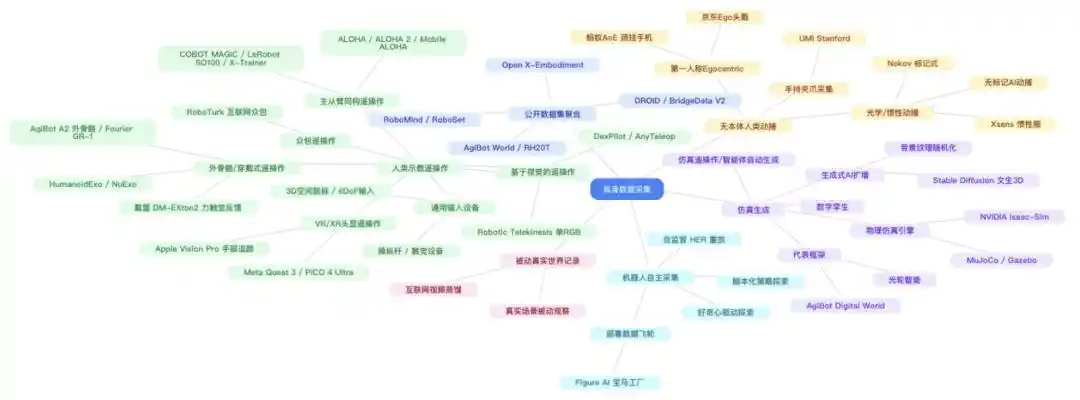
Teleoperation via real robots, portable collection without the robot body (UMI/Ego), simulation/synthetic data, and distillation from online videos are the four most mainstream methods.
(Listed in no particular order, I just jotted them down.)
If we were to classify further in detail, a long list could be made.
At least that's the answer AI gives, you can get a feel for it——
Recently, a new approach has begun to emerge and gain popularity. This method extends the focus of data collection from external movements further to the motor output side of the human body.
This is the currently highly regarded surface electromyography (sEMG) scheme.
OriginFlow (渊澈太初) is the hottest and most sought-after startup on this track.
Founder and CEO Qin Shentao, born in 2001, is currently a doctoral student at Tsinghua University's School of Vehicle and Mobility.
In August last year, he founded OriginFlow in Beijing; as of May this year, the company has publicly disclosed completing angel, strategic, and Pre-A1 rounds of financing, with a cumulative amount exceeding 500 million RMB. Investors include Lanchi, Lvzhou, Monolith, etc.
Qin Shentao told us:
There is a missing layer between real industrial scenarios and models that can abstract unstructured, high-precision, and complex physical interaction information into trainable representations.
Therefore, he started his own venture on Physical AGI infrastructure, aiming to use neural electromyography as one of the entry points for embodied data collection.
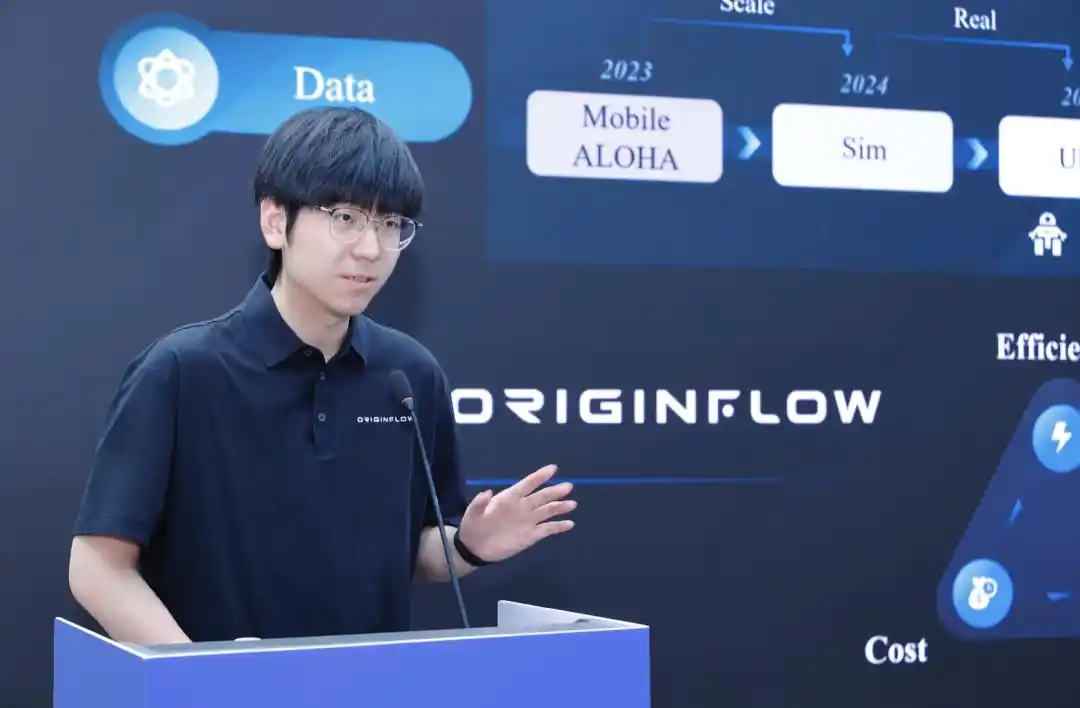
Qin Shentao says that in the short term, NeuroScale is more of an incremental addition to schemes like UMI and first-person Ego vision; but unobtrusive data collection is definitely an important future trend.
When a new transformation arises, a more suitable strategy is to evolve in synergy with existing technologies.
Collecting Embodied Data with "Neural Interfaces"
First, let's understand what OriginFlow is currently doing in a relatable way.
When a person tightens a screw, steadily holds a bowl of soup, or grips a soft object, the body continuously provides subtle feedback based on the actual situation.
When do the fingers start to tighten? How does the force increase or decrease?... In fact, people don't consciously think about each of these questions; often within an extremely short time, the body completes and executes a series of judgments about contact, friction, weight, and stability.
OriginFlow hopes to record this layer of reactions as part of embodied intelligence data.

The reason for betting on this direction must be traced back to Qin Shentao's undergraduate days.
During his undergraduate studies, Qin Shentao led his team to win almost all possible robotics competition championships; also during this period, he engaged in further reflection:
Keyboards, mice, and voice are not the most direct ways for humans to communicate with machines. Human hands are the most flexible tools. If machines could understand the true intent behind hand movements, human-machine interaction would reach a new level.
Thus, neural interfaces entered the field of view of Qin Shentao, who is "obsessed" with human-machine integration.
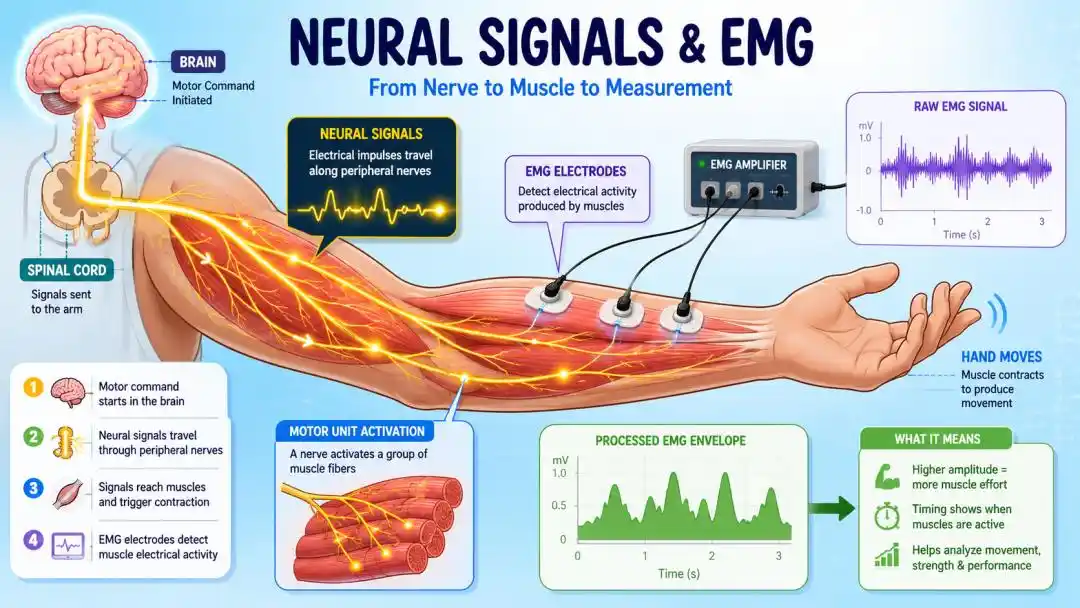
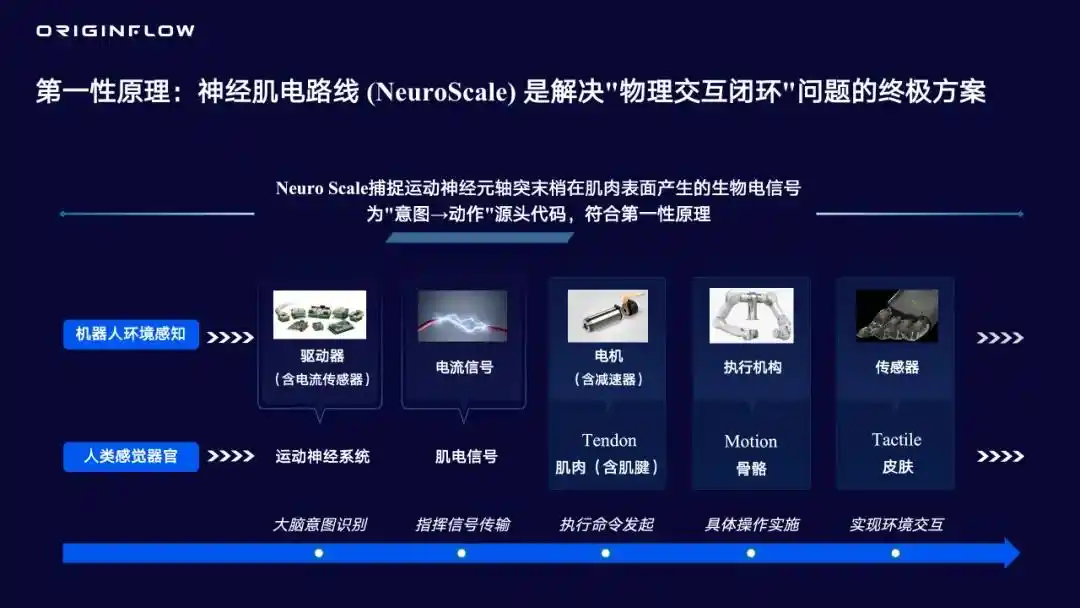
Neural interfaces collect body surface electrical signals related to peripheral motor nerves (i.e., surface electromyography signals), avoiding the high invasiveness, high channel count, and brain region mapping challenges of brain-computer interfaces.
Since its formal inception, sEMG had long been confined to university laboratories.
Later, with advancements in wireless sensing, dry electrodes, and AI algorithms, sEMG began to be used as an entry point for perceiving human movement intent, widely applied in biofeedback training for rehabilitation medicine, motion analysis in competitive sports, occupational ergonomic strain assessment, and discrete action control for myoelectric prosthetics.
△
Let's take a typical example~
In 2019, Meta's core R&D department, Reality Labs, acquired a non-invasive neural interface company, CTRL-Labs.
Before the acquisition, CTRL-Labs had already released a developer kit, containing a main device similar in size to a watch and a tethered component with electrodes.
It uses a 16-channel electromyography sensor to monitor the muscle electrical signals sent by motor neurons to the fingers at the wrist, and employs AI algorithms to decode these signals, converting them into digital commands (such as clicks, swipes, gestures, etc.).
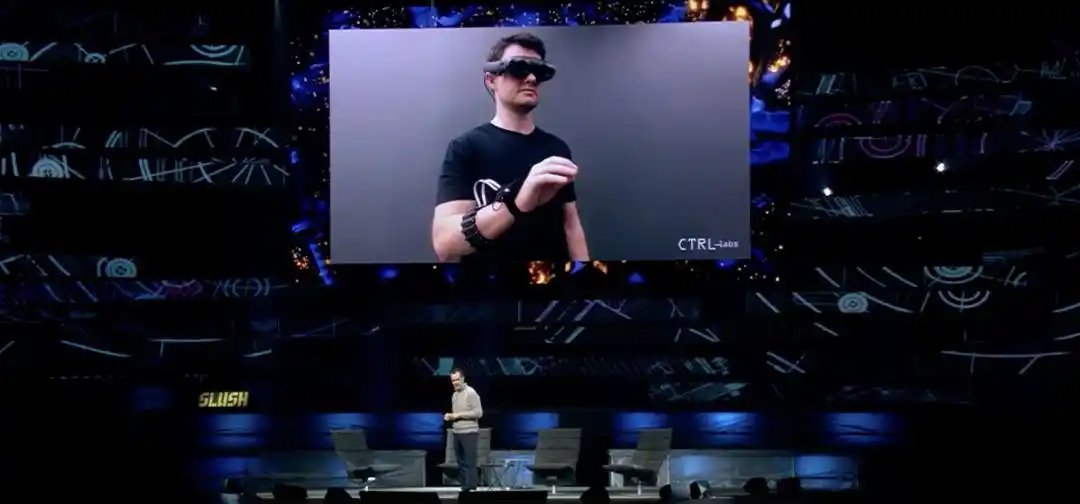
Two years later, Meta publicly demonstrated for the first time a neural interface wristband prototype Meta Neural Band based on CTRL-Labs' technology, showcasing its potential to control AR interfaces by capturing tiny neural signals, such as typing in mid-air, selecting menus, etc.
Zuckerberg stated at the time that because it can precisely perceive even the movement intent users haven't yet made, this interaction method offers "virtually infinite control."
Last year, Meta's third-generation smart glasses introduced a neural input wristband, allowing users to directly control the glasses' interface through hand movements (imagining swiping, clicking).
(A side note: The Apple Watch's "pinch" gestures for confirming or closing windows primarily rely on optical sensors.)
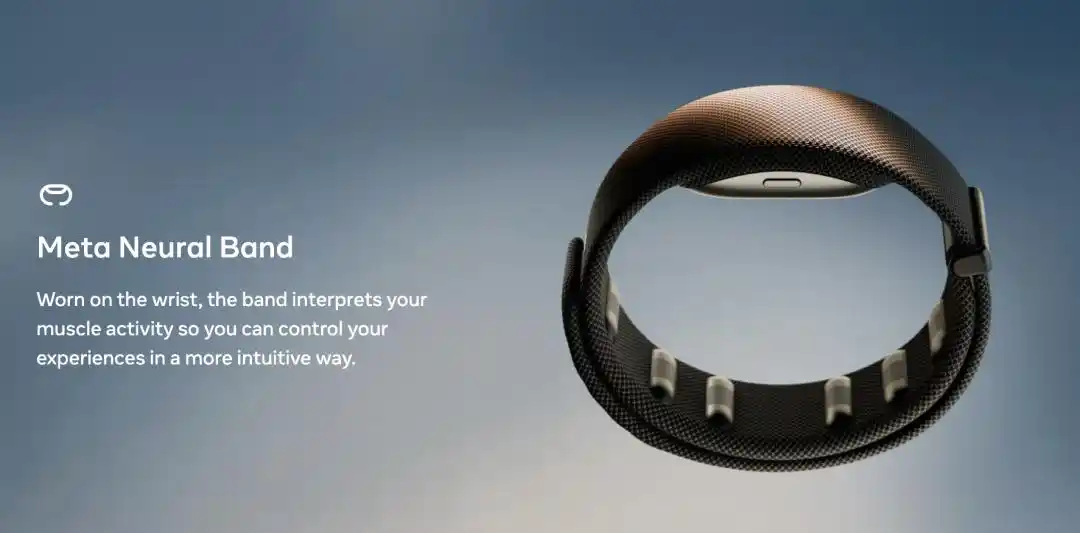
Unlike Meta, whose concern isn't exactly about making it easier for people to click, swipe, or type, Qin Shentao's focus lies on the conditions lacking for Physical AGI.
In his view, first, the current severe lack of high-quality physical interaction data has become a key constraint for the advancement of embodied intelligent robots.
Existing embodied data collection methods each have drawbacks. Could sEMG be used as a point of entry for further supplementation?
Moreover, choosing sEMG for collection might bypass differences in materials and sensors of specific contact surfaces, starting from the drive sides of both humans and machines to find a shared action representation that can connect muscle activation, tendon force, and joint movement.
Collection, Starting from a Wristband
In 2025, while pursuing his doctorate, Qin Shentao officially started his venture, registering and establishing OriginFlow, with the vision of building an "action foundation" beyond text and video for Physical AGI.
Soon, the team proposed the NeuroScale technology system.
NeuroScale is not simply about adding an sEMG wristband to existing embodied data collection equipment.
It is a comprehensive data and model system encompassing signal acquisition, physical quantity reconstruction, action representation, and cross-embodiment transfer.
This system uses non-invasive neural motor interfaces as the signal entry point, fuses multimodal information such as sEMG, first-person vision, and IMU, reconstructs posture, contact force, and driving force in human operations through the PULSE foundation model, and organizes a real operation into Human Tokens that machines can learn from.
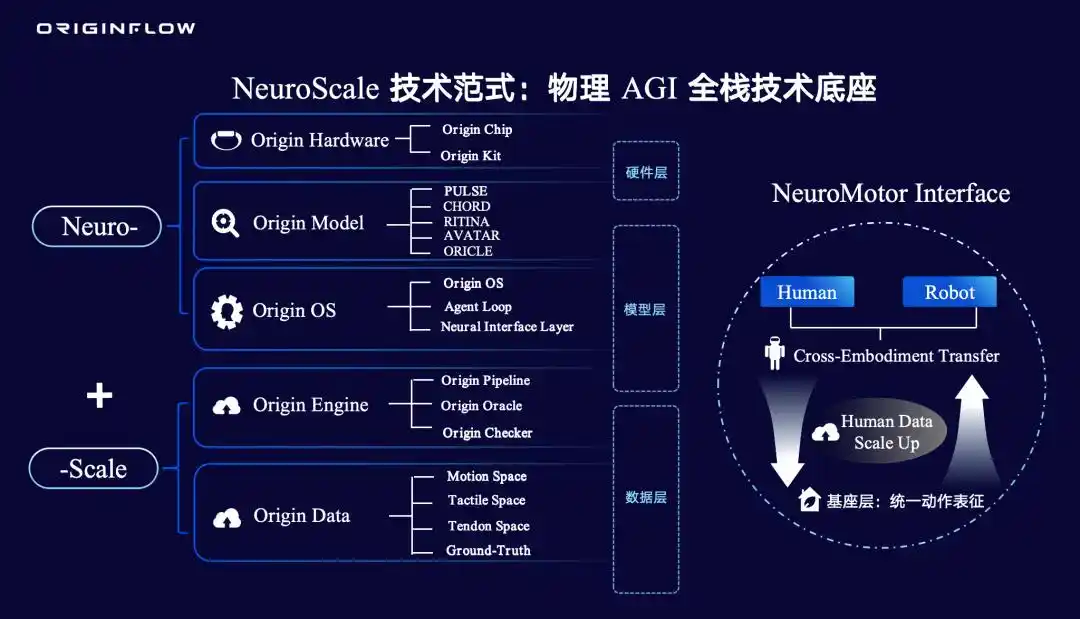
NeuroScale long-term focuses on two core issues.
First, How to achieve Human Data Scale Up?
That is, to continuously record real operations while minimizing interference with human natural perception and movement, producing more high-quality physical interaction data.
Second, How to achieve Cross-Embodiment Transfer between Human and Robot, allowing human motion experience to enter robots with different structures after representation and adaptation.
Beneath these two questions lies an even more fundamental technical problem: In what form should human actions enter foundation models?
Text has formed relatively mature Token representations, vision is also gradually converging to Patch or Latent representations, but the action modality still lacks a universally recognized normative representation.
OriginFlow deconstructs a physical operation into three interrelated spaces:
MotionSpace, describing hand posture and motion trajectory.
TactileSpace, describing normal force, tangential force, and contact feedback.
TendonSpace, describing muscle, tendon driving force, and joint torque.
Driving force produces motion, motion leads to contact, and contact ultimately forms force—together they constitute a physical causal chain.
The Human Tokens mentioned by OriginFlow are precisely action representations built upon these three types of physical quantities.
"In form, humans can be seen as a special case within the configuration space of an embodiment. Therefore, the transfer from human to robot is essentially a sub-problem of 'cross-embodiment migration.'" said Qin Shentao.
Specifically, large-scale Human Data is responsible for covering as broad a distribution of human actions and skills as possible; Cross-Embodiment Data, which is relatively smaller in scale but diverse enough in robot configurations, provides alignment anchor points between humans and different robot embodiments.
After combining the two types of data, the model has the opportunity to learn a set of shared action representations that are relatively decoupled from specific embodiments, and then remap the same segment of human movement and force information onto robot embodiments with different degrees of freedom and drive methods.
Therefore, OriginFlow does not aim to directly copy human operational data to robots, but first seeks shared actions, driving forces, and contact relationships between different embodiments, then completes adaptation and mapping.
In the real world, NeuroScale starts with a wristband.
The wristband is named OriginKitGen 1.0. Its design is slightly wider than an Apple Watch strap, but the overall volume is smaller and lighter.
The wristband is responsible for collecting microvolt-level surface EMG signals emitted by the wearer. The system uses 16-channel acquisition, with an information bitstream of about 96KB per second, and performs continuous modeling of hand movements.
However, the implementation of NeuroScale does not rely solely on the wristband.
With just the wristband, the system can only know the changes in forearm muscle activity but can hardly determine what the fingers are specifically doing.
The signals captured by OriginKitGen 1.0, along with first-person vision, IMU, and other information, enter the NeuroScale data pipeline.
After the raw waveforms are aligned, calibrated, and processed, they are fed into the self-developed foundation model PULSE to extract clues related to hand posture, motion trajectory, contact force, and tendon force—corresponding to Motion Space, Tactile Space, and Tendon Space respectively—hardware handles filtering, differencing, motion artifact suppression; the model handles neural signal encoding and strong supervised learning—gradually organizing them into action representations that machines can learn.
These are what the team calls Human Tokens.
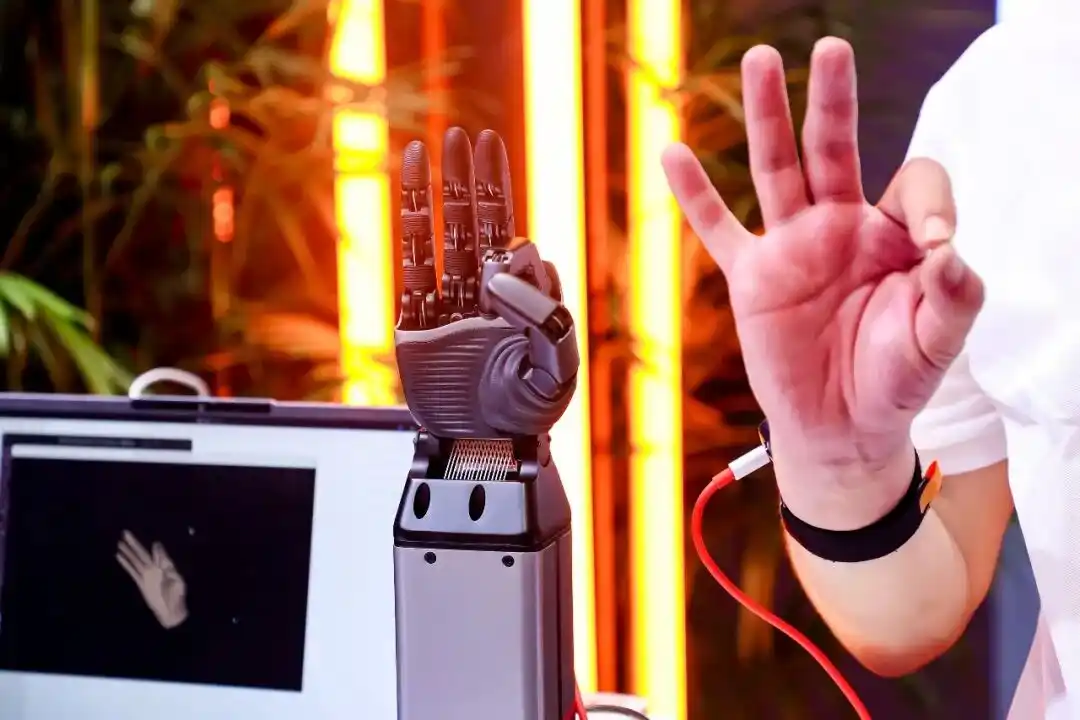
During WAIC, Qin Shentao and the team showcased current results, a demo of PULSE version 0.2:
The wristband collects 16-channel surface EMG signals, PULSE uses these signals as input for continuous modeling of hand movements and observes force changes during fingertip opposition.
Unlike discrete gesture recognition, PULSE focuses on continuous hand tracking and fingertip force representation.
When a user performs fingertip opposition, the system can observe force changes in real-time.
However, reconstructing motion from a segment of neural signals does not equate to obtaining data directly usable for robot training.
Raw data still needs to undergo multi-device clock alignment, individual calibration, motion artifact processing, task segmentation, action and force labeling, quality screening, and cross-embodiment mapping.
To this end, OriginFlow has also built a Data Infrastructure covering data production, processing, evaluation, and training.
Among them, ORACLE uses multimodal models to complete automated labeling of actions, forces, semantics, and task segments; the full-modal unified foundation CHORD is responsible for temporal and representational alignment between sEMG, vision, IMU, language, and robot states.
Data also goes through quality checks like physical validity, task validity, labeling validity, model value, and real-robot evaluation. Only data that can generate actual value in model training or robot tasks enters the final delivered dataset.
This means not only collecting the data but also being able to process massive raw signals into trainable, evaluable, and reusable data assets with sufficiently low marginal costs.
From Human Data to Enhancing Humans
The demonstration of PULSE 0.2 only shows a small part of the company's business; the model itself is also just a stage output.
The PULSE 0.3 under development is further exploring the relationship between tendon force and hand forward kinematics.
The wristband mentioned earlier is also only the current collection terminal, not the final product form.
For a path reliant on long-term, large-scale collection, whether the device can be naturally accepted by people determines whether data can be continuously generated.
Qin Shentao says, we need to make people willing to wear the device first, and then willing to wear it long enough.
In essence, OriginFlow hopes to continuously record a person's action output in the real world with minimal change to their original perception and movement, and process it into Physical Tokens.
Only then can data collection move away from collection factories and specially built workstations, entering daily life and real production processes.
By then, the currently unattainable "trillion hours of data" for the embodied intelligence field would only require recording all human behavior for about ten days.
Qin Shentao describes this process as the continuous amplification of data Scaling.
Looking to the future, we will drive the scale of full-modal Human Data from tens of millions of hours, hundreds of millions of hours, gradually towards trillions of hours.
And the envisioned next-generation physical entry point will gradually move towards lighter, more natural, and more consumer-oriented forms.
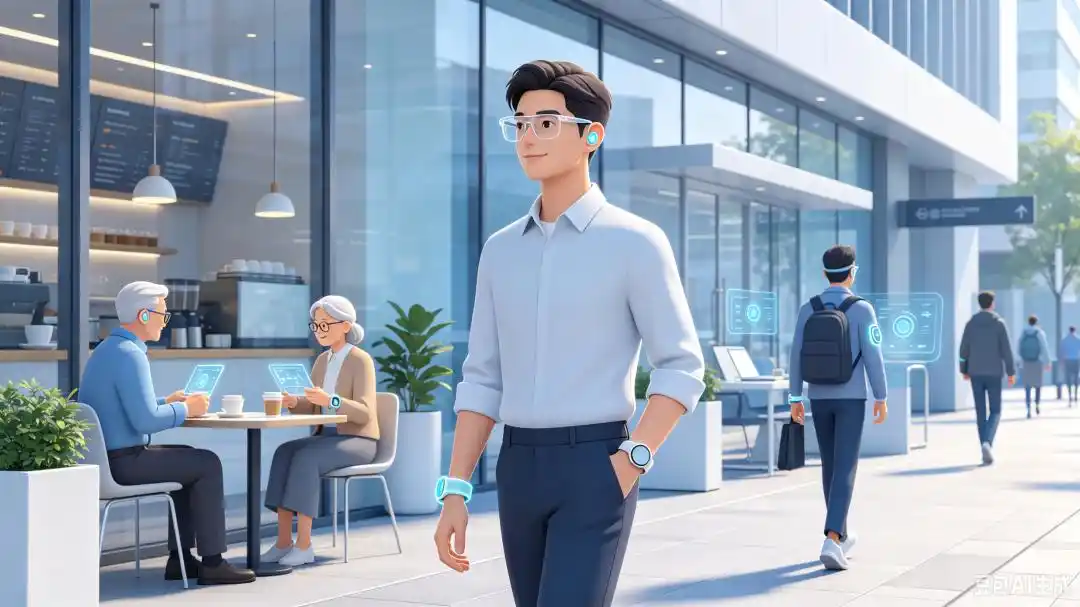
In their vision, in the future, people will only need to wear consumer-oriented glasses, watches, or lighter bracelets to continuously model themselves in daily life and gain convenience from personal models.
△
Overall, what OriginFlow is doing at this stage is still in the first phase of its own development plan.
They have outlined a three-phase development roadmap for themselves—Phase One, From Human, first capturing how humans move as thoroughly as possible, systematically distilling and converting human operational experience in the physical world into data and representations that machines can learn from.
OriginFlow hopes to fully restore human action output without interfering with natural human perception and movement processes.
The entire collection scheme always adheres to the principle of non-invasiveness, ensuring that while humans maintain their original state, their actions can be precisely observed and reconstructed by the system.
Phase Two, With Human.
This phase will involve building new-generation AI hardware, including robots, to integrate into daily work and life in an Always-on form, allowing more people to enjoy the value brought by the next generation of human-machine interfaces.
Phase Three looks toward the next 10 to 30 years, Enhancing Humans.
Of course, from a single fingertip opposition demo in PULSE 0.2 to the trillion-hour scale of full-modal Human Data, there is still a long journey of engineering validation in between.
One More Thing
Reportedly, other domestic startups like BrainCo, Octopus Power, SnowOrigin, Nianxiang Technology, Wujie Mailuo, Shouyi Technology, etc., are also using neural electromyography to collect embodied intelligence data.
This article is from the WeChat public account "QbitAI" (ID: QbitAI), author: Heng Yu