South Korea’s financial authority is expected to release the long-awaited regulatory framework next quarter, offering clear guidelines for the issuance and distribution of won-pegged stablecoins.
Stablecoin Guidelines By October
On Monday, local news media outlets reported that South Korea’s financial regulator, the Financial Services Commission (FSC), is expected to release a bill for a stablecoin pegged to the Korean won (KRW) within two months.
According to MoneyToday, a member of the Democratic Party of Korea (DPK), Park Min-kyu, confirmed that he had “recently received a report from the FSC on the direction of stablecoins,” affirming, “The government’s bill is expected to be submitted to the National Assembly around October.”
The bill is anticipated to be included in the second phase of the Virtual Asset User Protection Act. Notably, the FSC has been working to develop digital assets legislation and shift its regulatory approach for over a year, establishing the Virtual Asset Committee in November to prepare the next phase of its plan and finalize it by the second half of 2025.
The second phase of the Virtual Asset User Protection Act includes regulations on the distribution of digital assets and stablecoins, continuing its efforts to align with global standards. The FSC’s Vice Chairman Kim So-young previously stated that the Korean government was “speeding up efforts” to develop the Korean crypto market while protecting users.
Attention will be focused on the content of the rules, the report affirmed, as the FSC plans to unveil a regulatory framework outlining requirements for issuing won-pegged stablecoins, collateral management, and internal control systems, which have been a concern among both the crypto and banking industries.
The FSC’s Secretary-General warned in January that the regulator needed to address listing standards, how to deal with stablecoins, and how to create rules for the behavior of virtual asset exchanges.
Meanwhile, the banking sector has been studying two legalization scenarios, since it remains unclear whether non-bank entities will be allowed to be stablecoin issuers. Financial institutions have also been considering a business model in which banks establish a joint venture to issue stablecoins.
Stablecoins’ Momentum In South Korea
As the new media outlet noted, institutionalization of won-pegged stablecoins has gained significant attention after President Lee Jae-myung pledged it during his presidential campaign. The electoral promise, which also vowed to address the status of crypto-based exchange-traded funds (ETFs), followed the US’s regulatory shift under the Trump administration and its push for USD-pegged stablecoins, which currently lead the sector.
Previously, the chairman of the South Korea Stock Exchange, Jeong Eun-bo, urged authorities to institutionalize crypto in the country, noting that the Korean market needs to be revitalized to compete with other nations and prevent falling behind international markets.
Over the past two months, multiple bills related to the issuance and distribution of KRW-pegged stablecoins have been introduced in South Korea’s National Assembly. As reported by Bitcoinist, Korea’s ruling and opposition parties proposed rival bills in July to establish the highly anticipated regulatory framework for digital assets pegged to the Korean won.
Member of the Planning and Finance Committee from the Democratic Party, Ahn Do-gil, introduced the “Act on the Issuance and Distribution of Value-Stable Digital Assets,” while member of the Land, Infrastructure, and Transport Committee from the People Power Party (PPP), Kim Eun-hye, proposed the “Act on Payment Innovation Using Value-Fixed Digital Assets.”
Both bills share several similarities, including the assignment of stablecoin oversight to the Financial Services Commission (FSC). However, the two proposed legislation differ in the issue of interest payments, with the PPP’s bill allowing interest payments and the DPK’s bill completely banning interest payments to prevent market disruption.
Min Byung-deok, a member of the National Assembly’s Government Committee, also introduced the “Digital Assets Basic Act” in June, which proposes allowing the issuance of won-pegged stablecoins and establishing a Digital Asset Committee under the direct authority of the president.
Amid the global push for stablecoins, Korean individuals investing in overseas stocks have reportedly shifted from US big tech equities to crypto-linked stocks, with a focus on stablecoin-related companies throughout July, suggesting growing interest in the sector.
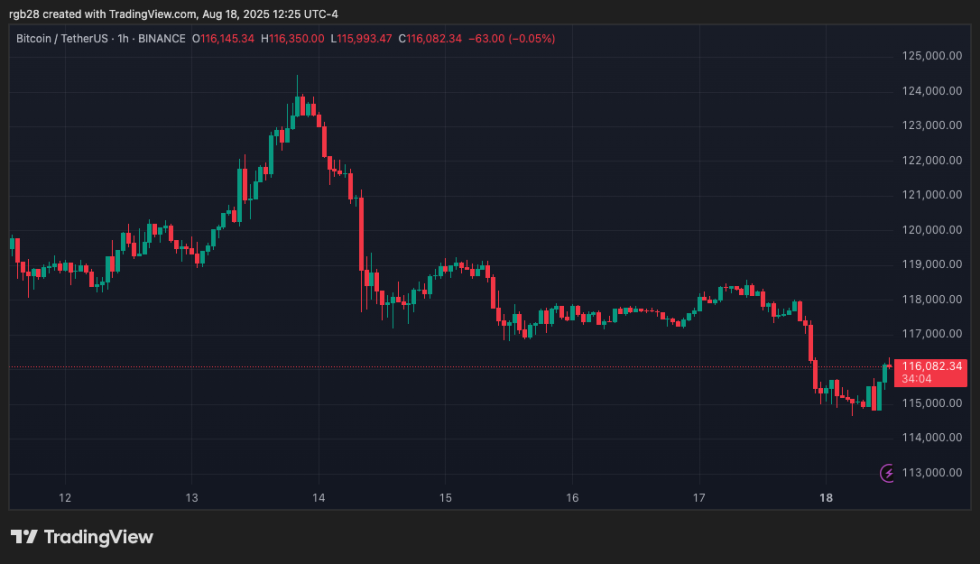
Bitcoin (BTC) trades at $116,082 in the one-week chart. Source: BTCUSDT on TradingView

Related Posts